

Architectural Review (Quarterly): Fall/Winter 2024
 |
Description
Book Introduction
The Restart of 《Architecture Criticism》
We revisit the architectural theory critique journal “Architecture Review”, which was launched in 2015.
It has been four years since the publication of the Winter 2020 issue (Volume 24) ended.
Meanwhile, the Architecture Criticism Community met with a new publisher, prepared for re-publication, considered sustainability, and revamped the editorial design.
However, the issues that 《Architecture Criticism》 has pursued so far remain unchanged, and there has been no significant change in the content composition.
“To foster a healthy critical culture that can take root in our architectural society, to overcome the problem of one-off criticism/criticism, to properly build the history of our modern architecture by rigorously exploring/exploring/discussing excellent architecture, and to discover resources that can serve as a good stimulus for the creative power of our architecture.” To achieve these founding goals, 《Architectural Criticism》 will maintain its own ‘slow and sticky passion’ to coolly enjoy architecture in its own way, and will create ‘rules of the game’ (as an agile centripetal force) to shape this in a refreshing way, and will try to weave together issues in the architectural world more deeply, broadly, and uniquely.
We revisit the architectural theory critique journal “Architecture Review”, which was launched in 2015.
It has been four years since the publication of the Winter 2020 issue (Volume 24) ended.
Meanwhile, the Architecture Criticism Community met with a new publisher, prepared for re-publication, considered sustainability, and revamped the editorial design.
However, the issues that 《Architecture Criticism》 has pursued so far remain unchanged, and there has been no significant change in the content composition.
“To foster a healthy critical culture that can take root in our architectural society, to overcome the problem of one-off criticism/criticism, to properly build the history of our modern architecture by rigorously exploring/exploring/discussing excellent architecture, and to discover resources that can serve as a good stimulus for the creative power of our architecture.” To achieve these founding goals, 《Architectural Criticism》 will maintain its own ‘slow and sticky passion’ to coolly enjoy architecture in its own way, and will create ‘rules of the game’ (as an agile centripetal force) to shape this in a refreshing way, and will try to weave together issues in the architectural world more deeply, broadly, and uniquely.
- You can preview some of the book's contents.
Preview
index
Opening remarks
Facing the reissued No. 25_Park Young-tae
Architecture: Seoul Seojin School
The Most Ordinary Special School_Yoo Jong-su, Kim Bin
Special Ordinary Architecture_Kim In-seong
The Intertwining of Memories and Facts of School_Hyun Myeong-seok
School City_Ji Jeong-woo
Everyone's School_Nam So-young
Young Architecture Critic: Lee Ki-cheol
Play Sequence_Lee Ki-cheol
Scenes and materiality in Lee Ki-cheol's work_Baek Seung-han
Hidden Concepts or Hidden Concepts_Im Seong-hun
Play Sequence or Playing Alley_Lee Kyung-chang
Architecture(s) Move: Nameless Architecture
Thoughts and Possibilities _ Na Eun-jung, Yoo So-rae
Nameless Chronicles
Project List
Project
Ghostly Ontology of Geometry_Jeong Man-young
Nameless, standing in between and not giving a name_Hyun Myeong-seok
Geometry of Nine Squares_Park Jeong-hyeon
Planning: Speaking of Architectural Criticism
Critical writing on architecture without relying on architects or buildings_ Park Jeong-hyeon + Hyun Myeong-seok
The Ambiguous Place of Criticism, Blurred Boundaries: Into the Network of Objects_Bae Hyeong-min + Hyeon Myeong-seok
Critical Writing by Architectural Historians_Kim Hyeon-seop + Kim In-seong
Communication and Imagination for Architectural Criticism_Lee Jong-geon + Kim In-seong
The Distance Between Production and Communication_Seo Jae-won + Park Young-tae
Architecture of Another World_Lee Hee-jun, Choi Na-wook, and Lim Seong-hun
Book review
A Critique of Kenneth Frampton's Modern Architecture: A Critical History (2020), from a Korean Perspective_Kim Hyun-seop
Serial: Laying the Foundations of Architectural Criticism ①
The Ontology of "Between": Preliminary Work for the Foundation of Architectural Criticism 1_Song Jong-yeol
Editor to Reader
Facing the reissued No. 25_Park Young-tae
Architecture: Seoul Seojin School
The Most Ordinary Special School_Yoo Jong-su, Kim Bin
Special Ordinary Architecture_Kim In-seong
The Intertwining of Memories and Facts of School_Hyun Myeong-seok
School City_Ji Jeong-woo
Everyone's School_Nam So-young
Young Architecture Critic: Lee Ki-cheol
Play Sequence_Lee Ki-cheol
Scenes and materiality in Lee Ki-cheol's work_Baek Seung-han
Hidden Concepts or Hidden Concepts_Im Seong-hun
Play Sequence or Playing Alley_Lee Kyung-chang
Architecture(s) Move: Nameless Architecture
Thoughts and Possibilities _ Na Eun-jung, Yoo So-rae
Nameless Chronicles
Project List
Project
Ghostly Ontology of Geometry_Jeong Man-young
Nameless, standing in between and not giving a name_Hyun Myeong-seok
Geometry of Nine Squares_Park Jeong-hyeon
Planning: Speaking of Architectural Criticism
Critical writing on architecture without relying on architects or buildings_ Park Jeong-hyeon + Hyun Myeong-seok
The Ambiguous Place of Criticism, Blurred Boundaries: Into the Network of Objects_Bae Hyeong-min + Hyeon Myeong-seok
Critical Writing by Architectural Historians_Kim Hyeon-seop + Kim In-seong
Communication and Imagination for Architectural Criticism_Lee Jong-geon + Kim In-seong
The Distance Between Production and Communication_Seo Jae-won + Park Young-tae
Architecture of Another World_Lee Hee-jun, Choi Na-wook, and Lim Seong-hun
Book review
A Critique of Kenneth Frampton's Modern Architecture: A Critical History (2020), from a Korean Perspective_Kim Hyun-seop
Serial: Laying the Foundations of Architectural Criticism ①
The Ontology of "Between": Preliminary Work for the Foundation of Architectural Criticism 1_Song Jong-yeol
Editor to Reader
Into the book
A common thread emerged from the many conversations. While the position of architectural criticism has always been precarious, our criticism is currently facing a particularly urgent crisis. What's most needed now is to foster genuine and diverse communication. Therefore, a broader, more expansive concept of architectural writing is called for, transcending traditional architectural criticism. However, even more intriguing is the common thread that emerges from all these diagnoses and perspectives. It's a confession that, regardless of age, position, or position, everyone has experienced fear from a small beginning, faced endless challenges and struggles, and continues to take shaky, difficult steps forward.
185p., Kim In-seong, “Talking about Architectural Criticism”
This school building has a slightly different architecture. Instead of a straight line or an H, it's laid out in a square shape with a courtyard. This creates a more democratic spatial hierarchy. Students see each other in this layout. In addition to the square shape, there are pods that jut out into the courtyard. Architecturally, this is the most striking feature, but its use has not yet been clearly defined by the members. The courtyard, along with the mushroom-roofed cafeteria space, holds many possibilities. It is a place where we can expect endless uses with the various activities of Seojin School in the post-pandemic period, and the rounded landscaping elements form a pattern.
44p., Ji Jeong-woo, “A City Called School”
Because the architecture we see here today is a collective and opaque mass, a tangled web of practical work by a group of Korean architects, each with its own distinct shape, it's nearly impossible to draw its entire form clearly and concisely. One way would be to slice the mass horizontally, vertically, and diagonally, revealing its inhomogeneous cross-sections, and then to draw contemporary Korean architecture from these sections.
128p., Hyun Myeong-seok, “Architecture(s) Move_Nameless Architecture”
How well does this book's Korean section reflect the development of modern Korean architecture? Unfortunately, it leaves much to be desired. This judgment is based on the imbalance in Frampton's architect selection and the numerous errors found in the text.
258p., Kim Hyeon-seop, “A Criticism of Kenneth Frampton’s ‘Modern Architecture: A Critical History’ (2020), from a Korean Perspective”
As we know, criticism is a "subjective and provisional" response (by the critic) to a situation. In other words, there can be no final or closed conclusion. Of course, criticism involves a parallel process of seeking empathy—a process of requesting agreement—through efforts to secure greater objectivity. Nevertheless, the fact remains that the starting point of criticism lies in the "subjective judgment" of the critic.
266p., Song Jong-yeol, “Ontology of ‘Between’: Preliminary Work for the Foundation of Architectural Criticism 1”
185p., Kim In-seong, “Talking about Architectural Criticism”
This school building has a slightly different architecture. Instead of a straight line or an H, it's laid out in a square shape with a courtyard. This creates a more democratic spatial hierarchy. Students see each other in this layout. In addition to the square shape, there are pods that jut out into the courtyard. Architecturally, this is the most striking feature, but its use has not yet been clearly defined by the members. The courtyard, along with the mushroom-roofed cafeteria space, holds many possibilities. It is a place where we can expect endless uses with the various activities of Seojin School in the post-pandemic period, and the rounded landscaping elements form a pattern.
44p., Ji Jeong-woo, “A City Called School”
Because the architecture we see here today is a collective and opaque mass, a tangled web of practical work by a group of Korean architects, each with its own distinct shape, it's nearly impossible to draw its entire form clearly and concisely. One way would be to slice the mass horizontally, vertically, and diagonally, revealing its inhomogeneous cross-sections, and then to draw contemporary Korean architecture from these sections.
128p., Hyun Myeong-seok, “Architecture(s) Move_Nameless Architecture”
How well does this book's Korean section reflect the development of modern Korean architecture? Unfortunately, it leaves much to be desired. This judgment is based on the imbalance in Frampton's architect selection and the numerous errors found in the text.
258p., Kim Hyeon-seop, “A Criticism of Kenneth Frampton’s ‘Modern Architecture: A Critical History’ (2020), from a Korean Perspective”
As we know, criticism is a "subjective and provisional" response (by the critic) to a situation. In other words, there can be no final or closed conclusion. Of course, criticism involves a parallel process of seeking empathy—a process of requesting agreement—through efforts to secure greater objectivity. Nevertheless, the fact remains that the starting point of criticism lies in the "subjective judgment" of the critic.
266p., Song Jong-yeol, “Ontology of ‘Between’: Preliminary Work for the Foundation of Architectural Criticism 1”
--- From the text
Publisher's Review
Confessions of an Architecture Critic
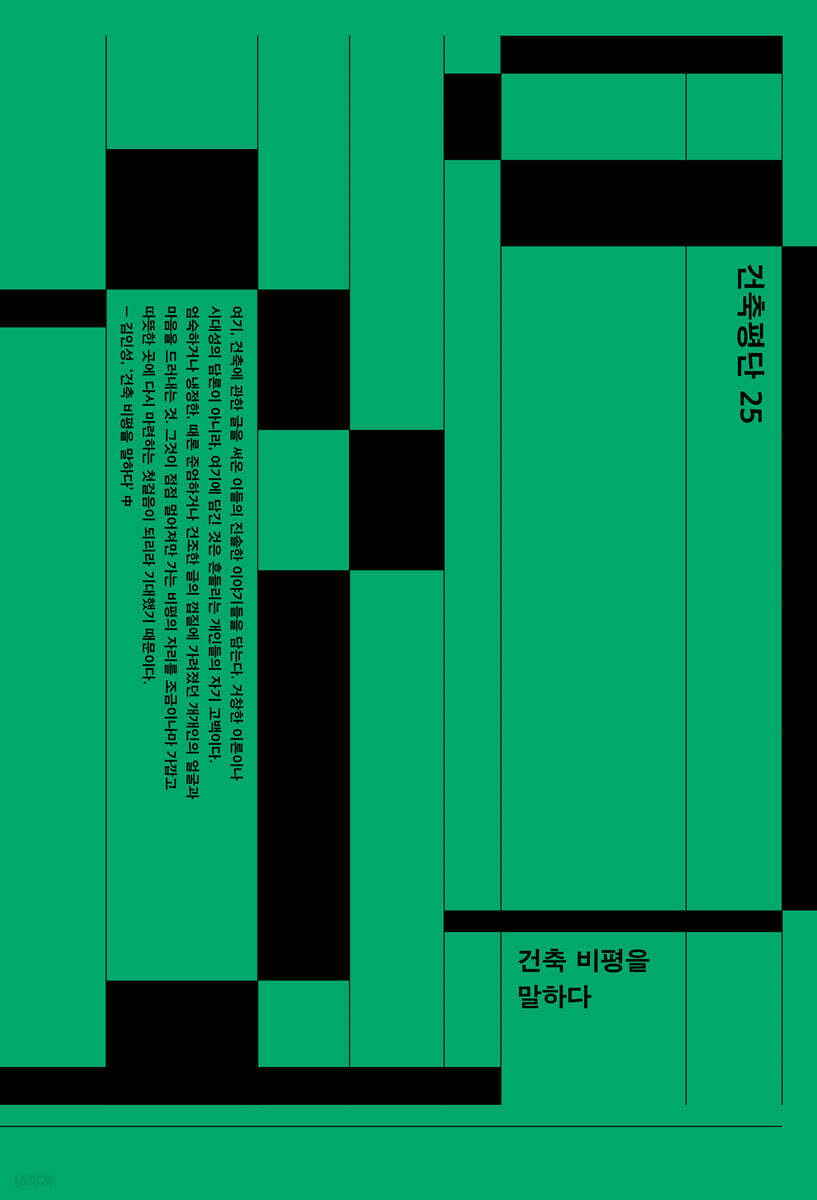
This reissue (Volume 25) contains honest stories from those who have written about architecture, with the intention of bringing criticism closer to home.
This is closer to the self-confession of wavering individuals than to a grand theory or discourse of the times.
Through the vivid voices and warm perspectives of four critics interviewing seven critics/architects, we hope to convey empathy and hope to countless other readers who also look forward to architecture and criticism.
Architects and architectural works
In addition, you can see the 'Seoul Seojin School', which proves through architecture that 'a world that is good for children and people with disabilities is a world that is good for everyone', the works of architect Lee Ki-cheol, who creates 'moments of space' with his own grammar, and the works of Nameless Architecture, which has grown into an influential mid-career architect since its first work was presented in Korea in 2012.
Book reviews and serials
In addition, we introduced a review of the expanded edition of Kenneth Frampton's "Modern Architecture: A Critical History" (2020), published in the British "The Journal of Architecture" in August 2021, to Korean readers, and provided an opportunity to reconsider critical writing and the act of criticism through a series befitting the banner of architectural criticism.
This reissue (Volume 25) contains honest stories from those who have written about architecture, with the intention of bringing criticism closer to home.
This is closer to the self-confession of wavering individuals than to a grand theory or discourse of the times.
Through the vivid voices and warm perspectives of four critics interviewing seven critics/architects, we hope to convey empathy and hope to countless other readers who also look forward to architecture and criticism.
Architects and architectural works
In addition, you can see the 'Seoul Seojin School', which proves through architecture that 'a world that is good for children and people with disabilities is a world that is good for everyone', the works of architect Lee Ki-cheol, who creates 'moments of space' with his own grammar, and the works of Nameless Architecture, which has grown into an influential mid-career architect since its first work was presented in Korea in 2012.
Book reviews and serials
In addition, we introduced a review of the expanded edition of Kenneth Frampton's "Modern Architecture: A Critical History" (2020), published in the British "The Journal of Architecture" in August 2021, to Korean readers, and provided an opportunity to reconsider critical writing and the act of criticism through a series befitting the banner of architectural criticism.
GOODS SPECIFICS
- Date of issue: November 8, 2024
- Page count, weight, size: 280 pages | 49g | 152*223*20mm
- ISBN13: 9791198750815
- ISBN10: 1198750812
You may also like
카테고리
korean


korean

![GQ KOREA Mark (Monthly): December [2025]](http://librairie.coreenne.fr/cdn/shop/files/8ef265dbbfbf186523ed75ba7319009d.jpg?v=1765340328&width=3840)


