

SKEPTIC Korea (quarterly): Issue 38
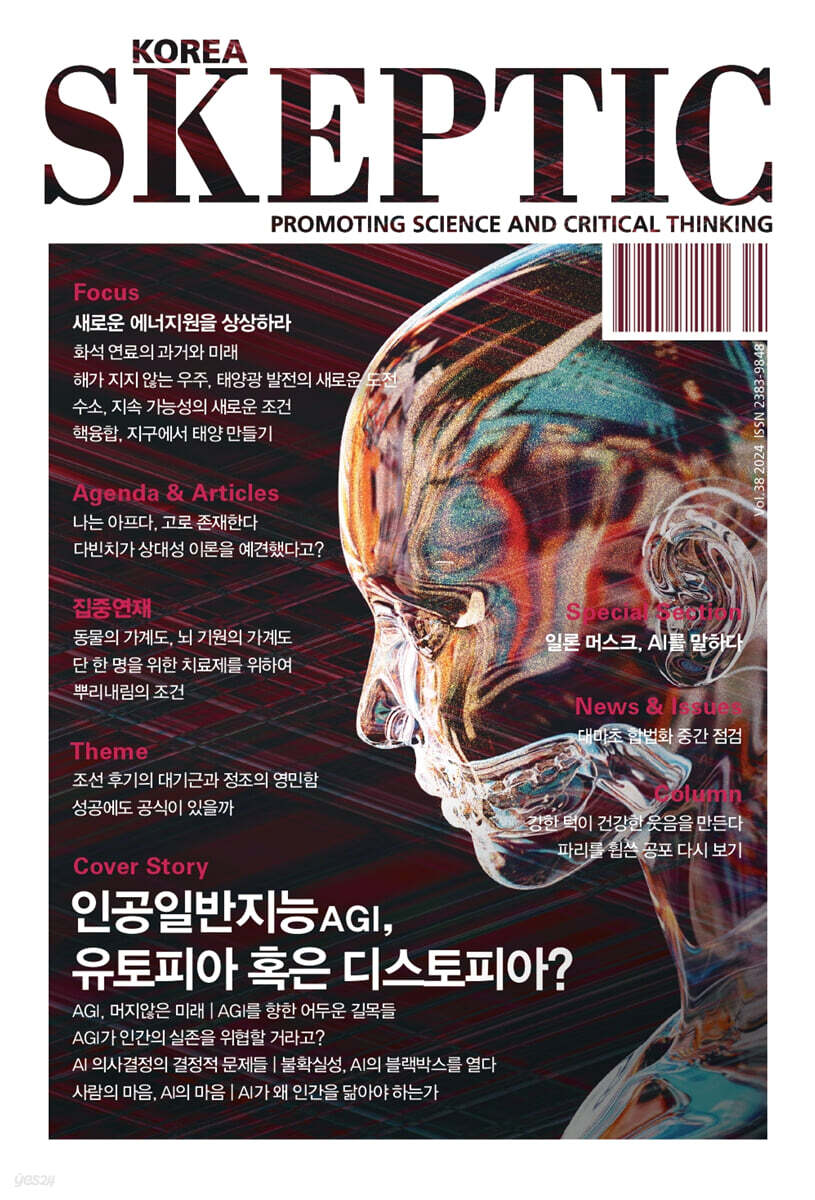 |
Description
Book Introduction
Korean Skeptic SKEPTIC No. 38
▶ AGI, the near future
▶ Dark Roads Towards AGI
▶ AGI will threaten human existence?
▶ Elon Musk X British Prime Minister Rishi Sunak Interview
▶ The Great Famine of the Late Joseon Dynasty and King Jeongjo's Acumen
▶ Animal Family Tree, Family Tree of Brain Origin
▶ Imagine a new energy source
Nuclear fusion: Creating the sun on Earth
▶ I am sick, therefore I exist.
The advent of general artificial intelligence (AGI)? Utopia or dystopia for humanity? How to peer into the black box of generative AI. Can we trust AI decision-making? How do AI and the human mind differ? Can humanity safely manage AI? Elon Musk and British Prime Minister Rishi Sunak discuss.
In the age of climate change, bold imaginations about new energy sources.
The meaning of pain from a life perspective.
Is gene therapy possible for everyone? Issue 38 of Skeptic is filled with fascinating articles, including a look at Korean history through climate, the great famine of the late Joseon Dynasty, and King Jeongjo's ingenuity.
▶ AGI, the near future
▶ Dark Roads Towards AGI
▶ AGI will threaten human existence?
▶ Elon Musk X British Prime Minister Rishi Sunak Interview
▶ The Great Famine of the Late Joseon Dynasty and King Jeongjo's Acumen
▶ Animal Family Tree, Family Tree of Brain Origin
▶ Imagine a new energy source
Nuclear fusion: Creating the sun on Earth
▶ I am sick, therefore I exist.
The advent of general artificial intelligence (AGI)? Utopia or dystopia for humanity? How to peer into the black box of generative AI. Can we trust AI decision-making? How do AI and the human mind differ? Can humanity safely manage AI? Elon Musk and British Prime Minister Rishi Sunak discuss.
In the age of climate change, bold imaginations about new energy sources.
The meaning of pain from a life perspective.
Is gene therapy possible for everyone? Issue 38 of Skeptic is filled with fascinating articles, including a look at Korean history through climate, the great famine of the late Joseon Dynasty, and King Jeongjo's ingenuity.
- You can preview some of the book's contents.
Preview
index
Column
A strong jaw makes a healthy smile - Peter S.
Unger
Revisiting the horror that swept Paris - Robert E.
Vasalamu
Theme
The Great Famine of the Late Joseon Dynasty and King Jeongjo's Acumen - Park Jeong-jae
Is there a formula for success? - Afternoon
Special Section: Elon Musk and British Prime Minister Rishi Sunak Talk
Can Humans Safely Manage AI? - Elon Musk, Rishi Sunak
Cover Story Artificial General Intelligence (AGI): Utopia or Dystopia?
AGI, the near future - Jeong Ji-hoon
Dark Roads to AGI - Peter Kassan
AGI threatens human existence? - Michael Shermer
Critical Issues in AI Decision-Making - Urs Gasser and Viktor Mayer-Schönberger
Uncertainty: Opening AI's Black Box - Maggie Jackson
The Human Mind, the AI Mind - Russell T.
one
Why AI Should Be Human-Like - Rudy Panvelcom
News & Issues
Marijuana Legalization Midterm Review - John D.
Van Dijk
Intensive series
Animal Family Tree, Family Tree of Brain Origins - Lee Dae-han
For a Cure for Just One Person - Jo Dong-hyun
Conditions for Rooting - Kim Sang-gyu
Focus: Imagine a new energy source
The Past and Future of Fossil Fuels - Donald R.
Processor
The Sun Never Sets in Space: A New Challenge for Solar Power Generation - Rob Mahan
Hydrogen: A New Condition for Sustainability - Park Hyun-seo
Nuclear Fusion: Creating the Sun on Earth - Na Yong-su
Agenda & Articles
I am sick, therefore I exist - Woo Chung-wan
Did Da Vinci Predict the Theory of Relativity? - José Maria Gonzalez Ondina
A strong jaw makes a healthy smile - Peter S.
Unger
Revisiting the horror that swept Paris - Robert E.
Vasalamu
Theme
The Great Famine of the Late Joseon Dynasty and King Jeongjo's Acumen - Park Jeong-jae
Is there a formula for success? - Afternoon
Special Section: Elon Musk and British Prime Minister Rishi Sunak Talk
Can Humans Safely Manage AI? - Elon Musk, Rishi Sunak
Cover Story Artificial General Intelligence (AGI): Utopia or Dystopia?
AGI, the near future - Jeong Ji-hoon
Dark Roads to AGI - Peter Kassan
AGI threatens human existence? - Michael Shermer
Critical Issues in AI Decision-Making - Urs Gasser and Viktor Mayer-Schönberger
Uncertainty: Opening AI's Black Box - Maggie Jackson
The Human Mind, the AI Mind - Russell T.
one
Why AI Should Be Human-Like - Rudy Panvelcom
News & Issues
Marijuana Legalization Midterm Review - John D.
Van Dijk
Intensive series
Animal Family Tree, Family Tree of Brain Origins - Lee Dae-han
For a Cure for Just One Person - Jo Dong-hyun
Conditions for Rooting - Kim Sang-gyu
Focus: Imagine a new energy source
The Past and Future of Fossil Fuels - Donald R.
Processor
The Sun Never Sets in Space: A New Challenge for Solar Power Generation - Rob Mahan
Hydrogen: A New Condition for Sustainability - Park Hyun-seo
Nuclear Fusion: Creating the Sun on Earth - Na Yong-su
Agenda & Articles
I am sick, therefore I exist - Woo Chung-wan
Did Da Vinci Predict the Theory of Relativity? - José Maria Gonzalez Ondina
Detailed image

Publisher's Review
▼ Cover Story: Artificial General Intelligence (AGI): Utopia or Dystopia?
On May 13th, OpenAI's GPT-4o was released.
Unlike previous works, the way it communicates with humans in real time through videos and photos drew admiration from people.
In addition, the way he understands human emotions and adjusts his reactions accordingly reminds me of the movie [Her].
Does this suggest that the advent of Artificial General Intelligence (AGI) is imminent? With technology advancing faster than ever, is AGI truly the future? And what does AGI mean for us humans? From the potential of AGI to the prerequisites for coexistence with humans, this issue's cover story comprehensively examines the challenges of AGI.
AGI, the not-so-distant future?
Is AGI, which achieves human-like general intelligence beyond specialized intelligence known as narrow AI or weak AI, a possible future? In "AGI, the Near Future," futurist Ji-hoon Jeong examines the major paths humanity is taking toward AGI, focusing on MoE (Mechanical Experimentation) combining domain-specific AI models, collaborative and self-evolving AI agents, and changes following the Large Language Model (LLM) (neurosymbolic).
He said there is little disagreement about achieving the goal of AGI itself, and predicted that AGI would bring about revolutionary changes in all aspects of human life, including work, aging, the climate crisis, and relationships.
On the other hand, Peter Kassan, in 'Dark Crossroads to AGI', points out that the 'understanding' shown by current AI is only a pseudo-understanding and is nothing more than a statistical combination, and argues that AGI is just a distant future unless we can implement consciousness in AI.
Futurist Rudi VanVelkom also raises a more fundamental question in his book, “Why AI Should Be Human-Like,” about why machines should resemble humans.
Submarines don't swim like fish, and airplanes don't fly like birds, so why do we expect computers to "think" like humans? He emphasizes that, prior to AI development, rather than considering intelligence itself as an end in itself, we should ask ourselves what purpose we intend to use intelligent machines for.
The Age of AGI: Utopia or Dystopia?
AI pioneer Eliezer Yudkowsky has long warned about the potential dangers of AI.
The emergence of artificial intelligence superior to humans will lead humanity down the path to destruction.
He muses as he surveys recent developments in AI:
“We are not prepared.
… If we continue like this, we will all die.” The thought experiment that best illustrates this AI dystopia theory is Nick Bostrom’s ‘paperclip maximizing machine.’
Bostrom warns that if an AI with the goal of creating paper clips continues to evolve and become self-controlled, it will turn humans and all of Earth's resources into paper clips.
AI utopians, on the other hand, anticipate that superintelligence like AGI will bring humanity unprecedented abundance and freedom.
Will the emergence of AGI, a general intelligence superior to human intelligence, represent a utopia or a dystopia for humanity? Michael Shermer, a leading skeptic, criticizes the AI utopian theory as overly optimistic and quite religious.
Shermer notes the role of emotions in human beings and argues that dystopian theories are also implausible.
Shermer predicts that the coming future will be closer to a protopia, based on the internal contradictions of dystopian theory and technological evolution.
The Black Box of Generative AI and the Problem of Decision-Making
Now, humanity is trying to surpass its cognitive limitations and enhance its abilities by entrusting decision-making to generative machines, a kind of mental prosthesis.
Can machine-based decision-making really bring about a better future?
But what if AI is inherently conservative? In "Critical Problems in AI Decision-Making," techno-sociologists Urs Gasser and Viktor Mayr-Schönberger point out the paradox of optimizing decision-making based on big data.
Imagine a world where all our decisions are made by machines.
As more machines determine our choices, the results will become a source of machine learning data, ultimately reducing the diversity of choices and actions.
The authors caution against excessive delegation of decision-making, pointing out that the path of human progress is paved with the tombstones of relentless tinkerers pursuing crazy ideas.
Another problem with AI decision-making is that generative AI's inference is like a black box.
It is virtually impossible for humans to individually track the results of numerous parameter combinations through learning.
Even programmers are unable to understand why the AI they created made such a decision.
Even if generative AI always makes good inferences, something is bound to always feel uneasy.
In "Uncertainty: Opening AI's Black Box," technology journalist Maggie Jackson addresses the problem of mistrust caused by the opacity of AI reasoning, arguing that uncertainty is key to solving the problem of human-AI interaction.
He emphasizes that, unlike the tradition that sought to imbue machines with certainty, AI must internalize and express uncertainty in order to ultimately communicate with humans and achieve harmony with human goals.
The human mind and the AI mind
Google engineer Blake Lemoine claims that his LaMDA has sentience.
In other words, it is claimed that Lambda “has feelings, emotions, and subjective experiences.”
Could generative AI, as Lemoine claims, possess a human-like mind? Psychologist Russell T., who studies human intelligence, has argued.
Won contrasts the human and AI minds, saying that AI's limitations reveal our own limitations regarding our own minds.
Despite its remarkable linguistic abilities, it seems difficult to say that Lambda has the sensitivity to pleasure, as Lemoine claims, given the ridiculous mistakes made by generative AI.
But if we could refine LLM a bit more precisely, correcting Lambda's awkward responses and making it pass the Turing Test perfectly, could we really claim that Lambda lacks pleasure sensitivity? Philosophers and scientists have pondered this for centuries, but we still don't know much about consciousness.
Therefore, the question of whether AI programs can have a sense of humor is fraught with uncertainty.
Interestingly, the limitations of AI highlight the limits of our understanding of the mind.
Elon Musk and British Prime Minister Rishi Sunak Talk
▼ Special: Can Humanity Safely Manage AI?
Amid growing concerns about AI development, the UK government hosted the first-ever AI Safety Summit on 1-2 November 2023, with representatives from 28 countries and business leaders in the AI sector.
The summit, held at Bletchley Park, where Turing deciphered Germany's Enigma machine during World War II, was attended by leaders of major countries such as the United States, China and the EU, as well as entrepreneur Elon Musk, who leads Tesla and SpaceX.
British Prime Minister Rishi Sunak and Elon Musk have agreed to work together to understand and manage the potential risks of AI, developing it safely and responsibly for the benefit of the global community.
In this special Skeptic section, you can see the discussion between Rishi Sunak and Elon Musk at the British Prime Minister's residence.
Musk's perspective, which intersects optimism about "universal high income" with concerns about the need for global regulation of AI safety, offers a glimpse into where our society is headed in the AI era.
▼ Focus: Imagine a new energy source
The transition from fossil fuels to new energy sources is no longer a matter of necessity, but of survival.
If we continue to consume fossil fuels at this rate, humanity may face its end within our generation.
To limit global warming to 2.5 degrees Celsius, transitioning to new energy sources has become a challenge of our time.
However, discussions about new energy sources usually end up becoming political battles within the framework of renewable energy and nuclear energy.
Rather than bold imagination or productive discussion based on science, it often flows into an emotional battle within an ideological framework.
However, we must keep in mind that when humanity was in crisis, it was not political ideology but imagination that broke the mold that saved humanity.
To that end, this issue's Focus explores bold, unconventional new energy sources, from the past of fossil fuels to space-based solar power, the potential of hydrogen energy, and the potential of an artificial sun that could provide limitless energy.
▼ The Great Famine of the Late Joseon Dynasty and King Jeongjo's Acumen
“A sinister rumor spread that a slave named Pilgrimage, who lived in a deep valley in Yeonsan, had killed his five-year-old daughter and three-year-old son and eaten their flesh.
When a fellow villager heard this, he went to her and asked if it was true, and she said, 'My son and daughter died from illness.
He himself was seriously ill and starving, so he boiled and ate his child's corpse.
However, it is said that he said, ‘I absolutely did not kill him for food.’” This is part of the record from March 21, year 12 of King Hyeonjong’s reign in the Annals of King Hyeonjong.
The famine that began in 1670 became even more severe in the spring of 1671, leading to the cannibalism of children.
This event, called the 'Gyeongsin Great Famine' because it occurred in the years of Gyeongsul and Sinhae, was the most disastrous famine throughout the Joseon Dynasty.
And not long after, during the reign of King Sukjong, the Eulbyeong famine, which was comparable to the Gyeongsin famine, continued.
At this time too, many people died from starvation and plague.
Why did the two great famines that shook Joseon in the late 17th century occur?
Professor Park Jeong-jae, a geographer at Seoul National University, rereads Korean history through the lens of climate through his new series, “Korean History Through the Eyes of Climate.”
He argues that much of human history has been determined by climate, and that Korean history is no different.
According to him, the two great famines were the result of changes in the number of sunspots and a decrease in solar irradiance due to volcanic eruptions.
These two factors consistently and periodically drove climate change in the late Joseon Dynasty, causing great social chaos each time.
So, has human society always been "determined" by climate? Professor Park uses the example of King Jeongjo to glimpse the potential of governance and human society.
From 1782 to 1788, while neighboring Japan was in the grip of extreme social chaos due to the Great Tenmei Famine, Joseon, under the rule of King Jeongjo, enjoyed a period of peace without any major crises.
What on earth was Jeongjo's secret?
▼ Is it possible to develop a cure for just one person?
CRISPR, which has made continuous progress, is now moving beyond the laboratory and into the medical field, offering hope for treating rare genetic diseases.
Can we now say that we have entered an era of truly individualized medicine?
With real-world examples of treatments being developed for just one person with a rare disease emerging one after another, it seems as though conquering genetic diseases is within reach.
However, Professor Cho Dong-hyun, who is treating patients with genetic diseases and conducting scientific research in the field, sees many mountains to overcome.
Although gene therapy is still in its infancy, the problem of genes being selected and not selected based on criteria such as business viability, profitability, patient country, and race is likely to persist.
Because genetic diseases are likely to affect a small number of patients, even if treatment is available, patients with genes that are not selected for various reasons may not be able to receive treatment.
We share various concerns about the era of gene therapy in 'For a Cure for Just One Person' by Professor Dong-Hyeon Cho of the Department of Anatomy, Seoul National University College of Medicine.
▼ Animal Family Tree, Family Tree of Brain Origins
Professor Lee Dae-han, an evolutionary geneticist at Sungkyunkwan University, returned to the most fundamental topic: 'brain evolution.'
In the new intensive series, "The Emergence of the Brain, the Deepest Secret of Life," Professor Lee Dae-han looks back at the animal family tree to trace how our brains evolved to what they are today.
In the first, 'The Family Tree of Animals, the Family Tree of Brain Origins,' we return to the point where the bilateral and non-bilateral animal groups diverged and trace why only the bilateral animal group evolved a centralized brain, rather than a nervous system.
The professor argues that the evolution of the current 'brain' was possible because changes in the biological system fundamentally changed the way we deal with external information.
Also, Skeptic No. 38
- In 'Is there a formula for success?', columnist Oh-hu examines the problem of self-development that touts the formula for success through the case of Temu, which has recently become a hot topic.
- In 'Strong Chins Make a Healthy Smile', paleoanthropologist and evolutionary biologist Peter S.
Professor Unger examines the prevalence of dental conditions such as malocclusion in modern society from the perspectives of paleoanthropology and evolution.
On May 13th, OpenAI's GPT-4o was released.
Unlike previous works, the way it communicates with humans in real time through videos and photos drew admiration from people.
In addition, the way he understands human emotions and adjusts his reactions accordingly reminds me of the movie [Her].
Does this suggest that the advent of Artificial General Intelligence (AGI) is imminent? With technology advancing faster than ever, is AGI truly the future? And what does AGI mean for us humans? From the potential of AGI to the prerequisites for coexistence with humans, this issue's cover story comprehensively examines the challenges of AGI.
AGI, the not-so-distant future?
Is AGI, which achieves human-like general intelligence beyond specialized intelligence known as narrow AI or weak AI, a possible future? In "AGI, the Near Future," futurist Ji-hoon Jeong examines the major paths humanity is taking toward AGI, focusing on MoE (Mechanical Experimentation) combining domain-specific AI models, collaborative and self-evolving AI agents, and changes following the Large Language Model (LLM) (neurosymbolic).
He said there is little disagreement about achieving the goal of AGI itself, and predicted that AGI would bring about revolutionary changes in all aspects of human life, including work, aging, the climate crisis, and relationships.
On the other hand, Peter Kassan, in 'Dark Crossroads to AGI', points out that the 'understanding' shown by current AI is only a pseudo-understanding and is nothing more than a statistical combination, and argues that AGI is just a distant future unless we can implement consciousness in AI.
Futurist Rudi VanVelkom also raises a more fundamental question in his book, “Why AI Should Be Human-Like,” about why machines should resemble humans.
Submarines don't swim like fish, and airplanes don't fly like birds, so why do we expect computers to "think" like humans? He emphasizes that, prior to AI development, rather than considering intelligence itself as an end in itself, we should ask ourselves what purpose we intend to use intelligent machines for.
The Age of AGI: Utopia or Dystopia?
AI pioneer Eliezer Yudkowsky has long warned about the potential dangers of AI.
The emergence of artificial intelligence superior to humans will lead humanity down the path to destruction.
He muses as he surveys recent developments in AI:
“We are not prepared.
… If we continue like this, we will all die.” The thought experiment that best illustrates this AI dystopia theory is Nick Bostrom’s ‘paperclip maximizing machine.’
Bostrom warns that if an AI with the goal of creating paper clips continues to evolve and become self-controlled, it will turn humans and all of Earth's resources into paper clips.
AI utopians, on the other hand, anticipate that superintelligence like AGI will bring humanity unprecedented abundance and freedom.
Will the emergence of AGI, a general intelligence superior to human intelligence, represent a utopia or a dystopia for humanity? Michael Shermer, a leading skeptic, criticizes the AI utopian theory as overly optimistic and quite religious.
Shermer notes the role of emotions in human beings and argues that dystopian theories are also implausible.
Shermer predicts that the coming future will be closer to a protopia, based on the internal contradictions of dystopian theory and technological evolution.
The Black Box of Generative AI and the Problem of Decision-Making
Now, humanity is trying to surpass its cognitive limitations and enhance its abilities by entrusting decision-making to generative machines, a kind of mental prosthesis.
Can machine-based decision-making really bring about a better future?
But what if AI is inherently conservative? In "Critical Problems in AI Decision-Making," techno-sociologists Urs Gasser and Viktor Mayr-Schönberger point out the paradox of optimizing decision-making based on big data.
Imagine a world where all our decisions are made by machines.
As more machines determine our choices, the results will become a source of machine learning data, ultimately reducing the diversity of choices and actions.
The authors caution against excessive delegation of decision-making, pointing out that the path of human progress is paved with the tombstones of relentless tinkerers pursuing crazy ideas.
Another problem with AI decision-making is that generative AI's inference is like a black box.
It is virtually impossible for humans to individually track the results of numerous parameter combinations through learning.
Even programmers are unable to understand why the AI they created made such a decision.
Even if generative AI always makes good inferences, something is bound to always feel uneasy.
In "Uncertainty: Opening AI's Black Box," technology journalist Maggie Jackson addresses the problem of mistrust caused by the opacity of AI reasoning, arguing that uncertainty is key to solving the problem of human-AI interaction.
He emphasizes that, unlike the tradition that sought to imbue machines with certainty, AI must internalize and express uncertainty in order to ultimately communicate with humans and achieve harmony with human goals.
The human mind and the AI mind
Google engineer Blake Lemoine claims that his LaMDA has sentience.
In other words, it is claimed that Lambda “has feelings, emotions, and subjective experiences.”
Could generative AI, as Lemoine claims, possess a human-like mind? Psychologist Russell T., who studies human intelligence, has argued.
Won contrasts the human and AI minds, saying that AI's limitations reveal our own limitations regarding our own minds.
Despite its remarkable linguistic abilities, it seems difficult to say that Lambda has the sensitivity to pleasure, as Lemoine claims, given the ridiculous mistakes made by generative AI.
But if we could refine LLM a bit more precisely, correcting Lambda's awkward responses and making it pass the Turing Test perfectly, could we really claim that Lambda lacks pleasure sensitivity? Philosophers and scientists have pondered this for centuries, but we still don't know much about consciousness.
Therefore, the question of whether AI programs can have a sense of humor is fraught with uncertainty.
Interestingly, the limitations of AI highlight the limits of our understanding of the mind.
Elon Musk and British Prime Minister Rishi Sunak Talk
▼ Special: Can Humanity Safely Manage AI?
Amid growing concerns about AI development, the UK government hosted the first-ever AI Safety Summit on 1-2 November 2023, with representatives from 28 countries and business leaders in the AI sector.
The summit, held at Bletchley Park, where Turing deciphered Germany's Enigma machine during World War II, was attended by leaders of major countries such as the United States, China and the EU, as well as entrepreneur Elon Musk, who leads Tesla and SpaceX.
British Prime Minister Rishi Sunak and Elon Musk have agreed to work together to understand and manage the potential risks of AI, developing it safely and responsibly for the benefit of the global community.
In this special Skeptic section, you can see the discussion between Rishi Sunak and Elon Musk at the British Prime Minister's residence.
Musk's perspective, which intersects optimism about "universal high income" with concerns about the need for global regulation of AI safety, offers a glimpse into where our society is headed in the AI era.
▼ Focus: Imagine a new energy source
The transition from fossil fuels to new energy sources is no longer a matter of necessity, but of survival.
If we continue to consume fossil fuels at this rate, humanity may face its end within our generation.
To limit global warming to 2.5 degrees Celsius, transitioning to new energy sources has become a challenge of our time.
However, discussions about new energy sources usually end up becoming political battles within the framework of renewable energy and nuclear energy.
Rather than bold imagination or productive discussion based on science, it often flows into an emotional battle within an ideological framework.
However, we must keep in mind that when humanity was in crisis, it was not political ideology but imagination that broke the mold that saved humanity.
To that end, this issue's Focus explores bold, unconventional new energy sources, from the past of fossil fuels to space-based solar power, the potential of hydrogen energy, and the potential of an artificial sun that could provide limitless energy.
▼ The Great Famine of the Late Joseon Dynasty and King Jeongjo's Acumen
“A sinister rumor spread that a slave named Pilgrimage, who lived in a deep valley in Yeonsan, had killed his five-year-old daughter and three-year-old son and eaten their flesh.
When a fellow villager heard this, he went to her and asked if it was true, and she said, 'My son and daughter died from illness.
He himself was seriously ill and starving, so he boiled and ate his child's corpse.
However, it is said that he said, ‘I absolutely did not kill him for food.’” This is part of the record from March 21, year 12 of King Hyeonjong’s reign in the Annals of King Hyeonjong.
The famine that began in 1670 became even more severe in the spring of 1671, leading to the cannibalism of children.
This event, called the 'Gyeongsin Great Famine' because it occurred in the years of Gyeongsul and Sinhae, was the most disastrous famine throughout the Joseon Dynasty.
And not long after, during the reign of King Sukjong, the Eulbyeong famine, which was comparable to the Gyeongsin famine, continued.
At this time too, many people died from starvation and plague.
Why did the two great famines that shook Joseon in the late 17th century occur?
Professor Park Jeong-jae, a geographer at Seoul National University, rereads Korean history through the lens of climate through his new series, “Korean History Through the Eyes of Climate.”
He argues that much of human history has been determined by climate, and that Korean history is no different.
According to him, the two great famines were the result of changes in the number of sunspots and a decrease in solar irradiance due to volcanic eruptions.
These two factors consistently and periodically drove climate change in the late Joseon Dynasty, causing great social chaos each time.
So, has human society always been "determined" by climate? Professor Park uses the example of King Jeongjo to glimpse the potential of governance and human society.
From 1782 to 1788, while neighboring Japan was in the grip of extreme social chaos due to the Great Tenmei Famine, Joseon, under the rule of King Jeongjo, enjoyed a period of peace without any major crises.
What on earth was Jeongjo's secret?
▼ Is it possible to develop a cure for just one person?
CRISPR, which has made continuous progress, is now moving beyond the laboratory and into the medical field, offering hope for treating rare genetic diseases.
Can we now say that we have entered an era of truly individualized medicine?
With real-world examples of treatments being developed for just one person with a rare disease emerging one after another, it seems as though conquering genetic diseases is within reach.
However, Professor Cho Dong-hyun, who is treating patients with genetic diseases and conducting scientific research in the field, sees many mountains to overcome.
Although gene therapy is still in its infancy, the problem of genes being selected and not selected based on criteria such as business viability, profitability, patient country, and race is likely to persist.
Because genetic diseases are likely to affect a small number of patients, even if treatment is available, patients with genes that are not selected for various reasons may not be able to receive treatment.
We share various concerns about the era of gene therapy in 'For a Cure for Just One Person' by Professor Dong-Hyeon Cho of the Department of Anatomy, Seoul National University College of Medicine.
▼ Animal Family Tree, Family Tree of Brain Origins
Professor Lee Dae-han, an evolutionary geneticist at Sungkyunkwan University, returned to the most fundamental topic: 'brain evolution.'
In the new intensive series, "The Emergence of the Brain, the Deepest Secret of Life," Professor Lee Dae-han looks back at the animal family tree to trace how our brains evolved to what they are today.
In the first, 'The Family Tree of Animals, the Family Tree of Brain Origins,' we return to the point where the bilateral and non-bilateral animal groups diverged and trace why only the bilateral animal group evolved a centralized brain, rather than a nervous system.
The professor argues that the evolution of the current 'brain' was possible because changes in the biological system fundamentally changed the way we deal with external information.
Also, Skeptic No. 38
- In 'Is there a formula for success?', columnist Oh-hu examines the problem of self-development that touts the formula for success through the case of Temu, which has recently become a hot topic.
- In 'Strong Chins Make a Healthy Smile', paleoanthropologist and evolutionary biologist Peter S.
Professor Unger examines the prevalence of dental conditions such as malocclusion in modern society from the perspectives of paleoanthropology and evolution.
GOODS SPECIFICS
- Date of issue: June 7, 2024
- Page count, weight, size: 288 pages | 170*250*20mm
- ISBN13: 9772383984000
- ISBN10: 23839848
You may also like
카테고리
korean


korean

![GQ KOREA Mark (Monthly): December [2025]](http://librairie.coreenne.fr/cdn/shop/files/8ef265dbbfbf186523ed75ba7319009d.jpg?v=1765340328&width=3840)


