

SKEPTIC Korea (quarterly): Issue 37
 |
Description
Book Introduction
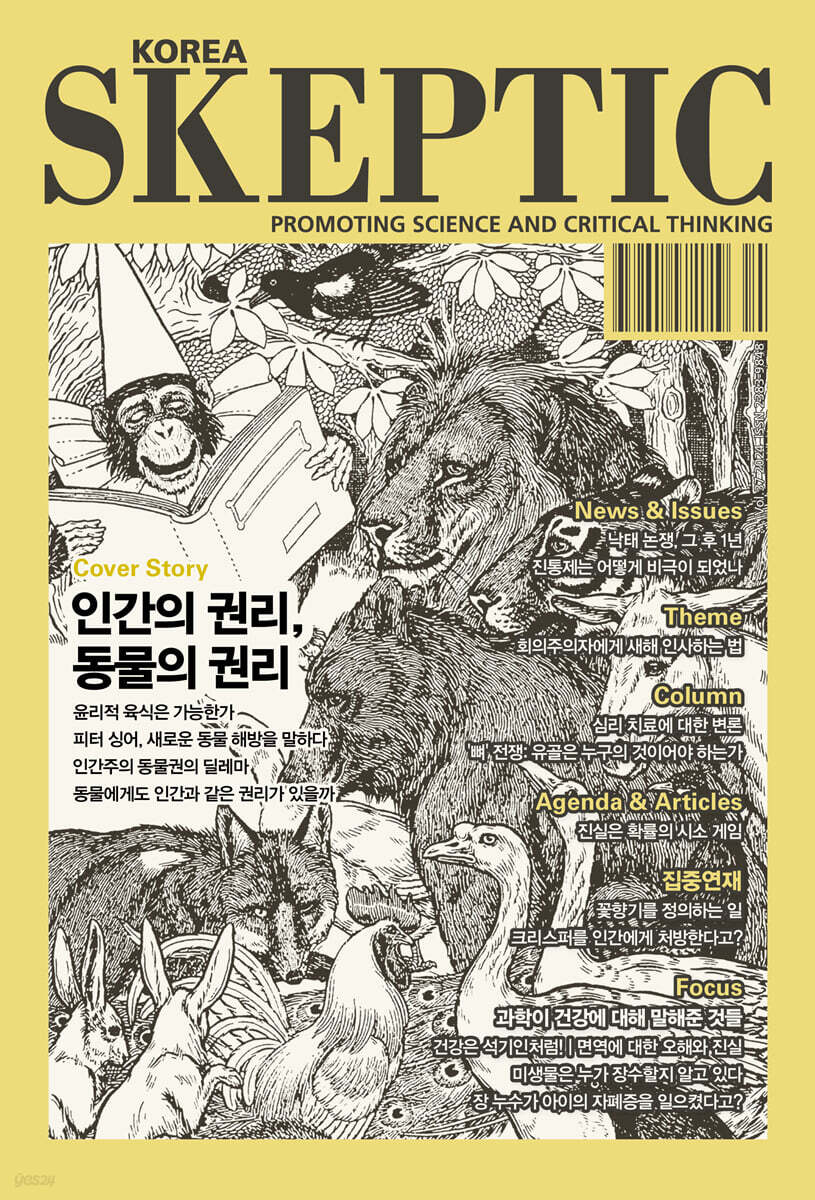
Do animals have the same rights as humans? Can we ethically protect animal rights while eating meat? What are the problems with anthropocentric animal rights? Do humans have the right to do whatever they want with animals, and even nature and the ecosystem? This question questions human and animal rights.
How to save money, time, and health in the flood of health information.
The secret to health revealed through evolution.
Misconceptions and truths about immunity, explained by Dr. Kang Byeong-cheol.
The tricks of homeopathic medicine to deceive sick people.
How Opioid Painkillers Became a Tragedy.
Skeptic Issue 37 is full of interesting articles, including the abortion debate and the year after.
How to save money, time, and health in the flood of health information.
The secret to health revealed through evolution.
Misconceptions and truths about immunity, explained by Dr. Kang Byeong-cheol.
The tricks of homeopathic medicine to deceive sick people.
How Opioid Painkillers Became a Tragedy.
Skeptic Issue 37 is full of interesting articles, including the abortion debate and the year after.
- You can preview some of the book's contents.
Preview
index
News & Issues
The Abortion Debate: One Year Later - Kevin McCaffrey
How Painkillers Became Tragic - Gerald Posner
Theme
How to Wish a Skeptic a Happy New Year - Afternoon
Cover Story: Human Rights, Animal Rights
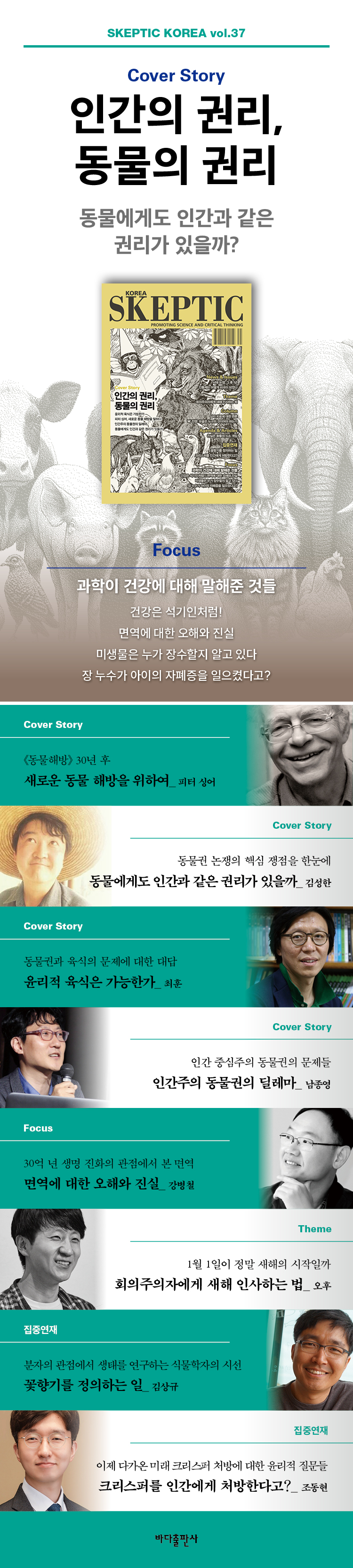
Do Animals Have the Same Rights as Humans? - Kim Seong-han
Is Ethical Meat Eating Possible? - Choi Hoon
The Dilemma of Humanistic Animal Rights - Nam Jong-young
For a New Animal Liberation - Peter Singer
Focus: What Science Tells Us About Health
Health like a Stone Age Man! - William Mellor
Misconceptions and Truths about Immunity - Kang Byeong-cheol
Microbes Know Who Will Live Longer - Michael Greger
Could Leaky Guts Cause Autism in Children? - John Summers
Intensive series
Defining the Scent of Flowers - Kim Sang-gyu
Prescribing CRISPR to Humans? - Cho Dong-hyun
Column
A Defense of Psychotherapy - Vivian Baruch
The 'Bone' Wars: Whose Remains Should Be? - Elizabeth Wiles, James W.
Springer
Agenda & Articles
Truth is a Seesaw Game of Probabilities - Ed Gibney, Zafir Ivanov
The Abortion Debate: One Year Later - Kevin McCaffrey
How Painkillers Became Tragic - Gerald Posner
Theme
How to Wish a Skeptic a Happy New Year - Afternoon
Cover Story: Human Rights, Animal Rights
Do Animals Have the Same Rights as Humans? - Kim Seong-han
Is Ethical Meat Eating Possible? - Choi Hoon
The Dilemma of Humanistic Animal Rights - Nam Jong-young
For a New Animal Liberation - Peter Singer
Focus: What Science Tells Us About Health
Health like a Stone Age Man! - William Mellor
Misconceptions and Truths about Immunity - Kang Byeong-cheol
Microbes Know Who Will Live Longer - Michael Greger
Could Leaky Guts Cause Autism in Children? - John Summers
Intensive series
Defining the Scent of Flowers - Kim Sang-gyu
Prescribing CRISPR to Humans? - Cho Dong-hyun
Column
A Defense of Psychotherapy - Vivian Baruch
The 'Bone' Wars: Whose Remains Should Be? - Elizabeth Wiles, James W.
Springer
Agenda & Articles
Truth is a Seesaw Game of Probabilities - Ed Gibney, Zafir Ivanov
Detailed image
Publisher's Review
▼ Cover Story: Human Rights, Animal Rights
The 'Dog Meat Consumption Prohibition Act' was passed at the plenary session of the National Assembly in January 2024.
On the one hand, some welcomed this law as an expansion of animal rights, while on the other hand, some expressed dissatisfaction, asking why only dogs were prohibited from being eaten.
Certainly, pets have become our companions, to the point where the slogan 'The Era of Ten Million Pets' is no longer awkward.
As the affection for pets grows, interest in 'animal rights' is also increasing.
But as the case of the dog meat consumption ban shows, animal rights raise many questions for us.
Why is it okay to eat beef while eating dogs is prohibited? Are there differences in rights among animals? Is there a standard that distinguishes humans from other animals? And should we all become vegetarians for the sake of animal rights? In this issue's cover story, we explore the issue of animal rights alongside animal ethicist Peter Singer's new book, "The New Animal Liberation," soon to be published in Korea.
First, ethicist Seonghan Yoon asks, "Do animals have the same rights as humans?" and examines whether the boundary dividing humans and animals is logically valid.
Next, philosopher Choi Hoon examines whether vegetarianism is the only way to protect animal rights from an animal rights perspective and asks about the possibility of ethical meat-eating.
Next, environmental journalist Nam Jong-young criticizes the dilemma of the human-centered discussion of animal rights and examines how far animal rights can be expanded.
Finally, in his new book, The New Animal Liberation, ethicist Peter Singer explores whether the arguments in his 1975 book are still relevant in 2024.
▼ Focus: What Science Tells Us About Health
We live in an age of health information overload. Health programs on TV and the internet abound with promises of a 100-year lifespan. Numerous health products, including vitamins, supplements, and antioxidants, tempt us with promises of a healthy future.
Moreover, recent remarkable advances in scientific understanding of health seem to suggest that humanity may soon achieve longevity, or even eternal life.
But the more noisy the situation, the more fakes tend to run rampant.
As Dr. Kang Byung-chul puts it, "In this era of extreme commercialization, isn't the key to protecting your precious money, time, and health through a minimum level of scientific knowledge?" In this issue's Focus, we examine the basic science needed to protect your health without being swayed by misinformation, as well as the tricks of pseudo-medical practices that mislead patients.
As biologist Dobzhansky said, “Without the light of evolution, biology can explain nothing,” medicine and health can also gain new insights when viewed through the lens of evolution.
Internist William Mellor shares fascinating insights from an evolutionary perspective, including why we struggle so much with our bodies and cavities, what constitutes a healthy diet, and why we should be cautious about taking supplements.
Pediatrician Dr. Kang Byeong-cheol also shares the basic science we need to know about immunity and criticizes the mistakes made by nutritional supplements that claim to "boost immunity."
Next, Dr. Michael Greger, MD, synthesizes the latest gut microbiome research to tell the story of the latest science, while John Summers, the father of a son with autism, shares his experience of how pseudo-medicine delves into the hearts of patients and their families.
How Painkillers Became a Tragedy
Opioids, including fentanyl, are tormenting people like an epidemic.
In 2021, the U.S. Centers for Disease Control and Prevention released shocking statistics showing that the number of Americans who died from opioid overdoses had surpassed 1 million since records began in 1999.
How did a painkiller that once saved patients writhing in pain become a tragedy? Journalist Gerald Posner traces how "pain" became a new vital sign in medicine, and how Big Pharma's pain marketing and government lax regulation transformed medical painkillers into state-sanctioned narcotics.
▼ The Abortion Debate, One Year Later
The abortion debate has become a public debate since the bombshell ruling overturning Roe v. Wade in June 2022.
It's been a year since the fierce debate between those divided into pro- and anti-abortion camps.
Where is the abortion debate headed? Kevin McCaffrey, a sociologist at the Skeptic Research Center, surveyed 3,014 American adults to assess their knowledge of abortion.
Interestingly, people were less informed about the objective data of the actual abortion debate, and especially the more partisan the debate, the less informed they were about each other and their own circumstances.
For example, Republican supporters in the United States believed that more than half of Republicans would want to completely ban abortion, but only 15 percent actually held that position.
McCaffrey discusses what data-driven approaches are needed to make the abortion debate more constructive.
▼ The 'Bone' War: Whose Remains Should Be?
On March 5, 2023, NBC News, in collaboration with ProPublica, a nonprofit investigative journalism outlet that investigates abuses of power, published a critical article about Tim White, a legendary paleoanthropologist who is currently a professor emeritus at the University of California, Berkeley.
The article criticized Tim White for using Native American bones and teeth as a teaching skeletal collection and for not properly preserving the remains.
Elizabeth Weiss, an anthropology professor at San Jose State University, reviews this critical article and discusses how the tenets of "political correctness" can pose a threat to education and anthropology.
▼ Prescribing CRISPR to humans?
Diseases that do not have a 100 percent incidence rate can be prevented through prenatal or preimplantation genetic testing.
But what if the incidence rate is 100 percent? There's one way.
The goal is to correct the genes that are causing the problem. It may sound like science fiction, but gene therapy is a reality of the near future.
Gene transfer therapy is already being used to treat actual patients, and clinical trials are also underway to correct the genes in problematic somatic cells.
So, it is not impossible to correct genes in embryos with diseases.
Gene editing of embryos has been criticized as unethical.
But which is more ethical: discarding embryos with a high incidence of preimplantation disease or genetically correcting the embryos? Professor Cho Dong-hyun, a physician-scientist at Seoul National University College of Medicine, emphasizes that gene therapy is not far off, and that now is the time to seriously consider the ethical issues surrounding gene therapy.
Also, Skeptic No. 37
- In 'How to Say New Year's Greetings to a Skeptic', columnist Oh Hu complains that it's difficult to even say New Year's greetings comfortably to a skeptic.
Anyone who has ever asked this question will understand the author's frustration.
Why is it called New Year's Day? What criteria were used to determine January 1st? In this article, I trace the history of calendars and discuss the possibility of a new calendar.
- In 'A Defense of Psychotherapy,' psychotherapist Vivian Baruch argues for the efficacy of psychotherapy against the late Harriet Hall's criticisms of it.
Baruch discusses the effectiveness of psychotherapy, highlighting how its effectiveness varies greatly depending on the therapist.
The 'Dog Meat Consumption Prohibition Act' was passed at the plenary session of the National Assembly in January 2024.
On the one hand, some welcomed this law as an expansion of animal rights, while on the other hand, some expressed dissatisfaction, asking why only dogs were prohibited from being eaten.
Certainly, pets have become our companions, to the point where the slogan 'The Era of Ten Million Pets' is no longer awkward.
As the affection for pets grows, interest in 'animal rights' is also increasing.
But as the case of the dog meat consumption ban shows, animal rights raise many questions for us.
Why is it okay to eat beef while eating dogs is prohibited? Are there differences in rights among animals? Is there a standard that distinguishes humans from other animals? And should we all become vegetarians for the sake of animal rights? In this issue's cover story, we explore the issue of animal rights alongside animal ethicist Peter Singer's new book, "The New Animal Liberation," soon to be published in Korea.
First, ethicist Seonghan Yoon asks, "Do animals have the same rights as humans?" and examines whether the boundary dividing humans and animals is logically valid.
Next, philosopher Choi Hoon examines whether vegetarianism is the only way to protect animal rights from an animal rights perspective and asks about the possibility of ethical meat-eating.
Next, environmental journalist Nam Jong-young criticizes the dilemma of the human-centered discussion of animal rights and examines how far animal rights can be expanded.
Finally, in his new book, The New Animal Liberation, ethicist Peter Singer explores whether the arguments in his 1975 book are still relevant in 2024.
▼ Focus: What Science Tells Us About Health
We live in an age of health information overload. Health programs on TV and the internet abound with promises of a 100-year lifespan. Numerous health products, including vitamins, supplements, and antioxidants, tempt us with promises of a healthy future.
Moreover, recent remarkable advances in scientific understanding of health seem to suggest that humanity may soon achieve longevity, or even eternal life.
But the more noisy the situation, the more fakes tend to run rampant.
As Dr. Kang Byung-chul puts it, "In this era of extreme commercialization, isn't the key to protecting your precious money, time, and health through a minimum level of scientific knowledge?" In this issue's Focus, we examine the basic science needed to protect your health without being swayed by misinformation, as well as the tricks of pseudo-medical practices that mislead patients.
As biologist Dobzhansky said, “Without the light of evolution, biology can explain nothing,” medicine and health can also gain new insights when viewed through the lens of evolution.
Internist William Mellor shares fascinating insights from an evolutionary perspective, including why we struggle so much with our bodies and cavities, what constitutes a healthy diet, and why we should be cautious about taking supplements.
Pediatrician Dr. Kang Byeong-cheol also shares the basic science we need to know about immunity and criticizes the mistakes made by nutritional supplements that claim to "boost immunity."
Next, Dr. Michael Greger, MD, synthesizes the latest gut microbiome research to tell the story of the latest science, while John Summers, the father of a son with autism, shares his experience of how pseudo-medicine delves into the hearts of patients and their families.
How Painkillers Became a Tragedy
Opioids, including fentanyl, are tormenting people like an epidemic.
In 2021, the U.S. Centers for Disease Control and Prevention released shocking statistics showing that the number of Americans who died from opioid overdoses had surpassed 1 million since records began in 1999.
How did a painkiller that once saved patients writhing in pain become a tragedy? Journalist Gerald Posner traces how "pain" became a new vital sign in medicine, and how Big Pharma's pain marketing and government lax regulation transformed medical painkillers into state-sanctioned narcotics.
▼ The Abortion Debate, One Year Later
The abortion debate has become a public debate since the bombshell ruling overturning Roe v. Wade in June 2022.
It's been a year since the fierce debate between those divided into pro- and anti-abortion camps.
Where is the abortion debate headed? Kevin McCaffrey, a sociologist at the Skeptic Research Center, surveyed 3,014 American adults to assess their knowledge of abortion.
Interestingly, people were less informed about the objective data of the actual abortion debate, and especially the more partisan the debate, the less informed they were about each other and their own circumstances.
For example, Republican supporters in the United States believed that more than half of Republicans would want to completely ban abortion, but only 15 percent actually held that position.
McCaffrey discusses what data-driven approaches are needed to make the abortion debate more constructive.
▼ The 'Bone' War: Whose Remains Should Be?
On March 5, 2023, NBC News, in collaboration with ProPublica, a nonprofit investigative journalism outlet that investigates abuses of power, published a critical article about Tim White, a legendary paleoanthropologist who is currently a professor emeritus at the University of California, Berkeley.
The article criticized Tim White for using Native American bones and teeth as a teaching skeletal collection and for not properly preserving the remains.
Elizabeth Weiss, an anthropology professor at San Jose State University, reviews this critical article and discusses how the tenets of "political correctness" can pose a threat to education and anthropology.
▼ Prescribing CRISPR to humans?
Diseases that do not have a 100 percent incidence rate can be prevented through prenatal or preimplantation genetic testing.
But what if the incidence rate is 100 percent? There's one way.
The goal is to correct the genes that are causing the problem. It may sound like science fiction, but gene therapy is a reality of the near future.
Gene transfer therapy is already being used to treat actual patients, and clinical trials are also underway to correct the genes in problematic somatic cells.
So, it is not impossible to correct genes in embryos with diseases.
Gene editing of embryos has been criticized as unethical.
But which is more ethical: discarding embryos with a high incidence of preimplantation disease or genetically correcting the embryos? Professor Cho Dong-hyun, a physician-scientist at Seoul National University College of Medicine, emphasizes that gene therapy is not far off, and that now is the time to seriously consider the ethical issues surrounding gene therapy.
Also, Skeptic No. 37
- In 'How to Say New Year's Greetings to a Skeptic', columnist Oh Hu complains that it's difficult to even say New Year's greetings comfortably to a skeptic.
Anyone who has ever asked this question will understand the author's frustration.
Why is it called New Year's Day? What criteria were used to determine January 1st? In this article, I trace the history of calendars and discuss the possibility of a new calendar.
- In 'A Defense of Psychotherapy,' psychotherapist Vivian Baruch argues for the efficacy of psychotherapy against the late Harriet Hall's criticisms of it.
Baruch discusses the effectiveness of psychotherapy, highlighting how its effectiveness varies greatly depending on the therapist.
GOODS SPECIFICS
- Date of issue: March 8, 2024
- Page count, weight, size: 276 pages | 170*250*20mm
- ISBN13: 9772383984000
- ISBN10: 23839848
You may also like
카테고리
korean


korean

![GQ KOREA Mark (Monthly): December [2025]](http://librairie.coreenne.fr/cdn/shop/files/8ef265dbbfbf186523ed75ba7319009d.jpg?v=1765340328&width=3840)


