

SKEPTIC Korea (quarterly): Issue 35
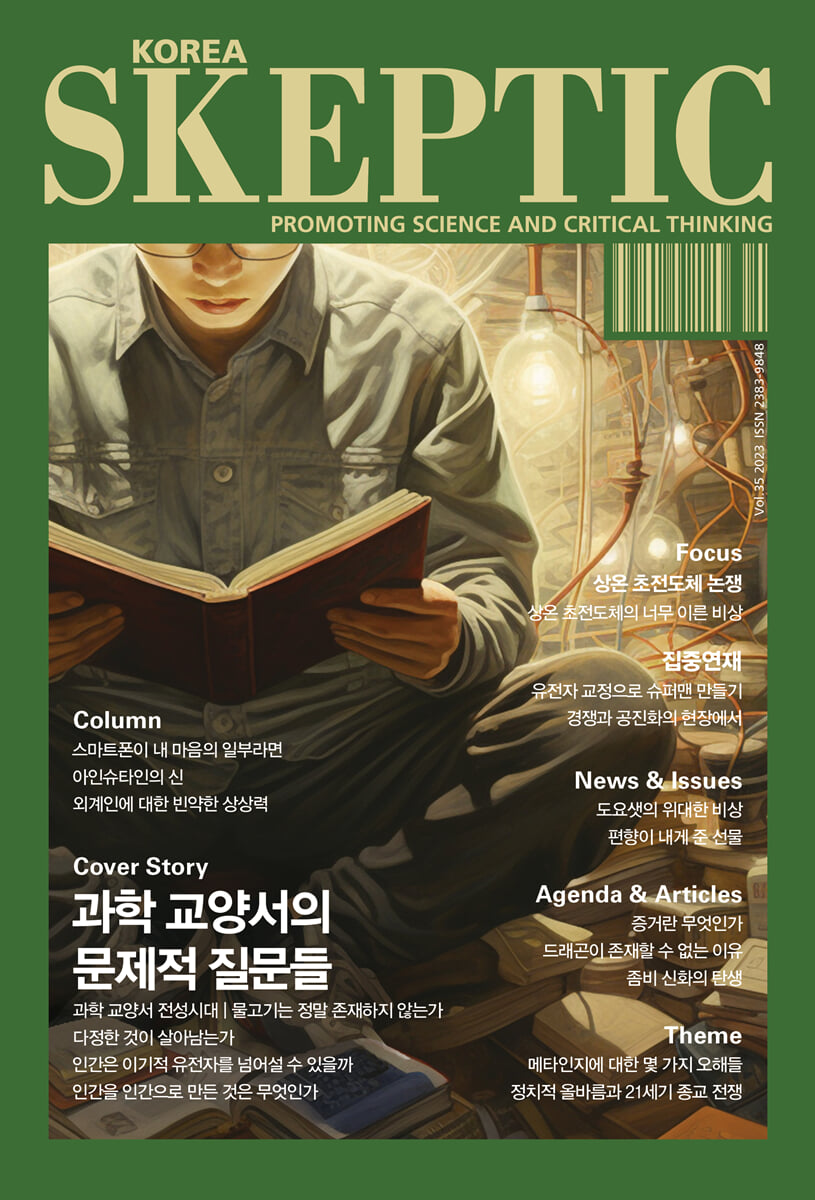 |
Description
Book Introduction
Korean Skeptic SKEPTIC No. 35
▶ The golden age of science textbooks
▶ Do fish really not exist?
▶ Can affection survive?
Can humans overcome selfish genes?
Political Correctness and the 21st Century Religious Wars
▶ Some misconceptions about metacognition
▶ Creating Superman through Gene Editing
▶ The Great Flight of the Toyosat
▶ Why dragons cannot exist
The golden age of science textbooks.
Why do we read popular science books? Do fish really exist? Do affectionate things survive? Can humans overcome selfish genes? What makes us human? The meaning of science is explored through the problematic questions of popular science books.
On the room-temperature superconductivity debate and scientific attitudes.
Professor Son Lisa, a metacognition expert, discusses some misconceptions about metacognition.
The great flight of the snipe.
Could genetic editing create a Superman?
Skeptic Issue 35 is full of interesting articles on political correctness and the 21st-century religious wars.
▶ The golden age of science textbooks
▶ Do fish really not exist?
▶ Can affection survive?
Can humans overcome selfish genes?
Political Correctness and the 21st Century Religious Wars
▶ Some misconceptions about metacognition
▶ Creating Superman through Gene Editing
▶ The Great Flight of the Toyosat
▶ Why dragons cannot exist
The golden age of science textbooks.
Why do we read popular science books? Do fish really exist? Do affectionate things survive? Can humans overcome selfish genes? What makes us human? The meaning of science is explored through the problematic questions of popular science books.
On the room-temperature superconductivity debate and scientific attitudes.
Professor Son Lisa, a metacognition expert, discusses some misconceptions about metacognition.
The great flight of the snipe.
Could genetic editing create a Superman?
Skeptic Issue 35 is full of interesting articles on political correctness and the 21st-century religious wars.
- You can preview some of the book's contents.
Preview
index
Column
If My Smartphone Were Part of My Mind - Carina Bold
Einstein's God - Jim Baggett
A Poor Imagination About Aliens - Philip Ball
Focus: The Room-Temperature Superconductor Debate
The Premature Emergence of Room-Temperature Superconductors - Kim Ki-duk
Theme
Some Misconceptions About Metacognition - Lisa Son
Political Correctness and the 21st Century Religious Wars - Afternoon
Cover Story: Problematic Questions in Science Textbooks
The Golden Age of Science Education - Lee Jeong-mo
Do Fish Really Exist? - Kang Seok-gi
Can Kindness Survive? - Park Han-seon
Can Humans Overcome Selfish Genes? - Kim Jun-hong
What Makes Humans Human? - Jo Hyun-wook
News & Issues
The Great Flight of the Toyosat - Hwang Jeong-ah
The Gift of Bias - Amanda Knox
What you see when you project your fears into the sky - Robert E.
Vasalamu
Intensive series
Creating Superman through Gene Editing - Jo Dong-hyun
In the Field of Competition and Coevolution - Kim Sang-gyu
Agenda & Articles
What is Evidence? - Heo Won-gi
Why Dragons Can't Exist - Douglas R.
Warwick
Zombie: A Tale of Two Clues - Daniel Loxton
The Earth is Too Far for Me - Morton Tarbell
If My Smartphone Were Part of My Mind - Carina Bold
Einstein's God - Jim Baggett
A Poor Imagination About Aliens - Philip Ball
Focus: The Room-Temperature Superconductor Debate
The Premature Emergence of Room-Temperature Superconductors - Kim Ki-duk
Theme
Some Misconceptions About Metacognition - Lisa Son
Political Correctness and the 21st Century Religious Wars - Afternoon
Cover Story: Problematic Questions in Science Textbooks
The Golden Age of Science Education - Lee Jeong-mo
Do Fish Really Exist? - Kang Seok-gi
Can Kindness Survive? - Park Han-seon
Can Humans Overcome Selfish Genes? - Kim Jun-hong
What Makes Humans Human? - Jo Hyun-wook
News & Issues
The Great Flight of the Toyosat - Hwang Jeong-ah
The Gift of Bias - Amanda Knox
What you see when you project your fears into the sky - Robert E.
Vasalamu
Intensive series
Creating Superman through Gene Editing - Jo Dong-hyun
In the Field of Competition and Coevolution - Kim Sang-gyu
Agenda & Articles
What is Evidence? - Heo Won-gi
Why Dragons Can't Exist - Douglas R.
Warwick
Zombie: A Tale of Two Clues - Daniel Loxton
The Earth is Too Far for Me - Morton Tarbell
Detailed image

Publisher's Review
▼ Focus: The premature emergence of room-temperature superconductors
This summer, our country was as hot as a superconductor.
After a domestic research team reported that they had observed superconductivity, a phenomenon previously observed only at extremely low temperatures, at room temperature, the news reported related news every day, and even a week before the research was announced, a stock related to superconductivity was created.
If true, this would be a groundbreaking discovery, so the excitement is understandable, but room-temperature superconductivity has taken off quickly, attracting unusually high public attention.
This discovery was especially significant because it was conducted by a domestic research team.
But the reason room-temperature superconductivity is considered the holy grail of physics is because, as fantastic as the phenomenon is, the odds of actually finding it are very low.
Dr. Kim Ki-duk, a condensed matter physicist, points out that the issue of room-temperature superconductivity was raised too quickly and too high before rigorous scientific verification.
In this Focus, he goes back to basics, examining what the phenomenon of superconductivity is and why room-temperature superconductivity is controversial in academia, and discusses the scientific approach to new discoveries.
▼ Cover Story: Problematic Questions in Science Textbooks
We are now in the golden age of science textbooks.
Unusually, popular science books such as “American Prometheus,” “The Science Study of Men with Humanities,” and “The Sky, the Wind, the Stars, and Humans” have made it to the general bestseller list.
Why on earth do people read science textbooks? One of last year's bestsellers left people wondering, "Fish don't exist."
That common fish doesn't exist? Many believe that the core of science lies in scientific facts.
In this age of science, it seems reasonable to grant authority to scientific facts.
But aren't provocative questions that challenge conventional wisdom, like the claim that fish don't exist, the essence of science?
Those problematic questions change our perspective on the world and life.
In this issue's cover story, we reread and delve deeply into science bestsellers to explore these problematic questions in science with our readers.
First, in 'The Golden Age of Science Education Books,' Lee Jeong-mo, former director of the National Science Museum in Gwacheon and a leading science writer in Korea, examines the flow of science education books, starting with the first generation of science education books such as 'Science Concert' and 'Discovery of the Ant Empire,' and discusses why science education books are necessary in this day and age.
Also, science columnist Kang Seok-gi critically examines the book “Fish Does Not Exist,” which was greatly loved last year, by asking the question, “Do fish really not exist?”
Next, evolutionary anthropologist Park Han-seon critically examines "The Affectionate Survive" from the perspective of evolution and strategy, and cultural evolutionist Kim Jun-hong critically examines "The Selfish Gene" based on the latest scientific theories and cultural evolution theory, asking whether humans can overcome selfish genes.
Finally, Hyunwook Cho, science columnist and translator of Sapiens, questions what makes humans human and examines whether Yuval Harari's critical thinking is still relevant.
▼ The Great Flight of the Toyosat
On October 4, 1957, the Soviet Union launched the world's first artificial satellite, Sputnik 1.
It was an event that shocked the world and signaled the beginning of space exploration.
Two years later, the Soviet Union successfully landed the unmanned lunar probe Luna 2 on the moon, and ten years after that, the United States successfully landed the world's first manned probe on the moon.
It has been over 50 years since Neil Armstrong first set foot on the moon.
Space exploration, which has emerged as a core technology in science, politics, and military affairs, is no longer a dream of humanity but a necessity.
India, which became the first country to land on the lunar south pole last August, has now begun exploring the sun.
As the world races fiercely in the space race, where does Korea stand in space exploration? Dr. Hwang Jeong-ah, an astrophysicist and developer of the Toyosat satellite, from the Korea Astronomy and Space Science Institute, examines the current state of Korean space exploration through the launch of Nuri, a satellite developed using Korea's own technology, in May.
From the arduous research process to the tense launch day, the story is as follows.
It contains the past, present, and future of Korean space exploration.
▼ The era of human gene editing is coming.
Gene editing technology, which emerged in the mid-2010s and shook up the biological world.
Jennifer Doudna and Emmanuel Charpentier, who developed this technique, were awarded the 2020 Nobel Prize in Physiology or Medicine.
The fact that the Nobel Prize was awarded so quickly is unusual, and it once again shows how groundbreaking their discovery was.
Where is gene editing technology headed? Professor Cho Dong-hyun, a physician-scientist at Seoul National University College of Medicine, will explore how gene editing technology is being applied to humans in four installments, examining the technical and ethical issues it raises.
This first installment explores how far human capabilities can be developed through genetic mutation, emphasizing that gene editing is no longer a technology unrelated to humans.
▼ Some misconceptions about metacognition
Metacognition, the core of Socrates' wisdom: “Know thyself.”
'Metacognition', which began to become widely known in Korea about five years ago, has received great attention mainly in relation to learning.
But perhaps because of that, metacognition was perceived as a strategy for successful learning.
Professor Lisa Son, an international expert on metacognition, seeks to correct some misunderstandings about metacognition following the publication of her book, Metacognitive Learning Methods.
He emphasizes that metacognition is not a single strategy, but a general ability to recognize and change oneself according to the situation, through examples such as learning situations with limited time and when facing bias.
Political Correctness and the 21st Century Religious Wars
A controversy arose surrounding the movie “The Little Mermaid,” which was released last May.
Was casting a black person as the Little Mermaid appropriate? Was Disney ruining its work by being obsessed with PC? Or wasn't this debate itself racist? The debate continued.
And these kinds of debates can now be found quite frequently throughout our society.
Critical columnist Oh-hu examines the current political correctness debate in our society within the framework of a new religious war in the 21st century.
Paradoxically, by examining the mechanisms by which "correctness" disrupts communication, the author reflects on what democratic values our society holds.
Also, Skeptic No. 35
- In 'What is Evidence?', philosopher of science Wonki Heo shows how the meaning of 'evidence' in science is more complex than our intuition suggests.
Through this, he emphasizes the need to maintain a critical attitude toward the standards of scientific evidence.
- In 'The Poor Imagination of Aliens,' science writer Philip Ball examines how limited our imagination of aliens is, discussing how much we extrapolate from human imagery when we picture aliens, both in everyday life and in scientific contexts.
- In 'Why Dragons Can't Exist', biologist Douglas R.
Warwick explores physical and genetic limitations as to why dragon-like monsters cannot exist.
This summer, our country was as hot as a superconductor.
After a domestic research team reported that they had observed superconductivity, a phenomenon previously observed only at extremely low temperatures, at room temperature, the news reported related news every day, and even a week before the research was announced, a stock related to superconductivity was created.
If true, this would be a groundbreaking discovery, so the excitement is understandable, but room-temperature superconductivity has taken off quickly, attracting unusually high public attention.
This discovery was especially significant because it was conducted by a domestic research team.
But the reason room-temperature superconductivity is considered the holy grail of physics is because, as fantastic as the phenomenon is, the odds of actually finding it are very low.
Dr. Kim Ki-duk, a condensed matter physicist, points out that the issue of room-temperature superconductivity was raised too quickly and too high before rigorous scientific verification.
In this Focus, he goes back to basics, examining what the phenomenon of superconductivity is and why room-temperature superconductivity is controversial in academia, and discusses the scientific approach to new discoveries.
▼ Cover Story: Problematic Questions in Science Textbooks
We are now in the golden age of science textbooks.
Unusually, popular science books such as “American Prometheus,” “The Science Study of Men with Humanities,” and “The Sky, the Wind, the Stars, and Humans” have made it to the general bestseller list.
Why on earth do people read science textbooks? One of last year's bestsellers left people wondering, "Fish don't exist."
That common fish doesn't exist? Many believe that the core of science lies in scientific facts.
In this age of science, it seems reasonable to grant authority to scientific facts.
But aren't provocative questions that challenge conventional wisdom, like the claim that fish don't exist, the essence of science?
Those problematic questions change our perspective on the world and life.
In this issue's cover story, we reread and delve deeply into science bestsellers to explore these problematic questions in science with our readers.
First, in 'The Golden Age of Science Education Books,' Lee Jeong-mo, former director of the National Science Museum in Gwacheon and a leading science writer in Korea, examines the flow of science education books, starting with the first generation of science education books such as 'Science Concert' and 'Discovery of the Ant Empire,' and discusses why science education books are necessary in this day and age.
Also, science columnist Kang Seok-gi critically examines the book “Fish Does Not Exist,” which was greatly loved last year, by asking the question, “Do fish really not exist?”
Next, evolutionary anthropologist Park Han-seon critically examines "The Affectionate Survive" from the perspective of evolution and strategy, and cultural evolutionist Kim Jun-hong critically examines "The Selfish Gene" based on the latest scientific theories and cultural evolution theory, asking whether humans can overcome selfish genes.
Finally, Hyunwook Cho, science columnist and translator of Sapiens, questions what makes humans human and examines whether Yuval Harari's critical thinking is still relevant.
▼ The Great Flight of the Toyosat
On October 4, 1957, the Soviet Union launched the world's first artificial satellite, Sputnik 1.
It was an event that shocked the world and signaled the beginning of space exploration.
Two years later, the Soviet Union successfully landed the unmanned lunar probe Luna 2 on the moon, and ten years after that, the United States successfully landed the world's first manned probe on the moon.
It has been over 50 years since Neil Armstrong first set foot on the moon.
Space exploration, which has emerged as a core technology in science, politics, and military affairs, is no longer a dream of humanity but a necessity.
India, which became the first country to land on the lunar south pole last August, has now begun exploring the sun.
As the world races fiercely in the space race, where does Korea stand in space exploration? Dr. Hwang Jeong-ah, an astrophysicist and developer of the Toyosat satellite, from the Korea Astronomy and Space Science Institute, examines the current state of Korean space exploration through the launch of Nuri, a satellite developed using Korea's own technology, in May.
From the arduous research process to the tense launch day, the story is as follows.
It contains the past, present, and future of Korean space exploration.
▼ The era of human gene editing is coming.
Gene editing technology, which emerged in the mid-2010s and shook up the biological world.
Jennifer Doudna and Emmanuel Charpentier, who developed this technique, were awarded the 2020 Nobel Prize in Physiology or Medicine.
The fact that the Nobel Prize was awarded so quickly is unusual, and it once again shows how groundbreaking their discovery was.
Where is gene editing technology headed? Professor Cho Dong-hyun, a physician-scientist at Seoul National University College of Medicine, will explore how gene editing technology is being applied to humans in four installments, examining the technical and ethical issues it raises.
This first installment explores how far human capabilities can be developed through genetic mutation, emphasizing that gene editing is no longer a technology unrelated to humans.
▼ Some misconceptions about metacognition
Metacognition, the core of Socrates' wisdom: “Know thyself.”
'Metacognition', which began to become widely known in Korea about five years ago, has received great attention mainly in relation to learning.
But perhaps because of that, metacognition was perceived as a strategy for successful learning.
Professor Lisa Son, an international expert on metacognition, seeks to correct some misunderstandings about metacognition following the publication of her book, Metacognitive Learning Methods.
He emphasizes that metacognition is not a single strategy, but a general ability to recognize and change oneself according to the situation, through examples such as learning situations with limited time and when facing bias.
Political Correctness and the 21st Century Religious Wars
A controversy arose surrounding the movie “The Little Mermaid,” which was released last May.
Was casting a black person as the Little Mermaid appropriate? Was Disney ruining its work by being obsessed with PC? Or wasn't this debate itself racist? The debate continued.
And these kinds of debates can now be found quite frequently throughout our society.
Critical columnist Oh-hu examines the current political correctness debate in our society within the framework of a new religious war in the 21st century.
Paradoxically, by examining the mechanisms by which "correctness" disrupts communication, the author reflects on what democratic values our society holds.
Also, Skeptic No. 35
- In 'What is Evidence?', philosopher of science Wonki Heo shows how the meaning of 'evidence' in science is more complex than our intuition suggests.
Through this, he emphasizes the need to maintain a critical attitude toward the standards of scientific evidence.
- In 'The Poor Imagination of Aliens,' science writer Philip Ball examines how limited our imagination of aliens is, discussing how much we extrapolate from human imagery when we picture aliens, both in everyday life and in scientific contexts.
- In 'Why Dragons Can't Exist', biologist Douglas R.
Warwick explores physical and genetic limitations as to why dragon-like monsters cannot exist.
GOODS SPECIFICS
- Date of issue: September 4, 2023
- Page count, weight, size: 264 pages | 170*250*20mm
- ISBN13: 9772383984000
- ISBN10: 23839848
You may also like
카테고리
korean


korean

![GQ KOREA Mark (Monthly): December [2025]](http://librairie.coreenne.fr/cdn/shop/files/8ef265dbbfbf186523ed75ba7319009d.jpg?v=1765340328&width=3840)


