

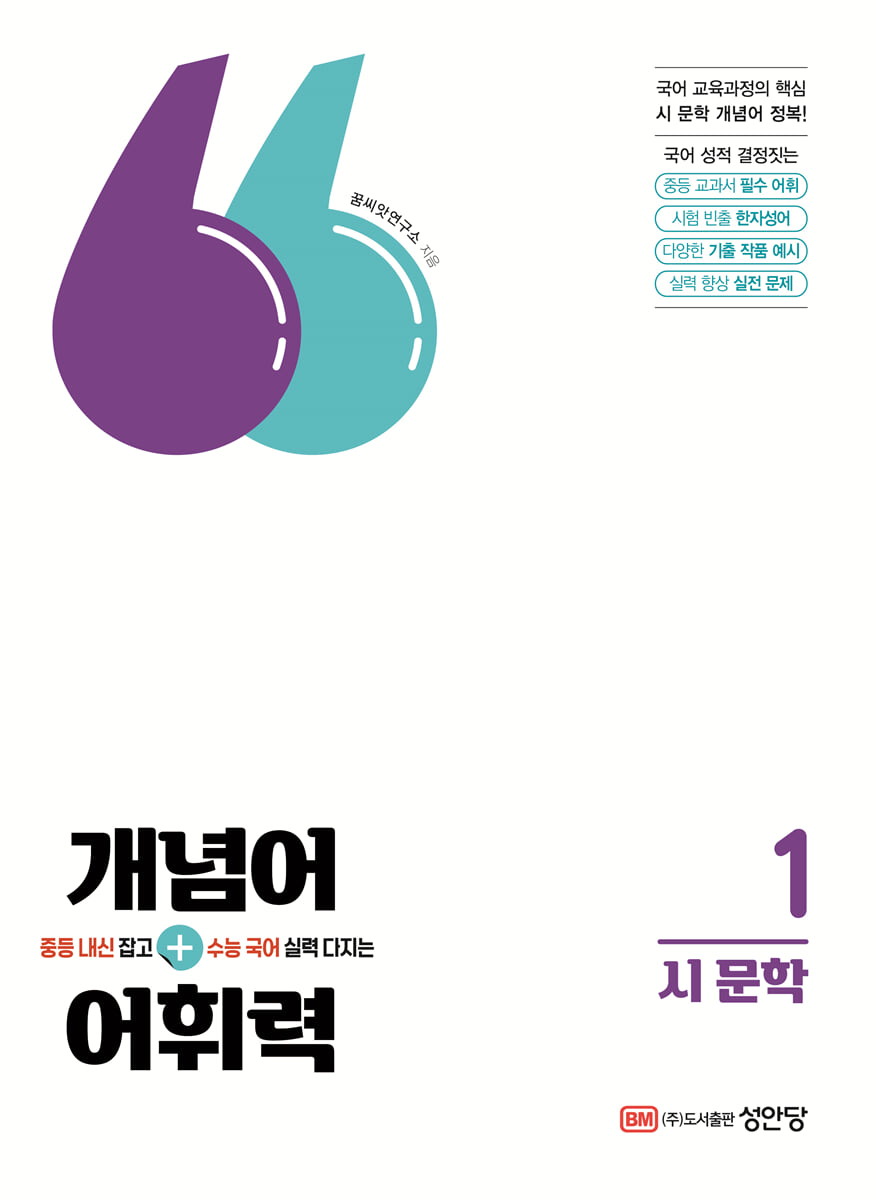
Conceptual Words and Vocabulary 1 - Poetry
 |
Description
Book Introduction
Boost your vocabulary and Korean language skills at the same time with concept words!
Korean language test, don't solve it by feeling!
After taking the Korean language test, many children say they got it wrong because they misread the question.
But this is because the intention and purpose of the problem were not accurately understood.
So how should we study to interpret the work and answer the questions as required on the exam? The answer lies in "conceptual language."
Even if the exam system or textbooks change, the study method of focusing on the basics and focusing on concepts will not change.
The most important thing in studying Korean is to know the related concepts accurately.
If you don't know the concept words accurately, you won't be able to properly understand the questions and passages on the Korean language test.
In fact, most of the questions that children get wrong on Korean language tests are related to vocabulary, and among them, they find conceptual words the most difficult.
It is essential to learn the characteristics, concepts, and vocabulary of each branch of literature, including poetry, novels, plays, and non-fiction.
The "Conceptual Words and Vocabulary to Improve Middle School Grades and College Scholastic Ability in Korean" series is a middle school vocabulary textbook divided into three volumes, "Poetry Literature, Novels (Prose), and Non-Literature," regardless of grade level, to enable students to study conceptual words, which are the core of Korean language studies.
It explains the core concepts of the Korean language curriculum in an easy-to-understand way, and helps you develop a sense of reality through various example works and past questions. It goes beyond simply providing dictionary definitions, and is structured so that you can understand the concepts more easily and be more effective in actual exams through abundant examples and real-world problems.
Additionally, you can effectively learn essential vocabulary from middle school textbooks through real-life examples and confirmation problems, and the four-character idioms, which serve as useful background knowledge, are explained in Chinese characters to accurately understand their meaning, and the explanations of their origins are a great help in expanding your vocabulary.
Korean language test, don't solve it by feeling!
After taking the Korean language test, many children say they got it wrong because they misread the question.
But this is because the intention and purpose of the problem were not accurately understood.
So how should we study to interpret the work and answer the questions as required on the exam? The answer lies in "conceptual language."
Even if the exam system or textbooks change, the study method of focusing on the basics and focusing on concepts will not change.
The most important thing in studying Korean is to know the related concepts accurately.
If you don't know the concept words accurately, you won't be able to properly understand the questions and passages on the Korean language test.
In fact, most of the questions that children get wrong on Korean language tests are related to vocabulary, and among them, they find conceptual words the most difficult.
It is essential to learn the characteristics, concepts, and vocabulary of each branch of literature, including poetry, novels, plays, and non-fiction.
The "Conceptual Words and Vocabulary to Improve Middle School Grades and College Scholastic Ability in Korean" series is a middle school vocabulary textbook divided into three volumes, "Poetry Literature, Novels (Prose), and Non-Literature," regardless of grade level, to enable students to study conceptual words, which are the core of Korean language studies.
It explains the core concepts of the Korean language curriculum in an easy-to-understand way, and helps you develop a sense of reality through various example works and past questions. It goes beyond simply providing dictionary definitions, and is structured so that you can understand the concepts more easily and be more effective in actual exams through abundant examples and real-world problems.
Additionally, you can effectively learn essential vocabulary from middle school textbooks through real-life examples and confirmation problems, and the four-character idioms, which serve as useful background knowledge, are explained in Chinese characters to accurately understand their meaning, and the explanations of their origins are a great help in expanding your vocabulary.
- You can preview some of the book's contents.
Preview
index
01
STEP 1: Check your basic skills
STEP 2: Understanding Korean language concepts with frequently appearing vocabulary on the test
syllable | word | phrase | verse | verse | line | stanza
STEP 3: Build your vocabulary with essential textbook words
Arena | Mangbuseok | Pasture | Public Interest | Sensitivity | Validity | Effectiveness | Identity | Awe | Vitality
STEP 4: Expand your vocabulary with idioms
Extortion | A desperate attempt | A desperate attempt | Sweet talk | Deception | A change of heart
STEP 5: Complete your vocabulary with practice problems
02
STEP 1: Check your basic skills
STEP 2: Understanding Korean language concepts with frequently appearing vocabulary on the test
Sensual | Sentimental | Passionate | Confessional
STEP 3: Build your vocabulary with essential textbook words
Helplessness | Deprivation | Affinity | Disgust | Strangeness | Discernment | Insight | Helplessness | Appeal | Discernment
STEP 4: Expand your vocabulary with idioms
A close relationship | A close relationship | A close relationship | A close relationship | A close relationship | A close relationship | A close relationship | A close relationship | A close relationship
STEP 5: Complete your vocabulary with practice problems
03
STEP 1: Check your basic skills
STEP 2: Understanding Korean language concepts with frequently appearing vocabulary on the test
Rhyme | Phoneme | Phonetic meter | Rhythm | Phonetic symbol
STEP 3: Build your vocabulary with essential textbook words
Laborer | Immigrant | Sojourner | Visionary | Helper | The Poorest | Giraffe | The Participant | Hopeful | Small-timer
STEP 4: Expand your vocabulary with idioms
Struggle | Desperate measures | Enduring hardship | Learning from the depths of knowledge | Too much is as bad as too little | A wise man's guidance
STEP 5: Complete your vocabulary with practice problems
04
STEP 1: Check your basic skills
STEP 2: Understanding Korean language concepts with frequently appearing vocabulary on the test
Classical | Idealistic | Contemplative | Didactic
STEP 3: Build your vocabulary with essential textbook words
Higher dimension | By-product | Stopgap | Scrapbook | Discontent | Whisper | Pride | Public speaking | Universalization | Barren land
STEP 4: Expand your vocabulary with idioms
A close match | A desperate measure | A trick | A scheme | A ploy | A triumph of good over evil | A triumph of power over the land
STEP 5: Complete your vocabulary with practice problems
05
STEP 1: Check your basic skills
STEP 2: Understanding Korean language concepts with frequently appearing vocabulary on the test
External rate | Metonymy | Metonymy | Metonymy | Metonymy | Metonymy | Metonymy | Metonymy | Prose
STEP 3: Build your vocabulary with essential textbook words
Growth rate | Green light | Red light | Illicit | Reckless | Shameless | Sleepless | Outsider | Defenseless | One-sided
STEP 4: Expand your vocabulary with idioms
Golden Orchid | The Icing on the Cake | Returning Home in Gold | Golden Jade Leaf | High-spiritedness | Knightly Revival
STEP 5: Complete your vocabulary with practice problems
06
STEP 1: Check your basic skills
STEP 2: Understanding Korean language concepts with frequently appearing vocabulary on the test
Constructive | Eccentric | Romantic | Cynical
STEP 3: Build your vocabulary with essential textbook words
Fuse | Star | A View | Gate to Success | Instigator | Motto | True Scene | Victory Without War | Blueprint | Long Line
STEP 4: Expand your vocabulary with idioms
Outrageous | Internal and external troubles | Careful consideration | The more the better | The more similar | The more inconsistent | The more black
STEP 5: Complete your vocabulary with practice problems
07
STEP 1: Check your basic skills
STEP 2: Understanding Korean language concepts with frequently appearing vocabulary on the test
Imagery | Visual imagery | Auditory imagery | Tactile imagery | Gustatory imagery | Olfactory imagery
STEP 3: Build your vocabulary with essential textbook words
Residence | Side road | Nine streams | Colony | Rural area | Freshwater | Sights | Geumseong | Daemok | Footsteps
STEP 4: Expand your vocabulary with idioms
Dokya Cheongcheong | Dongbun Seoju | Shumun Bulgogi | My Dongpung | Mangyang Borae | Bewildered
STEP 5: Complete your vocabulary with practice problems
08
STEP 1: Check your basic skills
STEP 2: Understanding Korean language concepts with frequently appearing vocabulary on the test
Assertive | Contrastive | Escapist | Contemplative
STEP 3: Build your vocabulary with essential textbook words
Measure | Authority | Other field | Justification | Fame | Face | Stuffed animal | Rank | Origin
STEP 4: Expand your vocabulary with idioms
Buy and sell | True to name | Silently answering | Water and nature are one | Misasyeogoo | Good customs and manners
STEP 5: Complete your vocabulary with practice problems
09
STEP 1: Check your basic skills
STEP 2: Understanding Korean language concepts with frequently appearing vocabulary on the test
Multisensory imagery | Synesthetic imagery | Visualization
STEP 3: Build your vocabulary with essential textbook words
Guts | Corruption | Foreshadowing | Dagger | Private Life | Mission | Hunting | Tactic | Sublimation
STEP 4: Expand your vocabulary with idioms
Wide-ranging knowledge | Banpojihyo | Ingratitude | A hopeless dream | A hundred-year plan | A hundred-year sea route
STEP 5: Complete your vocabulary with practice problems
10
STEP 1: Check your basic skills
STEP 2: Understanding Korean language concepts with frequently appearing vocabulary on the test
Monologic | Meditative | Pastoral | Descriptive
STEP 3: Build your vocabulary with essential textbook words
Current Affairs | New Life | Darkness | Aspects | Parasol | Thoughts | Journey | Inspiration | Honor and Disgrace | Five Geums
STEP 4: Expand your vocabulary with idioms
Baek-ui-jong-gun | Baek-jeon-jeon-jeon | Bu-hwa-no-dong | Bone-breaking | Indignation and resentment | Bi-il-bi-jae
STEP 5: Complete your vocabulary with practice problems
11
STEP 1: Check your basic skills
STEP 2: Understanding Korean language concepts with frequently appearing vocabulary on the test
Fixed form poetry | Free verse | Prose poetry | Epic poetry | Lyric poetry | Poetic license | Color words
STEP 3: Build your vocabulary with essential textbook words
Foreign land | Luck | Power | Prestige | Play | Intention | Incident | Consistency | Anecdote | Iron rule
STEP 4: Expand your vocabulary with idioms
A house on all sides | A house without a roof | A house without a roof | A house without a roof | A house without a roof | A house without a roof
STEP 5: Complete your vocabulary with practice problems
12
STEP 1: Check your basic skills
STEP 2: Understanding Korean language concepts with frequently appearing vocabulary on the test
folk-like | dreamy | reflective | ironic
STEP 3: Build your vocabulary with essential textbook words
Track | Strategy | Storm | Trend | A little | Purpose | Harm | Evil | Integrity | Hasty
STEP 4: Expand your vocabulary with idioms
Receiving the message | Su-eo-ji-gyo | Winning and losing | Right and wrong | Consistent | Appearances and disappearances
STEP 5: Complete your vocabulary with practice problems
13
STEP 1: Check your basic skills
STEP 2: Understanding Korean language concepts with frequently appearing vocabulary on the test
Speaker | Superficial Speaker | Subconscious Speaker | Listener | Monologue | Poetic Object | Poetic Situation
STEP 3: Build your vocabulary with essential textbook words
Ruin | Insidious plot | Ominous thing | Judgment | Remorse | Consideration | Reclamation | Opening of ports | Fury
STEP 4: Expand your vocabulary with idioms
Shintobuli | Ten out of ten | Nine out of ten | Arrogant | Survival of the fittest | Either/or
STEP 5: Complete your vocabulary with practice problems
14
STEP 1: Check your basic skills
STEP 2: Understanding Korean language concepts with frequently appearing vocabulary on the test
metaphorical | critical | reflective | factual
STEP 3: Build your vocabulary with essential textbook words
Check | Decision | Symbiosis | Reticence | Showoff | Exaggeration | Idea | Involvement | Disturbance | Exchange
STEP 4: Expand your vocabulary with idioms
Fisherman's Geography | Duck's Infinite Challenge | Omaebulmang | Obiirak | Ongojishin | Walgwalbu
STEP 5: Complete your vocabulary with practice problems
15
STEP 1: Check your basic skills
STEP 2: Understanding Korean language concepts with frequently appearing vocabulary on the test
Figure of speech | Figure of speech | Figure of speech | Figure of speech | Figure of speech | Figure of speech | Figure of speech
STEP 3: Build your vocabulary with essential textbook words
Bond | Resolution | Contempt | Repentance | Succession | Hardship | Naturalization | Appearance | Dejection | Disheartening
STEP 4: Expand your vocabulary with idioms
Twists and turns | Near-death experiences | Silence | The only child alive | Rumors | Birds of a feather flock together
STEP 5: Complete your vocabulary with practice problems
16
STEP 1: Check your basic skills
STEP 2: Understanding Korean language concepts with frequently appearing vocabulary on the test
Prosaic | Symbolic | Epigraphic | Epic
STEP 3: Build your vocabulary with essential textbook words
Return to the countryside | Indifference | Coldness | Aging | Leakage | Opposition | Promotion | Recovery | Attraction | Bribery
STEP 4: Expand your vocabulary with idioms
Leisurely | Telepathy | Cause and Effect | Human Face and Mind | Human Life and Death | Insensibility
STEP 5: Complete your vocabulary with practice problems
17
STEP 1: Check your basic skills
STEP 2: Understanding Korean language concepts with frequently appearing vocabulary on the test
Personification | Allegory | Metaphor | Double Meaning
STEP 3: Build your vocabulary with essential textbook words
Statement | Contempt | Free | Reckless | Shameless | Reprimand | Eradication | Emission | Indifference | Double
STEP 4: Expand your vocabulary with idioms
Cognitive assumption | Killing two birds with one stone | Killing everything in one fell swoop | In line | Clear at a glance | A spring dream
STEP 5: Complete your vocabulary with practice problems
18
STEP 1: Check your basic skills
STEP 2: Understanding Korean language concepts with frequently appearing vocabulary on the test
Descriptive | Reflective | Receptive | Mournful
STEP 3: Build your vocabulary with essential textbook words
Exclusion | Flood | Encounter | Desperation | Compliance | Discrimination | Dispersion | Disregard | Slander | Leap
STEP 4: Expand your vocabulary with idioms
A moment's notice | A quick rise | A wave of change | A single-minded determination | Impromptu response | Reaping what you sow
STEP 5: Complete your vocabulary with practice problems
19
STEP 1: Check your basic skills
STEP 2: Understanding Korean language concepts with frequently appearing vocabulary on the test
Repetition | Crescendo | Comparison | Contrast | Emptiness
STEP 3: Build your vocabulary with essential textbook words
Secret | Fertility | Ice | Selection | Annihilation | Action | Binding | Convergence | Deliberation | Purification
STEP 4: Expand your vocabulary with idioms
The whole story | Self-abandonment | Self-praise | The right person for the right job | The right person in the right place | Unprecedented
STEP 5: Complete your vocabulary with practice problems
20
STEP 1: Check your basic skills
STEP 2: Understanding Korean language concepts with frequently appearing vocabulary on the test
elegiac | dynamic | paradoxical | lamentable
STEP 3: Build your vocabulary with essential textbook words
Perseverance | Mediation | Insinuation | Tenacity | Strictness | Assault | Competence | Permanence | Distortion | Tolerance
STEP 4: Expand your vocabulary with idioms
Lightning | Unprecedented | Promising | Turning a Ring Around | Polishing Procedures | Desperately Strive
STEP 5: Complete your vocabulary with practice problems
21
STEP 1: Check your basic skills
STEP 2: Understanding Korean language concepts with frequently appearing vocabulary on the test
Inversion | Paradox | Antithesis | Irony | Paradox
STEP 3: Build your vocabulary with essential textbook words
Savor | Potential | Mastery | Transmission | Transmission | Thrill | Purification | Conclusion | Reconstruction | Jicheon
STEP 4: Expand your vocabulary with idioms
A sharp point | A quick step toward a strong wife | A quick step toward stopping the bleeding | A quick step toward three ways of moving | A long and arduous journey | A restless and anxious seat
STEP 5: Complete your vocabulary with practice problems
22
STEP 1: Check your basic skills
STEP 2: Understanding Korean language concepts with frequently appearing vocabulary on the test
Praiseful | Aesthetic | Volitional | Everyday
STEP 3: Build your vocabulary with essential textbook words
Delay | Wrath | Rebuke | Initiation | Rebuke | Contempt | Urgency | Trigger | Accumulation | Healing
STEP 4: Expand your vocabulary with idioms
Left and right | Left and right | Reversal of roles | Reading the scriptures day and night | Best friends | All-out chaos
STEP 5: Complete your vocabulary with practice problems
23
STEP 1: Check your basic skills
STEP 2: Understanding Korean language concepts with frequently appearing vocabulary on the test
Symbol | Archetypal Symbol | Conventional Symbol | Personal Symbol
STEP 3: Build your vocabulary with essential textbook words
Escaping | Squandering | Confessing | Complaining | Writing | Assigning | Containing | Enjoying | Breaking through | Escorting
STEP 4: Expand your vocabulary with idioms
Stagnant | A feast | A dilemma | Day after day | Unruly | A match made in heaven
STEP 5: Complete your vocabulary with practice problems
24
STEP 1: Check your basic skills
STEP 2: Understanding Korean language concepts with frequently appearing vocabulary on the test
Eco-friendly | Self-help | Resistant | Rural
STEP 3: Build your vocabulary with essential textbook words
Avoidance | Rare | Condemnation | Discrimination | Exaltation | Inspiration | Disparity | Category | Substance | Reality
STEP 4: Expand your vocabulary with idioms
A thousand hardships | Man-made disasters | Natural disasters | Myriad variations | Uniformity | Thoroughness
STEP 5: Complete your vocabulary with practice problems
25
STEP 1: Check your basic skills
STEP 2: Understanding Korean language concepts with frequently appearing vocabulary on the test
Sublime | Elegance | Tragic | Sorrowful
STEP 3: Build your vocabulary with essential textbook words
Promotion | Victory | Inspection | Interrogation | Reality | Mistake | Subordinate | Stronghold | Discord | Collusion
STEP 4: Expand your vocabulary with idioms
Integrity and innocence | Clear mountains and flowing water | A bolt from the blue | A sharp tongue | A sharp tongue | Falling down seven times and falling eight times
STEP 5: Complete your vocabulary with practice problems
26
STEP 1: Check your basic skills
STEP 2: Understanding Korean language concepts with frequently appearing vocabulary on the test
gradual | static | religious | intellectual
STEP 3: Build your vocabulary with essential textbook words
Strong | Resolute | Embarrassed | Hardened | Competitive | Composed | Public | Coincidental | Strange | Embarrassing
STEP 4: Expand your vocabulary with idioms
Bedrock | Consistency | A stone of wisdom | A table talk | A toss and turns | A tumultuous journey
STEP 5: Complete your vocabulary with practice problems
27
STEP 1: Check your basic skills
STEP 2: Understanding Korean language concepts with frequently appearing vocabulary on the test
Awards | Sumisangwan | Introduction, Development, Turn, and Conclusion | Seonkyunghujeong
STEP 3: Build your vocabulary with essential textbook words
To be generous | To be plentiful | To be colorful | To be monotonous | To be firm | To be indifferent | To be meticulous | To be reckless | To take risks
STEP 4: Expand your vocabulary with idioms
A great success | A great success | A beauty with many talents | A ruined family | A thief who laughs and snickers | Two-faced
STEP 5: Complete your vocabulary with practice problems
28
STEP 1: Check your basic skills
STEP 2: Understanding Korean language concepts with frequently appearing vocabulary on the test
satirical | humorous | realistic | surreal
STEP 3: Build your vocabulary with essential textbook words
subtle | wanton | sickly | unsightly | inevitable | sarcastic | awkward | unfamiliar | modest | elegant
STEP 4: Expand your vocabulary with idioms
Wind-driven lights | Academic expectations | Silent silence | Hamheung tea ceremony | Honesty | Bloody alone
STEP 5: Complete your vocabulary with practice problems
29
STEP 1: Check your basic skills
STEP 2: Understanding Korean language concepts with frequently appearing vocabulary on the test
Objective Correlative | Empathy | Medium
STEP 3: Build your vocabulary with essential textbook words
Easy | Somber | Uninteresting | Profound | Embracing | Gloomy | Sad | Young | Vivid | Gloomy
STEP 4: Expand your vocabulary with idioms
Hyeongseoljigong | Hogujicheok | Hosadama | Hoshitamtam | Boastful talk | Frightened and in a state of panic
STEP 5: Complete your vocabulary with practice problems
30
STEP 1: Check your basic skills
STEP 2: Understanding Korean language concepts with frequently appearing vocabulary on the test
Local | Retrospective | Allegorical | Conversational
STEP 3: Build your vocabulary with essential textbook words
Exquisite | Desperate | Neat | Steadfast | Orderly | Barren | Refreshing | Refreshing | Stale | Trite
STEP 4: Expand your vocabulary with idioms
Hoyeonjigi | Honyeonilchi | Hwaryongjeomjeong | Absurd and groundless | Regretful | Joy, anger, sorrow, and pleasure
STEP 5: Complete your vocabulary with practice problems
STEP 1: Check your basic skills
STEP 2: Understanding Korean language concepts with frequently appearing vocabulary on the test
syllable | word | phrase | verse | verse | line | stanza
STEP 3: Build your vocabulary with essential textbook words
Arena | Mangbuseok | Pasture | Public Interest | Sensitivity | Validity | Effectiveness | Identity | Awe | Vitality
STEP 4: Expand your vocabulary with idioms
Extortion | A desperate attempt | A desperate attempt | Sweet talk | Deception | A change of heart
STEP 5: Complete your vocabulary with practice problems
02
STEP 1: Check your basic skills
STEP 2: Understanding Korean language concepts with frequently appearing vocabulary on the test
Sensual | Sentimental | Passionate | Confessional
STEP 3: Build your vocabulary with essential textbook words
Helplessness | Deprivation | Affinity | Disgust | Strangeness | Discernment | Insight | Helplessness | Appeal | Discernment
STEP 4: Expand your vocabulary with idioms
A close relationship | A close relationship | A close relationship | A close relationship | A close relationship | A close relationship | A close relationship | A close relationship | A close relationship
STEP 5: Complete your vocabulary with practice problems
03
STEP 1: Check your basic skills
STEP 2: Understanding Korean language concepts with frequently appearing vocabulary on the test
Rhyme | Phoneme | Phonetic meter | Rhythm | Phonetic symbol
STEP 3: Build your vocabulary with essential textbook words
Laborer | Immigrant | Sojourner | Visionary | Helper | The Poorest | Giraffe | The Participant | Hopeful | Small-timer
STEP 4: Expand your vocabulary with idioms
Struggle | Desperate measures | Enduring hardship | Learning from the depths of knowledge | Too much is as bad as too little | A wise man's guidance
STEP 5: Complete your vocabulary with practice problems
04
STEP 1: Check your basic skills
STEP 2: Understanding Korean language concepts with frequently appearing vocabulary on the test
Classical | Idealistic | Contemplative | Didactic
STEP 3: Build your vocabulary with essential textbook words
Higher dimension | By-product | Stopgap | Scrapbook | Discontent | Whisper | Pride | Public speaking | Universalization | Barren land
STEP 4: Expand your vocabulary with idioms
A close match | A desperate measure | A trick | A scheme | A ploy | A triumph of good over evil | A triumph of power over the land
STEP 5: Complete your vocabulary with practice problems
05
STEP 1: Check your basic skills
STEP 2: Understanding Korean language concepts with frequently appearing vocabulary on the test
External rate | Metonymy | Metonymy | Metonymy | Metonymy | Metonymy | Metonymy | Metonymy | Prose
STEP 3: Build your vocabulary with essential textbook words
Growth rate | Green light | Red light | Illicit | Reckless | Shameless | Sleepless | Outsider | Defenseless | One-sided
STEP 4: Expand your vocabulary with idioms
Golden Orchid | The Icing on the Cake | Returning Home in Gold | Golden Jade Leaf | High-spiritedness | Knightly Revival
STEP 5: Complete your vocabulary with practice problems
06
STEP 1: Check your basic skills
STEP 2: Understanding Korean language concepts with frequently appearing vocabulary on the test
Constructive | Eccentric | Romantic | Cynical
STEP 3: Build your vocabulary with essential textbook words
Fuse | Star | A View | Gate to Success | Instigator | Motto | True Scene | Victory Without War | Blueprint | Long Line
STEP 4: Expand your vocabulary with idioms
Outrageous | Internal and external troubles | Careful consideration | The more the better | The more similar | The more inconsistent | The more black
STEP 5: Complete your vocabulary with practice problems
07
STEP 1: Check your basic skills
STEP 2: Understanding Korean language concepts with frequently appearing vocabulary on the test
Imagery | Visual imagery | Auditory imagery | Tactile imagery | Gustatory imagery | Olfactory imagery
STEP 3: Build your vocabulary with essential textbook words
Residence | Side road | Nine streams | Colony | Rural area | Freshwater | Sights | Geumseong | Daemok | Footsteps
STEP 4: Expand your vocabulary with idioms
Dokya Cheongcheong | Dongbun Seoju | Shumun Bulgogi | My Dongpung | Mangyang Borae | Bewildered
STEP 5: Complete your vocabulary with practice problems
08
STEP 1: Check your basic skills
STEP 2: Understanding Korean language concepts with frequently appearing vocabulary on the test
Assertive | Contrastive | Escapist | Contemplative
STEP 3: Build your vocabulary with essential textbook words
Measure | Authority | Other field | Justification | Fame | Face | Stuffed animal | Rank | Origin
STEP 4: Expand your vocabulary with idioms
Buy and sell | True to name | Silently answering | Water and nature are one | Misasyeogoo | Good customs and manners
STEP 5: Complete your vocabulary with practice problems
09
STEP 1: Check your basic skills
STEP 2: Understanding Korean language concepts with frequently appearing vocabulary on the test
Multisensory imagery | Synesthetic imagery | Visualization
STEP 3: Build your vocabulary with essential textbook words
Guts | Corruption | Foreshadowing | Dagger | Private Life | Mission | Hunting | Tactic | Sublimation
STEP 4: Expand your vocabulary with idioms
Wide-ranging knowledge | Banpojihyo | Ingratitude | A hopeless dream | A hundred-year plan | A hundred-year sea route
STEP 5: Complete your vocabulary with practice problems
10
STEP 1: Check your basic skills
STEP 2: Understanding Korean language concepts with frequently appearing vocabulary on the test
Monologic | Meditative | Pastoral | Descriptive
STEP 3: Build your vocabulary with essential textbook words
Current Affairs | New Life | Darkness | Aspects | Parasol | Thoughts | Journey | Inspiration | Honor and Disgrace | Five Geums
STEP 4: Expand your vocabulary with idioms
Baek-ui-jong-gun | Baek-jeon-jeon-jeon | Bu-hwa-no-dong | Bone-breaking | Indignation and resentment | Bi-il-bi-jae
STEP 5: Complete your vocabulary with practice problems
11
STEP 1: Check your basic skills
STEP 2: Understanding Korean language concepts with frequently appearing vocabulary on the test
Fixed form poetry | Free verse | Prose poetry | Epic poetry | Lyric poetry | Poetic license | Color words
STEP 3: Build your vocabulary with essential textbook words
Foreign land | Luck | Power | Prestige | Play | Intention | Incident | Consistency | Anecdote | Iron rule
STEP 4: Expand your vocabulary with idioms
A house on all sides | A house without a roof | A house without a roof | A house without a roof | A house without a roof | A house without a roof
STEP 5: Complete your vocabulary with practice problems
12
STEP 1: Check your basic skills
STEP 2: Understanding Korean language concepts with frequently appearing vocabulary on the test
folk-like | dreamy | reflective | ironic
STEP 3: Build your vocabulary with essential textbook words
Track | Strategy | Storm | Trend | A little | Purpose | Harm | Evil | Integrity | Hasty
STEP 4: Expand your vocabulary with idioms
Receiving the message | Su-eo-ji-gyo | Winning and losing | Right and wrong | Consistent | Appearances and disappearances
STEP 5: Complete your vocabulary with practice problems
13
STEP 1: Check your basic skills
STEP 2: Understanding Korean language concepts with frequently appearing vocabulary on the test
Speaker | Superficial Speaker | Subconscious Speaker | Listener | Monologue | Poetic Object | Poetic Situation
STEP 3: Build your vocabulary with essential textbook words
Ruin | Insidious plot | Ominous thing | Judgment | Remorse | Consideration | Reclamation | Opening of ports | Fury
STEP 4: Expand your vocabulary with idioms
Shintobuli | Ten out of ten | Nine out of ten | Arrogant | Survival of the fittest | Either/or
STEP 5: Complete your vocabulary with practice problems
14
STEP 1: Check your basic skills
STEP 2: Understanding Korean language concepts with frequently appearing vocabulary on the test
metaphorical | critical | reflective | factual
STEP 3: Build your vocabulary with essential textbook words
Check | Decision | Symbiosis | Reticence | Showoff | Exaggeration | Idea | Involvement | Disturbance | Exchange
STEP 4: Expand your vocabulary with idioms
Fisherman's Geography | Duck's Infinite Challenge | Omaebulmang | Obiirak | Ongojishin | Walgwalbu
STEP 5: Complete your vocabulary with practice problems
15
STEP 1: Check your basic skills
STEP 2: Understanding Korean language concepts with frequently appearing vocabulary on the test
Figure of speech | Figure of speech | Figure of speech | Figure of speech | Figure of speech | Figure of speech | Figure of speech
STEP 3: Build your vocabulary with essential textbook words
Bond | Resolution | Contempt | Repentance | Succession | Hardship | Naturalization | Appearance | Dejection | Disheartening
STEP 4: Expand your vocabulary with idioms
Twists and turns | Near-death experiences | Silence | The only child alive | Rumors | Birds of a feather flock together
STEP 5: Complete your vocabulary with practice problems
16
STEP 1: Check your basic skills
STEP 2: Understanding Korean language concepts with frequently appearing vocabulary on the test
Prosaic | Symbolic | Epigraphic | Epic
STEP 3: Build your vocabulary with essential textbook words
Return to the countryside | Indifference | Coldness | Aging | Leakage | Opposition | Promotion | Recovery | Attraction | Bribery
STEP 4: Expand your vocabulary with idioms
Leisurely | Telepathy | Cause and Effect | Human Face and Mind | Human Life and Death | Insensibility
STEP 5: Complete your vocabulary with practice problems
17
STEP 1: Check your basic skills
STEP 2: Understanding Korean language concepts with frequently appearing vocabulary on the test
Personification | Allegory | Metaphor | Double Meaning
STEP 3: Build your vocabulary with essential textbook words
Statement | Contempt | Free | Reckless | Shameless | Reprimand | Eradication | Emission | Indifference | Double
STEP 4: Expand your vocabulary with idioms
Cognitive assumption | Killing two birds with one stone | Killing everything in one fell swoop | In line | Clear at a glance | A spring dream
STEP 5: Complete your vocabulary with practice problems
18
STEP 1: Check your basic skills
STEP 2: Understanding Korean language concepts with frequently appearing vocabulary on the test
Descriptive | Reflective | Receptive | Mournful
STEP 3: Build your vocabulary with essential textbook words
Exclusion | Flood | Encounter | Desperation | Compliance | Discrimination | Dispersion | Disregard | Slander | Leap
STEP 4: Expand your vocabulary with idioms
A moment's notice | A quick rise | A wave of change | A single-minded determination | Impromptu response | Reaping what you sow
STEP 5: Complete your vocabulary with practice problems
19
STEP 1: Check your basic skills
STEP 2: Understanding Korean language concepts with frequently appearing vocabulary on the test
Repetition | Crescendo | Comparison | Contrast | Emptiness
STEP 3: Build your vocabulary with essential textbook words
Secret | Fertility | Ice | Selection | Annihilation | Action | Binding | Convergence | Deliberation | Purification
STEP 4: Expand your vocabulary with idioms
The whole story | Self-abandonment | Self-praise | The right person for the right job | The right person in the right place | Unprecedented
STEP 5: Complete your vocabulary with practice problems
20
STEP 1: Check your basic skills
STEP 2: Understanding Korean language concepts with frequently appearing vocabulary on the test
elegiac | dynamic | paradoxical | lamentable
STEP 3: Build your vocabulary with essential textbook words
Perseverance | Mediation | Insinuation | Tenacity | Strictness | Assault | Competence | Permanence | Distortion | Tolerance
STEP 4: Expand your vocabulary with idioms
Lightning | Unprecedented | Promising | Turning a Ring Around | Polishing Procedures | Desperately Strive
STEP 5: Complete your vocabulary with practice problems
21
STEP 1: Check your basic skills
STEP 2: Understanding Korean language concepts with frequently appearing vocabulary on the test
Inversion | Paradox | Antithesis | Irony | Paradox
STEP 3: Build your vocabulary with essential textbook words
Savor | Potential | Mastery | Transmission | Transmission | Thrill | Purification | Conclusion | Reconstruction | Jicheon
STEP 4: Expand your vocabulary with idioms
A sharp point | A quick step toward a strong wife | A quick step toward stopping the bleeding | A quick step toward three ways of moving | A long and arduous journey | A restless and anxious seat
STEP 5: Complete your vocabulary with practice problems
22
STEP 1: Check your basic skills
STEP 2: Understanding Korean language concepts with frequently appearing vocabulary on the test
Praiseful | Aesthetic | Volitional | Everyday
STEP 3: Build your vocabulary with essential textbook words
Delay | Wrath | Rebuke | Initiation | Rebuke | Contempt | Urgency | Trigger | Accumulation | Healing
STEP 4: Expand your vocabulary with idioms
Left and right | Left and right | Reversal of roles | Reading the scriptures day and night | Best friends | All-out chaos
STEP 5: Complete your vocabulary with practice problems
23
STEP 1: Check your basic skills
STEP 2: Understanding Korean language concepts with frequently appearing vocabulary on the test
Symbol | Archetypal Symbol | Conventional Symbol | Personal Symbol
STEP 3: Build your vocabulary with essential textbook words
Escaping | Squandering | Confessing | Complaining | Writing | Assigning | Containing | Enjoying | Breaking through | Escorting
STEP 4: Expand your vocabulary with idioms
Stagnant | A feast | A dilemma | Day after day | Unruly | A match made in heaven
STEP 5: Complete your vocabulary with practice problems
24
STEP 1: Check your basic skills
STEP 2: Understanding Korean language concepts with frequently appearing vocabulary on the test
Eco-friendly | Self-help | Resistant | Rural
STEP 3: Build your vocabulary with essential textbook words
Avoidance | Rare | Condemnation | Discrimination | Exaltation | Inspiration | Disparity | Category | Substance | Reality
STEP 4: Expand your vocabulary with idioms
A thousand hardships | Man-made disasters | Natural disasters | Myriad variations | Uniformity | Thoroughness
STEP 5: Complete your vocabulary with practice problems
25
STEP 1: Check your basic skills
STEP 2: Understanding Korean language concepts with frequently appearing vocabulary on the test
Sublime | Elegance | Tragic | Sorrowful
STEP 3: Build your vocabulary with essential textbook words
Promotion | Victory | Inspection | Interrogation | Reality | Mistake | Subordinate | Stronghold | Discord | Collusion
STEP 4: Expand your vocabulary with idioms
Integrity and innocence | Clear mountains and flowing water | A bolt from the blue | A sharp tongue | A sharp tongue | Falling down seven times and falling eight times
STEP 5: Complete your vocabulary with practice problems
26
STEP 1: Check your basic skills
STEP 2: Understanding Korean language concepts with frequently appearing vocabulary on the test
gradual | static | religious | intellectual
STEP 3: Build your vocabulary with essential textbook words
Strong | Resolute | Embarrassed | Hardened | Competitive | Composed | Public | Coincidental | Strange | Embarrassing
STEP 4: Expand your vocabulary with idioms
Bedrock | Consistency | A stone of wisdom | A table talk | A toss and turns | A tumultuous journey
STEP 5: Complete your vocabulary with practice problems
27
STEP 1: Check your basic skills
STEP 2: Understanding Korean language concepts with frequently appearing vocabulary on the test
Awards | Sumisangwan | Introduction, Development, Turn, and Conclusion | Seonkyunghujeong
STEP 3: Build your vocabulary with essential textbook words
To be generous | To be plentiful | To be colorful | To be monotonous | To be firm | To be indifferent | To be meticulous | To be reckless | To take risks
STEP 4: Expand your vocabulary with idioms
A great success | A great success | A beauty with many talents | A ruined family | A thief who laughs and snickers | Two-faced
STEP 5: Complete your vocabulary with practice problems
28
STEP 1: Check your basic skills
STEP 2: Understanding Korean language concepts with frequently appearing vocabulary on the test
satirical | humorous | realistic | surreal
STEP 3: Build your vocabulary with essential textbook words
subtle | wanton | sickly | unsightly | inevitable | sarcastic | awkward | unfamiliar | modest | elegant
STEP 4: Expand your vocabulary with idioms
Wind-driven lights | Academic expectations | Silent silence | Hamheung tea ceremony | Honesty | Bloody alone
STEP 5: Complete your vocabulary with practice problems
29
STEP 1: Check your basic skills
STEP 2: Understanding Korean language concepts with frequently appearing vocabulary on the test
Objective Correlative | Empathy | Medium
STEP 3: Build your vocabulary with essential textbook words
Easy | Somber | Uninteresting | Profound | Embracing | Gloomy | Sad | Young | Vivid | Gloomy
STEP 4: Expand your vocabulary with idioms
Hyeongseoljigong | Hogujicheok | Hosadama | Hoshitamtam | Boastful talk | Frightened and in a state of panic
STEP 5: Complete your vocabulary with practice problems
30
STEP 1: Check your basic skills
STEP 2: Understanding Korean language concepts with frequently appearing vocabulary on the test
Local | Retrospective | Allegorical | Conversational
STEP 3: Build your vocabulary with essential textbook words
Exquisite | Desperate | Neat | Steadfast | Orderly | Barren | Refreshing | Refreshing | Stale | Trite
STEP 4: Expand your vocabulary with idioms
Hoyeonjigi | Honyeonilchi | Hwaryongjeomjeong | Absurd and groundless | Regretful | Joy, anger, sorrow, and pleasure
STEP 5: Complete your vocabulary with practice problems
Detailed image
.jpg)
Publisher's Review
Mastering the core concepts of Korean language education: poetry and literature!
Even the most skilled readers will struggle to answer correctly if they don't know the frequently appearing concepts in poetry-related questions. "Concepts and Vocabulary 1: Poetry Literature" systematically teaches the related concepts frequently appearing in poetry-related questions and essays.
Many poetry-related questions ask about the poem's mood, the speaker's attitude, and tone. If you know the vocabulary that frequently appears in these types of questions, you can properly appreciate the poem, accurately understand the question's intent and suggestions, and easily choose the correct answer.
The structure of this book is as follows:
STEP 1 Check your basic skills - Before starting full-scale vocabulary study, this is the stage where you solve 'Korean language skills test questions' to check what you know and what you don't know.
STEP 2: Understanding Korean concepts with frequently appearing vocabulary - This is the most important step in studying Korean, where you accurately learn Korean-related concepts.
STEP 3: Build vocabulary with essential vocabulary from textbooks - This is the stage where you learn essential vocabulary carefully selected from Korean language textbooks used in many middle schools.
STEP 4 Expanding your vocabulary with four-character idioms - This is the step where you expand your vocabulary with four-character idioms, which are useful background knowledge not only for Korean language tests but also in everyday life.
STEP 5 Complete your vocabulary with practice problems - This is the step where you check whether you have properly understood the previously learned content through practice problems.
If you fully master the concepts and vocabulary in the series "Conceptual Words and Vocabulary to Improve Middle School Grades and College Scholastic Ability to Read the Korean Language", even students who find studying Korean difficult and daunting will have the amazing experience of being able to read the passages and options on the Korean language exam smoothly.
Even the most skilled readers will struggle to answer correctly if they don't know the frequently appearing concepts in poetry-related questions. "Concepts and Vocabulary 1: Poetry Literature" systematically teaches the related concepts frequently appearing in poetry-related questions and essays.
Many poetry-related questions ask about the poem's mood, the speaker's attitude, and tone. If you know the vocabulary that frequently appears in these types of questions, you can properly appreciate the poem, accurately understand the question's intent and suggestions, and easily choose the correct answer.
The structure of this book is as follows:
STEP 1 Check your basic skills - Before starting full-scale vocabulary study, this is the stage where you solve 'Korean language skills test questions' to check what you know and what you don't know.
STEP 2: Understanding Korean concepts with frequently appearing vocabulary - This is the most important step in studying Korean, where you accurately learn Korean-related concepts.
STEP 3: Build vocabulary with essential vocabulary from textbooks - This is the stage where you learn essential vocabulary carefully selected from Korean language textbooks used in many middle schools.
STEP 4 Expanding your vocabulary with four-character idioms - This is the step where you expand your vocabulary with four-character idioms, which are useful background knowledge not only for Korean language tests but also in everyday life.
STEP 5 Complete your vocabulary with practice problems - This is the step where you check whether you have properly understood the previously learned content through practice problems.
If you fully master the concepts and vocabulary in the series "Conceptual Words and Vocabulary to Improve Middle School Grades and College Scholastic Ability to Read the Korean Language", even students who find studying Korean difficult and daunting will have the amazing experience of being able to read the passages and options on the Korean language exam smoothly.
GOODS SPECIFICS
- Publication date: April 26, 2022
- Page count, weight, size: 192 pages | 466g | 190*260*9mm
- ISBN13: 9788931558487
- ISBN10: 8931558481
- Reference book for use in grades: Common for middle school students
You may also like
카테고리
korean


korean

![GQ KOREA Mark (Monthly): December [2025]](http://librairie.coreenne.fr/cdn/shop/files/8ef265dbbfbf186523ed75ba7319009d.jpg?v=1765340328&width=3840)


