

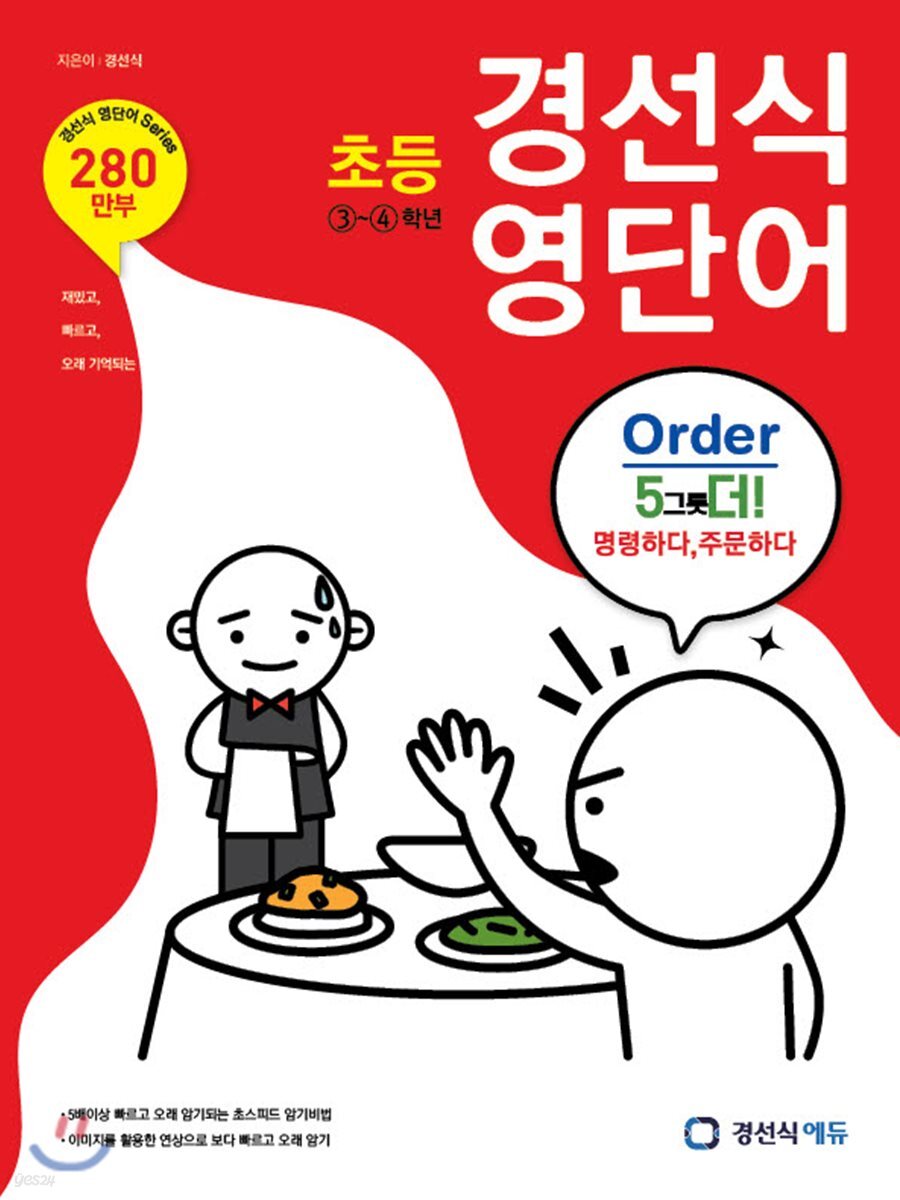
English Vocabulary for Elementary School Grades 3-4
 |
Description
Book Introduction
『Kyungseonsik English Vocabulary Elementary Grades 3-4』 is an English vocabulary book that combines essential elementary school vocabulary and basic middle school vocabulary with fun cartoons. For elementary school students who easily get tired of memorizing words, we have included almost all cartoons that correspond to the association method for each word to make memorization fun, and the association method that is connected when you pronounce it correctly is also easy and intuitively structured to naturally stimulate interest in English words and help you memorize English words more easily and quickly. It also helps you memorize 5 to 10 times faster with the hippocampus learning method. The 'hippocampus learning method' is a scientific associative memory learning method that utilizes the hippocampus in the brain, which plays a central role in memory function, to express and visualize the object to be remembered through association, allowing for faster and longer memorization. This hippocampus learning method is already recognized as the most effective vocabulary memorization method in many countries where English is chosen as a second foreign language. This book, consisting of two volumes, is one of the best-selling “Kyungseonsik English Vocabulary Super-Speed Memorization Secrets” series by teacher Kyungseonsik, chosen by over 3.3 million people. We have made it possible to naturally learn essential elementary school vocabulary and basic middle school vocabulary through cartoon images, associations, pronunciation symbols, and writing practice using the hippocampus learning method. |
- You can preview some of the book's contents.
Preview
index
FIRST STEP [Elementary (Essential) Vocabulary for 3rd-4th Graders]
01 ~ 18
01 ~ 18 Full Review
SECOND STEP [Elementary (Essential) Vocabulary for 3rd-4th Graders]
19 ~36
19-36 Full Review
supplement
INDEX
01 ~ 18
01 ~ 18 Full Review
SECOND STEP [Elementary (Essential) Vocabulary for 3rd-4th Graders]
19 ~36
19-36 Full Review
supplement
INDEX
Detailed image

Publisher's Review
There is a part of our brain called the hippocampus.
This hippocampus is where we focus our efforts when we make memories.
When we memorize English words by reading or writing them without thinking, the hippocampus is hardly activated. However, experiments have clearly proven that when we memorize by imagining a situation and drawing a picture in our heads, the hippocampus becomes more active.
If you imagine and memorize a scene like this, you will be able to remember it for a much longer period of time than if you just memorize it blindly.
Ultimately, the hippocampus learning method is an effective learning method that maximizes the memorization effect by making it easy to associate difficult-to-memorize content with images.
- What is the hippocampus learning method?
There is a part of our brain called the hippocampus.
It is named after its similar shape to a sea animal, the hippocampus, and this hippocampus is the area that is intensively used when we remember things.
However, when we memorize English words by reading or writing them without thinking, this hippocampus part is hardly activated.
On the other hand, it has been clearly experimentally proven that when you imagine a situation and memorize it by drawing a picture in your head, the hippocampus becomes more active.
If you imagine and memorize a scene like this, you will be able to remember it for a much longer period of time than if you just memorize it blindly.
Ultimately, the hippocampus learning method is an effective learning method that maximizes the memorization effect by making it easy to associate difficult-to-memorize content with images.
- Example of application of hippocampus learning method
To apply the hippocampus learning method to memorizing words, you need to create an appropriate image for each word.
For example, in order to memorize 'fruit (fruit-t: fruit)', you need to connect the word 'fruit' and its meaning with a video image, but the pronunciation 'fruit-t' can be recognized as a Korean word with a similar pronunciation, such as 'purut'.
That is, while pronouncing 'fruit' correctly, imagine the image of a green 'fruit' and remember it as a picture.
If you pronounce a word like this and bring to mind a visual image related to the meaning of the word, you will easily memorize the meaning and remember it for a long time.
- The memory strategy introduced in the K-broadcasting series 'How to Study Well' is the hippocampus learning method.
In the 'How to Study Well' series on K Broadcasting, the effectiveness of memory using association methods was measured and introduced.
Among a total of 100 subjects, 10 people whose memorization ability was ranked between 90th and 100th were trained to memorize using the association method. As a result, their memorization ability rankings improved significantly to 37th, 32nd, and 13th.
The association method increases brain utilization by equally utilizing the left brain, which remembers words and numbers, and the right brain, which remembers images.
Many experts agree that this hippocampal learning method is very effective in improving memory.
- How to get 200% out of this book
1.
You can see maximum results by understanding and learning the principles of the hippocampus learning method.
2.
After you have a good understanding of the principles of the hippocampus learning method, studying on your own with a book will be very effective, but if you use online lectures, you can learn by following the teacher's precise and clear pronunciation right away, and you can memorize faster and more effectively through the teacher's vivid facial expressions and conveyed feelings.
3.
Rather than just reading and understanding the explanation of the association method and moving on, stimulate the hippocampus by strongly embracing the situation and feeling related to the meaning, and practice pronouncing it so that you can think of the meaning at the same time.
4.
After listening to each lecture or learning from a book, review it immediately.
5.
When reviewing, it is more effective to repeat a word quickly several times rather than spending a lot of time on one word.
6.
When utilizing the lecture, actively imitate not only the teacher's pronunciation but also his actions and facial expressions, and memorize them by strongly absorbing the feeling.
7.
Rather than rushing to cover a lot of material, it is better to study by thoroughly reviewing each lecture even if the progress is slow.
8.
One day a week, I make sure to review the vocabulary I memorized that week.
9.
Even after you've studied all the way through, review it again and again from the beginning until you've completely memorized every word in the book.
(It is effective to use a portable memory pad at this time.)
Provides video lectures directly from the author
If you watch the video lecture, you will memorize it almost 100% on the spot and the effect will increase by more than 5 times.
Check out free sample lectures directly at www.kssedu.com.
* [Native Speaker Pronunciation] Free MP3 file download (kssedu.com)
This hippocampus is where we focus our efforts when we make memories.
When we memorize English words by reading or writing them without thinking, the hippocampus is hardly activated. However, experiments have clearly proven that when we memorize by imagining a situation and drawing a picture in our heads, the hippocampus becomes more active.
If you imagine and memorize a scene like this, you will be able to remember it for a much longer period of time than if you just memorize it blindly.
Ultimately, the hippocampus learning method is an effective learning method that maximizes the memorization effect by making it easy to associate difficult-to-memorize content with images.
- What is the hippocampus learning method?
There is a part of our brain called the hippocampus.
It is named after its similar shape to a sea animal, the hippocampus, and this hippocampus is the area that is intensively used when we remember things.
However, when we memorize English words by reading or writing them without thinking, this hippocampus part is hardly activated.
On the other hand, it has been clearly experimentally proven that when you imagine a situation and memorize it by drawing a picture in your head, the hippocampus becomes more active.
If you imagine and memorize a scene like this, you will be able to remember it for a much longer period of time than if you just memorize it blindly.
Ultimately, the hippocampus learning method is an effective learning method that maximizes the memorization effect by making it easy to associate difficult-to-memorize content with images.
- Example of application of hippocampus learning method
To apply the hippocampus learning method to memorizing words, you need to create an appropriate image for each word.
For example, in order to memorize 'fruit (fruit-t: fruit)', you need to connect the word 'fruit' and its meaning with a video image, but the pronunciation 'fruit-t' can be recognized as a Korean word with a similar pronunciation, such as 'purut'.
That is, while pronouncing 'fruit' correctly, imagine the image of a green 'fruit' and remember it as a picture.
If you pronounce a word like this and bring to mind a visual image related to the meaning of the word, you will easily memorize the meaning and remember it for a long time.
- The memory strategy introduced in the K-broadcasting series 'How to Study Well' is the hippocampus learning method.
In the 'How to Study Well' series on K Broadcasting, the effectiveness of memory using association methods was measured and introduced.
Among a total of 100 subjects, 10 people whose memorization ability was ranked between 90th and 100th were trained to memorize using the association method. As a result, their memorization ability rankings improved significantly to 37th, 32nd, and 13th.
The association method increases brain utilization by equally utilizing the left brain, which remembers words and numbers, and the right brain, which remembers images.
Many experts agree that this hippocampal learning method is very effective in improving memory.
- How to get 200% out of this book
1.
You can see maximum results by understanding and learning the principles of the hippocampus learning method.
2.
After you have a good understanding of the principles of the hippocampus learning method, studying on your own with a book will be very effective, but if you use online lectures, you can learn by following the teacher's precise and clear pronunciation right away, and you can memorize faster and more effectively through the teacher's vivid facial expressions and conveyed feelings.
3.
Rather than just reading and understanding the explanation of the association method and moving on, stimulate the hippocampus by strongly embracing the situation and feeling related to the meaning, and practice pronouncing it so that you can think of the meaning at the same time.
4.
After listening to each lecture or learning from a book, review it immediately.
5.
When reviewing, it is more effective to repeat a word quickly several times rather than spending a lot of time on one word.
6.
When utilizing the lecture, actively imitate not only the teacher's pronunciation but also his actions and facial expressions, and memorize them by strongly absorbing the feeling.
7.
Rather than rushing to cover a lot of material, it is better to study by thoroughly reviewing each lecture even if the progress is slow.
8.
One day a week, I make sure to review the vocabulary I memorized that week.
9.
Even after you've studied all the way through, review it again and again from the beginning until you've completely memorized every word in the book.
(It is effective to use a portable memory pad at this time.)
Provides video lectures directly from the author
If you watch the video lecture, you will memorize it almost 100% on the spot and the effect will increase by more than 5 times.
Check out free sample lectures directly at www.kssedu.com.
* [Native Speaker Pronunciation] Free MP3 file download (kssedu.com)
GOODS SPECIFICS
- Date of issue: February 1, 2019
- Page count, weight, size: 320 pages | 790g | 210*280*30mm
- ISBN13: 9791195495092
- ISBN10: 1195495099
- KC Certification: Certification Type: Conformity Confirmation
You may also like
카테고리
korean


korean

![GQ KOREA Mark (Monthly): December [2025]](http://librairie.coreenne.fr/cdn/shop/files/8ef265dbbfbf186523ed75ba7319009d.jpg?v=1765340328&width=3840)


