

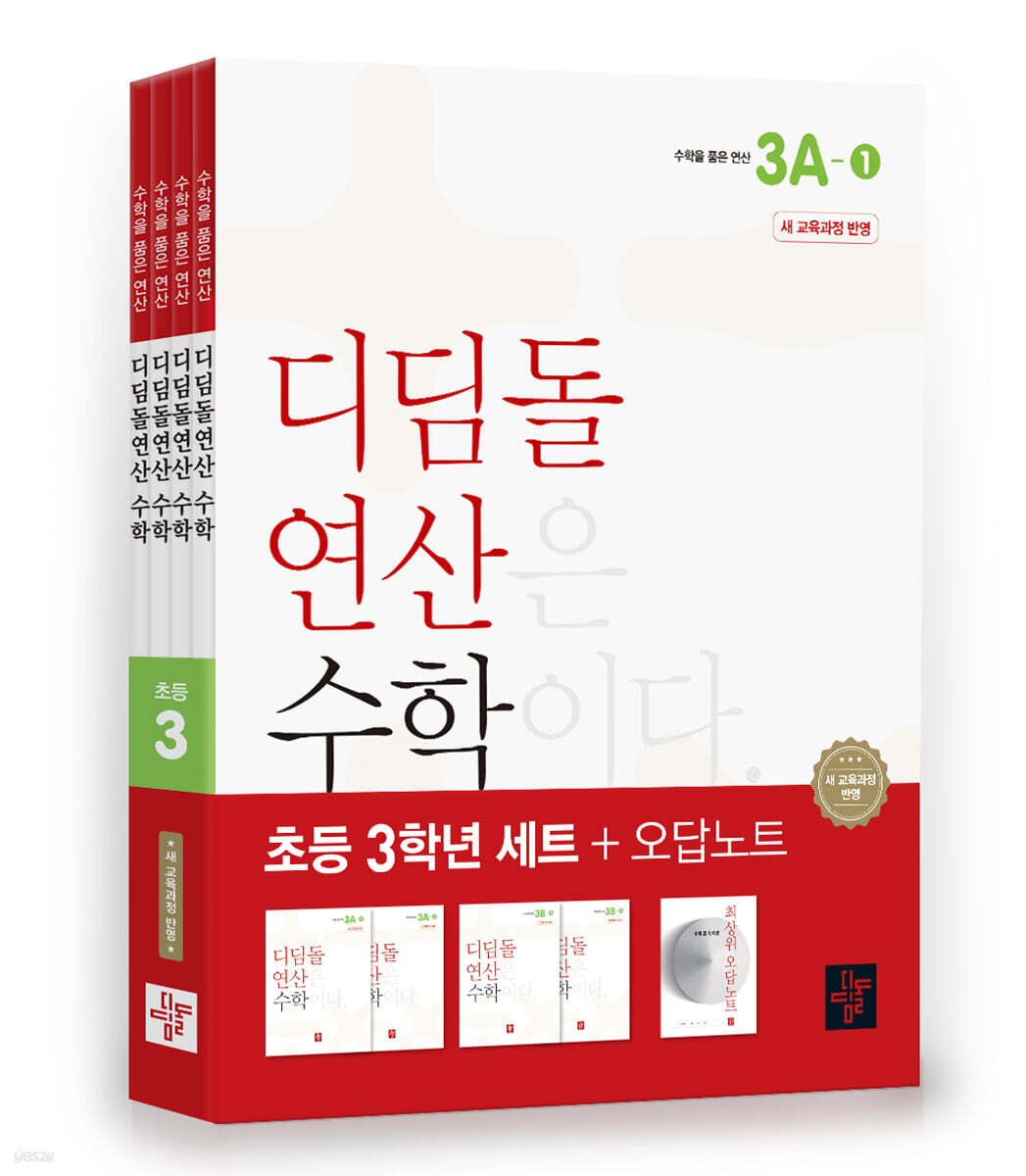
Elementary Stepping Stone Operations 3rd Grade Set
 |
Description
Book Introduction
This textbook was published to reflect the 22nd revised curriculum that will be newly revised starting in 2024.
Solving 10 problems in your head is more effective in building your math skills than solving 100 problems by hand.
Learning only calculation methods can develop 'calculation skills' but does not lead to 'mathematical skills'.
Just as calculations have principles and methods, each calculation has its own properties and there are relationships between calculations.
Additionally, children should be able to use calculations and develop number sense through calculations.
In this way, problems that allow for considering a single operation from various angles, rather than just a cross-sectional calculation, were designed based on mathematical design grounds to enable three-dimensional calculation training.
Solving 10 problems in your head is more effective in building your math skills than solving 100 problems by hand.
Learning only calculation methods can develop 'calculation skills' but does not lead to 'mathematical skills'.
Just as calculations have principles and methods, each calculation has its own properties and there are relationships between calculations.
Additionally, children should be able to use calculations and develop number sense through calculations.
In this way, problems that allow for considering a single operation from various angles, rather than just a cross-sectional calculation, were designed based on mathematical design grounds to enable three-dimensional calculation training.
index
3A-1
1.
(three-digit number)+(three-digit number) without carry
2.
(three-digit number) + (three-digit number) with one carry
3.
(three-digit number)+(three-digit number) with two carry-overs
4.
The relationship between addition and subtraction
5.
(three-digit number)-(three-digit number) without borrowing
6.
(three-digit number)-(three-digit number) with one rounding down
7.
(three-digit number)-(three-digit number) with two rounds
3A-2
1.
Basics of Division
2.
Division within multiplication tables without remainder
3.
(two-digit number) × (one-digit number) without carry
4.
(two-digit number) × (one-digit number) with one carry
5.
(two-digit number) × (one-digit number) with two carry-overs
3B-1
1.
(three-digit number) × (one-digit number) without carry
2.
(three-digit number) × (one-digit number) with one carry
3.
(three-digit number) × (one-digit number) with two rounds
4.
(two-digit number) × (two-digit number)
5.
Division with remainder
6.
(tens)÷(how many), (hundreds and tens)÷(how many)
3B-2
1.
(two-digit number) without descent ÷ (one-digit number)
2.
(two-digit number) ÷ (one-digit number) with rounding down
3.
(two-digit number)÷(one-digit number) with remainder
4.
(three-digit number) without remainder ÷ (one-digit number)
5.
(three-digit number)÷(one-digit number) with remainder
6.
fountain
1.
(three-digit number)+(three-digit number) without carry
2.
(three-digit number) + (three-digit number) with one carry
3.
(three-digit number)+(three-digit number) with two carry-overs
4.
The relationship between addition and subtraction
5.
(three-digit number)-(three-digit number) without borrowing
6.
(three-digit number)-(three-digit number) with one rounding down
7.
(three-digit number)-(three-digit number) with two rounds
3A-2
1.
Basics of Division
2.
Division within multiplication tables without remainder
3.
(two-digit number) × (one-digit number) without carry
4.
(two-digit number) × (one-digit number) with one carry
5.
(two-digit number) × (one-digit number) with two carry-overs
3B-1
1.
(three-digit number) × (one-digit number) without carry
2.
(three-digit number) × (one-digit number) with one carry
3.
(three-digit number) × (one-digit number) with two rounds
4.
(two-digit number) × (two-digit number)
5.
Division with remainder
6.
(tens)÷(how many), (hundreds and tens)÷(how many)
3B-2
1.
(two-digit number) without descent ÷ (one-digit number)
2.
(two-digit number) ÷ (one-digit number) with rounding down
3.
(two-digit number)÷(one-digit number) with remainder
4.
(three-digit number) without remainder ÷ (one-digit number)
5.
(three-digit number)÷(one-digit number) with remainder
6.
fountain
Publisher's Review
1.
Solving 10 problems in your head is more effective in building your math skills than solving 100 problems by hand.
Learning only calculation methods can develop 'calculation skills' but does not lead to 'mathematical skills'.
Just as calculations have principles and methods, each calculation has its own properties and there are relationships between calculations.
Additionally, children should be able to use calculations and develop number sense through calculations.
In this way, problems that allow for considering a single operation from various angles, rather than just a cross-sectional calculation, are designed based on mathematical design grounds to enable three-dimensional calculation training.
2.
You can master elementary, middle, and high school math by doing math operations, not just arithmetic operations.
Since mathematics is a subject that is connected to elementary, middle, and high school, concept formation in elementary school affects learning in middle and high school.
Concepts learned in elementary school can be easily taken lightly, but they are connected to important concepts in middle and high school, so learning operations that can grasp their mathematical meaning is essential.
Additionally, we must be able to provide the students with an experience of the mathematical rules they learn in middle and high school from an elementary school level, so that they can focus on their overall mathematical learning.
3.
Math concepts remain only after you think, solve, and feel them.
Calculating from beginning to end is not only boring for children, but also causes them to miss the mathematical meaning behind the calculations.
We have created a three-dimensional learning structure so that calculation training can lead to understanding of mathematical concepts by allowing students to understand the mathematical principles behind them and the corresponding calculation methods.
Additionally, the importance of the mathematical concepts contained in the problems and how they are related to secondary school learning are separately organized and included in the answer key.
Solving 10 problems in your head is more effective in building your math skills than solving 100 problems by hand.
Learning only calculation methods can develop 'calculation skills' but does not lead to 'mathematical skills'.
Just as calculations have principles and methods, each calculation has its own properties and there are relationships between calculations.
Additionally, children should be able to use calculations and develop number sense through calculations.
In this way, problems that allow for considering a single operation from various angles, rather than just a cross-sectional calculation, are designed based on mathematical design grounds to enable three-dimensional calculation training.
2.
You can master elementary, middle, and high school math by doing math operations, not just arithmetic operations.
Since mathematics is a subject that is connected to elementary, middle, and high school, concept formation in elementary school affects learning in middle and high school.
Concepts learned in elementary school can be easily taken lightly, but they are connected to important concepts in middle and high school, so learning operations that can grasp their mathematical meaning is essential.
Additionally, we must be able to provide the students with an experience of the mathematical rules they learn in middle and high school from an elementary school level, so that they can focus on their overall mathematical learning.
3.
Math concepts remain only after you think, solve, and feel them.
Calculating from beginning to end is not only boring for children, but also causes them to miss the mathematical meaning behind the calculations.
We have created a three-dimensional learning structure so that calculation training can lead to understanding of mathematical concepts by allowing students to understand the mathematical principles behind them and the corresponding calculation methods.
Additionally, the importance of the mathematical concepts contained in the problems and how they are related to secondary school learning are separately organized and included in the answer key.
GOODS SPECIFICS
- Date of issue: June 10, 2024
- Page count, weight, size: Checking page count | 220*300*20mm
- ISBN13: 9788926164822
- ISBN10: 8926164829
- Reference book for grades: 3rd grade elementary school
- Reference book difficulty: Medium Reference book difficulty guide
You may also like
카테고리
korean


korean

![GQ KOREA Mark (Monthly): December [2025]](http://librairie.coreenne.fr/cdn/shop/files/8ef265dbbfbf186523ed75ba7319009d.jpg?v=1765340328&width=3840)


