

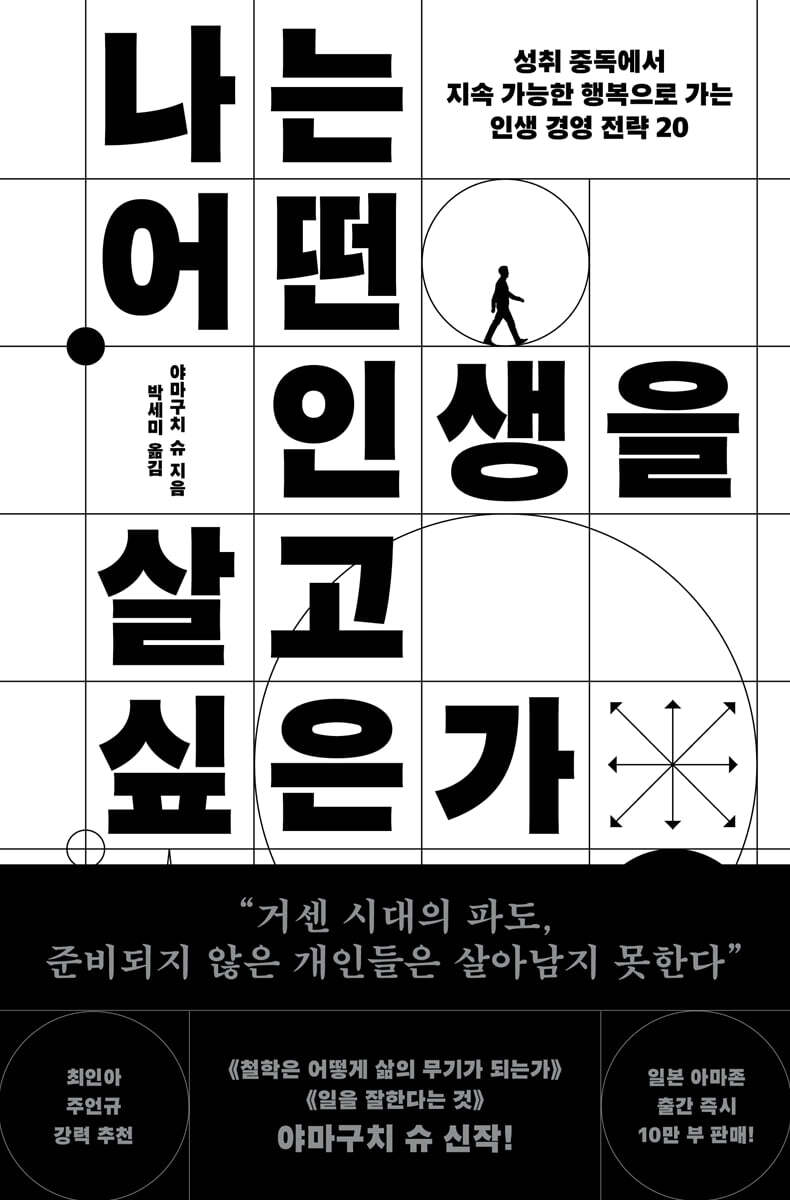
What kind of life do I want to live?
 |
Description
Book Introduction
“The rough waves of the times,
“Unprepared individuals do not survive.”
Recommended by Choi In-ah and Joo Eon-gyu! ★ 100,000 copies sold immediately after release on Amazon Japan! ★
★《How Philosophy Becomes a Weapon for Life》 and 《Doing Good Work》 - New Works by Shu Yamaguchi!★
Shu Yamaguchi, author of "How Philosophy Becomes a Weapon for Life," explains various concepts and theories of management and presents 20 ways to apply them to life and live independently and authentically.
Shu Yamaguchi is a self-help writer who combines business, philosophy, and art to provide insights that emphasize a more fundamental mindset than traditional growth methods (building up specs, honing skills, etc.).
In other words, we have always talked about growth centered on meaning, and this book in particular helps people who are currently stuck in a growth slump, to look at the long maze called life from above and find new ways of thinking and life strategies.
“Unprepared individuals do not survive.”
Recommended by Choi In-ah and Joo Eon-gyu! ★ 100,000 copies sold immediately after release on Amazon Japan! ★
★《How Philosophy Becomes a Weapon for Life》 and 《Doing Good Work》 - New Works by Shu Yamaguchi!★
Shu Yamaguchi, author of "How Philosophy Becomes a Weapon for Life," explains various concepts and theories of management and presents 20 ways to apply them to life and live independently and authentically.
Shu Yamaguchi is a self-help writer who combines business, philosophy, and art to provide insights that emphasize a more fundamental mindset than traditional growth methods (building up specs, honing skills, etc.).
In other words, we have always talked about growth centered on meaning, and this book in particular helps people who are currently stuck in a growth slump, to look at the long maze called life from above and find new ways of thinking and life strategies.
- You can preview some of the book's contents.
Preview
index
Preface to the Korean edition_ To the Korean readers
Entering_ Life doesn't always go as planned, but I try my best.
Chapter 0: Why Do We Need Management Strategy in Life?
Problem Awareness ① The Rough Waves of the Times
Mental decline and loss of self in a transitional society l An era where one's position determines one's life l A social structure presupposing high growth l A world where it is difficult to rely solely on fate
Problem Awareness ② Unprepared Individuals
The idea that "something will work out" l Social change begins with individual change.
Problem Awareness ③ Polarizing theories of life and career
Neither is the right answer l The path to innovation that breaks contradictions l Be wise as a snake, be kind as a dove
Chapter 1: Setting Goals for the Project Called "Life"
01 Understanding the Basic Principles of Life - Purpose
The right strategy starts with the right goal l The game of changing time capital into other capital l Social capital increases with human capital l Social capital creates financial capital l Two types of capital l Money and success are not everything l The equation of quality of life and three types of capital l How to avoid having your life stolen by time thieves
Chapter 2: Making Long-Term Plans to Avoid "Just Going With the Flow"
02 Project logic over a very long period of time - life cycle curve
Life has four seasons l It's never too early or too late l Lesson ① Rational behavior changes with each season l Lesson ② Roles and ways of contributing at each stage of life l Is the peak of intellectual productivity in your 40s? l
In the latter half of life, we utilize another intelligence l Lesson ③ The importance of long-term rationality l The pitfalls of short-term rationality l The diverging lives of two pianists
03 Read the signs and move faster than others - Chasm
The landscape changes when it exceeds 20% l Companies that enter the market before the chasm l Growth markets explode in an instant l You can't win if you're not premature l Too early, too late is a problem l Differential lenses for reading social change l Signs that key talent recognizes first
04 How to Turn Unexpected Events into Opportunities - Adaptation Strategies
Plan, execute, and modify l Be flexible, sometimes boldly l My adaptation strategy
Chapter 3: How to Make Better Choices
Finding Your Place with the 5-Force Model - Positioning Part 1
The real reason why broadcasting companies have high salaries l The standard for measuring the attractiveness of a location l The flow of change that the broadcasting industry has experienced l Decision-making is not a matter of courage or ambition l This story applies equally to individuals l The value of talent is determined by supply and demand l The trap of trendy qualifications or degrees l The threat of substitutes brought about by technological advancements l Three strategies for surviving in the AI era
06 Finding a Place to Stay While Keeping Moving - Positioning Part 2
The primal question of 'Where are you?' l Let's change location rather than ability l The era of nationwide competition created by remote work l The function of location and performance l From regional centers to national niche markets l Beware of a life of complacency l The reason I boldly left a successful consulting firm
07 Why You Should Pay Attention to Companies Creating Social Benefits - CSV Competitive Strategy
Porter's Confusing Thesis | Social Value Comes First | Organizational Culture Determines Performance | Vision Changes Organizational Culture | Where Does True Motivation Come From? | We Choose Affiliations Based on Social Values | Individual Movements Move Society
08 He who works hard cannot beat him who enjoys it - Self-motivation
Consistency Wins Over Talent l Japanese Society Obsesses Over Innate Talent l Those Who Enjoy Can't Win l
How much you enjoy something determines your success l When rewards become poison
09 Focus on the characteristics that others cannot imitate - Resource-based perspective
Equip yourself with resources and capabilities that are hard to come by. l A fatal weakness can become a strength. l The dangerous question of strength. l Find the answer in what you've been doing for a long time.
10 My Own Combination of Different Things - Initiative Portfolio
Advantages of a portfolio l Try things with different risks and returns l Einstein, a representative example of the barbell strategy l Include differences in time axes l Balance between rice work and life work l How to run social enterprises and for-profit businesses together l Be careful about diversifying strategic resources l Why I started a blog
Chapter 4: Decision-Making Skills That Apply to Me
11. Create Your Own Combination - Blue Ocean Strategy
You don't have to be number one in your industry | Unique combinations are important | The more intersections there are, the more diverse the world becomes | The clues to combinations lie in the past
12. Number of plate appearances is more important than batting average - Creativity theory
You didn't make a lot because you succeeded, but you succeeded because you made a lot l The basis of strategy is a lot of useless attempts l How to apply various results to life l The cost-effectiveness of success and failure is asymmetrical l It's more important to stand at the plate than to batting average l It's surprisingly difficult to keep failing
13. Make a choice that is advantageous no matter which way you go - the strategy of absolute advantage.
Choosing the 1983 America's Cup Champion Yacht l What is an Absolute Advantage Strategy in a Race l Converse Betting is Effective Early in Life l Performance Doesn't Guarantee Victory
14 Time Allocation Methods Considering Future Value - Net Present Value
It's dangerous to focus solely on immediate value. l Consider the time it takes to achieve results. l Don't waste time on trendy technologies and knowledge. l The most enduring competitive edge comes from a liberal arts education.
15 Always have multiple options at hand - The value of choice
Using the concept of options in everyday life l Applying the mindset of option value to real-world decision-making l The more successful a person is, the more he or she secures option value l In an era where cowards have a competitive advantage l How to utilize options in life management
Chapter 5: Learning and Growth
16 Write down and score important things yourself - Balanced Score Card (BSC)
Evaluation criteria include both short-term and long-term l Apply BSC to life l Set your own standards l
The sin of deviating from the goal l An elite who follows others' standards l Setting standards based on my own answers
17. If you hit a dead end, try it first - Benchmarking
Benchmarking comes from humility l Benchmarking is possible even in different fields l The first step to learning is imitation l Creativity and imitation are only a sheet of paper apart l Three ways to practice benchmarking in life
18 How to Turn Failure into an Asset - Experiential Learning Theory
Experience is a good failure l If everything goes smoothly, it is a sign of danger l An organization's experience is a management resource l It creates opportunities for itself and changes itself to suit opportunities
19 The more you expose your weaknesses, the stronger you become - Development-oriented organizations
The true meaning of being in the right place at the right time l Think of weaknesses as resources l Turn everyday tasks into training l Break out of the comfort zone l Even seemingly trivial tasks can be surprisingly valuable
20. Servant Leadership: Making the Joy of Sharing and Helping Your Life Energy
Support instead of domination l Limitations of dominating leadership l How to overcome the transition period l Let go of the values you pursued in the summer of life l The intelligence that shines as you age l Fluid intelligence and crystallized intelligence l The relationship between servant leadership and crystallized intelligence l Jumping over the waves of two intelligences l The real fun starts now
In closing, to hackers in capitalist society:
Appendix: List of Books for Self-Study in Business Administration
Entering_ Life doesn't always go as planned, but I try my best.
Chapter 0: Why Do We Need Management Strategy in Life?
Problem Awareness ① The Rough Waves of the Times
Mental decline and loss of self in a transitional society l An era where one's position determines one's life l A social structure presupposing high growth l A world where it is difficult to rely solely on fate
Problem Awareness ② Unprepared Individuals
The idea that "something will work out" l Social change begins with individual change.
Problem Awareness ③ Polarizing theories of life and career
Neither is the right answer l The path to innovation that breaks contradictions l Be wise as a snake, be kind as a dove
Chapter 1: Setting Goals for the Project Called "Life"
01 Understanding the Basic Principles of Life - Purpose
The right strategy starts with the right goal l The game of changing time capital into other capital l Social capital increases with human capital l Social capital creates financial capital l Two types of capital l Money and success are not everything l The equation of quality of life and three types of capital l How to avoid having your life stolen by time thieves
Chapter 2: Making Long-Term Plans to Avoid "Just Going With the Flow"
02 Project logic over a very long period of time - life cycle curve
Life has four seasons l It's never too early or too late l Lesson ① Rational behavior changes with each season l Lesson ② Roles and ways of contributing at each stage of life l Is the peak of intellectual productivity in your 40s? l
In the latter half of life, we utilize another intelligence l Lesson ③ The importance of long-term rationality l The pitfalls of short-term rationality l The diverging lives of two pianists
03 Read the signs and move faster than others - Chasm
The landscape changes when it exceeds 20% l Companies that enter the market before the chasm l Growth markets explode in an instant l You can't win if you're not premature l Too early, too late is a problem l Differential lenses for reading social change l Signs that key talent recognizes first
04 How to Turn Unexpected Events into Opportunities - Adaptation Strategies
Plan, execute, and modify l Be flexible, sometimes boldly l My adaptation strategy
Chapter 3: How to Make Better Choices
Finding Your Place with the 5-Force Model - Positioning Part 1
The real reason why broadcasting companies have high salaries l The standard for measuring the attractiveness of a location l The flow of change that the broadcasting industry has experienced l Decision-making is not a matter of courage or ambition l This story applies equally to individuals l The value of talent is determined by supply and demand l The trap of trendy qualifications or degrees l The threat of substitutes brought about by technological advancements l Three strategies for surviving in the AI era
06 Finding a Place to Stay While Keeping Moving - Positioning Part 2
The primal question of 'Where are you?' l Let's change location rather than ability l The era of nationwide competition created by remote work l The function of location and performance l From regional centers to national niche markets l Beware of a life of complacency l The reason I boldly left a successful consulting firm
07 Why You Should Pay Attention to Companies Creating Social Benefits - CSV Competitive Strategy
Porter's Confusing Thesis | Social Value Comes First | Organizational Culture Determines Performance | Vision Changes Organizational Culture | Where Does True Motivation Come From? | We Choose Affiliations Based on Social Values | Individual Movements Move Society
08 He who works hard cannot beat him who enjoys it - Self-motivation
Consistency Wins Over Talent l Japanese Society Obsesses Over Innate Talent l Those Who Enjoy Can't Win l
How much you enjoy something determines your success l When rewards become poison
09 Focus on the characteristics that others cannot imitate - Resource-based perspective
Equip yourself with resources and capabilities that are hard to come by. l A fatal weakness can become a strength. l The dangerous question of strength. l Find the answer in what you've been doing for a long time.
10 My Own Combination of Different Things - Initiative Portfolio
Advantages of a portfolio l Try things with different risks and returns l Einstein, a representative example of the barbell strategy l Include differences in time axes l Balance between rice work and life work l How to run social enterprises and for-profit businesses together l Be careful about diversifying strategic resources l Why I started a blog
Chapter 4: Decision-Making Skills That Apply to Me
11. Create Your Own Combination - Blue Ocean Strategy
You don't have to be number one in your industry | Unique combinations are important | The more intersections there are, the more diverse the world becomes | The clues to combinations lie in the past
12. Number of plate appearances is more important than batting average - Creativity theory
You didn't make a lot because you succeeded, but you succeeded because you made a lot l The basis of strategy is a lot of useless attempts l How to apply various results to life l The cost-effectiveness of success and failure is asymmetrical l It's more important to stand at the plate than to batting average l It's surprisingly difficult to keep failing
13. Make a choice that is advantageous no matter which way you go - the strategy of absolute advantage.
Choosing the 1983 America's Cup Champion Yacht l What is an Absolute Advantage Strategy in a Race l Converse Betting is Effective Early in Life l Performance Doesn't Guarantee Victory
14 Time Allocation Methods Considering Future Value - Net Present Value
It's dangerous to focus solely on immediate value. l Consider the time it takes to achieve results. l Don't waste time on trendy technologies and knowledge. l The most enduring competitive edge comes from a liberal arts education.
15 Always have multiple options at hand - The value of choice
Using the concept of options in everyday life l Applying the mindset of option value to real-world decision-making l The more successful a person is, the more he or she secures option value l In an era where cowards have a competitive advantage l How to utilize options in life management
Chapter 5: Learning and Growth
16 Write down and score important things yourself - Balanced Score Card (BSC)
Evaluation criteria include both short-term and long-term l Apply BSC to life l Set your own standards l
The sin of deviating from the goal l An elite who follows others' standards l Setting standards based on my own answers
17. If you hit a dead end, try it first - Benchmarking
Benchmarking comes from humility l Benchmarking is possible even in different fields l The first step to learning is imitation l Creativity and imitation are only a sheet of paper apart l Three ways to practice benchmarking in life
18 How to Turn Failure into an Asset - Experiential Learning Theory
Experience is a good failure l If everything goes smoothly, it is a sign of danger l An organization's experience is a management resource l It creates opportunities for itself and changes itself to suit opportunities
19 The more you expose your weaknesses, the stronger you become - Development-oriented organizations
The true meaning of being in the right place at the right time l Think of weaknesses as resources l Turn everyday tasks into training l Break out of the comfort zone l Even seemingly trivial tasks can be surprisingly valuable
20. Servant Leadership: Making the Joy of Sharing and Helping Your Life Energy
Support instead of domination l Limitations of dominating leadership l How to overcome the transition period l Let go of the values you pursued in the summer of life l The intelligence that shines as you age l Fluid intelligence and crystallized intelligence l The relationship between servant leadership and crystallized intelligence l Jumping over the waves of two intelligences l The real fun starts now
In closing, to hackers in capitalist society:
Appendix: List of Books for Self-Study in Business Administration
Detailed image

Into the book
Systems often reveal their vulnerabilities when they are in transition, that is, when they change to another system, and this is true of societies as well.
Émile Durkheim, considered a pioneer of French sociology, pointed out that in a transitional society where an old social system is moving to the next stage, if existing rules and institutions cannot keep up with social changes, norms will collapse and anomie will occur.
People are left hanging in the air when they know that old institutions and rules are no longer useful, but cannot figure out new ones to replace them.
Individuals and organizations in disarray are prone to desperately clinging to old rules and common sense, or to hastily resorting to flimsy theories.
Durkheim warned that in such societies, morals become desolate, people become spiritually regressive, and ultimately, they lose their sense of self.
--- From "Why Do We Need Management Strategies in Life Now?"
We are the sole stewards and leaders of the project called life.
Be honest with yourself, speak up even if it seems selfish at times, and walk away if necessary.
These are the choices that will drive organizations and society in a better direction.
In Japanese society today, whenever something happens, the government or companies are blamed for the problem.
But we must not forget that the most important cause of social decline is the loss of individual vitality.
The essence of the crisis we face today lies in the fact that we have lost the power to think and decide for ourselves.
To borrow Toynbee's expression, today's reality is that we have fallen into the trap of 'the emptiness within ourselves.'
--- From "Why do we need a management strategy in life now?"
In 1974, American economist Richard Easterlin announced the 'Easterlin's Paradox', which states that happiness no longer increases after income exceeds a certain level.
Subsequent studies have supported this, showing that factors like money, status, and fame have no direct correlation with a good life beyond a certain level.
This book acknowledges these elements as basic conditions for a happy life, but never regards them as the ultimate goal of life.
Note in particular that the goal here is stipulated to be 'sustainable'.
This means rejecting the idea that 'you only need to live a happy life right before you die.'
The reason is simple.
Because we don't know when death will come.
That's why it's important to keep the goal as 'always' rather than 'someday' to maintain a sustainable state.
--- From "Setting Goals for the Project Called 'Life'"
Representative examples include Paul Gauguin, who worked in the financial industry and then became a painter in his forties, and Albert Schweitzer, who began his life as a priest and organist and then achieved great things as a doctor after turning forty.
In the era they lived in, most people did not live past the age of 60, but today, with life expectancy significantly increased, it is quite possible to start the spring of life again after passing a certain age, a so-called "life second act."
Ultimately, the relationship between each stage and age presented in the life cycle curve is for reference only.
There is no need to force yourself into this mold, nor is there any need to think that it is too soon or too late.
Life strategies can always be flexibly adjusted according to individual choices and timing, and the most important thing is to move at your own pace and at your own time.
--- From "Making Long-Term Plans to Avoid 'Just Going With the Flow'"
To solve a problem, you must first define it, and the quality of the questions you ask is crucial. Whether you can transform the countless correct answers AI generates into true value depends on this.
So how can we improve our problem-posing skills?
There are many ways, but the only way I can think of is through liberal arts.
Liberal arts are the skills to think freely.
It is also the power to ask, "Is it really right?", "Is it really beautiful?" about the absurdities of reality that people have accepted without question, believing them to be common sense, and to imagine a better version of things that are different from the existing ones.
Émile Durkheim, considered a pioneer of French sociology, pointed out that in a transitional society where an old social system is moving to the next stage, if existing rules and institutions cannot keep up with social changes, norms will collapse and anomie will occur.
People are left hanging in the air when they know that old institutions and rules are no longer useful, but cannot figure out new ones to replace them.
Individuals and organizations in disarray are prone to desperately clinging to old rules and common sense, or to hastily resorting to flimsy theories.
Durkheim warned that in such societies, morals become desolate, people become spiritually regressive, and ultimately, they lose their sense of self.
--- From "Why Do We Need Management Strategies in Life Now?"
We are the sole stewards and leaders of the project called life.
Be honest with yourself, speak up even if it seems selfish at times, and walk away if necessary.
These are the choices that will drive organizations and society in a better direction.
In Japanese society today, whenever something happens, the government or companies are blamed for the problem.
But we must not forget that the most important cause of social decline is the loss of individual vitality.
The essence of the crisis we face today lies in the fact that we have lost the power to think and decide for ourselves.
To borrow Toynbee's expression, today's reality is that we have fallen into the trap of 'the emptiness within ourselves.'
--- From "Why do we need a management strategy in life now?"
In 1974, American economist Richard Easterlin announced the 'Easterlin's Paradox', which states that happiness no longer increases after income exceeds a certain level.
Subsequent studies have supported this, showing that factors like money, status, and fame have no direct correlation with a good life beyond a certain level.
This book acknowledges these elements as basic conditions for a happy life, but never regards them as the ultimate goal of life.
Note in particular that the goal here is stipulated to be 'sustainable'.
This means rejecting the idea that 'you only need to live a happy life right before you die.'
The reason is simple.
Because we don't know when death will come.
That's why it's important to keep the goal as 'always' rather than 'someday' to maintain a sustainable state.
--- From "Setting Goals for the Project Called 'Life'"
Representative examples include Paul Gauguin, who worked in the financial industry and then became a painter in his forties, and Albert Schweitzer, who began his life as a priest and organist and then achieved great things as a doctor after turning forty.
In the era they lived in, most people did not live past the age of 60, but today, with life expectancy significantly increased, it is quite possible to start the spring of life again after passing a certain age, a so-called "life second act."
Ultimately, the relationship between each stage and age presented in the life cycle curve is for reference only.
There is no need to force yourself into this mold, nor is there any need to think that it is too soon or too late.
Life strategies can always be flexibly adjusted according to individual choices and timing, and the most important thing is to move at your own pace and at your own time.
--- From "Making Long-Term Plans to Avoid 'Just Going With the Flow'"
To solve a problem, you must first define it, and the quality of the questions you ask is crucial. Whether you can transform the countless correct answers AI generates into true value depends on this.
So how can we improve our problem-posing skills?
There are many ways, but the only way I can think of is through liberal arts.
Liberal arts are the skills to think freely.
It is also the power to ask, "Is it really right?", "Is it really beautiful?" about the absurdities of reality that people have accepted without question, believing them to be common sense, and to imagine a better version of things that are different from the existing ones.
--- From "How to Make Better Choices"
Publisher's Review
“Who is deciding my life?”
The Art of Self-Determination for the Project Called 'Life'
"What Kind of Life Do I Want to Live" is a book about living your own life in an age that has lost its meaning, and it is a reboot button for your thoughts that will get your stagnant life moving again.
Shu Yamaguchi is a thinker who crosses the boundaries of philosophy, management, and art, and has written books that redefine the essence of life through "how to think."
His previous works, "How Philosophy Becomes a Weapon for Life" and "Doing a Good Job," became bestsellers and sparked a "boom in thought" by redefining the meaning of work and life.
This new work, "What Kind of Life Do I Want to Live," is the result of his deeper thinking, and it became the most talked-about book of the year, selling 100,000 copies immediately after its publication on Amazon Japan in 2025 and establishing itself as a comprehensive bestseller.
He no longer discusses matters of work or success.
Instead, he says that we should view life itself as a 'project' and devise appropriate strategies as if we were running a business.
Having worked as an advertising planner and management consultant, he has brought together his areas of expertise in a refreshing way.
Think, decide, live your life
The modern disease he diagnoses is 'loss of self-determination.'
Yamaguchi Shu says this:
“He who does not think is chosen.
The moment you stop making your own decisions, your life is moved and governed by the strategies of others.” Those who live according to the standards set by society eventually come to a halt when faced with the question, “Who am I, and why do I live this way?”
That moment of pause is the only chance to change the direction of your life.
Stopping is not failure, it is inspection.
Identity can be seen as a distress signal that life sends us and an opportunity for redesign.
Shu Yamaguchi suggests that we should not fear this period, but rather use it as a “period of renewal of thought.”
The author redesigns life from a management perspective.
The core concepts are three capitals.
Time capital, social capital, financial capital.
Time capital refers to 'how I spend my time', social capital refers to 'who I am connected to', and financial capital refers to 'how stably I maintain my foundation'.
When the balance of these three capitals is broken, life loses direction.
What he particularly emphasizes is that the way you spend your time determines the structure of your life.
A shift in thinking that prioritizes time over money and meaning over efficiency is the beginning of sustainable happiness.
His life strategy is not 'more' but 'deeper' growth.
A life-planning class for today's times, taught through 20 strategies.
The book unfolds through a total of 20 strategies.
In the introduction, we bring up the issues we must address in this day and age.
This is an era in which we have lost ‘self-determination.’
And, by viewing life as a 'project', we begin to talk in earnest about the balance of the three capitals of money, relationships, and time, as a premise for life planning.
The author views life as a very long life cycle.
It acknowledges the cycle of growth, maturity, decline, and recovery that comes and goes like the seasons, and teaches us how to adjust our lives with long-term rationality rather than short-term efficiency.
It also suggests adaptive strategies that turn unexpected events into opportunities, how to redesign one's "place" through a positioning perspective, how to secure options to avoid being shaken by uncertainty, how to quantify and check one's standards, and practical advice to begin action with benchmarking when facing a dead end.
Finally, we delve into the essence of ‘learning and growth’.
It emphasizes transforming failure into an experience asset, embracing a culture of revealing weaknesses and learning from them, and emphasizing an attitude of using "support" and "sharing" rather than "domination" as the energy of life, similar to servant leadership.
This is a comprehensive guide on how to develop the talent that is me over a long period of time.
This book's 20 life management strategies rearrange life design to cultivate "depth of meaning" rather than "height of success," helping readers regain the power to think and make decisions for themselves.
The Art of Self-Determination for the Project Called 'Life'
"What Kind of Life Do I Want to Live" is a book about living your own life in an age that has lost its meaning, and it is a reboot button for your thoughts that will get your stagnant life moving again.
Shu Yamaguchi is a thinker who crosses the boundaries of philosophy, management, and art, and has written books that redefine the essence of life through "how to think."
His previous works, "How Philosophy Becomes a Weapon for Life" and "Doing a Good Job," became bestsellers and sparked a "boom in thought" by redefining the meaning of work and life.
This new work, "What Kind of Life Do I Want to Live," is the result of his deeper thinking, and it became the most talked-about book of the year, selling 100,000 copies immediately after its publication on Amazon Japan in 2025 and establishing itself as a comprehensive bestseller.
He no longer discusses matters of work or success.
Instead, he says that we should view life itself as a 'project' and devise appropriate strategies as if we were running a business.
Having worked as an advertising planner and management consultant, he has brought together his areas of expertise in a refreshing way.
Think, decide, live your life
The modern disease he diagnoses is 'loss of self-determination.'
Yamaguchi Shu says this:
“He who does not think is chosen.
The moment you stop making your own decisions, your life is moved and governed by the strategies of others.” Those who live according to the standards set by society eventually come to a halt when faced with the question, “Who am I, and why do I live this way?”
That moment of pause is the only chance to change the direction of your life.
Stopping is not failure, it is inspection.
Identity can be seen as a distress signal that life sends us and an opportunity for redesign.
Shu Yamaguchi suggests that we should not fear this period, but rather use it as a “period of renewal of thought.”
The author redesigns life from a management perspective.
The core concepts are three capitals.
Time capital, social capital, financial capital.
Time capital refers to 'how I spend my time', social capital refers to 'who I am connected to', and financial capital refers to 'how stably I maintain my foundation'.
When the balance of these three capitals is broken, life loses direction.
What he particularly emphasizes is that the way you spend your time determines the structure of your life.
A shift in thinking that prioritizes time over money and meaning over efficiency is the beginning of sustainable happiness.
His life strategy is not 'more' but 'deeper' growth.
A life-planning class for today's times, taught through 20 strategies.
The book unfolds through a total of 20 strategies.
In the introduction, we bring up the issues we must address in this day and age.
This is an era in which we have lost ‘self-determination.’
And, by viewing life as a 'project', we begin to talk in earnest about the balance of the three capitals of money, relationships, and time, as a premise for life planning.
The author views life as a very long life cycle.
It acknowledges the cycle of growth, maturity, decline, and recovery that comes and goes like the seasons, and teaches us how to adjust our lives with long-term rationality rather than short-term efficiency.
It also suggests adaptive strategies that turn unexpected events into opportunities, how to redesign one's "place" through a positioning perspective, how to secure options to avoid being shaken by uncertainty, how to quantify and check one's standards, and practical advice to begin action with benchmarking when facing a dead end.
Finally, we delve into the essence of ‘learning and growth’.
It emphasizes transforming failure into an experience asset, embracing a culture of revealing weaknesses and learning from them, and emphasizing an attitude of using "support" and "sharing" rather than "domination" as the energy of life, similar to servant leadership.
This is a comprehensive guide on how to develop the talent that is me over a long period of time.
This book's 20 life management strategies rearrange life design to cultivate "depth of meaning" rather than "height of success," helping readers regain the power to think and make decisions for themselves.
GOODS SPECIFICS
- Date of issue: November 26, 2025
- Page count, weight, size: 304 pages | 452g | 135*205*17mm
- ISBN13: 9791171715411
- ISBN10: 1171715412
You may also like
카테고리
korean


korean

![ELLE 엘르 스페셜 에디션 A형 : 12월 [2025]](http://librairie.coreenne.fr/cdn/shop/files/b8e27a3de6c9538896439686c6b0e8fb.jpg?v=1766436872&width=3840)


