

Unsupported conversation
 |
Description
Book Introduction
The science of persuasion systematized by Aristotle
Perfectly brought back to life in modern language!
If you are good at conversation, your relationships will change, and if you are good at persuasion, opportunities will follow.
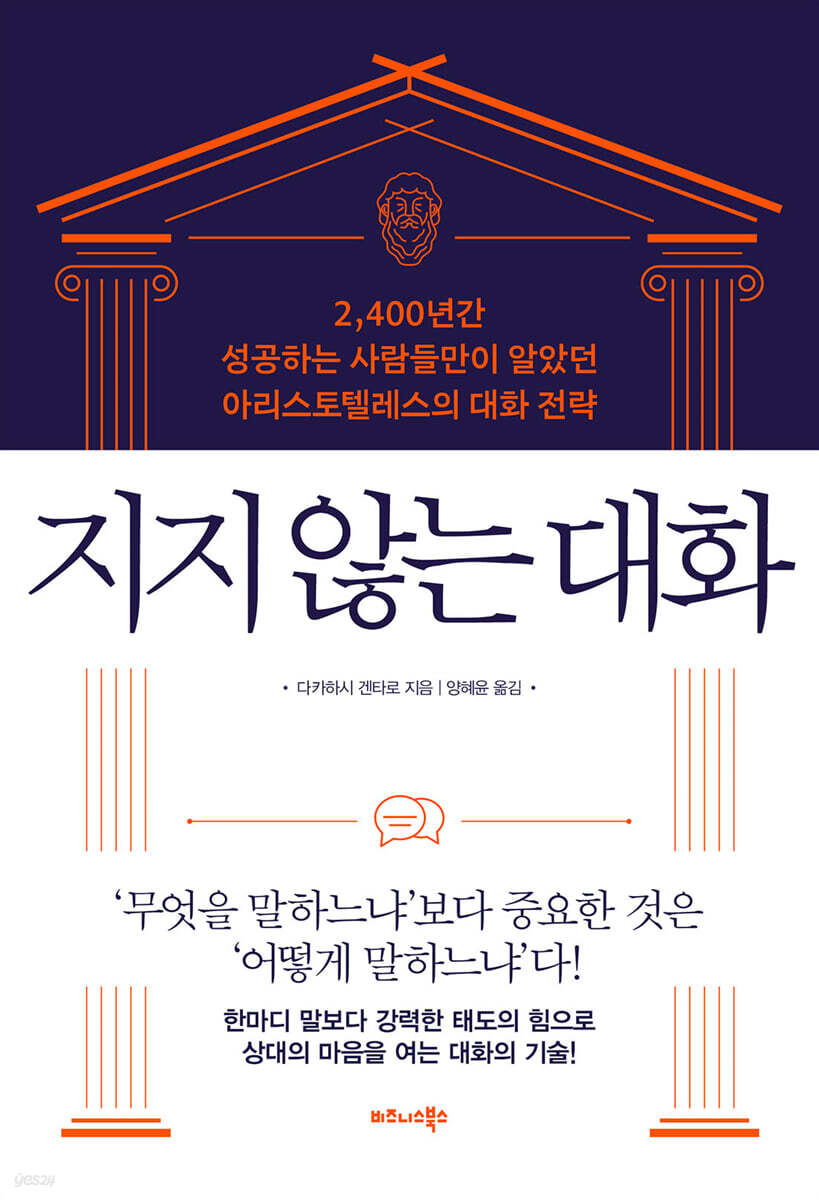
《Unsupported Dialogue》 is a book that interprets Aristotle's 《Rhetoric》, a classic work of rhetoric, in a modern way and explains it as a practical conversation method that anyone can immediately use in their daily lives.
It introduces specific methods for applying the three axes of persuasion—logic, emotion, and personality—to actual conversations, and in particular, explains the various types of persuasion formulas called “Topos” in an easy and fun way with abundant examples.
Additionally, the Korean edition of this book includes a preface written by the author, Kentaro Takahashi, specifically for Korean readers, containing warnings and encouragement on how to protect oneself from the whirlwind of words in the online age.
If you want to communicate effectively and protect yourself from the sway of emotions in everyday life, if you want to learn how to deal with people who just don't make sense, or if you want to protect yourself from the information overflowing online on YouTube, Instagram, and other platforms, this book will teach you the timeless principles of conversation and persuasion.
Perfectly brought back to life in modern language!
If you are good at conversation, your relationships will change, and if you are good at persuasion, opportunities will follow.
《Unsupported Dialogue》 is a book that interprets Aristotle's 《Rhetoric》, a classic work of rhetoric, in a modern way and explains it as a practical conversation method that anyone can immediately use in their daily lives.
It introduces specific methods for applying the three axes of persuasion—logic, emotion, and personality—to actual conversations, and in particular, explains the various types of persuasion formulas called “Topos” in an easy and fun way with abundant examples.
Additionally, the Korean edition of this book includes a preface written by the author, Kentaro Takahashi, specifically for Korean readers, containing warnings and encouragement on how to protect oneself from the whirlwind of words in the online age.
If you want to communicate effectively and protect yourself from the sway of emotions in everyday life, if you want to learn how to deal with people who just don't make sense, or if you want to protect yourself from the information overflowing online on YouTube, Instagram, and other platforms, this book will teach you the timeless principles of conversation and persuasion.
- You can preview some of the book's contents.
Preview
index
Preface to the Korean Edition: Aristotle's Guide to Protecting Yourself from the Whirlwind of Words
Introduction: The ability to persuade others determines one's life.
Aristotle's Argumentation: Understanding it in One Go
Chapter 1.
The best rhetoric passed down for two thousand years
: How to protect yourself from rhetoric
The most outstanding persuasion technique in human history
Aristotle in 1 Minute
Aristotle, the philosopher of philosophers
A classic on words, spanning two thousand years: "Rhetoric"
Four Reasons to Learn Aristotle's Argumentation
Organizing notes
Chapter 2.
The art of persuasion that works anytime, anywhere
: How to move people with plain words like a philosopher
Philosophers persuade with plain language that anyone can understand.
People are not persuaded by hearing the right words.
Convince others that you are a great person
Use the listener's emotions as a criterion for persuasion.
If you want to persuade others, first acknowledge them.
Organizing notes
Chapter 3.
The formula for winning before you even argue
: How to Persuade Logically Like Aristotle
What is the core of rhetoric, the elliptical syllogism?
The more concise the words and logic, the more solid they become.
The more 'individual' and 'specific' it is, the more persuasive it becomes.
Topos, the philosopher's winning formula for persuasion
Topos of Justice: Instill Justice First
Topos of Opposition: Use Oppositional Nature to Persuade
Topos of the Correlation: If it applies here, it applies there too
Topic of Decision: Use Precedent and History
Topic of Comparison: Persuade with Comparison
Topos of Division: Break it down into easy-to-understand pieces
Topos of Good and Evil: Use what's favorable to you as your basis
Topic of the Mind and the Packaging: Criticize the Opponent's Contradictions
Topos of the Parable: Justify Proportionally
Topos of Results: Emphasize Results Over Intentions
Topos of Consistency: Point Out the Past That Dissonates with the Present
Topos of Speculation: Use the Unfounded Unconscious as a Basis
The Topos of the Impossible: The Absurd Becomes Plausible
Topos of Induction: Find Commonalities and Derive Laws
Another logical speaking technique, example
To make the argument more persuasive, add examples to the ellipsis.
Organizing notes
Chapter 4.
The psychology of words that control the listener
: How to control a conversation by manipulating emotions
How can I speak to manipulate the emotions of my listeners?
Pay attention to this to elicit emotions
Anger: Force pain into the hearts of your audience.
Friendship: Become someone else to your audience.
Fear: When you're gripped by fear, you're more susceptible to persuasion.
Shame: Harness the Weight of Others' Eyes
Compassion: Induce empathy by empathizing with others, feeling like you are the same.
Organizing notes
Chapter 5.
A way of speaking that wins over the other person without anyone knowing
: How to make me look like a great sage
What a 'good person' says sounds like 'good things'
Words that seem virtuous sound like good words.
Provide evidence of virtue with 'beautiful things'
Phronesis, Speak Like an Everyday Philosopher
How to Convey Phronesis 1: Persuade with Good Side
How to Convey Phronesis 2: Offer "Something Better"
How to protect myself from unfair attacks
Organizing notes
Chapter 6.
The Art of Forbidden Words
: Wisdom that protects me from sophistry
Why should you learn the art of forbidden words?
The Art of Forbidden Words 1: False Topos as Conclusions
The Art of Forbidden Words 2: The False Topos of Diversity
The Art of Forbidden Words 3: The False Topos of Division and Synthesis
The Art of Forbidden Words 4: The False Topos of Collateral Consequences
The Art of Forbidden Words 5: The False Topos of Conditions
Organizing notes
Outgoing text: Persuasion begins with understanding the other person.
Introduction: The ability to persuade others determines one's life.
Aristotle's Argumentation: Understanding it in One Go
Chapter 1.
The best rhetoric passed down for two thousand years
: How to protect yourself from rhetoric
The most outstanding persuasion technique in human history
Aristotle in 1 Minute
Aristotle, the philosopher of philosophers
A classic on words, spanning two thousand years: "Rhetoric"
Four Reasons to Learn Aristotle's Argumentation
Organizing notes
Chapter 2.
The art of persuasion that works anytime, anywhere
: How to move people with plain words like a philosopher
Philosophers persuade with plain language that anyone can understand.
People are not persuaded by hearing the right words.
Convince others that you are a great person
Use the listener's emotions as a criterion for persuasion.
If you want to persuade others, first acknowledge them.
Organizing notes
Chapter 3.
The formula for winning before you even argue
: How to Persuade Logically Like Aristotle
What is the core of rhetoric, the elliptical syllogism?
The more concise the words and logic, the more solid they become.
The more 'individual' and 'specific' it is, the more persuasive it becomes.
Topos, the philosopher's winning formula for persuasion
Topos of Justice: Instill Justice First
Topos of Opposition: Use Oppositional Nature to Persuade
Topos of the Correlation: If it applies here, it applies there too
Topic of Decision: Use Precedent and History
Topic of Comparison: Persuade with Comparison
Topos of Division: Break it down into easy-to-understand pieces
Topos of Good and Evil: Use what's favorable to you as your basis
Topic of the Mind and the Packaging: Criticize the Opponent's Contradictions
Topos of the Parable: Justify Proportionally
Topos of Results: Emphasize Results Over Intentions
Topos of Consistency: Point Out the Past That Dissonates with the Present
Topos of Speculation: Use the Unfounded Unconscious as a Basis
The Topos of the Impossible: The Absurd Becomes Plausible
Topos of Induction: Find Commonalities and Derive Laws
Another logical speaking technique, example
To make the argument more persuasive, add examples to the ellipsis.
Organizing notes
Chapter 4.
The psychology of words that control the listener
: How to control a conversation by manipulating emotions
How can I speak to manipulate the emotions of my listeners?
Pay attention to this to elicit emotions
Anger: Force pain into the hearts of your audience.
Friendship: Become someone else to your audience.
Fear: When you're gripped by fear, you're more susceptible to persuasion.
Shame: Harness the Weight of Others' Eyes
Compassion: Induce empathy by empathizing with others, feeling like you are the same.
Organizing notes
Chapter 5.
A way of speaking that wins over the other person without anyone knowing
: How to make me look like a great sage
What a 'good person' says sounds like 'good things'
Words that seem virtuous sound like good words.
Provide evidence of virtue with 'beautiful things'
Phronesis, Speak Like an Everyday Philosopher
How to Convey Phronesis 1: Persuade with Good Side
How to Convey Phronesis 2: Offer "Something Better"
How to protect myself from unfair attacks
Organizing notes
Chapter 6.
The Art of Forbidden Words
: Wisdom that protects me from sophistry
Why should you learn the art of forbidden words?
The Art of Forbidden Words 1: False Topos as Conclusions
The Art of Forbidden Words 2: The False Topos of Diversity
The Art of Forbidden Words 3: The False Topos of Division and Synthesis
The Art of Forbidden Words 4: The False Topos of Collateral Consequences
The Art of Forbidden Words 5: The False Topos of Conditions
Organizing notes
Outgoing text: Persuasion begins with understanding the other person.
Detailed image
.jpg)
Into the book
“Nearly ten years have passed since this book was first published in Japan in 2015.
Comparing then and now, the importance of rhetoric has become more urgent than ever.
Because the world is increasingly being influenced by ‘online public opinion.’
Nowadays, if people you don't even know online click "Like," it becomes a good product, but conversely, if a baseless rumor spreads and a "bad" review spreads, it can be sold out in an instant.
Stories floating around online, such as 'It was actually like this, it turned out to be like that', are influencing reality.
The unique trajectory of our lives, built day by day, and our true selves living our daily lives here and now, are instantly evaporated by the words wielded by modern-day sophists. This is the characteristic of the online space from which we can never escape today.
In this threat, what we need is a vaccine that can prevent us from losing ourselves by becoming addicted to 'their words.'
I hope that Aristotle's 'true rhetoric' introduced in this book will serve as just such a vaccine.”
---From the "Korean Edition Preface"
“People don’t move by logic alone.
Aristotle believed that persuasion was achieved through three factors: the speaker's character, the listener's emotions, and the logic of the speech.
Persuasion is not complete with just one of these three.
In fact, if we look back at the communication situations in our daily lives, we can see that modern society is not much different from Athens, where Aristotle lived 2,400 years ago.
If the speaker has a good personality, if the listener is in a good mood, or if the argument is irrefutable, we are persuaded.
But one of these alone is not enough.
“Persuasion is moving the heart through logic.”
---From the "Introductory Note"
“Common sense leads to understanding, and when understanding builds up, it leads to persuasion.
The basic rules of Aristotle's rhetoric are simple.
'Convince by starting with common sense and repeatedly trying to convince!' Common sense is information that everyone assumes is obvious in advance.
That's why, in reality, no matter how passionately a product development department employee explains how great a new product they've just developed, there are cases where they don't elicit much of a response from the sales department employee.
When attempting to persuade, you must always check, "Does the other person think my common sense is common sense?" and "Does the other person also accept my premise?"
---From "Chapter 2: The Art of Persuasion That Works Anytime, Anywhere"
“Topos is a winning pattern for persuasion.
It is a formula that adds logical power to words, as an extension of the basis and conclusion.
For example, 'Life is a series of trials.
Therefore, the sentence, "Let's not be discouraged even if the results are different from what we expected, but rather work harder," is a typical example of a "topos of justice," which defines the concept of "life" as "a series of trials" and then draws a conclusion based on that definition.
Also, 'If it is a loss to the rival company, it is a benefit to our company.
So, we must adopt this idea.' is a structure that applies the 'opposite topos'.
“Whether or not you speak with awareness of the structure of this topos makes a crucial difference in persuasiveness.”
---From "Chapter 3: The Formula for Winning Before Even Arguing"
“The logic seems to make sense, but somehow I can’t understand it.
This kind of argument is called 'sophistry'.
The sophistry that Aristotle talks about is 'a speaking technique that uses a pseudo-ellipsis instead of an elliptical syllogism to induce a specific emotion from the other person and to persuade the other person by portraying one's own personality.'
When you exploit a false topos, it becomes a means of deceiving others.
Nevertheless, the reason why we must learn false topos is because we must properly understand sophistry so as not to fall prey to it.”
---From "Chapter 6: The Art of Forbidden Words"
“Persuasion is not a technique to win over the other person, but a process to convince the other person.
Aristotle's rhetoric is a tool for creating a smooth agreement between the other person and myself.
“I hope that by using the tools presented in this book, your discussions will become more fruitful.”
Comparing then and now, the importance of rhetoric has become more urgent than ever.
Because the world is increasingly being influenced by ‘online public opinion.’
Nowadays, if people you don't even know online click "Like," it becomes a good product, but conversely, if a baseless rumor spreads and a "bad" review spreads, it can be sold out in an instant.
Stories floating around online, such as 'It was actually like this, it turned out to be like that', are influencing reality.
The unique trajectory of our lives, built day by day, and our true selves living our daily lives here and now, are instantly evaporated by the words wielded by modern-day sophists. This is the characteristic of the online space from which we can never escape today.
In this threat, what we need is a vaccine that can prevent us from losing ourselves by becoming addicted to 'their words.'
I hope that Aristotle's 'true rhetoric' introduced in this book will serve as just such a vaccine.”
---From the "Korean Edition Preface"
“People don’t move by logic alone.
Aristotle believed that persuasion was achieved through three factors: the speaker's character, the listener's emotions, and the logic of the speech.
Persuasion is not complete with just one of these three.
In fact, if we look back at the communication situations in our daily lives, we can see that modern society is not much different from Athens, where Aristotle lived 2,400 years ago.
If the speaker has a good personality, if the listener is in a good mood, or if the argument is irrefutable, we are persuaded.
But one of these alone is not enough.
“Persuasion is moving the heart through logic.”
---From the "Introductory Note"
“Common sense leads to understanding, and when understanding builds up, it leads to persuasion.
The basic rules of Aristotle's rhetoric are simple.
'Convince by starting with common sense and repeatedly trying to convince!' Common sense is information that everyone assumes is obvious in advance.
That's why, in reality, no matter how passionately a product development department employee explains how great a new product they've just developed, there are cases where they don't elicit much of a response from the sales department employee.
When attempting to persuade, you must always check, "Does the other person think my common sense is common sense?" and "Does the other person also accept my premise?"
---From "Chapter 2: The Art of Persuasion That Works Anytime, Anywhere"
“Topos is a winning pattern for persuasion.
It is a formula that adds logical power to words, as an extension of the basis and conclusion.
For example, 'Life is a series of trials.
Therefore, the sentence, "Let's not be discouraged even if the results are different from what we expected, but rather work harder," is a typical example of a "topos of justice," which defines the concept of "life" as "a series of trials" and then draws a conclusion based on that definition.
Also, 'If it is a loss to the rival company, it is a benefit to our company.
So, we must adopt this idea.' is a structure that applies the 'opposite topos'.
“Whether or not you speak with awareness of the structure of this topos makes a crucial difference in persuasiveness.”
---From "Chapter 3: The Formula for Winning Before Even Arguing"
“The logic seems to make sense, but somehow I can’t understand it.
This kind of argument is called 'sophistry'.
The sophistry that Aristotle talks about is 'a speaking technique that uses a pseudo-ellipsis instead of an elliptical syllogism to induce a specific emotion from the other person and to persuade the other person by portraying one's own personality.'
When you exploit a false topos, it becomes a means of deceiving others.
Nevertheless, the reason why we must learn false topos is because we must properly understand sophistry so as not to fall prey to it.”
---From "Chapter 6: The Art of Forbidden Words"
“Persuasion is not a technique to win over the other person, but a process to convince the other person.
Aristotle's rhetoric is a tool for creating a smooth agreement between the other person and myself.
“I hope that by using the tools presented in this book, your discussions will become more fruitful.”
---From "Outgoing Writing"
Publisher's Review
The master's persuasion tools become my weapons!
The most outstanding horsemanship in 2,400 years of history!
Rhetoric, which contains the principles of persuasion systematized by a master of human philosophy, is still considered the most important book in all theories of conversation and persuasion, even after 2,400 years.
However, although it was a fairly systematic work, it was not easy to understand and apply in practice because the context was different from today and theories of various dimensions were complexly intertwined.
《Unsupported Dialogue》 is a work that perfectly recreates 《Rhetoric》, one of the greatest treasure troves in Western intellectual history, in modern language.
Beyond simple explanations, it is written in concrete, everyday language to help solve problems encountered in real-life conversations and persuasion.
This book consists of six chapters in total.
Chapter 1 covers the foundations of Aristotle's rhetoric, and Chapter 2 covers the wisdom of philosophers who move people with simple words.
Chapter 3 details the logical persuasion formula called "Topos," which is the core of this book. Chapter 4 presents psychological techniques for manipulating emotions, and Chapter 5 presents methods for presenting yourself as a wise man.
The final chapter, Chapter 6, perfectly summarizes the defensive techniques to protect yourself from sophistry.
At the end of each chapter, there is a summary note summarizing the key points so that you can apply them immediately in practice.
Getting the desired results from the other person
The three principles of Aristotle's rhetoric!
This book presents practical conversation techniques for persuading others through three axes: logic, emotion, and character.
This is not simply a conversation technique to win, but a tool to get your point across and protect yourself in unfair situations.
First, Logos, the first axis of persuasion, is a method of persuading the other party based on rational logic and evidence.
In practice, you can increase the persuasiveness of your argument by using the omitted syllogism and topos (logical persuasion formula) such as “Because ○○, it is ××.”
For example, you can persuade people by presenting logical data, such as, “If you look at the data from last quarter, the old method showed a monthly growth rate of 5%, but the test group that applied this new method showed a 15% growth rate.”
The core of logos is the 'topos', the formula for persuasion devised by Aristotle.
A topos is a pattern of common sense or logic that everyone can relate to.
It is more practical and special because it presents 14 persuasion patterns that anyone can use without special expertise.
Pathos, the second axis of persuasion, is a persuasive strategy that moves the hearts of the audience by appealing to their emotions and desires.
In practice, the key is to speak in a way that stimulates various emotions, such as a sense of crisis, empathy, compassion, and fear.
For example, “If we don’t make this change now, we will fall behind our competitors.
You can create a sense of urgency by saying things like, “As you can see, the market is changing rapidly,” to elicit emotional agreement.
Finally, ethos is a method of persuasion based on the speaker's credibility, personality, and expertise.
The power of persuasion is maximized when you make the other person feel trustworthy and believe that 'this person is trustworthy.'
For example, “I have led three successful projects in this industry over the past five years.
You can build trust with experience, expertise, and sincerity, as in, “I’m speaking based on that experience.”
How to protect myself from sophistry disguised as logic!
Another thing to note in this book is the part that presents strategies for defending yourself against sophistry.
Sophistry is a speaking style that deceives the other person by making it seem logically invalid or logical only on the surface. In this age of overflowing words, it is perhaps the most necessary conversational skill.
This book dissects these patterns of sophistry in detail, and guides you through how to spot them in practice and respond logically.
· False topos as a conclusion: A method of making the evidence and conclusion appear to be a logical conclusion even though there is no connection between them (e.g., “This new product was created with a novel idea that has never been seen before.”
So it will be a huge hit.” - Even though a new idea doesn't guarantee immediate success, the conjunction "therefore" makes it seem like a logical conclusion.)
· False topos of diversity: A way to blur logic by cleverly switching the meanings of a single word (e.g., “Philosophy books are helpful in life”—sounds like they impart wisdom—but “Using them as a pillow helps you sleep well”)
· False topos of division and synthesis: A method of arbitrarily splitting or combining events to lead to a false conclusion (e.g., “If you take this medicine twice, you will have side effects.”
So, even if you keep the quantity, it is a little harmful.” - Ignoring the fact that a change in quantity causes a change in quality)
· False topos of incidental results: A method of packaging a coincidental result as if it were an essential causal relationship (e.g., “If you go to the baseball field, you can pick up a thousand won.” - going to the baseball field and picking up a thousand won are coincidental, but are disguised as causal)
· False conditional topos: A method of generalizing a claim that is true only under certain conditions as if it were a universal truth (e.g., “If you take this diet supplement, you will lose 10 kg in 2 months!” - but in reality, it is conditional on “if you also eat properly and exercise”).
In this way, the true value of this book does not end with simply teaching 'how to speak well.'
It provides the insight to determine whether the other person's words are based on true logic or rely on emotional manipulation or authority.
By doing so, you can develop critical thinking skills, logical judgment, and the inner strength to live confidently with your own opinions.
If you want to learn how to communicate your opinions persuasively in any situation, if you want to cultivate the power to protect yourself from the information overload, or if you are looking for a way to resolve a blocked relationship through dialogue, I hope you will learn the wisdom that has endured for 2,400 years through this book and make it your weapon today.
The most outstanding horsemanship in 2,400 years of history!
Rhetoric, which contains the principles of persuasion systematized by a master of human philosophy, is still considered the most important book in all theories of conversation and persuasion, even after 2,400 years.
However, although it was a fairly systematic work, it was not easy to understand and apply in practice because the context was different from today and theories of various dimensions were complexly intertwined.
《Unsupported Dialogue》 is a work that perfectly recreates 《Rhetoric》, one of the greatest treasure troves in Western intellectual history, in modern language.
Beyond simple explanations, it is written in concrete, everyday language to help solve problems encountered in real-life conversations and persuasion.
This book consists of six chapters in total.
Chapter 1 covers the foundations of Aristotle's rhetoric, and Chapter 2 covers the wisdom of philosophers who move people with simple words.
Chapter 3 details the logical persuasion formula called "Topos," which is the core of this book. Chapter 4 presents psychological techniques for manipulating emotions, and Chapter 5 presents methods for presenting yourself as a wise man.
The final chapter, Chapter 6, perfectly summarizes the defensive techniques to protect yourself from sophistry.
At the end of each chapter, there is a summary note summarizing the key points so that you can apply them immediately in practice.
Getting the desired results from the other person
The three principles of Aristotle's rhetoric!
This book presents practical conversation techniques for persuading others through three axes: logic, emotion, and character.
This is not simply a conversation technique to win, but a tool to get your point across and protect yourself in unfair situations.
First, Logos, the first axis of persuasion, is a method of persuading the other party based on rational logic and evidence.
In practice, you can increase the persuasiveness of your argument by using the omitted syllogism and topos (logical persuasion formula) such as “Because ○○, it is ××.”
For example, you can persuade people by presenting logical data, such as, “If you look at the data from last quarter, the old method showed a monthly growth rate of 5%, but the test group that applied this new method showed a 15% growth rate.”
The core of logos is the 'topos', the formula for persuasion devised by Aristotle.
A topos is a pattern of common sense or logic that everyone can relate to.
It is more practical and special because it presents 14 persuasion patterns that anyone can use without special expertise.
Pathos, the second axis of persuasion, is a persuasive strategy that moves the hearts of the audience by appealing to their emotions and desires.
In practice, the key is to speak in a way that stimulates various emotions, such as a sense of crisis, empathy, compassion, and fear.
For example, “If we don’t make this change now, we will fall behind our competitors.
You can create a sense of urgency by saying things like, “As you can see, the market is changing rapidly,” to elicit emotional agreement.
Finally, ethos is a method of persuasion based on the speaker's credibility, personality, and expertise.
The power of persuasion is maximized when you make the other person feel trustworthy and believe that 'this person is trustworthy.'
For example, “I have led three successful projects in this industry over the past five years.
You can build trust with experience, expertise, and sincerity, as in, “I’m speaking based on that experience.”
How to protect myself from sophistry disguised as logic!
Another thing to note in this book is the part that presents strategies for defending yourself against sophistry.
Sophistry is a speaking style that deceives the other person by making it seem logically invalid or logical only on the surface. In this age of overflowing words, it is perhaps the most necessary conversational skill.
This book dissects these patterns of sophistry in detail, and guides you through how to spot them in practice and respond logically.
· False topos as a conclusion: A method of making the evidence and conclusion appear to be a logical conclusion even though there is no connection between them (e.g., “This new product was created with a novel idea that has never been seen before.”
So it will be a huge hit.” - Even though a new idea doesn't guarantee immediate success, the conjunction "therefore" makes it seem like a logical conclusion.)
· False topos of diversity: A way to blur logic by cleverly switching the meanings of a single word (e.g., “Philosophy books are helpful in life”—sounds like they impart wisdom—but “Using them as a pillow helps you sleep well”)
· False topos of division and synthesis: A method of arbitrarily splitting or combining events to lead to a false conclusion (e.g., “If you take this medicine twice, you will have side effects.”
So, even if you keep the quantity, it is a little harmful.” - Ignoring the fact that a change in quantity causes a change in quality)
· False topos of incidental results: A method of packaging a coincidental result as if it were an essential causal relationship (e.g., “If you go to the baseball field, you can pick up a thousand won.” - going to the baseball field and picking up a thousand won are coincidental, but are disguised as causal)
· False conditional topos: A method of generalizing a claim that is true only under certain conditions as if it were a universal truth (e.g., “If you take this diet supplement, you will lose 10 kg in 2 months!” - but in reality, it is conditional on “if you also eat properly and exercise”).
In this way, the true value of this book does not end with simply teaching 'how to speak well.'
It provides the insight to determine whether the other person's words are based on true logic or rely on emotional manipulation or authority.
By doing so, you can develop critical thinking skills, logical judgment, and the inner strength to live confidently with your own opinions.
If you want to learn how to communicate your opinions persuasively in any situation, if you want to cultivate the power to protect yourself from the information overload, or if you are looking for a way to resolve a blocked relationship through dialogue, I hope you will learn the wisdom that has endured for 2,400 years through this book and make it your weapon today.
GOODS SPECIFICS
- Date of issue: July 18, 2025
- Page count, weight, size: 232 pages | 378g | 140*205*20mm
- ISBN13: 9791162544303
- ISBN10: 1162544309
You may also like
카테고리
korean


korean

![GQ KOREA Mark (Monthly): December [2025]](http://librairie.coreenne.fr/cdn/shop/files/8ef265dbbfbf186523ed75ba7319009d.jpg?v=1765340328&width=3840)


