

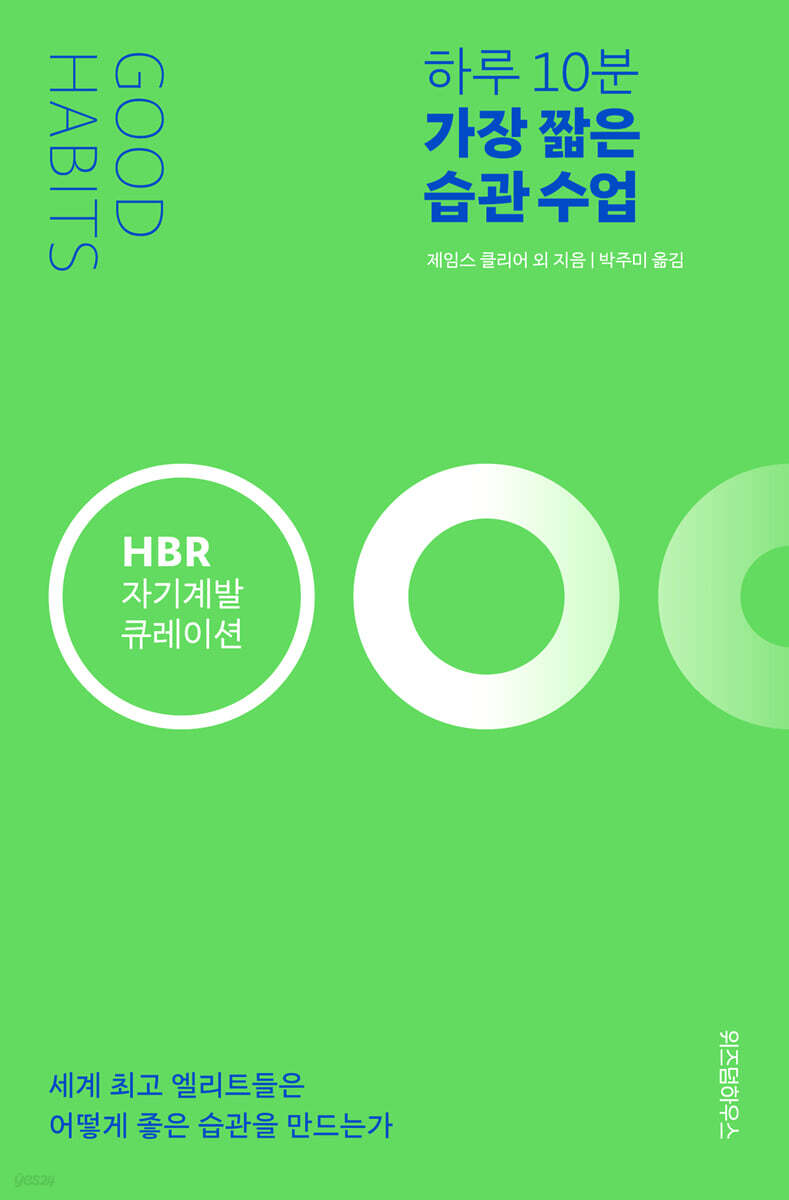
The shortest habit lesson of 10 minutes a day
 |
Description
Book Introduction
How the World's Elite Develop Good Habits
Today, for you who are tired of giving up on your resolutions for three days
Self-development experts provide comprehensive growth coaching.
Everyone knows the importance of habits.
But forming good habits isn't easy.
This book is a self-help book written by Harvard Business Review, which carefully selects essential topics related to habits for those who are tired of giving up after three days.
James Clear, author of the bestseller "The Power of Tiny Habits," and other authors, including time management coaches, leadership coaches, and business professors, provide simple and clear guidance on how to change your life by forming good habits.
It covers 11 topics related to habits, from mindset to specific implementation methods, such as 'How to create new habits', 'How to break bad habits', and 'How to form habits with a checklist', and provides useful knowledge to those who want to start studying habits anytime, anywhere in a compact size for 10 minutes a day.
Today, for you who are tired of giving up on your resolutions for three days
Self-development experts provide comprehensive growth coaching.
Everyone knows the importance of habits.
But forming good habits isn't easy.
This book is a self-help book written by Harvard Business Review, which carefully selects essential topics related to habits for those who are tired of giving up after three days.
James Clear, author of the bestseller "The Power of Tiny Habits," and other authors, including time management coaches, leadership coaches, and business professors, provide simple and clear guidance on how to change your life by forming good habits.
It covers 11 topics related to habits, from mindset to specific implementation methods, such as 'How to create new habits', 'How to break bad habits', and 'How to form habits with a checklist', and provides useful knowledge to those who want to start studying habits anytime, anywhere in a compact size for 10 minutes a day.
- You can preview some of the book's contents.
Preview
index
Chapter 1.
Just 1 percent better every day: The right way to build new habits
Chapter 2.
Start by creating a routine: The difference between a routine and a habit.
Chapter 3.
Empathy Reduces Burnout: How to Build Resilient Habits
Chapter 4.
Rethinking Behaviors and Rewards: How to Break Bad Habits
Chapter 5.
The busier you are, the more you need to focus on your daily habits: The four areas of habit.
Chapter 6.
Think about what needs to be done and how long it will take: How to Timebox for Productivity
Chapter 7.
A Second Can Make the Difference Between Failure and Success: Five Habits That Create a Safeguard for Your Mind
Chapter 8.
If you're really tired, start by creating healthy habits: How to create sustainable habits.
Chapter 9.
Set Trackable Goals: Break Bad Habits with a Simple Checklist
Chapter 10.
Immediate Rewards Create Good Habits: The Difference Between Achieved and Failed Goals
Chapter 11.
Habits Follow an S-Curve: How to Celebrate Small Achievements
Americas
Just 1 percent better every day: The right way to build new habits
Chapter 2.
Start by creating a routine: The difference between a routine and a habit.
Chapter 3.
Empathy Reduces Burnout: How to Build Resilient Habits
Chapter 4.
Rethinking Behaviors and Rewards: How to Break Bad Habits
Chapter 5.
The busier you are, the more you need to focus on your daily habits: The four areas of habit.
Chapter 6.
Think about what needs to be done and how long it will take: How to Timebox for Productivity
Chapter 7.
A Second Can Make the Difference Between Failure and Success: Five Habits That Create a Safeguard for Your Mind
Chapter 8.
If you're really tired, start by creating healthy habits: How to create sustainable habits.
Chapter 9.
Set Trackable Goals: Break Bad Habits with a Simple Checklist
Chapter 10.
Immediate Rewards Create Good Habits: The Difference Between Achieved and Failed Goals
Chapter 11.
Habits Follow an S-Curve: How to Celebrate Small Achievements
Americas
Detailed image
Into the book
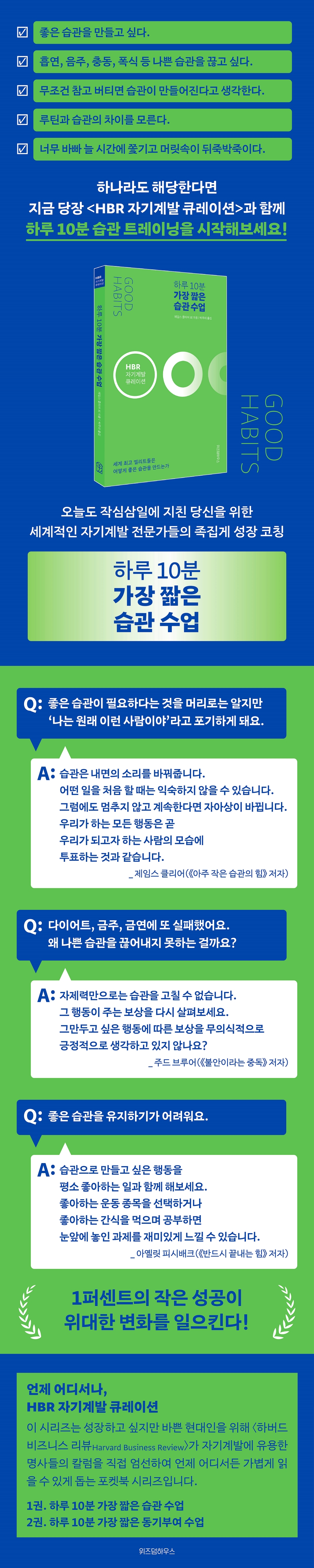
Habits also change your self-image.
When we do something for the first time, or even when we do it ten times or a hundred times, we don't see ourselves as changed.
You may not be good at that.
If you keep going without stopping, at some point you will cross the invisible boundary.
That's when we start thinking like this:
'Wow, I'm quite a studious person' or 'I'm a neat and organized person'.
Every action we take is a vote for the kind of person we want to become.
Working toward a goal to build a habit is about casting more votes on the ideal version of yourself and creating evidence that can say, "Hey, this is who I am."
From this perspective, my approach is a little different from the traditional “fake it until you make it.”
The saying, “Fake it until you make it” means to believe in yourself positively without any basis.
These unfounded beliefs are called 'delusions'.
---「Chapter 1.
From "Just get 1 percent better every day"
In modern society, we see so many bad habits that stem from technology and convenience, especially when it comes to our phones and apps.
The way we form the habit of having our phones in our hands at any given moment is really simple.
Just a moment of distraction can take you out of what you were doing.
Whether it's your desk at work or your workspace at home, rearranging your surroundings can boost your productivity without much resistance.
You can also increase your resistance to distractions.
If you want to improve your work performance, you should first focus on two areas: energy habits and attention habits.
---「Chapter 1.
From "Just get 1 percent better every day"
The process of creating good habits and achieving better results often takes this form:
If you practice this every day, the temperature will rise little by little.
If you make small improvements like this, you will get better by 1 percent.
But the results you put in aren't immediately commensurate with your efforts.
Giving up on a habit after building it for a month, three months, or six months because you don't see any results is like raising the temperature from -3.5℃ to -0.5℃ and complaining that the ice cube won't melt.
Effort doesn't evaporate.
It just builds up little by little.
This is how you build a habit.
What completes a novel is not the last sentence, but all the sentences written up to that point.
Building a healthy body is not about the last exercise, but about all the exercises you've done up until then.
If we are willing to continue practicing, creating potential energy, and realizing that energy builds within us, we can strive to create better habits and ultimately achieve the rewards we desire.
---「Chapter 1.
From "Just get 1 percent better every day"
To make a behavior a habit, it must first become a routine that you perform regularly.
But most people try to skip the step of creating a routine.
“The problem arises because people mistakenly believe that habits are like autopilot, taking care of boring and uninteresting tasks for them,” Eyal said (which is true).
Anyway, if things could just work themselves out, there would be a lot less to do.
Unlike habits, routines are uncomfortable and require effort.
For example, if you plan to create a routine of waking up early every morning to go jogging or meditating for 10 minutes every night, you will initially need to take conscious action to stick to that goal.
On the other hand, a habit is a behavior that is so deeply ingrained in our daily lives that it would be strange if we didn't do it.
Imagine not brushing your teeth before bed or not drinking coffee in the morning.
If this behavior has become a habit, it will be uncomfortable when you don't do it.
---「Chapter 2.
From "First, create a routine"
Why on earth can't we control ourselves and turn bad habits into good ones? Research from Yale University and other institutions shows that when triggers like stress occur, brain networks associated with self-control, such as the prefrontal cortex, are the first to deactivate.
However, 'self-control theory', which emphasizes the role of self-control, has been widely propagated for decades.
I, too, was taught in medical school to advise patients on the seemingly innocuous practice of self-control.
“I need to lose weight? Then I shouldn’t eat instant food.
Want to quit smoking? Quit smoking now or use a nicotine replacement therapy.”
But after becoming a doctor and working directly, I quickly learned that this method was not realistically effective.
When we do something for the first time, or even when we do it ten times or a hundred times, we don't see ourselves as changed.
You may not be good at that.
If you keep going without stopping, at some point you will cross the invisible boundary.
That's when we start thinking like this:
'Wow, I'm quite a studious person' or 'I'm a neat and organized person'.
Every action we take is a vote for the kind of person we want to become.
Working toward a goal to build a habit is about casting more votes on the ideal version of yourself and creating evidence that can say, "Hey, this is who I am."
From this perspective, my approach is a little different from the traditional “fake it until you make it.”
The saying, “Fake it until you make it” means to believe in yourself positively without any basis.
These unfounded beliefs are called 'delusions'.
---「Chapter 1.
From "Just get 1 percent better every day"
In modern society, we see so many bad habits that stem from technology and convenience, especially when it comes to our phones and apps.
The way we form the habit of having our phones in our hands at any given moment is really simple.
Just a moment of distraction can take you out of what you were doing.
Whether it's your desk at work or your workspace at home, rearranging your surroundings can boost your productivity without much resistance.
You can also increase your resistance to distractions.
If you want to improve your work performance, you should first focus on two areas: energy habits and attention habits.
---「Chapter 1.
From "Just get 1 percent better every day"
The process of creating good habits and achieving better results often takes this form:
If you practice this every day, the temperature will rise little by little.
If you make small improvements like this, you will get better by 1 percent.
But the results you put in aren't immediately commensurate with your efforts.
Giving up on a habit after building it for a month, three months, or six months because you don't see any results is like raising the temperature from -3.5℃ to -0.5℃ and complaining that the ice cube won't melt.
Effort doesn't evaporate.
It just builds up little by little.
This is how you build a habit.
What completes a novel is not the last sentence, but all the sentences written up to that point.
Building a healthy body is not about the last exercise, but about all the exercises you've done up until then.
If we are willing to continue practicing, creating potential energy, and realizing that energy builds within us, we can strive to create better habits and ultimately achieve the rewards we desire.
---「Chapter 1.
From "Just get 1 percent better every day"
To make a behavior a habit, it must first become a routine that you perform regularly.
But most people try to skip the step of creating a routine.
“The problem arises because people mistakenly believe that habits are like autopilot, taking care of boring and uninteresting tasks for them,” Eyal said (which is true).
Anyway, if things could just work themselves out, there would be a lot less to do.
Unlike habits, routines are uncomfortable and require effort.
For example, if you plan to create a routine of waking up early every morning to go jogging or meditating for 10 minutes every night, you will initially need to take conscious action to stick to that goal.
On the other hand, a habit is a behavior that is so deeply ingrained in our daily lives that it would be strange if we didn't do it.
Imagine not brushing your teeth before bed or not drinking coffee in the morning.
If this behavior has become a habit, it will be uncomfortable when you don't do it.
---「Chapter 2.
From "First, create a routine"
Why on earth can't we control ourselves and turn bad habits into good ones? Research from Yale University and other institutions shows that when triggers like stress occur, brain networks associated with self-control, such as the prefrontal cortex, are the first to deactivate.
However, 'self-control theory', which emphasizes the role of self-control, has been widely propagated for decades.
I, too, was taught in medical school to advise patients on the seemingly innocuous practice of self-control.
“I need to lose weight? Then I shouldn’t eat instant food.
Want to quit smoking? Quit smoking now or use a nicotine replacement therapy.”
But after becoming a doctor and working directly, I quickly learned that this method was not realistically effective.
---「Chapter 4.
From “Revisiting Actions and Rewards”
From “Revisiting Actions and Rewards”
Publisher's Review
How the World's Elite Develop Good Habits
Today, for you who are tired of giving up on your resolutions for three days
Comprehensive growth coaching from world-renowned self-development experts
In the past few years, the keyword 'God-saeng' has become a social craze.
The key to living each day to the fullest lies in habits.
Good habits like proper exercise, a balanced diet, and regular sleep make us healthy, more productive, and bring a positive touch to our daily lives.
On the other hand, bad habits such as smoking, drinking, and overeating make us sick and ruin our day and life.
Successful entrepreneurs and scholars from various fields, including psychology and neuroscience, unanimously emphasize the power of habits.
In fact, everyone knows the importance of habits.
When the new year comes, I make plans to create good habits.
But achieving that goal is not easy.
Of course, there are countless self-help books and motivational lectures out there, but when I come home exhausted, all I can do is lie in bed and stare at my smartphone.
If you missed the gym today, overeaten, or jumped out of bed in a hurry after oversleeping, "The Shortest Habit Lesson: 10 Minutes a Day" will give you the answer.
This book is a self-help book that Harvard Business Review carefully selected from topics people are most curious about regarding habits.
James Clear, author of the bestseller "The Power of Tiny Habits," and other authors, including time management coaches, leadership coaches, and business professors, provide simple and clear guidance on how to change your life by forming good habits.
Its compact size makes it perfect for reading on your desk or in your bag.
Before you start your day, why not immerse yourself in a 10-minute daily lecture from the world's top self-development experts?
1% of small success every day makes a big difference!
10-Minute Habit Training a Day with HBR's Curated Self-Improvement Guide
How do the world's elite develop good habits? This book proposes two main approaches.
It's about distinguishing between routines and habits and continuing to achieve small successes every day.
We often think of routines and habits as the same thing or confuse them.
But according to this book, the two are distinctly different concepts, and good habits begin with distinguishing between the two.
A routine is a behavior that you do consciously, while a habit is a behavior that you do naturally without being conscious.
So, writing a diary or playing an instrument can become routines, but they cannot become habits.
To create a habit, you must identify the behavior that can become a habit.
Once you've decided which behavior you want to make a habit of, it's time to put it into practice.
At this time, it is important not to make too grand a plan, but to keep it short and practice it every day to make it your identity.
For example, if you decide to develop a running habit, it is more effective to run for 10 minutes every day rather than running a marathon.
If you keep that promise to yourself, you will establish your identity as a runner and increase the likelihood of achieving your goals.
This book covers 11 topics, from mindset to specific implementation methods, including "How to Create New Habits," "How to Break Bad Habits," and "How to Form Habits with a Checklist."
This is a practical book that provides a comprehensive overview of the concepts in one volume for beginners in self-development who want to learn about various perspectives on habits and basic knowledge.
If you want to know how talented people create habits and use them as a stepping stone and tool for success, start your training with this book.
HBR Self-Improvement Curation
This series is a pocketbook series that Harvard Business Review has personally selected columns by prominent figures useful for self-development for busy modern people who want to grow, and helps them read them easily anytime, anywhere.
Today, for you who are tired of giving up on your resolutions for three days
Comprehensive growth coaching from world-renowned self-development experts
In the past few years, the keyword 'God-saeng' has become a social craze.
The key to living each day to the fullest lies in habits.
Good habits like proper exercise, a balanced diet, and regular sleep make us healthy, more productive, and bring a positive touch to our daily lives.
On the other hand, bad habits such as smoking, drinking, and overeating make us sick and ruin our day and life.
Successful entrepreneurs and scholars from various fields, including psychology and neuroscience, unanimously emphasize the power of habits.
In fact, everyone knows the importance of habits.
When the new year comes, I make plans to create good habits.
But achieving that goal is not easy.
Of course, there are countless self-help books and motivational lectures out there, but when I come home exhausted, all I can do is lie in bed and stare at my smartphone.
If you missed the gym today, overeaten, or jumped out of bed in a hurry after oversleeping, "The Shortest Habit Lesson: 10 Minutes a Day" will give you the answer.
This book is a self-help book that Harvard Business Review carefully selected from topics people are most curious about regarding habits.
James Clear, author of the bestseller "The Power of Tiny Habits," and other authors, including time management coaches, leadership coaches, and business professors, provide simple and clear guidance on how to change your life by forming good habits.
Its compact size makes it perfect for reading on your desk or in your bag.
Before you start your day, why not immerse yourself in a 10-minute daily lecture from the world's top self-development experts?
1% of small success every day makes a big difference!
10-Minute Habit Training a Day with HBR's Curated Self-Improvement Guide
How do the world's elite develop good habits? This book proposes two main approaches.
It's about distinguishing between routines and habits and continuing to achieve small successes every day.
We often think of routines and habits as the same thing or confuse them.
But according to this book, the two are distinctly different concepts, and good habits begin with distinguishing between the two.
A routine is a behavior that you do consciously, while a habit is a behavior that you do naturally without being conscious.
So, writing a diary or playing an instrument can become routines, but they cannot become habits.
To create a habit, you must identify the behavior that can become a habit.
Once you've decided which behavior you want to make a habit of, it's time to put it into practice.
At this time, it is important not to make too grand a plan, but to keep it short and practice it every day to make it your identity.
For example, if you decide to develop a running habit, it is more effective to run for 10 minutes every day rather than running a marathon.
If you keep that promise to yourself, you will establish your identity as a runner and increase the likelihood of achieving your goals.
This book covers 11 topics, from mindset to specific implementation methods, including "How to Create New Habits," "How to Break Bad Habits," and "How to Form Habits with a Checklist."
This is a practical book that provides a comprehensive overview of the concepts in one volume for beginners in self-development who want to learn about various perspectives on habits and basic knowledge.
If you want to know how talented people create habits and use them as a stepping stone and tool for success, start your training with this book.
HBR Self-Improvement Curation
This series is a pocketbook series that Harvard Business Review has personally selected columns by prominent figures useful for self-development for busy modern people who want to grow, and helps them read them easily anytime, anywhere.
GOODS SPECIFICS
- Date of issue: February 14, 2024
- Page count, weight, size: 144 pages | 238g | 125*190*11mm
- ISBN13: 9791171711291
- ISBN10: 1171711298
You may also like
카테고리
korean


korean

![ELLE 엘르 스페셜 에디션 A형 : 12월 [2025]](http://librairie.coreenne.fr/cdn/shop/files/b8e27a3de6c9538896439686c6b0e8fb.jpg?v=1766436872&width=3840)


