

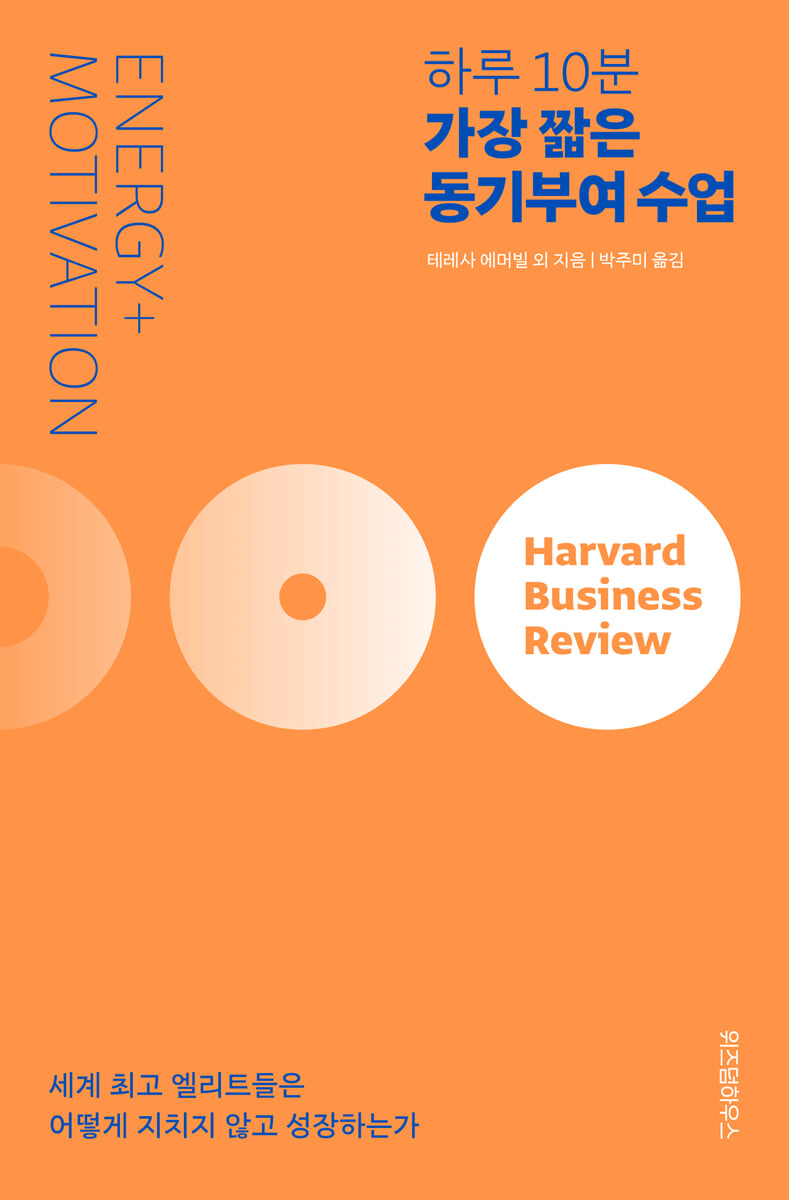
The shortest motivational lesson of 10 minutes a day
 |
Description
Book Introduction
How the World's Top Elite Grow Without Tire
For those who want to overcome depression, anxiety, and burnout
Self-development experts provide comprehensive growth coaching.
Why do we burn out? The key to motivation isn't a single, powerful punch, but rather the ability to persevere until you reach your goal.
This book is a selection of columns by world-renowned self-development experts, including Daniel Cable of the best-selling "Life Transformation Project" and Sean Archer of "Big Potential," carefully selected by Harvard Business Review. It provides information on how to effectively manage energy and continuously remind yourself of your goals to anyone struggling with motivation, including new employees, leaders, and students.
If you've ever wondered how the world's best people use their energy and find motivation, this book will give you the simple, clear answers in just 10 minutes a day.
For those who want to overcome depression, anxiety, and burnout
Self-development experts provide comprehensive growth coaching.
Why do we burn out? The key to motivation isn't a single, powerful punch, but rather the ability to persevere until you reach your goal.
This book is a selection of columns by world-renowned self-development experts, including Daniel Cable of the best-selling "Life Transformation Project" and Sean Archer of "Big Potential," carefully selected by Harvard Business Review. It provides information on how to effectively manage energy and continuously remind yourself of your goals to anyone struggling with motivation, including new employees, leaders, and students.
If you've ever wondered how the world's best people use their energy and find motivation, this book will give you the simple, clear answers in just 10 minutes a day.
- You can preview some of the book's contents.
Preview
index
Chapter 1.
Fuel Your Passion with Small Successes: The Power of Forward Movement to Transform Your Inner State of Work
Chapter 2.
Focus on what you want instead of forcing a smile: How to reduce the stress of doing things you don't want to do.
Chapter 3.
Willpower Alone Doesn't Get You There: How to Break the Habit of Procrastination
Chapter 4.
Increase Energy Efficiency Through Self-Regulation: Four Ways to Effectively Manage Your Energy
Chapter 5.
When Motivation Drops, Focus on Results: How to Break Free from the Illusion of Motivation
Chapter 6.
Connectedness Energizes Organizations: The Relationship Energy That Drives Peak Performance
Chapter 7.
Find Your Own Energy Recharge: Mental Energy Management for Women Leaders
Chapter 8.
Accept the reality first: Five ways to focus your energy in a crisis.
Chapter 9.
Resilience begins with rest: Resilience gained through recharging rather than enduring.
Chapter 10.
Satisfying Higher Needs: Maslow's Illusion on Motivation
Chapter 11.
Good Leaders Focus on the Exploration System: How to Motivate Team Members
Fuel Your Passion with Small Successes: The Power of Forward Movement to Transform Your Inner State of Work
Chapter 2.
Focus on what you want instead of forcing a smile: How to reduce the stress of doing things you don't want to do.
Chapter 3.
Willpower Alone Doesn't Get You There: How to Break the Habit of Procrastination
Chapter 4.
Increase Energy Efficiency Through Self-Regulation: Four Ways to Effectively Manage Your Energy
Chapter 5.
When Motivation Drops, Focus on Results: How to Break Free from the Illusion of Motivation
Chapter 6.
Connectedness Energizes Organizations: The Relationship Energy That Drives Peak Performance
Chapter 7.
Find Your Own Energy Recharge: Mental Energy Management for Women Leaders
Chapter 8.
Accept the reality first: Five ways to focus your energy in a crisis.
Chapter 9.
Resilience begins with rest: Resilience gained through recharging rather than enduring.
Chapter 10.
Satisfying Higher Needs: Maslow's Illusion on Motivation
Chapter 11.
Good Leaders Focus on the Exploration System: How to Motivate Team Members
Detailed image

Into the book
I've realized that of all the things that motivate employees and make them feel good about their work, the most important thing is simply to move forward in work that they find meaningful.
This is the law of progress.
---「Chapter 1.
From “Find Your Passion Through Small Successes”
At work, most people feel pressured to run out of time due to the heavy workload.
If that happens, it's easy to get caught in a situation where you feel like you're on a treadmill.
To put it another way, it's a situation where you run nonstop all the time.
This refers to a situation where you feel like you're juggling a lot of balls, but you're not making progress on the core tasks that require creativity and establishing yourself as an innovative leader.
To avoid this situation, we need to set aside at least 30 to 60 minutes a day to fully focus on something that is meaningful to us and important to the organization, without being distracted by the requests of others.
To do this, you may sometimes have to arrive at work 30 minutes earlier than others or go home 30 minutes later.
You may need to go to a coffee shop or find an unused conference room.
I also recommend recording the small accomplishments you achieve each day.
This will help you create a positive inner state in your work life and greatly motivate you.
---「Chapter 1.
From “Find Your Passion Through Small Successes”
If you get caught up in the mindset that 'now is the time to work', it's easy to think of everything as 'things that need to be done'.
And most of the time, their finances are not good enough to make work a hobby.
However, if you give your assigned tasks meaning in themselves, such as "freely discussing with colleagues and generating creative ideas" or "making the system more efficient," you can elevate your job from something that is required of you to something you choose.
To be clear, I'm not suggesting you blindly think positively or rationalize away realistic problems.
The trick is to exploit the subtle trap of language that defines work you enjoy as work you don't want to do.
If you can't find something you truly love to do in your core job, it may be a sign that a change is needed.
---「Chapter 2.
From "Focus on what you want instead of forcing a smile"
There are times when we do something to achieve something or achieve something, that is, to become better than we are now.
For example, you might think, 'If I successfully complete a project, my team leader will appreciate me' or 'If I exercise regularly, I'll look great.'
In psychology, this is called achievement orientation.
Research shows that achievement-oriented people are motivated by the idea of gaining something and perform best when they are motivated and optimistic.
Doesn't that sound great? Well, if you're afraid of messing up a task that seems unclear, achievement-oriented isn't for you.
Anxiety and doubt always weaken our motivation to achieve and lower our will to even try something.
Rather than becoming weak and doubting what needs to be done, it is necessary to find ways to do things ideally well.
This is where stability orientation can be a useful tool.
---「Chapter 3.
From “You can’t move forward with willpower alone”
So how can we recover and build resilience? Most people assume that if they stop responding to emails or writing, their brains will naturally recover and they'll be recharged by the next morning.
But we've all probably had the experience of lying in bed for hours, unable to fall asleep because of thoughts swirling around in our heads.
Even if you lie in bed and rest for eight hours like that, you will still feel tired the next morning.
Rest and recovery are different.
The stopped state and the recovered state are also different.
This is the law of progress.
---「Chapter 1.
From “Find Your Passion Through Small Successes”
At work, most people feel pressured to run out of time due to the heavy workload.
If that happens, it's easy to get caught in a situation where you feel like you're on a treadmill.
To put it another way, it's a situation where you run nonstop all the time.
This refers to a situation where you feel like you're juggling a lot of balls, but you're not making progress on the core tasks that require creativity and establishing yourself as an innovative leader.
To avoid this situation, we need to set aside at least 30 to 60 minutes a day to fully focus on something that is meaningful to us and important to the organization, without being distracted by the requests of others.
To do this, you may sometimes have to arrive at work 30 minutes earlier than others or go home 30 minutes later.
You may need to go to a coffee shop or find an unused conference room.
I also recommend recording the small accomplishments you achieve each day.
This will help you create a positive inner state in your work life and greatly motivate you.
---「Chapter 1.
From “Find Your Passion Through Small Successes”
If you get caught up in the mindset that 'now is the time to work', it's easy to think of everything as 'things that need to be done'.
And most of the time, their finances are not good enough to make work a hobby.
However, if you give your assigned tasks meaning in themselves, such as "freely discussing with colleagues and generating creative ideas" or "making the system more efficient," you can elevate your job from something that is required of you to something you choose.
To be clear, I'm not suggesting you blindly think positively or rationalize away realistic problems.
The trick is to exploit the subtle trap of language that defines work you enjoy as work you don't want to do.
If you can't find something you truly love to do in your core job, it may be a sign that a change is needed.
---「Chapter 2.
From "Focus on what you want instead of forcing a smile"
There are times when we do something to achieve something or achieve something, that is, to become better than we are now.
For example, you might think, 'If I successfully complete a project, my team leader will appreciate me' or 'If I exercise regularly, I'll look great.'
In psychology, this is called achievement orientation.
Research shows that achievement-oriented people are motivated by the idea of gaining something and perform best when they are motivated and optimistic.
Doesn't that sound great? Well, if you're afraid of messing up a task that seems unclear, achievement-oriented isn't for you.
Anxiety and doubt always weaken our motivation to achieve and lower our will to even try something.
Rather than becoming weak and doubting what needs to be done, it is necessary to find ways to do things ideally well.
This is where stability orientation can be a useful tool.
---「Chapter 3.
From “You can’t move forward with willpower alone”
So how can we recover and build resilience? Most people assume that if they stop responding to emails or writing, their brains will naturally recover and they'll be recharged by the next morning.
But we've all probably had the experience of lying in bed for hours, unable to fall asleep because of thoughts swirling around in our heads.
Even if you lie in bed and rest for eight hours like that, you will still feel tired the next morning.
Rest and recovery are different.
The stopped state and the recovered state are also different.
---Chapter 9.
From "Resilience begins with rest"
From "Resilience begins with rest"
Publisher's Review
How the World's Top Elite Grow Without Tire
For those who want to overcome depression, anxiety, and burnout
Comprehensive growth coaching from world-renowned self-development experts
Recently, the number of office workers complaining of burnout has been increasing.
According to a survey by a job portal, 95% of workers have experienced burnout.
Burnout has become such a widespread social phenomenon that the World Health Organization classified it as a problem in its International Classification of Diseases in 2019.
Why do we burn out? Is it because we lack mental fortitude? People often believe that if they have a powerful insight, they can overcome all adversity and achieve success.
Reality is different.
Everyone moves forward quickly immediately after setting a goal.
But after some time, when your energy is depleted, you forget your goals and fall into burnout.
In other words, the key to motivation is not one powerful punch, but rather keeping you going until you reach your goal.
"The Shortest Motivational Lesson: 10 Minutes a Day" provides 11 ways to effectively manage energy and consistently remind yourself of your goals for anyone who needs motivation to grow, whether it's an office worker who doesn't know why they're doing what they do, a student who's lost their purpose and wandering, or a leader who's wondering how to inspire their followers.
Harvard Business Review has carefully selected columns from world-renowned self-development experts, including Daniel Cable of the best-selling "The Life Transformation Project" and Sean Archer of "Big Potential," to correct misconceptions about motivation and discuss ways to cultivate the resilience necessary for continuous growth.
Strategic rest builds resilience!
10-Minute Recovery Training a Day with HBR's Curated Self-Improvement Guide
There are many misconceptions and truths about motivation discussed in this book.
Among them, the most interesting one is that 'motivation also requires energy.'
To stay motivated, you need resilience to keep your body and mind in balance.
Because it takes energy to switch from rest mode to forward mode.
This is why this book covers both motivation and energy management.
We often think that when we get off work, sleep, and wake up, our energy will automatically be recharged.
But even if you're not thinking about work, if you're watching upsetting news or stressed out by unresolved household chores, you won't be able to recharge your energy properly.
And people with high resilience know how to take high-intensity breaks before their energy is completely depleted.
The second is that 'motivation is nothing special'.
We over-idealize motivation.
I believe that at the starting point of great change, there must be a greater motivation, and that the more achievement-oriented a person is, the higher the probability of success.
But motivation is literally just a 'reason to do something', and it doesn't have to be something grand.
Rather, ordinary thoughts like, ‘If I don’t do this now, I’ll get in trouble with my team leader’ or ‘I have a family to take care of’ can be the driving force.
Rather than waiting for inspiration to strike, you can make progress by finding reasons to do what's right in front of you and taking small steps toward it.
If you need a powerful motivation to move forward right now, start with the easy and clear motivational lectures provided in this book, just 10 minutes a day.
As you explore how the world's best talent uses their energy and finds motivation, you'll find yourself growing in resilience.
HBR Self-Improvement Curation
This series is a pocketbook series that Harvard Business Review has personally selected columns by prominent figures useful for self-development for busy modern people who want to grow, and helps them read them easily anytime, anywhere.
For those who want to overcome depression, anxiety, and burnout
Comprehensive growth coaching from world-renowned self-development experts
Recently, the number of office workers complaining of burnout has been increasing.
According to a survey by a job portal, 95% of workers have experienced burnout.
Burnout has become such a widespread social phenomenon that the World Health Organization classified it as a problem in its International Classification of Diseases in 2019.
Why do we burn out? Is it because we lack mental fortitude? People often believe that if they have a powerful insight, they can overcome all adversity and achieve success.
Reality is different.
Everyone moves forward quickly immediately after setting a goal.
But after some time, when your energy is depleted, you forget your goals and fall into burnout.
In other words, the key to motivation is not one powerful punch, but rather keeping you going until you reach your goal.
"The Shortest Motivational Lesson: 10 Minutes a Day" provides 11 ways to effectively manage energy and consistently remind yourself of your goals for anyone who needs motivation to grow, whether it's an office worker who doesn't know why they're doing what they do, a student who's lost their purpose and wandering, or a leader who's wondering how to inspire their followers.
Harvard Business Review has carefully selected columns from world-renowned self-development experts, including Daniel Cable of the best-selling "The Life Transformation Project" and Sean Archer of "Big Potential," to correct misconceptions about motivation and discuss ways to cultivate the resilience necessary for continuous growth.
Strategic rest builds resilience!
10-Minute Recovery Training a Day with HBR's Curated Self-Improvement Guide
There are many misconceptions and truths about motivation discussed in this book.
Among them, the most interesting one is that 'motivation also requires energy.'
To stay motivated, you need resilience to keep your body and mind in balance.
Because it takes energy to switch from rest mode to forward mode.
This is why this book covers both motivation and energy management.
We often think that when we get off work, sleep, and wake up, our energy will automatically be recharged.
But even if you're not thinking about work, if you're watching upsetting news or stressed out by unresolved household chores, you won't be able to recharge your energy properly.
And people with high resilience know how to take high-intensity breaks before their energy is completely depleted.
The second is that 'motivation is nothing special'.
We over-idealize motivation.
I believe that at the starting point of great change, there must be a greater motivation, and that the more achievement-oriented a person is, the higher the probability of success.
But motivation is literally just a 'reason to do something', and it doesn't have to be something grand.
Rather, ordinary thoughts like, ‘If I don’t do this now, I’ll get in trouble with my team leader’ or ‘I have a family to take care of’ can be the driving force.
Rather than waiting for inspiration to strike, you can make progress by finding reasons to do what's right in front of you and taking small steps toward it.
If you need a powerful motivation to move forward right now, start with the easy and clear motivational lectures provided in this book, just 10 minutes a day.
As you explore how the world's best talent uses their energy and finds motivation, you'll find yourself growing in resilience.
HBR Self-Improvement Curation
This series is a pocketbook series that Harvard Business Review has personally selected columns by prominent figures useful for self-development for busy modern people who want to grow, and helps them read them easily anytime, anywhere.
GOODS SPECIFICS
- Date of issue: February 14, 2024
- Page count, weight, size: 144 pages | 230g | 125*190*11mm
- ISBN13: 9791171711307
- ISBN10: 1171711301
You may also like
카테고리
korean


korean

![GQ KOREA Mark (Monthly): December [2025]](http://librairie.coreenne.fr/cdn/shop/files/8ef265dbbfbf186523ed75ba7319009d.jpg?v=1765340328&width=3840)


