

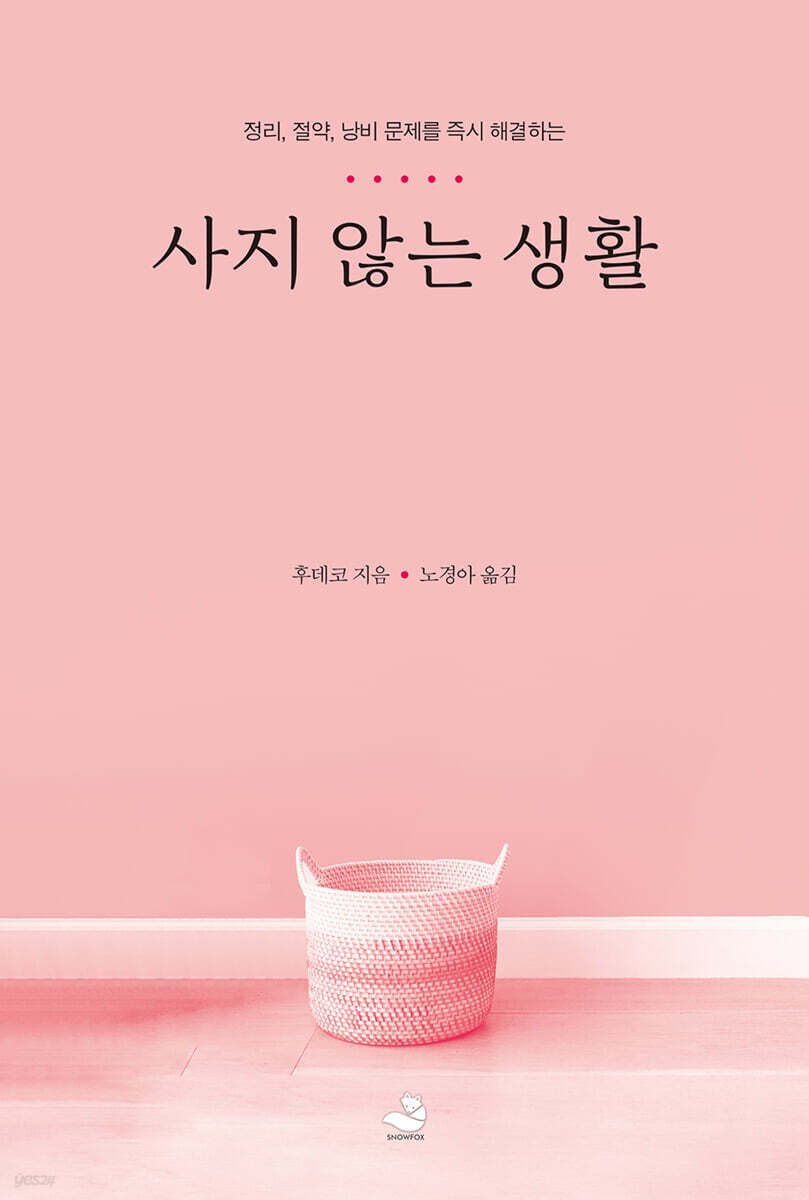
Life without buying
 |
Description
Book Introduction
Do you really need that thing? Things and money, time and bankbook, 25 ways to enrich your life. This book, "The Life Without Buying," is about the addiction to things of modern people who are accustomed to "buying everything." This book serves as a wake-up call to those of us who live in a house already filled with things we have collected, but are addicted to the habit of perceiving things with slightly different designs or functions as new. The author of the book presented a new perspective on the mindless buying of everything, and this caused a great revolt among the public. The author points out that the variety and detail of products from Japan, Korea, and China are driving people to buy more and more frequently, and he interprets this as stemming from a lack of a subconscious mindset that dictates that people should have more. It refers to a series of shopping addictions in which one sees something that looks better, flashier, or has more features and perceives it as a new item that one does not have. Ultimately, most of us are not only wasting our homes on the maintenance of unused items, but we're also spending precious money on items that will only last a short time before becoming difficult to dispose of. He warns that once you get into the habit of buying something, you will immediately react by saying, "I have to buy that." Not everyone buys things with the same features or design. However, the author emphasizes that we have been reacting almost unconsciously to the sales tactics of selling the same function in slightly different ways. Chapter 1 begins by raising awareness of the problem of buying anything without thinking. I talk about my shopping habits now, why I keep buying things, and what I'm trying to fill up. Chapters 2 and 3 are realistic and can be transformed into people who can't afford to buy real things. From whether bulk buying really pays off to 16 ways to avoid impulse buying, how to distinguish between needs and wants, and how to take stock of everything you own, this book offers a variety of practical tips to help you start living a no-buy lifestyle today. |
- You can preview some of the book's contents.
Preview
index
Prologue | In Search of the Real Secret Hidden Behind Fantasy and Hope
Chapter 1.
What are your shopping habits?
1.
What are your shopping habits?
2.
Why do we continue to live?
3.
Things to fill with shopping
4.
The story of shopaholic Fudeko
5.
Is bulk buying really beneficial?
6.
Money doesn't just go out once
Chapter 2.
How to Change Your Shopping Habits
1.
Let's change it like this
2.
challenge
3.
Fifteen Ways to Avoid Impulse Buying
4.
The psychology of rushing like moths to a flame for events and discounts
5.
Shop with a sense of purpose
6.
Distinguish between needs and wants
Chapter 3.
Organizing your belongings, the beginning of a "buy-free life"
1.
Benefits of Throwing Away
2.
Throwing away is saving
3.
The freedom that comes only after letting go
4.
But if it's still difficult to 'throw it away'
5.
Six Questions to Find More Throwaway Items
Chapter 4: What's More Important Than Money
1.
How to reduce money stress?
2.
Realize the Money Shame
3.
Insufficient Mind vs. Sufficient Mind
4.
Resources other than money
5.
What is more important than money is invisible to the eye.
6.
Is money really the most important thing?
7.
Set priorities
In conclusion
The most important thing is to build up little by little every day.
Chapter 1.
What are your shopping habits?
1.
What are your shopping habits?
2.
Why do we continue to live?
3.
Things to fill with shopping
4.
The story of shopaholic Fudeko
5.
Is bulk buying really beneficial?
6.
Money doesn't just go out once
Chapter 2.
How to Change Your Shopping Habits
1.
Let's change it like this
2.
challenge
3.
Fifteen Ways to Avoid Impulse Buying
4.
The psychology of rushing like moths to a flame for events and discounts
5.
Shop with a sense of purpose
6.
Distinguish between needs and wants
Chapter 3.
Organizing your belongings, the beginning of a "buy-free life"
1.
Benefits of Throwing Away
2.
Throwing away is saving
3.
The freedom that comes only after letting go
4.
But if it's still difficult to 'throw it away'
5.
Six Questions to Find More Throwaway Items
Chapter 4: What's More Important Than Money
1.
How to reduce money stress?
2.
Realize the Money Shame
3.
Insufficient Mind vs. Sufficient Mind
4.
Resources other than money
5.
What is more important than money is invisible to the eye.
6.
Is money really the most important thing?
7.
Set priorities
In conclusion
The most important thing is to build up little by little every day.
Detailed image
.jpg)
Into the book
Niche products, as we refer to them here, are products that satisfy special needs or special customers who occupy a very small portion of the market.
In particular, Korean, Chinese, and Japanese companies, which pursue perfection down to the smallest detail, are developing and selling all kinds of convenient products targeting this special demand.
There are several types of egg timers.
Popular stores sell egg timers that help you cook eggs according to their hard-boiled, soft-boiled, and hard-boiled levels, and Amazon also carries similar products.
This is a transparent product that changes color from the outside when placed in a pot with eggs, allowing you to visually see how much the color has changed and determine the degree of doneness of the eggs.
--- p.23
But, whether it's fashion or electronics, new products are constantly appearing.
So, they often replace the items they bought previously with new ones even though they are still usable.
Sometimes, we buy things that are good for showing off because we want to 'stand out from others'.
In fact, these days, almost everyone uses social media like Instagram, so there are many cases where people buy things that make their lives look cool in order to become popular, get a lot of likes, and increase their followers.
--- p.31
But if you look into it, dopamine is secreted the most not when you shop, but before you shop, that is, when you think, 'I'm going to get something new soon.'
Anticipation is what triggers the release of dopamine.
So, as soon as you finish shopping, the happiness disappears.
So I want to go shopping again and feel happy.
At that time, I also kept repeating the process of 'I want to experience the excitement before shopping → I go shopping → I lose interest → I want to feel excitement again → I go shopping → I lose interest'.
--- p.45
Whether it's food or non-food, if you have large amounts of it at home, it ends up being wasted.
Humans hate losing so much that they tend to be frugal with anything they have.
On the other hand, if it piles up, you just use it without thinking.
Even if you buy in bulk to lower the unit price, overeating or overusing in this way will actually increase your expenses.
--- p.55
If you think, "This can't go on," pick out the part you most want to change and figure out a specific way to improve it.
It's also a good idea to give yourself specific tasks like "not going to the convenience store for a month" or "not buying snacks for two months" and try to put them into practice.
In particular, Korean, Chinese, and Japanese companies, which pursue perfection down to the smallest detail, are developing and selling all kinds of convenient products targeting this special demand.
There are several types of egg timers.
Popular stores sell egg timers that help you cook eggs according to their hard-boiled, soft-boiled, and hard-boiled levels, and Amazon also carries similar products.
This is a transparent product that changes color from the outside when placed in a pot with eggs, allowing you to visually see how much the color has changed and determine the degree of doneness of the eggs.
--- p.23
But, whether it's fashion or electronics, new products are constantly appearing.
So, they often replace the items they bought previously with new ones even though they are still usable.
Sometimes, we buy things that are good for showing off because we want to 'stand out from others'.
In fact, these days, almost everyone uses social media like Instagram, so there are many cases where people buy things that make their lives look cool in order to become popular, get a lot of likes, and increase their followers.
--- p.31
But if you look into it, dopamine is secreted the most not when you shop, but before you shop, that is, when you think, 'I'm going to get something new soon.'
Anticipation is what triggers the release of dopamine.
So, as soon as you finish shopping, the happiness disappears.
So I want to go shopping again and feel happy.
At that time, I also kept repeating the process of 'I want to experience the excitement before shopping → I go shopping → I lose interest → I want to feel excitement again → I go shopping → I lose interest'.
--- p.45
Whether it's food or non-food, if you have large amounts of it at home, it ends up being wasted.
Humans hate losing so much that they tend to be frugal with anything they have.
On the other hand, if it piles up, you just use it without thinking.
Even if you buy in bulk to lower the unit price, overeating or overusing in this way will actually increase your expenses.
--- p.55
If you think, "This can't go on," pick out the part you most want to change and figure out a specific way to improve it.
It's also a good idea to give yourself specific tasks like "not going to the convenience store for a month" or "not buying snacks for two months" and try to put them into practice.
--- p.79
Publisher's Review
'The key to saving money is to live without buying.'
The world is full of people who think, 'I don't have money,' 'I wish I had more money,' or 'I need to save more.'
There are many people who tighten their belts and strive to save money in all aspects of life.
But in reality, there is no need to force yourself to endure and save so hard.
All you have to do is change your current shopping habits of constantly buying things you don't need.
Then, you will naturally have some spare money.
Many people constantly think about cutting back on spending, yet they continue to buy unnecessary cosmetics, groceries, and other items without even realizing that they are doing so.
So, even when people say they are reducing their spending, they often end up limiting themselves to reducing fixed food expenses.
“No, I don’t waste money.
No matter how much I think about it, there is nothing more to reduce.”
Perhaps you'd like to say something like that? But most people convince themselves, "I absolutely have to buy this," but in reality, they end up buying things they don't need.
Let's take detergent as an example.
Even for personal hygiene, there are many types, such as for washing the face, hair, and body.
Household detergents are divided into cleaning detergents, dish detergents, and clothing detergents.
Even cleaning products are divided into floor and bathroom sprays, and there are even separate sprays for toilets and stain removal.
In fact, you can keep your body and home clean without having to stock up on all these different cleaning products.
There are too many people who buy things they don't need or things that don't interfere with their lives without any suspicion.
If you just change these habits, you will have more money to spare and be able to save more without having to work hard to save.
Perhaps you strive for simplicity and strive to stay organized every day. But don't let that stop you.
This is because such people may be continuously spending money on useless items without thinking.
So, let's take a closer look at how well the patterns below match your own.
1.
I have a lot of clothes to wear at home, but I buy pretty and inexpensive clothes that catch my eye.
2. How many times do you wear it?
But there are many other clothes, so after wearing them a few times, they get mixed in with the clothes I originally had.
3. I have a lot of clothes that I don't wear, but I can't throw them away because I think I might wear them someday.
Clothes keep piling up at home.
4. If your drawers are full, buy another storage case, hanger, or small cabinet.
But that too soon fills up.
5. When I see pretty and cheap clothes, I want to buy them again.
The clothes keep piling up.
I'm going to make up my mind and organize my clothes.
I decided to start by getting rid of the oldest clothes.
6. I'm so short on money these days, so I'm looking for a job that pays more than what I have now.
7. Still, since I have a new job, I think I need a few nice clothes, so I buy them again.
Once you get into the habit of buying things easily, whenever an opportunity arises, the thought 'I have to buy this and that' comes to mind.
From now on, you are a beginner in the life without buying.
What do you need to do today?
The world is full of people who think, 'I don't have money,' 'I wish I had more money,' or 'I need to save more.'
There are many people who tighten their belts and strive to save money in all aspects of life.
But in reality, there is no need to force yourself to endure and save so hard.
All you have to do is change your current shopping habits of constantly buying things you don't need.
Then, you will naturally have some spare money.
Many people constantly think about cutting back on spending, yet they continue to buy unnecessary cosmetics, groceries, and other items without even realizing that they are doing so.
So, even when people say they are reducing their spending, they often end up limiting themselves to reducing fixed food expenses.
“No, I don’t waste money.
No matter how much I think about it, there is nothing more to reduce.”
Perhaps you'd like to say something like that? But most people convince themselves, "I absolutely have to buy this," but in reality, they end up buying things they don't need.
Let's take detergent as an example.
Even for personal hygiene, there are many types, such as for washing the face, hair, and body.
Household detergents are divided into cleaning detergents, dish detergents, and clothing detergents.
Even cleaning products are divided into floor and bathroom sprays, and there are even separate sprays for toilets and stain removal.
In fact, you can keep your body and home clean without having to stock up on all these different cleaning products.
There are too many people who buy things they don't need or things that don't interfere with their lives without any suspicion.
If you just change these habits, you will have more money to spare and be able to save more without having to work hard to save.
Perhaps you strive for simplicity and strive to stay organized every day. But don't let that stop you.
This is because such people may be continuously spending money on useless items without thinking.
So, let's take a closer look at how well the patterns below match your own.
1.
I have a lot of clothes to wear at home, but I buy pretty and inexpensive clothes that catch my eye.
2. How many times do you wear it?
But there are many other clothes, so after wearing them a few times, they get mixed in with the clothes I originally had.
3. I have a lot of clothes that I don't wear, but I can't throw them away because I think I might wear them someday.
Clothes keep piling up at home.
4. If your drawers are full, buy another storage case, hanger, or small cabinet.
But that too soon fills up.
5. When I see pretty and cheap clothes, I want to buy them again.
The clothes keep piling up.
I'm going to make up my mind and organize my clothes.
I decided to start by getting rid of the oldest clothes.
6. I'm so short on money these days, so I'm looking for a job that pays more than what I have now.
7. Still, since I have a new job, I think I need a few nice clothes, so I buy them again.
Once you get into the habit of buying things easily, whenever an opportunity arises, the thought 'I have to buy this and that' comes to mind.
From now on, you are a beginner in the life without buying.
What do you need to do today?
GOODS SPECIFICS
- Publication date: November 2, 2022
- Page count, weight, size: 252 pages | 442g | 135*195*17mm
- ISBN13: 9791191769241
- ISBN10: 1191769240
You may also like
카테고리
korean


korean

![ELLE 엘르 스페셜 에디션 A형 : 12월 [2025]](http://librairie.coreenne.fr/cdn/shop/files/b8e27a3de6c9538896439686c6b0e8fb.jpg?v=1766436872&width=3840)


