

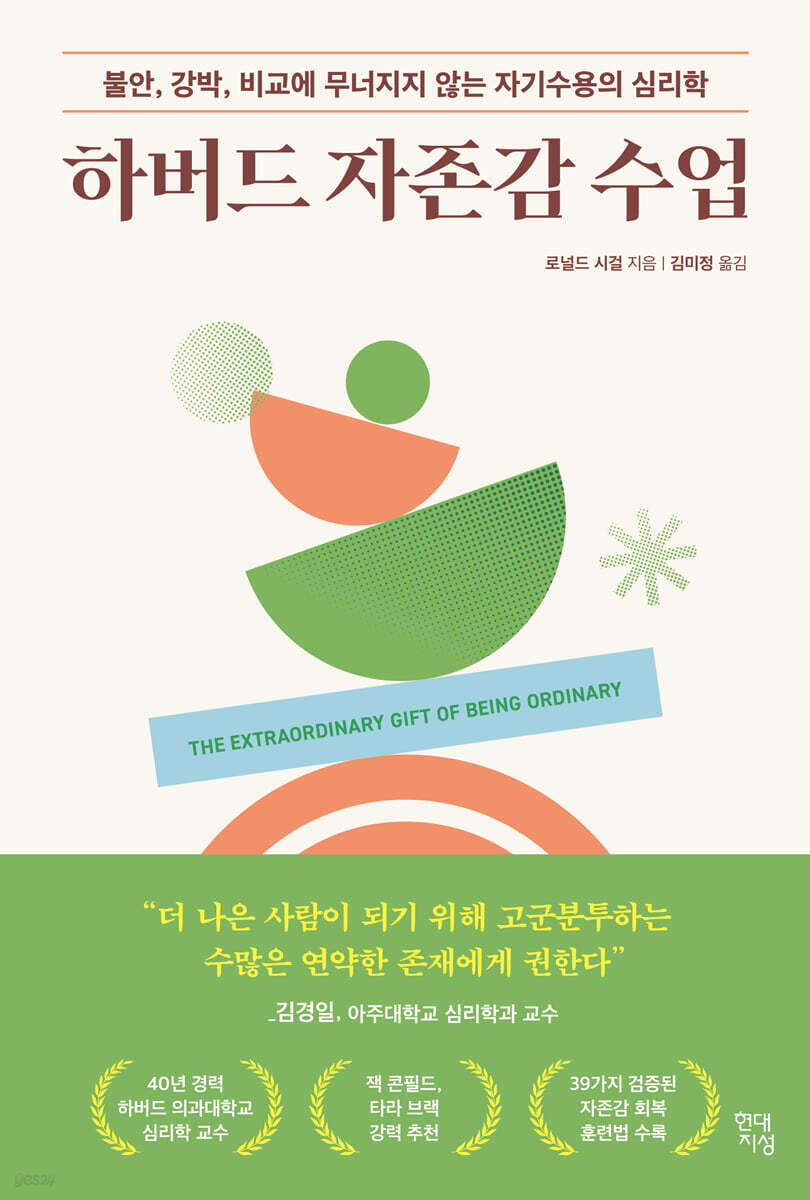
Harvard Self-Esteem Class
 |
Description
Book Introduction
“Struggling to become a better person
“I recommend it to countless fragile beings.”
Kim Kyung-il, Professor of Psychology at Ajou University
“This book will take you swimming toward near happiness.”
Judson Brewer, author of How Addiction Changes the Brain
A clinical psychologist with 40 years of experience at Harvard Medical School
A self-esteem recovery manual to read when life is painful.
- I often stay up all night thinking about what happened during the day.
- I have a lot of work to do, but I can't concentrate because I'm always checking social media and messages.
- When I come back from meeting people, I often think, 'I should have said this.'
- I'm afraid of being rejected, so I can't even ask for small favors and I'm afraid of talking to strangers.
- When emotions fluctuate, you tend to binge eat or overspend, and then regret it later.
If any of these apply to you, your self-esteem is at risk.
If you feel like nothing you do seems to work out, if you're always anxious because you're only showing your shortcomings, and if you often feel your emotions fluctuate and anger rises twelve times a day, the real cause is likely low self-esteem.
This is because an anxious mind begins with feeling ashamed and not being able to accept oneself as is.
The author of this book, Ronald Segal, is an authority on mindfulness who has taught in the psychology department at Harvard Medical School for over 40 years.
If Jon Kabat-Zinn created the concept of 'mindfulness,' Ronald Segal is the person who created and systematized the framework for applying mindfulness to the field of psychotherapy.
So to speak, he is the 'teacher of psychological counselors.'
Drawing on his own painful experience of comparison, 40 years of clinical experience, and a wide range of research, Dr. Siegel argues that the obsession with being better than others leads to anxiety, nervousness, depression, and anger.
Furthermore, it contains specific and practical solutions that you can try out right away while reading.
This is a good 'self-esteem recovery manual' to read when life is painful and you feel depressed.
A fresh graduate who is worried because her job doesn't seem to fit her personality, an office worker who is angry because her boss doesn't seem to recognize her hard work, a working mom in her 40s who struggles with guilt and feelings of inadequacy while juggling work and family, and a person in their 60s who feels anxious and nervous because their social standing seems to be diminishing. As you read about the process of characters who feel like they are your own story diagnosing their problems and finding treatments, you will naturally be able to figure out what kind of state you are in and find the perfect solution.
“I recommend it to countless fragile beings.”
Kim Kyung-il, Professor of Psychology at Ajou University
“This book will take you swimming toward near happiness.”
Judson Brewer, author of How Addiction Changes the Brain
A clinical psychologist with 40 years of experience at Harvard Medical School
A self-esteem recovery manual to read when life is painful.
- I often stay up all night thinking about what happened during the day.
- I have a lot of work to do, but I can't concentrate because I'm always checking social media and messages.
- When I come back from meeting people, I often think, 'I should have said this.'
- I'm afraid of being rejected, so I can't even ask for small favors and I'm afraid of talking to strangers.
- When emotions fluctuate, you tend to binge eat or overspend, and then regret it later.
If any of these apply to you, your self-esteem is at risk.
If you feel like nothing you do seems to work out, if you're always anxious because you're only showing your shortcomings, and if you often feel your emotions fluctuate and anger rises twelve times a day, the real cause is likely low self-esteem.
This is because an anxious mind begins with feeling ashamed and not being able to accept oneself as is.
The author of this book, Ronald Segal, is an authority on mindfulness who has taught in the psychology department at Harvard Medical School for over 40 years.
If Jon Kabat-Zinn created the concept of 'mindfulness,' Ronald Segal is the person who created and systematized the framework for applying mindfulness to the field of psychotherapy.
So to speak, he is the 'teacher of psychological counselors.'
Drawing on his own painful experience of comparison, 40 years of clinical experience, and a wide range of research, Dr. Siegel argues that the obsession with being better than others leads to anxiety, nervousness, depression, and anger.
Furthermore, it contains specific and practical solutions that you can try out right away while reading.
This is a good 'self-esteem recovery manual' to read when life is painful and you feel depressed.
A fresh graduate who is worried because her job doesn't seem to fit her personality, an office worker who is angry because her boss doesn't seem to recognize her hard work, a working mom in her 40s who struggles with guilt and feelings of inadequacy while juggling work and family, and a person in their 60s who feels anxious and nervous because their social standing seems to be diminishing. As you read about the process of characters who feel like they are your own story diagnosing their problems and finding treatments, you will naturally be able to figure out what kind of state you are in and find the perfect solution.
- You can preview some of the book's contents.
Preview
index
Praise poured in for this book
Entering
Part 1: How long should we live comparing ourselves to others?
Chapter 1: Why You Can't Be Happy No Matter How Hard You Try
The day when you're satisfied with who you are now will never come. │ The true source of fear and anger. │ Everyone's self-esteem standards are different. │ Is a positive self-image essential for happiness? │ "Despair is the fertilizer of enlightenment."
Chapter 2: Two Conflicting Instincts Within Us
Competition is animal nature │ The altruistic instinct that has allowed us to survive │ The wolf I feed wins
Part 2: How to Trust in Yourself and Move Forward
Chapter 3: The True Freedom That Mindfulness Brings
Treat your mind like a puppy │ Focus on the present experience │ Mindfulness also requires practice
Chapter 4: Let's Break Free from the Illusion of "I"
There is no such thing as a 'self' │ Embrace the shadow within you │ We see the world as we think │ How to face burdensome emotions │ Get out of the well and experience a wider world
Part 3: Checking Your Habit of Criticizing Yourself
Chapter 5: How Much Success Do You Need to Be Satisfied?
Why Achievement Doesn't Last | How to Find Meaningful Goals | The Illusion of Being Better Than Average | We Don't Need to Be Special
Chapter 6: How to Let Go of the Pressure to Prove Yourself
Too much self-esteem is worse than too little │ The lies we post on social media │ Focus on self-control rather than self-esteem │ Find peace in the ordinary
Chapter 7: Don't Obsess Over Appearance
Why We're Obsessed with Unnecessary Boasting │ Be Honest About Your Inferiority │ Avoid the Trap of the Latest Trends │ There's Dignity in Small Things │ How to Free Yourself from the Competitive Instinct
Chapter 8: Why We Can't Quit Social Media
The Neurobiological Mechanism of Addiction │ The Secret of People Who Are Likeable Even If They Are Not Better Than Others │ Recognize Your Addictive Behavior │ Avoid Triggers │ Addiction Comes When You Ignore Pain │ The Secret to Sustainable Pleasure
Part 4: Breaking Free from Anger and Anxiety and Finding Happiness Near You
Chapter 9: Salvation in Deep Relationships
The relationship between love and self-esteem │ Self-centered love has its limits │ Be honest and respectful of others │ Competitiveness leads to deprivation │ Take off the colored glasses of anger and see things as they are │ Let go of pride and become a team player │ Break free from inferiority complex and explore the shadows within yourself │ Finding common ground creates a sense of connection
Chapter 10: The Power of Compassion to Set Us Free
The Origin of the Instinct to Care for Others │ The Power of Loving-Kindness Meditation to Cultivate Compassion │ “If I were that person, would I have acted differently?” │ I Must Embrace Myself First │ Only by Accepting Myself Can I Get Along Well with Others
Chapter 11: Only by fully experiencing pain can one heal.
To manage your emotions, first name them │ Why do we feel shame │ A society that encourages shame │ Separating guilt and shame │ Talk to the voice inside me that criticizes me │ Look at myself with the eyes of a loving adult
Chapter 12: Separating Myself from My Actions
Why We Criticize Ourselves Harshly │ “It’s Not That You’re Bad, It’s That Your Behavior Is Inappropriate” │ Trying to Be Incorrectly Perfect │ There Is No Such Thing as a “True Self” │ Where Is the Boundary Between Me and the World?
Chapter 13: Ordinariness is the Most Precious Thing
The Curse of Specialness │ How to Be Kind to Yourself │ Facing Aging and Death │ Embracing Meaninglessness Brings Happiness
Chapter 14: The Path to Happiness Beyond Me
We are all connected │ “Be selfish.
Love one another.” │ The best medicine in times of pain is gratitude │ The courage to risk being hurt again │ Failure is an opportunity for growth
Acknowledgements
References
Entering
Part 1: How long should we live comparing ourselves to others?
Chapter 1: Why You Can't Be Happy No Matter How Hard You Try
The day when you're satisfied with who you are now will never come. │ The true source of fear and anger. │ Everyone's self-esteem standards are different. │ Is a positive self-image essential for happiness? │ "Despair is the fertilizer of enlightenment."
Chapter 2: Two Conflicting Instincts Within Us
Competition is animal nature │ The altruistic instinct that has allowed us to survive │ The wolf I feed wins
Part 2: How to Trust in Yourself and Move Forward
Chapter 3: The True Freedom That Mindfulness Brings
Treat your mind like a puppy │ Focus on the present experience │ Mindfulness also requires practice
Chapter 4: Let's Break Free from the Illusion of "I"
There is no such thing as a 'self' │ Embrace the shadow within you │ We see the world as we think │ How to face burdensome emotions │ Get out of the well and experience a wider world
Part 3: Checking Your Habit of Criticizing Yourself
Chapter 5: How Much Success Do You Need to Be Satisfied?
Why Achievement Doesn't Last | How to Find Meaningful Goals | The Illusion of Being Better Than Average | We Don't Need to Be Special
Chapter 6: How to Let Go of the Pressure to Prove Yourself
Too much self-esteem is worse than too little │ The lies we post on social media │ Focus on self-control rather than self-esteem │ Find peace in the ordinary
Chapter 7: Don't Obsess Over Appearance
Why We're Obsessed with Unnecessary Boasting │ Be Honest About Your Inferiority │ Avoid the Trap of the Latest Trends │ There's Dignity in Small Things │ How to Free Yourself from the Competitive Instinct
Chapter 8: Why We Can't Quit Social Media
The Neurobiological Mechanism of Addiction │ The Secret of People Who Are Likeable Even If They Are Not Better Than Others │ Recognize Your Addictive Behavior │ Avoid Triggers │ Addiction Comes When You Ignore Pain │ The Secret to Sustainable Pleasure
Part 4: Breaking Free from Anger and Anxiety and Finding Happiness Near You
Chapter 9: Salvation in Deep Relationships
The relationship between love and self-esteem │ Self-centered love has its limits │ Be honest and respectful of others │ Competitiveness leads to deprivation │ Take off the colored glasses of anger and see things as they are │ Let go of pride and become a team player │ Break free from inferiority complex and explore the shadows within yourself │ Finding common ground creates a sense of connection
Chapter 10: The Power of Compassion to Set Us Free
The Origin of the Instinct to Care for Others │ The Power of Loving-Kindness Meditation to Cultivate Compassion │ “If I were that person, would I have acted differently?” │ I Must Embrace Myself First │ Only by Accepting Myself Can I Get Along Well with Others
Chapter 11: Only by fully experiencing pain can one heal.
To manage your emotions, first name them │ Why do we feel shame │ A society that encourages shame │ Separating guilt and shame │ Talk to the voice inside me that criticizes me │ Look at myself with the eyes of a loving adult
Chapter 12: Separating Myself from My Actions
Why We Criticize Ourselves Harshly │ “It’s Not That You’re Bad, It’s That Your Behavior Is Inappropriate” │ Trying to Be Incorrectly Perfect │ There Is No Such Thing as a “True Self” │ Where Is the Boundary Between Me and the World?
Chapter 13: Ordinariness is the Most Precious Thing
The Curse of Specialness │ How to Be Kind to Yourself │ Facing Aging and Death │ Embracing Meaninglessness Brings Happiness
Chapter 14: The Path to Happiness Beyond Me
We are all connected │ “Be selfish.
Love one another.” │ The best medicine in times of pain is gratitude │ The courage to risk being hurt again │ Failure is an opportunity for growth
Acknowledgements
References
Detailed image

Into the book
The British philosopher Bertrand Russell lamented that our standards are constantly being stretched, leaving us feeling constantly inadequate.
“If you want glory, you might envy Napoleon, but Napoleon envied Caesar, Caesar envied Alexander, and Alexander envied Hercules, who never existed.”
--- From Chapter 1, “Why You Can’t Be Happy No Matter How Hard You Try”
I first went to a silent mindfulness meditation retreat when I was young because of depression.
It was a difficult time for me because of something that had to do with my college girlfriend and her ex-boyfriend.
It was a frustrating situation in many ways, one of which was that my self-esteem was completely destroyed.
'Why did you choose that guy over me? Was I lacking something?' I was filled with such thoughts.
The effects of meditation were powerful.
It was painful every time I thought of my girlfriend, but through that process, I was able to distance myself from the depression that had been plaguing me.
--- From Chapter 3, “The True Freedom That Mindfulness Brings”
Psychologist and pastor Norman Pierce has pointed out that polytheism has been common throughout history.
(…) Why is polytheism more common than monotheism? A careful examination of our experience reveals not a single, coherent, unified "I," but rather multiple parts that arise and then disappear.
--- From Chapter 4, “Let’s Break Free from the Illusion of ‘I’”
In modern society, complaining about being busy is considered a form of boasting.
A few years ago, a Thai anthropologist reportedly ended a letter to an American colleague with the words, "I hope you are very busy."
When a bewildered American called to ask what he meant, the Thai man explained it this way:
“In America, being busy seems to indicate social status.
Patients wait for doctors, lawyers wait for judges, and vice presidents wait for CEOs.
It was a proverb that wished you to rise to a high position.”
--- From Chapter 7, “Don’t Be Obsessed with Appearances”
Every time we receive a post, text, or email notification, we experience excitement.
My heart is pounding, wondering if this is news that will make me feel satisfied and popular.
Without likes, friends, and followers, social media wouldn't be very engaging.
The problem is that every time we receive positive attention, we become more addicted to this stimulation.
The release of dopamine, which activates the precuneus, makes us crave social media more.
--- From Chapter 8, “Why We Can’t Quit Social Media”
Shadows don't just disappear because we don't like them; they cast a shadow over how we view others, especially individuals or groups we ignore, and they interfere with our relationships.
That is why there is a tendency to stereotype other outgroups.
(…) The reason we dismiss overweight people or those with obvious addictions as gluttons or lack self-control is because most of us have a hard time accepting our own lack of self-control and feel a self-righteous sense of superiority.
--- From Chapter 9, “Salvation Is in Deep Relationships”
The problem is timing.
When we try to move beyond anger and blame and reach compassion too quickly, the real feelings don't disappear; they just get buried deep inside.
This is an avoidance behavior and shortcut called spiritual bypass, and it is very likely that the feelings will come back later and cause you pain again.
Therefore, only after you have accepted and fully felt your anger and judgment, can you calmly consider what caused the other person to act that way.
--- From Chapter 10, “The Power of Compassion That Sets Us Free”
Healthy regret is necessary, but not excessive.
Even if our regrets aren't great, we can still get better.
Because most of us first experience shame and negative self-judgment in childhood, we tend to view these emotions through a child's eyes.
So we confuse minor misdeeds with serious crimes, and we don't objectively examine ourselves and ask, 'How terrible was what I did?'
(…) Sometimes we think that there must be something wrong with us just because we are unhappy with ourselves, which is obviously a circular reasoning that is wrong.
--- From Chapter 11, “Only by Feeling Pain Fully Can You Heal”
We don't really look at how our 'self-esteem' is structured.
Because if we do that, the assumptions we have made will crumble from the ground up.
But when we realize how illusory our sense of self is, we can free ourselves from excessive self-concern and gain an objective perspective.
(…) If you practice mindfulness intensively, you can see the nature of consciousness more easily.
A stable, separate 'self' is never found within us.
Rather, it is closer to a flow of experience that changes as it constantly interacts with the environment.
“If you want glory, you might envy Napoleon, but Napoleon envied Caesar, Caesar envied Alexander, and Alexander envied Hercules, who never existed.”
--- From Chapter 1, “Why You Can’t Be Happy No Matter How Hard You Try”
I first went to a silent mindfulness meditation retreat when I was young because of depression.
It was a difficult time for me because of something that had to do with my college girlfriend and her ex-boyfriend.
It was a frustrating situation in many ways, one of which was that my self-esteem was completely destroyed.
'Why did you choose that guy over me? Was I lacking something?' I was filled with such thoughts.
The effects of meditation were powerful.
It was painful every time I thought of my girlfriend, but through that process, I was able to distance myself from the depression that had been plaguing me.
--- From Chapter 3, “The True Freedom That Mindfulness Brings”
Psychologist and pastor Norman Pierce has pointed out that polytheism has been common throughout history.
(…) Why is polytheism more common than monotheism? A careful examination of our experience reveals not a single, coherent, unified "I," but rather multiple parts that arise and then disappear.
--- From Chapter 4, “Let’s Break Free from the Illusion of ‘I’”
In modern society, complaining about being busy is considered a form of boasting.
A few years ago, a Thai anthropologist reportedly ended a letter to an American colleague with the words, "I hope you are very busy."
When a bewildered American called to ask what he meant, the Thai man explained it this way:
“In America, being busy seems to indicate social status.
Patients wait for doctors, lawyers wait for judges, and vice presidents wait for CEOs.
It was a proverb that wished you to rise to a high position.”
--- From Chapter 7, “Don’t Be Obsessed with Appearances”
Every time we receive a post, text, or email notification, we experience excitement.
My heart is pounding, wondering if this is news that will make me feel satisfied and popular.
Without likes, friends, and followers, social media wouldn't be very engaging.
The problem is that every time we receive positive attention, we become more addicted to this stimulation.
The release of dopamine, which activates the precuneus, makes us crave social media more.
--- From Chapter 8, “Why We Can’t Quit Social Media”
Shadows don't just disappear because we don't like them; they cast a shadow over how we view others, especially individuals or groups we ignore, and they interfere with our relationships.
That is why there is a tendency to stereotype other outgroups.
(…) The reason we dismiss overweight people or those with obvious addictions as gluttons or lack self-control is because most of us have a hard time accepting our own lack of self-control and feel a self-righteous sense of superiority.
--- From Chapter 9, “Salvation Is in Deep Relationships”
The problem is timing.
When we try to move beyond anger and blame and reach compassion too quickly, the real feelings don't disappear; they just get buried deep inside.
This is an avoidance behavior and shortcut called spiritual bypass, and it is very likely that the feelings will come back later and cause you pain again.
Therefore, only after you have accepted and fully felt your anger and judgment, can you calmly consider what caused the other person to act that way.
--- From Chapter 10, “The Power of Compassion That Sets Us Free”
Healthy regret is necessary, but not excessive.
Even if our regrets aren't great, we can still get better.
Because most of us first experience shame and negative self-judgment in childhood, we tend to view these emotions through a child's eyes.
So we confuse minor misdeeds with serious crimes, and we don't objectively examine ourselves and ask, 'How terrible was what I did?'
(…) Sometimes we think that there must be something wrong with us just because we are unhappy with ourselves, which is obviously a circular reasoning that is wrong.
--- From Chapter 11, “Only by Feeling Pain Fully Can You Heal”
We don't really look at how our 'self-esteem' is structured.
Because if we do that, the assumptions we have made will crumble from the ground up.
But when we realize how illusory our sense of self is, we can free ourselves from excessive self-concern and gain an objective perspective.
(…) If you practice mindfulness intensively, you can see the nature of consciousness more easily.
A stable, separate 'self' is never found within us.
Rather, it is closer to a flow of experience that changes as it constantly interacts with the environment.
--- From Chapter 12, “Separating Myself from My Actions”
Publisher's Review
Highly recommended by world-renowned mindfulness authorities Tara Brach and Jack Kornfield!
A book for those of you who are berating yourself for your emotional ups and downs today.
The number of "young people who have taken a break from work" who have not been able to find the job they want has reached 800,000, and the number of people in their 20s and 30s who are looking for a job after graduating from a four-year university is at an all-time high.
Although there is a lot of criticism that they are just playing around because their standards are high, they will not be as anxious and nervous as the person who is unable to work.
The fact that people in their 20s and 30s account for the largest proportion of all depression patients proves this fact.
No matter what I do, nothing works, I feel frustrated because I always see my shortcomings, I suffer from emotions that jump around twelve times a day, and I get endlessly angry at the society that doesn't work properly.
This existential crisis is not just a problem for the 2030s.
Regardless of age, the feeling that we are not contributing or that we are not important negatively impacts our self-esteem and well-being.
The author of this book, Ronald Segal, finds the cause of the anxiety, nervousness, depression, and anger experienced by modern people not in a simple problem of emotional control, but in a lack of self-esteem.
The cause is that you are ashamed of yourself and cannot accept yourself as you are.
The author, who has lectured in the psychology department at Harvard Medical School for over 40 years and has made significant contributions to applying mindfulness to psychotherapy, presents specific and clear solutions instead of providing vague instructions like other mindfulness guides.
It contains methods you can immediately put into practice as you read, such as examining your conspicuous spending habits, finding stability in your romantic relationships, and easing jealousy and anxiety around competitors.
If you're struggling with how to deal with the unexplainable emotions that come up in everyday life, this book will be the solution.
No more comparing, evaluating, or proving yourself!
We need the courage to be imperfect.
Although we know that self-esteem is important, few people truly understand what self-esteem is.
It's just a vague feeling of 'I feel the most precious'.
However, the author criticizes that idea as 'false self-esteem'.
In fact, because of these misconceptions, countless modern people suffer from a sense of deprivation and depression, thinking that they are not the best, as they peek into the daily lives of people who are better than them through social media and other means.
He emphasizes that 'true self-esteem' is not about thinking that you are better or special than others, but rather accepting yourself as you are now.
This book presents mindfulness as a solution to self-acceptance.
While most mindfulness meditation methods tend to be religious or Buddhist, Dr. Segal's long-term clinical and research experience in psychotherapy and workshops gives him a more practical perspective than most.
For those who ruminate on minor mistakes and evaluate themselves, she recommends intentionally engaging in strange behavior, such as wearing the wrong pair of socks or deliberately wandering the wrong way. For those who overspend to impress others, she suggests activities to reflect on their spending habits and emotions. For those who are addicted to social media and messengers out of anxiety that they might miss important messages, she gently teaches them how to control their impulses.
Furthermore, based on extensive research across various fields, including evolutionary psychology, social psychology, clinical psychology, and neurobiology, it introduces ways to break free from the human instinct of self-evaluation.
Even though I have been practicing clinical psychology for over 40 years, I candidly admit that it has not been easy for me to break free from the social framework of comparison. I also recommend that you practice continuously rather than just once.
Only when you embrace the ordinary can you truly become extraordinary.
The Psychology of Self-Acceptance That Doesn't Collapse into Anxiety, Obsession, or Depression
Have you ever ordered a custom drink at Starbucks? The author sharply criticizes how even the mundane act of creating your own drink carries a subtle message from modern society: the need to strive for distinction.
Furthermore, he says that the culture of having to be special compared to others has permeated the concept of self-esteem, causing confusion in the definition of self-esteem.
We think that if we become more successful, attractive, or smarter than we are now, we will be happy, but this assumption is completely wrong from the start.
Dr. Segal advises that the most important thing is to stop trying to find a "one perfect, unique self" and instead to deeply savor the experience of the moment and accept yourself as you are, changing from moment to moment.
Thus, he asserts that the secret to acquiring a firm mind that is not shaken by anything is “realizing one’s own ordinariness.”
If you're worried because you feel strangely depressed every time you meet your friends, if you've lost confidence because the period of preparing for exams or job hunting has been too long, if you're worried about yourself wandering around and not settling down properly at work or in a relationship, if you feel uncomfortable because you feel like you haven't done enough today, let's start by acknowledging the most ordinary person you are.
There's no need to struggle to be perfect or to get better.
Just as when we stop struggling and relax our bodies, they naturally float to the surface, so too does our life.
A book for those of you who are berating yourself for your emotional ups and downs today.
The number of "young people who have taken a break from work" who have not been able to find the job they want has reached 800,000, and the number of people in their 20s and 30s who are looking for a job after graduating from a four-year university is at an all-time high.
Although there is a lot of criticism that they are just playing around because their standards are high, they will not be as anxious and nervous as the person who is unable to work.
The fact that people in their 20s and 30s account for the largest proportion of all depression patients proves this fact.
No matter what I do, nothing works, I feel frustrated because I always see my shortcomings, I suffer from emotions that jump around twelve times a day, and I get endlessly angry at the society that doesn't work properly.
This existential crisis is not just a problem for the 2030s.
Regardless of age, the feeling that we are not contributing or that we are not important negatively impacts our self-esteem and well-being.
The author of this book, Ronald Segal, finds the cause of the anxiety, nervousness, depression, and anger experienced by modern people not in a simple problem of emotional control, but in a lack of self-esteem.
The cause is that you are ashamed of yourself and cannot accept yourself as you are.
The author, who has lectured in the psychology department at Harvard Medical School for over 40 years and has made significant contributions to applying mindfulness to psychotherapy, presents specific and clear solutions instead of providing vague instructions like other mindfulness guides.
It contains methods you can immediately put into practice as you read, such as examining your conspicuous spending habits, finding stability in your romantic relationships, and easing jealousy and anxiety around competitors.
If you're struggling with how to deal with the unexplainable emotions that come up in everyday life, this book will be the solution.
No more comparing, evaluating, or proving yourself!
We need the courage to be imperfect.
Although we know that self-esteem is important, few people truly understand what self-esteem is.
It's just a vague feeling of 'I feel the most precious'.
However, the author criticizes that idea as 'false self-esteem'.
In fact, because of these misconceptions, countless modern people suffer from a sense of deprivation and depression, thinking that they are not the best, as they peek into the daily lives of people who are better than them through social media and other means.
He emphasizes that 'true self-esteem' is not about thinking that you are better or special than others, but rather accepting yourself as you are now.
This book presents mindfulness as a solution to self-acceptance.
While most mindfulness meditation methods tend to be religious or Buddhist, Dr. Segal's long-term clinical and research experience in psychotherapy and workshops gives him a more practical perspective than most.
For those who ruminate on minor mistakes and evaluate themselves, she recommends intentionally engaging in strange behavior, such as wearing the wrong pair of socks or deliberately wandering the wrong way. For those who overspend to impress others, she suggests activities to reflect on their spending habits and emotions. For those who are addicted to social media and messengers out of anxiety that they might miss important messages, she gently teaches them how to control their impulses.
Furthermore, based on extensive research across various fields, including evolutionary psychology, social psychology, clinical psychology, and neurobiology, it introduces ways to break free from the human instinct of self-evaluation.
Even though I have been practicing clinical psychology for over 40 years, I candidly admit that it has not been easy for me to break free from the social framework of comparison. I also recommend that you practice continuously rather than just once.
Only when you embrace the ordinary can you truly become extraordinary.
The Psychology of Self-Acceptance That Doesn't Collapse into Anxiety, Obsession, or Depression
Have you ever ordered a custom drink at Starbucks? The author sharply criticizes how even the mundane act of creating your own drink carries a subtle message from modern society: the need to strive for distinction.
Furthermore, he says that the culture of having to be special compared to others has permeated the concept of self-esteem, causing confusion in the definition of self-esteem.
We think that if we become more successful, attractive, or smarter than we are now, we will be happy, but this assumption is completely wrong from the start.
Dr. Segal advises that the most important thing is to stop trying to find a "one perfect, unique self" and instead to deeply savor the experience of the moment and accept yourself as you are, changing from moment to moment.
Thus, he asserts that the secret to acquiring a firm mind that is not shaken by anything is “realizing one’s own ordinariness.”
If you're worried because you feel strangely depressed every time you meet your friends, if you've lost confidence because the period of preparing for exams or job hunting has been too long, if you're worried about yourself wandering around and not settling down properly at work or in a relationship, if you feel uncomfortable because you feel like you haven't done enough today, let's start by acknowledging the most ordinary person you are.
There's no need to struggle to be perfect or to get better.
Just as when we stop struggling and relax our bodies, they naturally float to the surface, so too does our life.
GOODS SPECIFICS
- Date of issue: December 3, 2025
- Page count, weight, size: 326 pages | 150*225*30mm
- ISBN13: 9791139728606
- ISBN10: 1139728601
You may also like
카테고리
korean


korean

![ELLE 엘르 스페셜 에디션 A형 : 12월 [2025]](http://librairie.coreenne.fr/cdn/shop/files/b8e27a3de6c9538896439686c6b0e8fb.jpg?v=1766436872&width=3840)


