

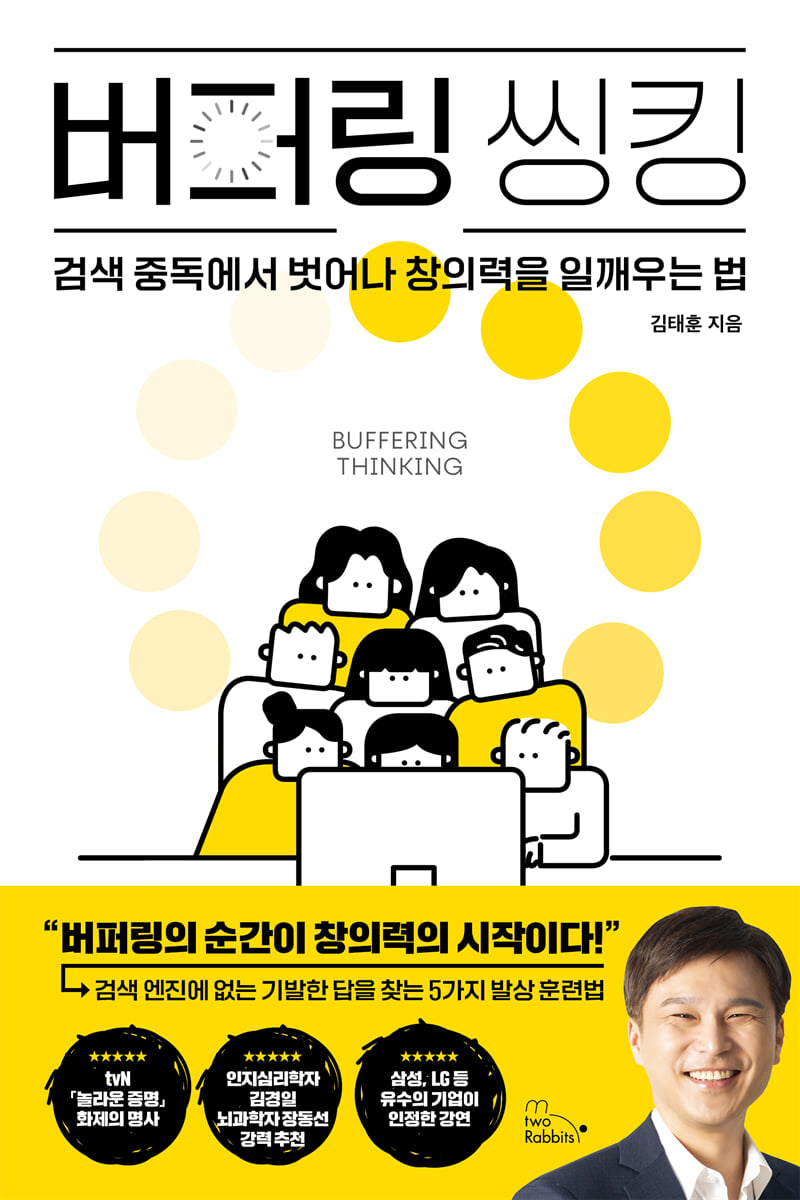
Buffering Thinking
 |
Description
Book Introduction
"Search is fast, but thinking is short-sighted."
In this smart age, why has it become harder to think deeply?
Cognitive psychologist Professor Taehoon Kim tells us
5 Mind Training Techniques to Reclaim Your Deep Thinking Power in a Fast-paced World
★ Strongly recommended by cognitive psychologist Kim Kyung-il and neuroscientist Jang Dong-seon ★
★ Hot topic of tvN's "Amazing Proof" and JTBC's "Knowing Bros" ★
Students who only ask, "What's the answer?" in class and are unable to ask questions of their own; office workers who seek out AI output before brainstorming in meetings; and we, who have become accustomed to consuming only "correct answer-type information" on social media.
In this way, we are all living without the opportunity to think for ourselves.
"Buffering Thinking" is a book born from this very question. In an age where AI provides all the answers, how much of our "power to think for ourselves" do we truly retain? Cognitive psychologist Kim Tae-hoon explores ways to maintain human originality and foster creativity even in the age of AI.
He argues that the 'buffering moment' should be viewed not as a simple pause, but as a preparatory process for new ideas.
In the past, time spent thinking was essential to solving complex problems.
But now, with AI providing instant solutions, we are being robbed of even the opportunity to 'think'.
To address these issues, Buffering Thinking combines cognitive psychology and creative thinking methods to propose a five-step framework called SCORE (Sense, Constrain, reOrganize, Relate, Execute) to revitalize our thinking abilities.
This framework is not simply a concept; it contains specific strategies that can be effectively applied in real-world creative problem-solving processes.
In other words, through the process of observation (Sense) that grasps the essence of a problem and stimulates creativity by opening the senses, constraint (Constrain) that generates new ideas in a limited environment, reorganize (Reorganize) that breaks the familiar framework and looks at the problem from a new perspective, connect (Relate) that creates innovation by connecting different ideas, and execution (Execute) that turns ideas into reality, we can regain the 'power to think' that is more important than quick reactions and maintain human creativity even in the AI era.
In this smart age, why has it become harder to think deeply?
Cognitive psychologist Professor Taehoon Kim tells us
5 Mind Training Techniques to Reclaim Your Deep Thinking Power in a Fast-paced World
★ Strongly recommended by cognitive psychologist Kim Kyung-il and neuroscientist Jang Dong-seon ★
★ Hot topic of tvN's "Amazing Proof" and JTBC's "Knowing Bros" ★
Students who only ask, "What's the answer?" in class and are unable to ask questions of their own; office workers who seek out AI output before brainstorming in meetings; and we, who have become accustomed to consuming only "correct answer-type information" on social media.
In this way, we are all living without the opportunity to think for ourselves.
"Buffering Thinking" is a book born from this very question. In an age where AI provides all the answers, how much of our "power to think for ourselves" do we truly retain? Cognitive psychologist Kim Tae-hoon explores ways to maintain human originality and foster creativity even in the age of AI.
He argues that the 'buffering moment' should be viewed not as a simple pause, but as a preparatory process for new ideas.
In the past, time spent thinking was essential to solving complex problems.
But now, with AI providing instant solutions, we are being robbed of even the opportunity to 'think'.
To address these issues, Buffering Thinking combines cognitive psychology and creative thinking methods to propose a five-step framework called SCORE (Sense, Constrain, reOrganize, Relate, Execute) to revitalize our thinking abilities.
This framework is not simply a concept; it contains specific strategies that can be effectively applied in real-world creative problem-solving processes.
In other words, through the process of observation (Sense) that grasps the essence of a problem and stimulates creativity by opening the senses, constraint (Constrain) that generates new ideas in a limited environment, reorganize (Reorganize) that breaks the familiar framework and looks at the problem from a new perspective, connect (Relate) that creates innovation by connecting different ideas, and execution (Execute) that turns ideas into reality, we can regain the 'power to think' that is more important than quick reactions and maintain human creativity even in the AI era.
- You can preview some of the book's contents.
Preview
index
? Recommended article
Prologue.
In the age of speed, capitalize on the buffering moment.
? Buffering Thinking Check Test
INTRO.
Is your brain 'buffering'?
01.
To you who is confused at the moment when your thoughts stop
02.
Buffering moments are opportunities, not anxiety.
03.
How to Make the Most of Your Buffering Time: 5 Tools to Turn Your Buffering Time into Creative Thinking
Buffering Thinking Step 1
Observe, creativity begins with the senses_____________________________#SENSE
01.
When your eyes are deceived, find the truth.
02.
Break free from the trap of judgment
03.
See with your brain, not your eyes
04.
Context is the answer: Find the hidden clues!
05.
A psychologist's note-taking method for capturing the flow of ideas
06.
Idea generation methods to improve observation skills
A Guide to Using Buffering Time: The Art of Observation
Buffering Thinking Step 2
Constrain yourself, limitations inspire creativity_____________________________#Constrain
01.
Anything is nothing
02.
No time, no money? That's where innovation begins.
03.
Jugaad Thinking: The Ability to Turn Limitations into Opportunities
04.
When limited time becomes your best weapon
05.
Don't break the mold, twist the mold
06.
Find the best solution in the box
07.
How to expand the boundaries of your thinking
08.
Your most demanding customers are your business' compass.
A Guide to Utilizing Buffering Time: The Art of Constraints
?Buffering Thinking 3 Steps
Reorganize, make the familiar strange_____________________________#reOrganize
01.
Twist the frame of thought
02.
How to Be Persuasive with Your Point of View
03.
How to get better conclusions from the same data
04.
A small difference can make a huge difference
05.
The frame of success created by accurate analysis
06.
A Question for Restructuring: Redefine My Karma
07.
Define my 'work' in a new language
08.
Aimless conversation creates a new frame.
A Guide to Utilizing Buffering Time: The Art of Reconstruction
Buffering Thinking Step 4
Connect, weave together the unfamiliar to innovate_____________________________#Relate
01.
Innovation comes from connections, not inventions.
02.
Strange connections create innovation.
03.
Connecting Time: How to Create Trends and Emotions
04.
Connecting the Experience: How to Move Consumers' Emotions
05.
Connecting Value: How to Win the Hearts of Tomorrow's Consumers
06.
Zoom in and out, see the world through the lens of creation.
07.
The beginning of an idea is a connection.
A Guide to Utilizing Buffering Time: The Art of Connecting
?Buffering Thinking 5 Steps
Execute, the art of turning ideas into results_____________________________#Execute
01.
Understand the role and perspective
02.
Good ideas survive through persuasion.
03.
Idea-Generating Skills for Creative Organizations
04.
Read the Focus: Understanding Your Organization's Goals and Inclinations
05.
Speak your ideas in the language the organization wants.
06.
Ideas don't grow alone.
A Guide to Utilizing Buffering Time: The Art of Execution
A checklist for creative use of buffering
Prologue.
In the age of speed, capitalize on the buffering moment.
? Buffering Thinking Check Test
INTRO.
Is your brain 'buffering'?
01.
To you who is confused at the moment when your thoughts stop
02.
Buffering moments are opportunities, not anxiety.
03.
How to Make the Most of Your Buffering Time: 5 Tools to Turn Your Buffering Time into Creative Thinking
Buffering Thinking Step 1
Observe, creativity begins with the senses_____________________________#SENSE
01.
When your eyes are deceived, find the truth.
02.
Break free from the trap of judgment
03.
See with your brain, not your eyes
04.
Context is the answer: Find the hidden clues!
05.
A psychologist's note-taking method for capturing the flow of ideas
06.
Idea generation methods to improve observation skills
A Guide to Using Buffering Time: The Art of Observation
Buffering Thinking Step 2
Constrain yourself, limitations inspire creativity_____________________________#Constrain
01.
Anything is nothing
02.
No time, no money? That's where innovation begins.
03.
Jugaad Thinking: The Ability to Turn Limitations into Opportunities
04.
When limited time becomes your best weapon
05.
Don't break the mold, twist the mold
06.
Find the best solution in the box
07.
How to expand the boundaries of your thinking
08.
Your most demanding customers are your business' compass.
A Guide to Utilizing Buffering Time: The Art of Constraints
?Buffering Thinking 3 Steps
Reorganize, make the familiar strange_____________________________#reOrganize
01.
Twist the frame of thought
02.
How to Be Persuasive with Your Point of View
03.
How to get better conclusions from the same data
04.
A small difference can make a huge difference
05.
The frame of success created by accurate analysis
06.
A Question for Restructuring: Redefine My Karma
07.
Define my 'work' in a new language
08.
Aimless conversation creates a new frame.
A Guide to Utilizing Buffering Time: The Art of Reconstruction
Buffering Thinking Step 4
Connect, weave together the unfamiliar to innovate_____________________________#Relate
01.
Innovation comes from connections, not inventions.
02.
Strange connections create innovation.
03.
Connecting Time: How to Create Trends and Emotions
04.
Connecting the Experience: How to Move Consumers' Emotions
05.
Connecting Value: How to Win the Hearts of Tomorrow's Consumers
06.
Zoom in and out, see the world through the lens of creation.
07.
The beginning of an idea is a connection.
A Guide to Utilizing Buffering Time: The Art of Connecting
?Buffering Thinking 5 Steps
Execute, the art of turning ideas into results_____________________________#Execute
01.
Understand the role and perspective
02.
Good ideas survive through persuasion.
03.
Idea-Generating Skills for Creative Organizations
04.
Read the Focus: Understanding Your Organization's Goals and Inclinations
05.
Speak your ideas in the language the organization wants.
06.
Ideas don't grow alone.
A Guide to Utilizing Buffering Time: The Art of Execution
A checklist for creative use of buffering
Detailed image

Into the book
This book began with the concern that our thinking skills are gradually deteriorating in an age where AI and algorithms are replacing our thinking.
We focus only on speed, failing to effectively utilize buffering and repeatedly producing mediocre results.
But rather, we should use the moment of 'buffering', when our mind pauses due to overload, as an opportunity for creative thinking.
In other words, let's look at buffering not as a simple state of standstill, but as a preparatory process for new ideas.
From a cognitive psychology perspective, moments when the brain cannot provide an immediate answer are not simply gaps.
Rather, it is a process in which the brain rearranges existing information and creates new connections to find more creative answers.
However, many people cannot tolerate these buffering moments, and in the pressure to find answers quickly, they miss opportunities for deep thinking.
This is why I decided to write this book.
--- From "In the Age of Speed, Take Advantage of the Moment of Buffering"
The experience of preparing for a meeting frantically from the morning, only to have your mind go blank when it's your turn to present.
There are times when you need to come up with a new plan, but no matter how hard you think, no idea comes to mind.
It was a busy day, but looking back, I feel a sense of emptiness and wonder, 'What did I do?'
Are these moments simply due to fatigue? Or is my mind truly hardened? We dread these moments.
(…) However, cognitive psychology focuses on these ‘buffering moments’.
Your brain is still working.
It's just that it's not visible on the surface.
We are exposed to a tremendous amount of information every day.
We check our smartphones as soon as we wake up in the morning, scroll through the news on our way to work, and check messengers and emails throughout the day.
In meetings, immediate answers are required, and at work, quick decisions must be made.
Even after work, I consume new information through social media and watch YouTube or Netflix to relieve my fatigue.
The modern human brain is like a CPU that operates without rest.
--- From "To You Who Bewildered When Your Thoughts Stop"
We often experience moments when it feels like our brains have stopped working.
Sometimes you suddenly feel speechless, unable to come up with ideas, or as if your thoughts are floating in the air.
These moments are often mistaken for 'incompetence' or 'lack of concentration', but in reality, they are more likely the brain preparing for deep thinking.
I like to call this phenomenon buffering thinking.
This is a similar concept to 'buffering', where the computer pauses for a moment while loading data or performing complex calculations.
Although the screen may appear frozen, our brains are actually processing complex information internally, stopping their immediate reactions and instead organizing or reassembling information.
These buffering moments occur especially frequently during creative thinking and problem-solving processes.
For example, when trying to solve a complex problem, there are times when your thinking seems to stop.
But this is because the brain has entered a preparatory process to perform higher-level thinking rather than simple calculations.
In other words, the buffering moment is not a simple pause, but a process in which the brain searches for a better answer.
--- From "The moment of buffering is an opportunity, not an anxiety"
How can we transform "buffering moments" from mere pauses into creative thinking? The answer is to utilize the SCORE framework.
SCORE is a model that organizes the creative thinking process into steps, with each step organically connected.
The five steps of Sense → Constrain → ReOrganize → Relate → Execute are not simply a way of thinking, but provide a way to strategically utilize buffering thinking.
A buffering moment is not simply a pause in thought.
It is the starting point of new thinking, and if we utilize this moment well, creative thinking can be born.
However, many people fail to utilize this process properly and try to find immediate solutions to relieve their anxiety.
It's like planting a seed and expecting a tree to grow right away.
Creative thinking can be developed through step-by-step thinking training.
Now, let's look at how each step of the SCORE framework organically connects.
--- From "How to Use Buffering Time 200%"
Among whiskey lovers, Kavalan is a fairly well-known brand.
It has achieved outstanding results in numerous international competitions, and received significant attention in particular when it won the World's Best Single Malt award at the 2015 World Wishkies Awards.
Unusually, Kavalan whisky is a Taiwanese product.
Traditionally, whisky is made by aging it for a long time in cool climates, such as Scotland.
Therefore, producing it in Taiwan, with its warm and humid subtropical climate, was a challenging endeavor.
This is because high temperature and humidity greatly increase evaporation, which is called the 'angel's share', resulting in significant losses during ripening.
It is said that as many as 15% of them disappear every year.
However, Kavalan has instead turned the rapid maturation process into a product advantage. Using the STR (Shaving, Toasting, Recharring) process, they focused on achieving a deep flavor even during a short maturation period.
These technological innovations have enabled Taiwan to overcome climatic limitations and produce high-quality whiskey.
In fact, isn't it true that what's important in whiskey is taste and flavor, not aging period?
While maturation period has long been considered a criterion for measuring the quality of whiskey, ultimately, the key is how rich and balanced the whiskey is to the palate.
--- From "Don't break the mold, twist the mold"
A good example is HOKA, a new sports brand that recently threatened Nike.
Hoka, which has been receiving great responses from runners around the world and has shown remarkable growth in market share, was founded in 2009 and was acquired by Deckers in 2013. It is now a major sports brand with sales exceeding 1 trillion won.
What extreme customer demand did Hoka reflect, and how did it do so? It was a shoe that allowed for fast running without slowing down, even on downhill slopes.
Runners don't just run on flat ground.
Sometimes you have to climb uphill and sometimes you have to go down steep hills.
When going downhill, you have to slow down because of the risk of impact or injury… … .
Isn't it too much to ask for a shoe that can fly high on a downhill slope where it's difficult to even maintain balance?
However, Hoka thought about how to provide a stable fit while maintaining cushioning and traction, and introduced a running shoe with a unique thick yet lightweight sole that absorbs shock when going downhill.
Actually, Hoka's products are not that pretty.
In particular, when the product first appeared in 2009, minimalist shoes with thin and clean sneakers were in vogue, so Hoka's design was the complete opposite, maximalist, so it must have seemed even more strange.
The colors are too flashy, the brand logo is too big, and the oversized sole looks bizarre.
However, because it is perceived as being as comfortable as it is ugly, it has become popular with customers in jobs that require standing for long periods of time, such as nurses.
Customers who have actually tried Hoka say that it feels so fluffy, like floating on a cloud.
We focus only on speed, failing to effectively utilize buffering and repeatedly producing mediocre results.
But rather, we should use the moment of 'buffering', when our mind pauses due to overload, as an opportunity for creative thinking.
In other words, let's look at buffering not as a simple state of standstill, but as a preparatory process for new ideas.
From a cognitive psychology perspective, moments when the brain cannot provide an immediate answer are not simply gaps.
Rather, it is a process in which the brain rearranges existing information and creates new connections to find more creative answers.
However, many people cannot tolerate these buffering moments, and in the pressure to find answers quickly, they miss opportunities for deep thinking.
This is why I decided to write this book.
--- From "In the Age of Speed, Take Advantage of the Moment of Buffering"
The experience of preparing for a meeting frantically from the morning, only to have your mind go blank when it's your turn to present.
There are times when you need to come up with a new plan, but no matter how hard you think, no idea comes to mind.
It was a busy day, but looking back, I feel a sense of emptiness and wonder, 'What did I do?'
Are these moments simply due to fatigue? Or is my mind truly hardened? We dread these moments.
(…) However, cognitive psychology focuses on these ‘buffering moments’.
Your brain is still working.
It's just that it's not visible on the surface.
We are exposed to a tremendous amount of information every day.
We check our smartphones as soon as we wake up in the morning, scroll through the news on our way to work, and check messengers and emails throughout the day.
In meetings, immediate answers are required, and at work, quick decisions must be made.
Even after work, I consume new information through social media and watch YouTube or Netflix to relieve my fatigue.
The modern human brain is like a CPU that operates without rest.
--- From "To You Who Bewildered When Your Thoughts Stop"
We often experience moments when it feels like our brains have stopped working.
Sometimes you suddenly feel speechless, unable to come up with ideas, or as if your thoughts are floating in the air.
These moments are often mistaken for 'incompetence' or 'lack of concentration', but in reality, they are more likely the brain preparing for deep thinking.
I like to call this phenomenon buffering thinking.
This is a similar concept to 'buffering', where the computer pauses for a moment while loading data or performing complex calculations.
Although the screen may appear frozen, our brains are actually processing complex information internally, stopping their immediate reactions and instead organizing or reassembling information.
These buffering moments occur especially frequently during creative thinking and problem-solving processes.
For example, when trying to solve a complex problem, there are times when your thinking seems to stop.
But this is because the brain has entered a preparatory process to perform higher-level thinking rather than simple calculations.
In other words, the buffering moment is not a simple pause, but a process in which the brain searches for a better answer.
--- From "The moment of buffering is an opportunity, not an anxiety"
How can we transform "buffering moments" from mere pauses into creative thinking? The answer is to utilize the SCORE framework.
SCORE is a model that organizes the creative thinking process into steps, with each step organically connected.
The five steps of Sense → Constrain → ReOrganize → Relate → Execute are not simply a way of thinking, but provide a way to strategically utilize buffering thinking.
A buffering moment is not simply a pause in thought.
It is the starting point of new thinking, and if we utilize this moment well, creative thinking can be born.
However, many people fail to utilize this process properly and try to find immediate solutions to relieve their anxiety.
It's like planting a seed and expecting a tree to grow right away.
Creative thinking can be developed through step-by-step thinking training.
Now, let's look at how each step of the SCORE framework organically connects.
--- From "How to Use Buffering Time 200%"
Among whiskey lovers, Kavalan is a fairly well-known brand.
It has achieved outstanding results in numerous international competitions, and received significant attention in particular when it won the World's Best Single Malt award at the 2015 World Wishkies Awards.
Unusually, Kavalan whisky is a Taiwanese product.
Traditionally, whisky is made by aging it for a long time in cool climates, such as Scotland.
Therefore, producing it in Taiwan, with its warm and humid subtropical climate, was a challenging endeavor.
This is because high temperature and humidity greatly increase evaporation, which is called the 'angel's share', resulting in significant losses during ripening.
It is said that as many as 15% of them disappear every year.
However, Kavalan has instead turned the rapid maturation process into a product advantage. Using the STR (Shaving, Toasting, Recharring) process, they focused on achieving a deep flavor even during a short maturation period.
These technological innovations have enabled Taiwan to overcome climatic limitations and produce high-quality whiskey.
In fact, isn't it true that what's important in whiskey is taste and flavor, not aging period?
While maturation period has long been considered a criterion for measuring the quality of whiskey, ultimately, the key is how rich and balanced the whiskey is to the palate.
--- From "Don't break the mold, twist the mold"
A good example is HOKA, a new sports brand that recently threatened Nike.
Hoka, which has been receiving great responses from runners around the world and has shown remarkable growth in market share, was founded in 2009 and was acquired by Deckers in 2013. It is now a major sports brand with sales exceeding 1 trillion won.
What extreme customer demand did Hoka reflect, and how did it do so? It was a shoe that allowed for fast running without slowing down, even on downhill slopes.
Runners don't just run on flat ground.
Sometimes you have to climb uphill and sometimes you have to go down steep hills.
When going downhill, you have to slow down because of the risk of impact or injury… … .
Isn't it too much to ask for a shoe that can fly high on a downhill slope where it's difficult to even maintain balance?
However, Hoka thought about how to provide a stable fit while maintaining cushioning and traction, and introduced a running shoe with a unique thick yet lightweight sole that absorbs shock when going downhill.
Actually, Hoka's products are not that pretty.
In particular, when the product first appeared in 2009, minimalist shoes with thin and clean sneakers were in vogue, so Hoka's design was the complete opposite, maximalist, so it must have seemed even more strange.
The colors are too flashy, the brand logo is too big, and the oversized sole looks bizarre.
However, because it is perceived as being as comfortable as it is ugly, it has become popular with customers in jobs that require standing for long periods of time, such as nurses.
Customers who have actually tried Hoka say that it feels so fluffy, like floating on a cloud.
--- From "The most demanding customer is the compass of business"
Publisher's Review
Lost the 'habit of thinking'
A reminder for all of us
We now live in an age where searching replaces thinking, and answers come before questions.
Whether you're a child or an adult, we all experience that moment of "buffering" when faced with a complex problem, when our minds go blank.
Cognitive psychologist Professor Kim Tae-hoon says that this very moment of buffering can be the starting point of creativity.
"Buffering Thinking" introduces SCORE, a five-step thinking training method that helps maintain deep thinking even in an age of information overload. SCORE is a framework comprised of Sense, Constrain, Reorganize, Relate, and Execute. It's not just a theory; it's a practical tool for recovering and developing real-world creativity.
This book is not for a specific age or occupation.
From office workers who struggle with their thoughts during meetings, to parents concerned about their children's reliance on search engines, to teachers pondering the nature of creativity in the AI era, to students seeking to organize their thoughts, this book is a "brain user manual" that transcends generations and can be used by everyone.
In this age of information overload and limited time for reflection, "Buffering Thinking" offers the courage and direction to start thinking again.
How to think before you search.
The power to ask questions before responding.
The habit of choosing depth over speed.
All of this is training that we desperately need now, and for future generations.
Buffering Thinking will be the starting point.
With the '5 Frameworks'
Take back control of your thoughts!
Published amidst the contemporary awareness that 'searching is fast, but thinking has stopped', 'Buffering Thinking' is a self-help book that helps modern people who have lost their thinking ability in the age of information overload to regain 'the control of their thoughts' through five thinking frameworks proposed by cognitive psychologist Professor Taehoon Kim.
The thought-training methods contained in this book have been proven effective in executive lectures and internal training programs at leading companies such as Samsung, LG, and Hyundai. They are already attracting attention from numerous leaders and companies as a strategic tool that fosters practical problem-solving skills, not just creative inspiration.
Professor Kim Tae-hoon emphasizes that creativity is not an innate talent, but rather an ability that anyone can systematically train. He presents an integrative approach that combines cognitive psychology, brain science, and business strategy to provide practical implementation capabilities that can be implemented in real-world work and organizations.
In particular, it analyzes the thinking and problem-solving practices of domestic and international innovative companies such as Tridge, HOKA, and Blank Street Coffee, and demonstrates specifically how creative thinking leads to business performance.
This book offers an opportunity for everyone—from office workers seeking to regain depth of thought in today's fast-paced society, to leaders struggling to organize their thoughts, and even parents contemplating the essence of their children's education—to reflect on their own thinking habits and reset them.
Buffering Thinking is not just a book that stimulates your thoughts, but a book that makes your thoughts 'work'.
Now is the time to stop buffering in our own minds and regain control of our thoughts through the cognitive science-based framework presented by Professor Kim Tae-hoon.
This book provides a practical guide useful to all those who want to check the flow of their thoughts and awaken again, including office workers and organizational leaders who want to recover deep thinking in today's fast-paced society, parents who feel frustrated seeing their children lose their ability to think, teachers who need to teach critical thinking, students who want to acquire the "power to question" in the AI era, and even adults who feel stuck in routine and stagnant lives.
Buffering Thinking is not just a book that stimulates your thoughts, but a book that makes your thoughts 'work'.
Now is the time to stop buffering in our own minds and regain control of our thoughts through the cognitive science-based framework presented by Professor Kim Tae-hoon.
A reminder for all of us
We now live in an age where searching replaces thinking, and answers come before questions.
Whether you're a child or an adult, we all experience that moment of "buffering" when faced with a complex problem, when our minds go blank.
Cognitive psychologist Professor Kim Tae-hoon says that this very moment of buffering can be the starting point of creativity.
"Buffering Thinking" introduces SCORE, a five-step thinking training method that helps maintain deep thinking even in an age of information overload. SCORE is a framework comprised of Sense, Constrain, Reorganize, Relate, and Execute. It's not just a theory; it's a practical tool for recovering and developing real-world creativity.
This book is not for a specific age or occupation.
From office workers who struggle with their thoughts during meetings, to parents concerned about their children's reliance on search engines, to teachers pondering the nature of creativity in the AI era, to students seeking to organize their thoughts, this book is a "brain user manual" that transcends generations and can be used by everyone.
In this age of information overload and limited time for reflection, "Buffering Thinking" offers the courage and direction to start thinking again.
How to think before you search.
The power to ask questions before responding.
The habit of choosing depth over speed.
All of this is training that we desperately need now, and for future generations.
Buffering Thinking will be the starting point.
With the '5 Frameworks'
Take back control of your thoughts!
Published amidst the contemporary awareness that 'searching is fast, but thinking has stopped', 'Buffering Thinking' is a self-help book that helps modern people who have lost their thinking ability in the age of information overload to regain 'the control of their thoughts' through five thinking frameworks proposed by cognitive psychologist Professor Taehoon Kim.
The thought-training methods contained in this book have been proven effective in executive lectures and internal training programs at leading companies such as Samsung, LG, and Hyundai. They are already attracting attention from numerous leaders and companies as a strategic tool that fosters practical problem-solving skills, not just creative inspiration.
Professor Kim Tae-hoon emphasizes that creativity is not an innate talent, but rather an ability that anyone can systematically train. He presents an integrative approach that combines cognitive psychology, brain science, and business strategy to provide practical implementation capabilities that can be implemented in real-world work and organizations.
In particular, it analyzes the thinking and problem-solving practices of domestic and international innovative companies such as Tridge, HOKA, and Blank Street Coffee, and demonstrates specifically how creative thinking leads to business performance.
This book offers an opportunity for everyone—from office workers seeking to regain depth of thought in today's fast-paced society, to leaders struggling to organize their thoughts, and even parents contemplating the essence of their children's education—to reflect on their own thinking habits and reset them.
Buffering Thinking is not just a book that stimulates your thoughts, but a book that makes your thoughts 'work'.
Now is the time to stop buffering in our own minds and regain control of our thoughts through the cognitive science-based framework presented by Professor Kim Tae-hoon.
This book provides a practical guide useful to all those who want to check the flow of their thoughts and awaken again, including office workers and organizational leaders who want to recover deep thinking in today's fast-paced society, parents who feel frustrated seeing their children lose their ability to think, teachers who need to teach critical thinking, students who want to acquire the "power to question" in the AI era, and even adults who feel stuck in routine and stagnant lives.
Buffering Thinking is not just a book that stimulates your thoughts, but a book that makes your thoughts 'work'.
Now is the time to stop buffering in our own minds and regain control of our thoughts through the cognitive science-based framework presented by Professor Kim Tae-hoon.
GOODS SPECIFICS
- Date of issue: March 15, 2025
- Page count, weight, size: 260 pages | 140*210*15mm
- ISBN13: 9791199056367
You may also like
카테고리
korean


korean

![ELLE 엘르 스페셜 에디션 A형 : 12월 [2025]](http://librairie.coreenne.fr/cdn/shop/files/b8e27a3de6c9538896439686c6b0e8fb.jpg?v=1766436872&width=3840)


