

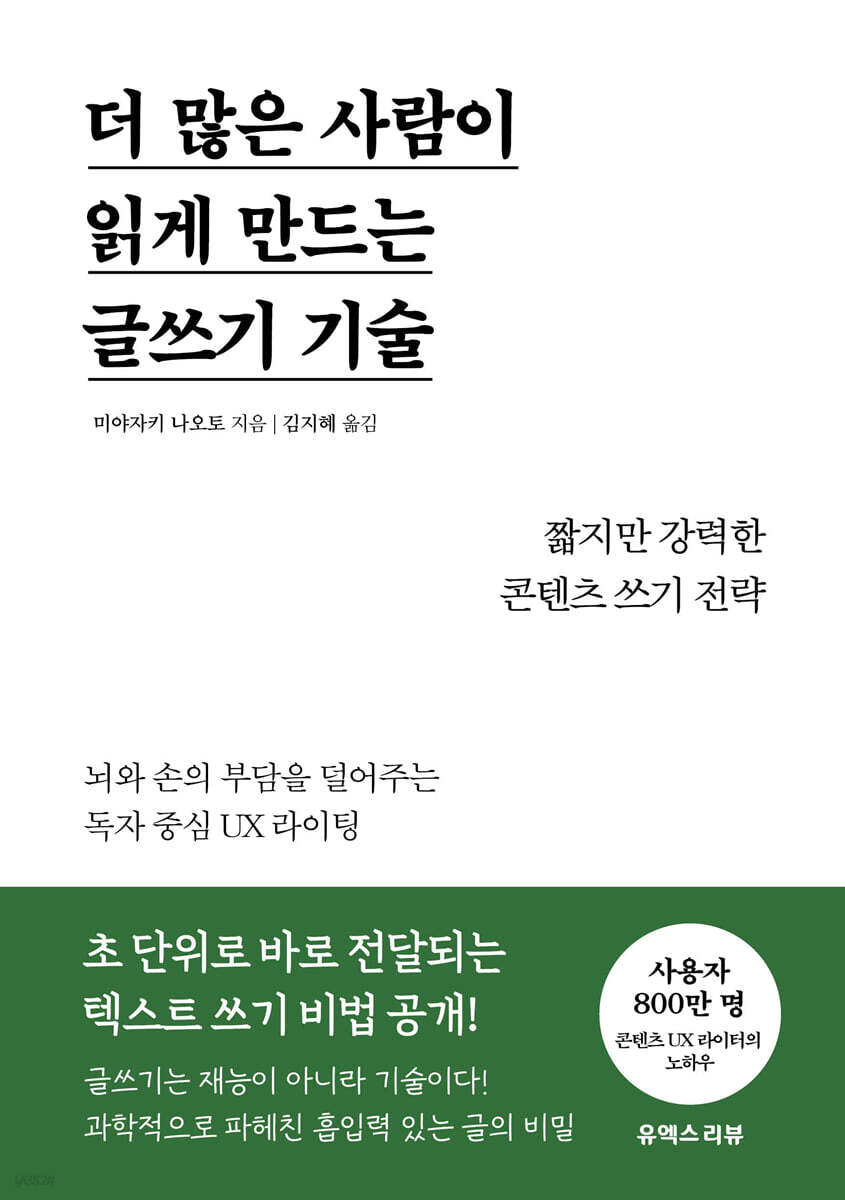
Writing techniques that get more people to read
 |
Description
Book Introduction
Writing is a skill, not a talent!
A professional copywriter who moves 8 million users through scientific research and
The secret to compelling writing, revealed through extensive experience!
There are countless books on writing, but this one is unique in that it teaches writing strategies that will get more people reading in the first place.
The author, who says that “writing skills are not a talent, but a skill,” is currently working as a copywriter and UX writer for Paydy, a famous Japanese fintech brand with 8 million users.
As a writing expert in the business world who needs to see results quickly, the author's techniques are effective enough to be put to use right away.
He first scientifically analyzes the reasons why many people do not read.
It shows the fact that 'humans only read 20% of sentences' and convinces us that we should write reader-centered articles rather than articles that we want to write.
And it covers the specific method of 'writing briefly', which is the most important starting point of such reader-centered writing, and guides you through the requirements of writing that makes people read to the end.
The six requirements are beautiful appearance, organized list, important content first, rhythm, no foreign words, and update after a day.
Another unique feature of this book is that it provides the fundamentals of UX writing and real-world examples that can be applied immediately to all types of writing.
It is packed with know-how to make numerous users move in the intended direction with just concise text.
This book, which can be considered the bible for writing "readable" writing, which is more important than good writing, will help you capture attention faster and secure more readers.
A professional copywriter who moves 8 million users through scientific research and
The secret to compelling writing, revealed through extensive experience!
There are countless books on writing, but this one is unique in that it teaches writing strategies that will get more people reading in the first place.
The author, who says that “writing skills are not a talent, but a skill,” is currently working as a copywriter and UX writer for Paydy, a famous Japanese fintech brand with 8 million users.
As a writing expert in the business world who needs to see results quickly, the author's techniques are effective enough to be put to use right away.
He first scientifically analyzes the reasons why many people do not read.
It shows the fact that 'humans only read 20% of sentences' and convinces us that we should write reader-centered articles rather than articles that we want to write.
And it covers the specific method of 'writing briefly', which is the most important starting point of such reader-centered writing, and guides you through the requirements of writing that makes people read to the end.
The six requirements are beautiful appearance, organized list, important content first, rhythm, no foreign words, and update after a day.
Another unique feature of this book is that it provides the fundamentals of UX writing and real-world examples that can be applied immediately to all types of writing.
It is packed with know-how to make numerous users move in the intended direction with just concise text.
This book, which can be considered the bible for writing "readable" writing, which is more important than good writing, will help you capture attention faster and secure more readers.
index
Entering
Chapter 1: The Truth: Humans Don't Read Sentences
Chapter 2: How to Write Short and Boldly
Chapter 3: Six Rules for Reader-Centered Writing
Chapter 4: The Aesthetics of Simplicity
Chapter 5: Reader-Centered Writing: Lessons from Advertising Copy
Chapter 6: Learning Reader-Centered Writing through UX Writing
Chapter 7: Functional Writing and Emotional Writing
Chapter 8: Completing Writing with the Most Complete Sentence Skills
Conclusion
Chapter 1: The Truth: Humans Don't Read Sentences
Chapter 2: How to Write Short and Boldly
Chapter 3: Six Rules for Reader-Centered Writing
Chapter 4: The Aesthetics of Simplicity
Chapter 5: Reader-Centered Writing: Lessons from Advertising Copy
Chapter 6: Learning Reader-Centered Writing through UX Writing
Chapter 7: Functional Writing and Emotional Writing
Chapter 8: Completing Writing with the Most Complete Sentence Skills
Conclusion
Detailed image

Into the book
I believe that the writing skills needed in the digital age are those that consider "how can I convey what I want?" under the premise that "humans don't read."
And I believe that achieving this with your own skills is a very rewarding and valuable thing.
--- From "Chapter 1: Humans Do Not Read Sentences"
One method I often use is to quote famous sayings, phrases, or lyrics from my favorite songs.
Placing a quote that fits your message in your introduction can be a powerful way to draw your readers in.
To do this, it is important to develop the habit of writing down your favorite articles or great sentences.
--- From "Chapter 3: Six Rules for Reader-Centered Writing"
The phrase “It’s sunny today” simply describes the weather, but the expression “It would be nice to have lunch outside” has the power to move readers by verbalizing the values they desire.
To verbalize the values that readers desire and become the arrow that moves readers.
I believe this is truly reader-centric copy.
--- From “Chapter 5: Reader-Centered Writing: Learning from Advertising Copy”
If UX aims to improve customer experience, what is required from sentences is to improve reader experience.
This book clearly explains this, and the "reader-centered" mindset. UX thinking and UX writing are concepts that will be crucial in all fields in the future.
Of course, it is important to learn sentence structure, but it is also very useful knowledge that can improve your business and daily life, so if you are interested, I strongly recommend that you actively learn it.
--- From "Chapter 6: Learning Reader-Centered Writing through UX Writing"
In fact, the rules that must be followed in functional writing explained so far are thoroughly observed in this advertising copy as well.
Each sentence is short, no difficult words are used, the layout is designed with readability in mind, and the rhythm is excellent when reading.
In other words, emotional writing is about appealing to emotional value after you have mastered functional writing.
And I believe that achieving this with your own skills is a very rewarding and valuable thing.
--- From "Chapter 1: Humans Do Not Read Sentences"
One method I often use is to quote famous sayings, phrases, or lyrics from my favorite songs.
Placing a quote that fits your message in your introduction can be a powerful way to draw your readers in.
To do this, it is important to develop the habit of writing down your favorite articles or great sentences.
--- From "Chapter 3: Six Rules for Reader-Centered Writing"
The phrase “It’s sunny today” simply describes the weather, but the expression “It would be nice to have lunch outside” has the power to move readers by verbalizing the values they desire.
To verbalize the values that readers desire and become the arrow that moves readers.
I believe this is truly reader-centric copy.
--- From “Chapter 5: Reader-Centered Writing: Learning from Advertising Copy”
If UX aims to improve customer experience, what is required from sentences is to improve reader experience.
This book clearly explains this, and the "reader-centered" mindset. UX thinking and UX writing are concepts that will be crucial in all fields in the future.
Of course, it is important to learn sentence structure, but it is also very useful knowledge that can improve your business and daily life, so if you are interested, I strongly recommend that you actively learn it.
--- From "Chapter 6: Learning Reader-Centered Writing through UX Writing"
In fact, the rules that must be followed in functional writing explained so far are thoroughly observed in this advertising copy as well.
Each sentence is short, no difficult words are used, the layout is designed with readability in mind, and the rhythm is excellent when reading.
In other words, emotional writing is about appealing to emotional value after you have mastered functional writing.
--- From Chapter 7, Functional Writing and Emotional Writing
Publisher's Review
A veteran copywriter who has moved 8 million users
Scientific, strategic writing techniques revealed!
It may take a lot of practice and talent to develop the kind of writing that moves readers to tears, but writing that captures readers' attention at a glance and makes them understand intuitively, such as business plans, product descriptions, advertising copy, company introductions on websites, and social media marketing, can all be done well with just a systematic technique.
The author is a 'UX writer' who has worked to inspire countless people to take action through writing online.
Just as UX writing naturally enhances the user experience, it analyzes the reader's reading experience and explains how to write text that can be understood in seconds without putting a burden on the brain, using "short writing" techniques and scientifically proven writing frameworks.
For most writing, where the goal is to convey facts, personal thoughts, and past experiences to readers, this is a practical approach that focuses on presenting accurate information clearly and writing logically and simply for quick persuasion.
As many international readers who have already read this book have experienced, it will provide you with a tremendous weapon in your life, where you must constantly write.
The first thing to think about when writing!
What to say
As Arthur Schopenhauer said, “Say extraordinary things in ordinary words,” the most important thing when writing for readers is to “keep it short, no matter what.”
It has already been proven through numerous studies that the human brain is not suited to reading.
Moreover, with the advent of smartphones and social media, people's concentration levels are continuously declining, and now, with people watching videos far more than reading, the act of reading itself has become difficult.
That's why you need something to focus your attention in your writing.
Short writing has that exact effect.
The most important thing when writing a short piece is to specify 'what to say'.
After identifying and listing the features in a sentence, you should aim to convey only the three most important features.
It is about removing less important content and clearly conveying only the more important elements.
Research has shown that the human brain can easily remember about 3 to 4 items, so it is better to talk about three important things rather than conveying a lot of information.
In this way, you can understand the human brain structure for reading through various scientific data and learn various secret techniques unique to authors who write concisely.
Just by reading this book once, you will feel that your understanding of writing and your writing skills have rapidly improved.
The most complete way to write fast-paced text!
A Writing Framework with 6 Rules That Apply to Any Writing
The author says that six elements are necessary for effective reader-centered writing.
① Beautiful appearance ② Organize the list ③ Important content first ④ Rhythm is life ⑤ No foreign words ⑥ Update after a day, these are the six things.
These are all details that are not difficult to put into practice, but are not to be missed.
If you pay attention to each step as explained in this book, you will soon be able to write well-read articles.
What's particularly interesting about it is that it emphasizes the appearance of the text.
The human brain automatically compensates for any problems with what it perceives with its eyes by restoring it to a normal state, so ‘appearance’ is also very important in writing.
No matter how great the content is, if the appearance is not beautiful, readers will not read it.
One of the things I paid the most attention to when creating this book was its appearance, namely its design.
To capture the most beautiful appearance of the text, line breaks and paragraphs were separated to improve readability, and the refreshing layout that makes the main points stand out allows readers to read the book with a light heart.
Additionally, through the numerous examples and practice problems included, you can quickly learn the writing secrets of the author, a veteran UX writer and copywriter.
It conveys the method of writing good articles in an easy and fun way through examples such as company work, advertising copy, anecdotes of Steve Jobs and Gabriel Coco, and famous quotes from Schopenhauer.
This book will elevate the skills of anyone who wants to sell their value and products through writing, whether they're a marketer who's struggling to write a single line of copy, an office worker who wants to achieve results, an aspiring writer, or someone trying to take on the challenge of multiple jobs.
Scientific, strategic writing techniques revealed!
It may take a lot of practice and talent to develop the kind of writing that moves readers to tears, but writing that captures readers' attention at a glance and makes them understand intuitively, such as business plans, product descriptions, advertising copy, company introductions on websites, and social media marketing, can all be done well with just a systematic technique.
The author is a 'UX writer' who has worked to inspire countless people to take action through writing online.
Just as UX writing naturally enhances the user experience, it analyzes the reader's reading experience and explains how to write text that can be understood in seconds without putting a burden on the brain, using "short writing" techniques and scientifically proven writing frameworks.
For most writing, where the goal is to convey facts, personal thoughts, and past experiences to readers, this is a practical approach that focuses on presenting accurate information clearly and writing logically and simply for quick persuasion.
As many international readers who have already read this book have experienced, it will provide you with a tremendous weapon in your life, where you must constantly write.
The first thing to think about when writing!
What to say
As Arthur Schopenhauer said, “Say extraordinary things in ordinary words,” the most important thing when writing for readers is to “keep it short, no matter what.”
It has already been proven through numerous studies that the human brain is not suited to reading.
Moreover, with the advent of smartphones and social media, people's concentration levels are continuously declining, and now, with people watching videos far more than reading, the act of reading itself has become difficult.
That's why you need something to focus your attention in your writing.
Short writing has that exact effect.
The most important thing when writing a short piece is to specify 'what to say'.
After identifying and listing the features in a sentence, you should aim to convey only the three most important features.
It is about removing less important content and clearly conveying only the more important elements.
Research has shown that the human brain can easily remember about 3 to 4 items, so it is better to talk about three important things rather than conveying a lot of information.
In this way, you can understand the human brain structure for reading through various scientific data and learn various secret techniques unique to authors who write concisely.
Just by reading this book once, you will feel that your understanding of writing and your writing skills have rapidly improved.
The most complete way to write fast-paced text!
A Writing Framework with 6 Rules That Apply to Any Writing
The author says that six elements are necessary for effective reader-centered writing.
① Beautiful appearance ② Organize the list ③ Important content first ④ Rhythm is life ⑤ No foreign words ⑥ Update after a day, these are the six things.
These are all details that are not difficult to put into practice, but are not to be missed.
If you pay attention to each step as explained in this book, you will soon be able to write well-read articles.
What's particularly interesting about it is that it emphasizes the appearance of the text.
The human brain automatically compensates for any problems with what it perceives with its eyes by restoring it to a normal state, so ‘appearance’ is also very important in writing.
No matter how great the content is, if the appearance is not beautiful, readers will not read it.
One of the things I paid the most attention to when creating this book was its appearance, namely its design.
To capture the most beautiful appearance of the text, line breaks and paragraphs were separated to improve readability, and the refreshing layout that makes the main points stand out allows readers to read the book with a light heart.
Additionally, through the numerous examples and practice problems included, you can quickly learn the writing secrets of the author, a veteran UX writer and copywriter.
It conveys the method of writing good articles in an easy and fun way through examples such as company work, advertising copy, anecdotes of Steve Jobs and Gabriel Coco, and famous quotes from Schopenhauer.
This book will elevate the skills of anyone who wants to sell their value and products through writing, whether they're a marketer who's struggling to write a single line of copy, an office worker who wants to achieve results, an aspiring writer, or someone trying to take on the challenge of multiple jobs.
GOODS SPECIFICS
- Date of issue: February 3, 2025
- Page count, weight, size: 196 pages | 148*210*20mm
- ISBN13: 9791193217979
- ISBN10: 1193217970
You may also like
카테고리
korean


korean

![ELLE 엘르 스페셜 에디션 A형 : 12월 [2025]](http://librairie.coreenne.fr/cdn/shop/files/b8e27a3de6c9538896439686c6b0e8fb.jpg?v=1766436872&width=3840)


