

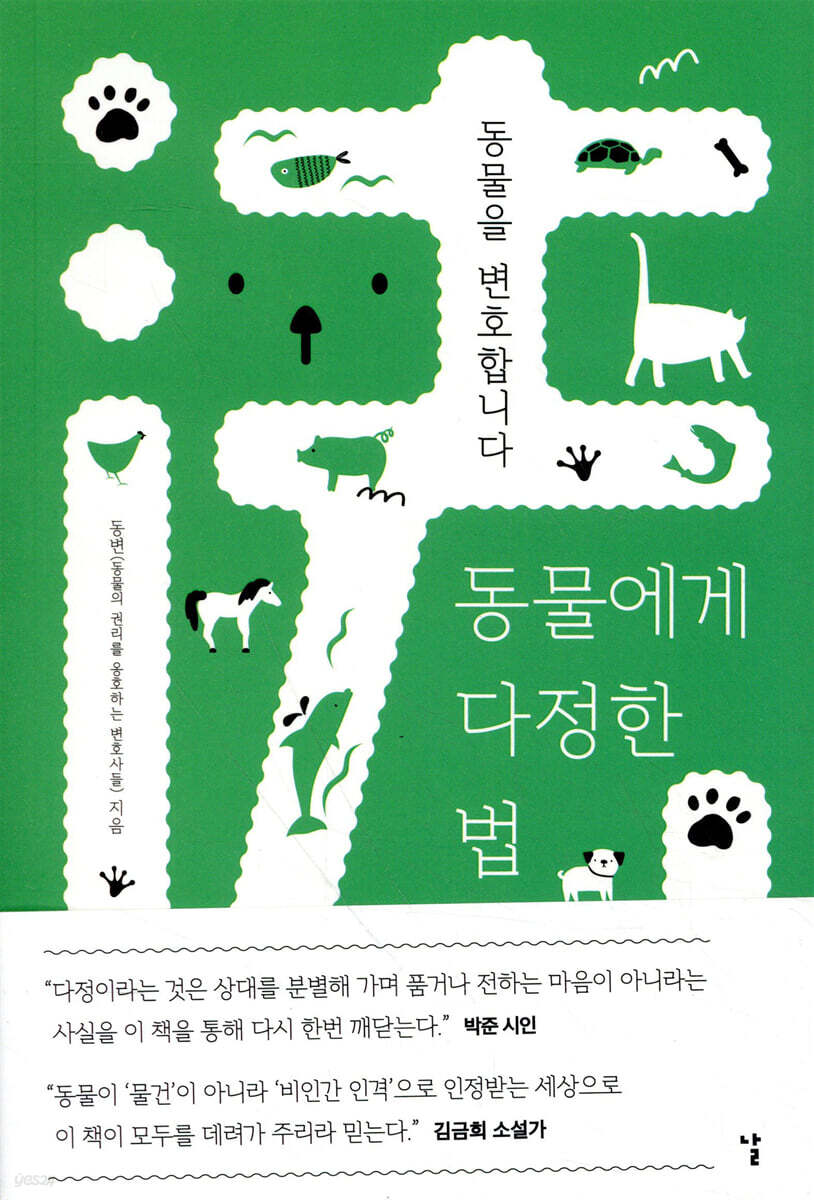
How to be kind to animals
 |
Description
Book Introduction
From flower carriage horses to animal abuse videos
How does the law respond to animal suffering?
In our country, it is still rare to receive a prison sentence for animal abuse.
This means that animal abuse is not taken seriously, and it is also evidence of low social awareness of animal rights.
《Animal-Friendly Law》 is a book that focuses on 11 animal-related cases that I have handled or worked on at Dongbyeon (a group of lawyers who advocate for animal rights), and it identifies problems with the current animal protection law and suggests ways to improve it.
There have been quite a few published essays on companion animals and reports exposing the realities of (non-human) animals, but this book is the first to go a step further and shed light on the issues of animal-related laws.
“Yes, I defend animals.”
Dongbyeon, short for "Lawyers for the Rights of (Non-human) Animals," first met in 2014.
The lawyers at Dongbyeon work at their respective offices during the day and meet in the evenings and on weekends to resolve animal-related cases.
There are many urgent matters, so the group chat room rings frequently even in the early morning.
This book contains a selection of 11 activities from various past years.
These are things that show the current state of (non-human) animals in our society.
Horses in flower carriages that are not allowed to urinate or defecate while in motion and suffer from thirst and hunger all day long while carrying people several times their size; trout that are forced to participate in festivals like slaves and then die; animals whose abuse or killing is filmed and distributed; animals that are used for experiments even when they are sick while living in poor environments; animals that are sacrificed for dissection training; dolphins that are still confined and exhibited in aquariums despite scientific evidence that they are similar to humans and that fish are also dignified creatures that feel ‘pain’; rural dogs that are neglected and not properly managed or protected; animals in zoos that are handled and exhibited carelessly despite the trend of euthanasia; animals that continue to be sacrificed to animal hoarders because there is no prohibition on ‘ownership’; animals in shelters that are euthanized(?) using ‘cruel methods’; dogs that are still killed in cruel ways like electrocution for food even though other Asian countries are moving toward banning the consumption of dogs.
How does the law respond to animal suffering?
In our country, it is still rare to receive a prison sentence for animal abuse.
This means that animal abuse is not taken seriously, and it is also evidence of low social awareness of animal rights.
《Animal-Friendly Law》 is a book that focuses on 11 animal-related cases that I have handled or worked on at Dongbyeon (a group of lawyers who advocate for animal rights), and it identifies problems with the current animal protection law and suggests ways to improve it.
There have been quite a few published essays on companion animals and reports exposing the realities of (non-human) animals, but this book is the first to go a step further and shed light on the issues of animal-related laws.
“Yes, I defend animals.”
Dongbyeon, short for "Lawyers for the Rights of (Non-human) Animals," first met in 2014.
The lawyers at Dongbyeon work at their respective offices during the day and meet in the evenings and on weekends to resolve animal-related cases.
There are many urgent matters, so the group chat room rings frequently even in the early morning.
This book contains a selection of 11 activities from various past years.
These are things that show the current state of (non-human) animals in our society.
Horses in flower carriages that are not allowed to urinate or defecate while in motion and suffer from thirst and hunger all day long while carrying people several times their size; trout that are forced to participate in festivals like slaves and then die; animals whose abuse or killing is filmed and distributed; animals that are used for experiments even when they are sick while living in poor environments; animals that are sacrificed for dissection training; dolphins that are still confined and exhibited in aquariums despite scientific evidence that they are similar to humans and that fish are also dignified creatures that feel ‘pain’; rural dogs that are neglected and not properly managed or protected; animals in zoos that are handled and exhibited carelessly despite the trend of euthanasia; animals that continue to be sacrificed to animal hoarders because there is no prohibition on ‘ownership’; animals in shelters that are euthanized(?) using ‘cruel methods’; dogs that are still killed in cruel ways like electrocution for food even though other Asian countries are moving toward banning the consumption of dogs.
- You can preview some of the book's contents.
Preview
index
In publishing a book
1.
The Weight of the Flower Cart - Chae Su-ji
2.
What Happens During Trout Transport - Lee Hyun-ji
3.
Posting a video of a dead animal - Song Si-hyeon
4.
Why Do Animals Continue to Be Used as Experimental Materials? - Kim Do-hee
5.
What Animal Dissection Practice Left Behind - Kwon Yu-rim
6.
Watching dolphins, or rather, humans, trapped in an aquarium - Hyun So-jin
7.
Is a country dog okay? - Solbi Lee
8.
From the zoo to the sanctuary! - Han Joo-hyun
9.
Why Animal Hoarders Won't Go Away - Kwon Yu-rim
10.
How to Kill Well - Kim Sung-woo
11.
You have to kill them to eat them - Kim So-ri
Reviews
1.
The Weight of the Flower Cart - Chae Su-ji
2.
What Happens During Trout Transport - Lee Hyun-ji
3.
Posting a video of a dead animal - Song Si-hyeon
4.
Why Do Animals Continue to Be Used as Experimental Materials? - Kim Do-hee
5.
What Animal Dissection Practice Left Behind - Kwon Yu-rim
6.
Watching dolphins, or rather, humans, trapped in an aquarium - Hyun So-jin
7.
Is a country dog okay? - Solbi Lee
8.
From the zoo to the sanctuary! - Han Joo-hyun
9.
Why Animal Hoarders Won't Go Away - Kwon Yu-rim
10.
How to Kill Well - Kim Sung-woo
11.
You have to kill them to eat them - Kim So-ri
Reviews
Detailed image
.jpg)
Into the book
Because the horses in flower carriages work long hours, they easily lose weight and become dehydrated, so it is very important to provide them with adequate food and water.
However, employers often do not provide food or water to their horses while they are working to prevent them from defecating anywhere during the workday.
--- p.15
The Canadian city of Montreal also banned horse-drawn carriages in December 2019.
The decision was made despite the city having maintained its European traditions for over 400 years, and the carriage industry being an important means of attracting tourists.
--- p.17
Previously, many argued that fish did not feel pain because they did not have a neocortex in their brains, but recently, as behavioral evidence has accumulated, the mainstream academic trend is to view fish as sentient beings that feel pain.
--- p.28
The trout starve from the moment they leave their homeland until the festival ends.
They are starving because they are not given food.
Why starve them? They'll bite the bait when they're hungry, and that's how visitors feel rewarded and entertained.
--- p.30
Some people may find this view of trout uncomfortable.
Then, why do we eat mackerel, saury, tuna, salmon, etc.?
Some might point out that it is hypocritical to criticize only the trout festival while eating other fish as food.
However, if humans must sacrifice other species, it should be done to the 'minimum', and death should be brought about as quickly and painlessly as possible.
Because this is an action that conforms to the spirit of respect for life.
--- p.33~34
I conclude by sharing a message from Jane Goodall, a world-renowned environmental activist and zoologist, while I was working on the trout incident.
“It is truly shocking and appalling that in this day and age, some people still take it for granted to exploit and torture animals for human pleasure.
( … ) Now we know through science.
That countless animals feel sadness, depression, fear, contentment, and joy, and that among them, pain is felt by almost all species.
I love Korea and have many Korean friends.
So I'm sad to learn about the Hwacheon Sancheoneo Festival.
“It is truly horrific to catch and eat thousands of fish trapped under the ice and enjoy the pleasure of it.”
--- p.43
The Animal Protection Act prohibits the sale, display, transmission, screening, or online posting of photos or videos of animal abuse. Violators are subject to fines of up to 3 million won.
It may be a matter of opinion, but considering the negative impact of spreading animal abuse content, I think the sentence is too lenient.
--- p.59
In fact, until recently, the legal punishment for killing an animal and for injuring an animal were the same.
As criticism continued to mount over how killing and injuring could be treated the same, the two were finally given different statutory sentences in 2020.
However, as the sentences for the Nth Room and creator defendants are almost the same, there is still a long way to go.
There also needs to be a change in how investigative agencies and courts judge animal abuse cases.
Investigative authorities should treat animal abuse as a serious crime and enforce animal protection laws more aggressively to severely punish animal abuse.
--- p.61
Putting aside the fundamental debate over whether or not animals should be used in experiments, compared to the past, there are now many ways to conduct experiments without using animals.
Experiments that culture cells, tissues, and organs extracted from humans or animals, or that predict changes through computer modeling, are gaining attention as safe and accurate alternative experimental methods with fewer variables and errors.
--- p.79
The reality of unethical animal use in experiments has already been revealed through several incidents, many of which occurred in university laboratories.
More animals are used in experiments in university laboratories than in public institutions or medical institutions.
However, there is no law that can regulate universities.
Universities, citing budget constraints and other reasons, bring in animals from unregistered companies and conduct unethical experiments.
--- p.81
Many people were concerned that animal dissection practices left more psychological scars than educational benefits, and these thoughts led to a change in the law.
In 2018, the Animal Protection Act was revised, and a new provision (Article 24-2) was added that prohibits minors from practicing animal dissection.
--- p.86
Due to these concerns, many countries, including the United States, Switzerland, Norway, Denmark, the Netherlands, Slovakia, Israel, and Argentina, have banned the practice or education of animal dissection, and this trend is spreading.
Specifically, Switzerland, Norway, the Netherlands, and Denmark prohibit animal dissection experiments in middle and high schools, and Taiwan prohibits animal experiments for students in middle school and below.
India bans animal dissection experiments at universities, instead using simulations to teach related subjects. In the UK, students at the undergraduate level and below are prohibited from engaging in any learning activity that could cause pain or suffering to vertebrate animals.
These countries consider animal testing, such as dissection, to be "uneducational" for children and adolescents.
--- p.91
Dolphins also have language learning abilities comparable to those of humans.
They are highly sophisticated animals that can communicate smoothly with other individuals through language expressions and other means.
This has been scientifically proven for decades.
Therefore, the core perspective of Dongbyeon's view on the deaths of dolphins in aquariums was that whales should not be kept in captivity for human entertainment, but should be viewed as 'non-human persons' with inherent rights and abilities.
--- p.99
The Ministry of Justice's July 2021 amendment to the Civil Code added a new provision, Article 98-2, regarding the legal status of animals, stating that "animals are not things," under Article 98 of the Civil Code, which defines things.
There is a growing social consensus that animals should be respected as living beings, but the current law treats animals as objects, which is seen as a cause of animal abuse.
However, this amendment still views animals as objects, except in cases specifically provided for by law.
This is because among animals raised for profit or livelihood, there are cases where they must be maintained as 'objects'.
--- p.111~112
However, Article 9 still places the guardian's responsibility for raising and managing animals only as a "recommendation," making it difficult to prevent neglect before it causes disease, injury, or death to the animal.
In this way, the revised Animal Protection Act excludes the act itself from punishment, even though it states that animal neglect constitutes abuse.
--- p.115
At first, they only found a few horses and fed them sweet potatoes, carrots, and other food.
Then I learned that there are many different animals, such as camels, monkeys, rabbits, goats, and sheep.
All the animals were hungry and thirsty.
The monkeys and raccoons locked in the exhibit were so thirsty that when people put a hose into a small hole to give them water, they sat right in front of the hole and licked the water that flowed down to the ground.
--- p.125
In fact, many countries are moving towards operating 'sanctuaries' instead of zoos.
A sanctuary is a facility that protects animals by providing an environment that is as close to their natural habitat as possible.
The Wild Animal Sanctuary in Colorado, USA, is a whopping 319 hectares of grassland where the animals protected there live in open habitats and are not forced to be on display to humans.
--- p.133
Indoor zoos and experiential zoos that are popular in Korea are not places where you can learn about the mystery and greatness of life.
Would it be too harsh to say that zoos merely encourage a disregard for life, viewing it as a tool for play and entertainment, something we can touch whenever we want? It's time for domestic zoos to transform from mere zoos for viewing and petting to sanctuaries where we can learn about the mystery and grandeur of life.
--- p.135~136
The problem arises because the current law punishes animal hoarders when animals are injured or killed due to hoarding, but does not prohibit hoarders from raising more animals.
When we see the director trying to take away the remaining dogs on a truck during the demolition of Aerinwon, it is very likely that animal hoarders will repeat the same behavior.
--- p.151
The current Animal Protection Act does not have separate provisions for punishment for failure to comply with a series of procedures and requirements when providing "humane treatment."
Even if euthanasia is performed illegally, it is not subject to criminal punishment.
If the investigative authorities and the courts in this case decide that illegal euthanasia, especially the act of killing animals painfully without administering anesthesia, is punishable under the Animal Protection Act, then from now on, illegal euthanasia will also be punishable as a violation of the Animal Protection Act.
--- p.165
What is the purpose of a dog farm?
It's about raising dogs for food.
However, our law does not consider dogs as 'livestock for consumption'.
This is because there are no specific regulations prohibiting or permitting the consumption of dog meat.
Rather, it should be viewed as a ban on eating it.
--- p.169
The Korean Veterinary Association stated that since there are no legal standards for slaughtering dogs and no scientific research results on the pain dogs experience during the slaughter process, slaughtering dogs with electric skewers can be judged to be the same as electrocuting dogs to death in extreme pain, and thus constitutes clear animal abuse.
--- p.180~181
It is somewhat regrettable that the sentence was suspended even for a fine of only 1 million won, but this ruling clearly confirms that killing a dog with an electric skewer is animal abuse.
In reality, most dog farms slaughter dogs with electricity, and there are no specific standards for slaughtering dogs, so this ruling can be interpreted as effectively banning the slaughter of dogs for consumption.
However, employers often do not provide food or water to their horses while they are working to prevent them from defecating anywhere during the workday.
--- p.15
The Canadian city of Montreal also banned horse-drawn carriages in December 2019.
The decision was made despite the city having maintained its European traditions for over 400 years, and the carriage industry being an important means of attracting tourists.
--- p.17
Previously, many argued that fish did not feel pain because they did not have a neocortex in their brains, but recently, as behavioral evidence has accumulated, the mainstream academic trend is to view fish as sentient beings that feel pain.
--- p.28
The trout starve from the moment they leave their homeland until the festival ends.
They are starving because they are not given food.
Why starve them? They'll bite the bait when they're hungry, and that's how visitors feel rewarded and entertained.
--- p.30
Some people may find this view of trout uncomfortable.
Then, why do we eat mackerel, saury, tuna, salmon, etc.?
Some might point out that it is hypocritical to criticize only the trout festival while eating other fish as food.
However, if humans must sacrifice other species, it should be done to the 'minimum', and death should be brought about as quickly and painlessly as possible.
Because this is an action that conforms to the spirit of respect for life.
--- p.33~34
I conclude by sharing a message from Jane Goodall, a world-renowned environmental activist and zoologist, while I was working on the trout incident.
“It is truly shocking and appalling that in this day and age, some people still take it for granted to exploit and torture animals for human pleasure.
( … ) Now we know through science.
That countless animals feel sadness, depression, fear, contentment, and joy, and that among them, pain is felt by almost all species.
I love Korea and have many Korean friends.
So I'm sad to learn about the Hwacheon Sancheoneo Festival.
“It is truly horrific to catch and eat thousands of fish trapped under the ice and enjoy the pleasure of it.”
--- p.43
The Animal Protection Act prohibits the sale, display, transmission, screening, or online posting of photos or videos of animal abuse. Violators are subject to fines of up to 3 million won.
It may be a matter of opinion, but considering the negative impact of spreading animal abuse content, I think the sentence is too lenient.
--- p.59
In fact, until recently, the legal punishment for killing an animal and for injuring an animal were the same.
As criticism continued to mount over how killing and injuring could be treated the same, the two were finally given different statutory sentences in 2020.
However, as the sentences for the Nth Room and creator defendants are almost the same, there is still a long way to go.
There also needs to be a change in how investigative agencies and courts judge animal abuse cases.
Investigative authorities should treat animal abuse as a serious crime and enforce animal protection laws more aggressively to severely punish animal abuse.
--- p.61
Putting aside the fundamental debate over whether or not animals should be used in experiments, compared to the past, there are now many ways to conduct experiments without using animals.
Experiments that culture cells, tissues, and organs extracted from humans or animals, or that predict changes through computer modeling, are gaining attention as safe and accurate alternative experimental methods with fewer variables and errors.
--- p.79
The reality of unethical animal use in experiments has already been revealed through several incidents, many of which occurred in university laboratories.
More animals are used in experiments in university laboratories than in public institutions or medical institutions.
However, there is no law that can regulate universities.
Universities, citing budget constraints and other reasons, bring in animals from unregistered companies and conduct unethical experiments.
--- p.81
Many people were concerned that animal dissection practices left more psychological scars than educational benefits, and these thoughts led to a change in the law.
In 2018, the Animal Protection Act was revised, and a new provision (Article 24-2) was added that prohibits minors from practicing animal dissection.
--- p.86
Due to these concerns, many countries, including the United States, Switzerland, Norway, Denmark, the Netherlands, Slovakia, Israel, and Argentina, have banned the practice or education of animal dissection, and this trend is spreading.
Specifically, Switzerland, Norway, the Netherlands, and Denmark prohibit animal dissection experiments in middle and high schools, and Taiwan prohibits animal experiments for students in middle school and below.
India bans animal dissection experiments at universities, instead using simulations to teach related subjects. In the UK, students at the undergraduate level and below are prohibited from engaging in any learning activity that could cause pain or suffering to vertebrate animals.
These countries consider animal testing, such as dissection, to be "uneducational" for children and adolescents.
--- p.91
Dolphins also have language learning abilities comparable to those of humans.
They are highly sophisticated animals that can communicate smoothly with other individuals through language expressions and other means.
This has been scientifically proven for decades.
Therefore, the core perspective of Dongbyeon's view on the deaths of dolphins in aquariums was that whales should not be kept in captivity for human entertainment, but should be viewed as 'non-human persons' with inherent rights and abilities.
--- p.99
The Ministry of Justice's July 2021 amendment to the Civil Code added a new provision, Article 98-2, regarding the legal status of animals, stating that "animals are not things," under Article 98 of the Civil Code, which defines things.
There is a growing social consensus that animals should be respected as living beings, but the current law treats animals as objects, which is seen as a cause of animal abuse.
However, this amendment still views animals as objects, except in cases specifically provided for by law.
This is because among animals raised for profit or livelihood, there are cases where they must be maintained as 'objects'.
--- p.111~112
However, Article 9 still places the guardian's responsibility for raising and managing animals only as a "recommendation," making it difficult to prevent neglect before it causes disease, injury, or death to the animal.
In this way, the revised Animal Protection Act excludes the act itself from punishment, even though it states that animal neglect constitutes abuse.
--- p.115
At first, they only found a few horses and fed them sweet potatoes, carrots, and other food.
Then I learned that there are many different animals, such as camels, monkeys, rabbits, goats, and sheep.
All the animals were hungry and thirsty.
The monkeys and raccoons locked in the exhibit were so thirsty that when people put a hose into a small hole to give them water, they sat right in front of the hole and licked the water that flowed down to the ground.
--- p.125
In fact, many countries are moving towards operating 'sanctuaries' instead of zoos.
A sanctuary is a facility that protects animals by providing an environment that is as close to their natural habitat as possible.
The Wild Animal Sanctuary in Colorado, USA, is a whopping 319 hectares of grassland where the animals protected there live in open habitats and are not forced to be on display to humans.
--- p.133
Indoor zoos and experiential zoos that are popular in Korea are not places where you can learn about the mystery and greatness of life.
Would it be too harsh to say that zoos merely encourage a disregard for life, viewing it as a tool for play and entertainment, something we can touch whenever we want? It's time for domestic zoos to transform from mere zoos for viewing and petting to sanctuaries where we can learn about the mystery and grandeur of life.
--- p.135~136
The problem arises because the current law punishes animal hoarders when animals are injured or killed due to hoarding, but does not prohibit hoarders from raising more animals.
When we see the director trying to take away the remaining dogs on a truck during the demolition of Aerinwon, it is very likely that animal hoarders will repeat the same behavior.
--- p.151
The current Animal Protection Act does not have separate provisions for punishment for failure to comply with a series of procedures and requirements when providing "humane treatment."
Even if euthanasia is performed illegally, it is not subject to criminal punishment.
If the investigative authorities and the courts in this case decide that illegal euthanasia, especially the act of killing animals painfully without administering anesthesia, is punishable under the Animal Protection Act, then from now on, illegal euthanasia will also be punishable as a violation of the Animal Protection Act.
--- p.165
What is the purpose of a dog farm?
It's about raising dogs for food.
However, our law does not consider dogs as 'livestock for consumption'.
This is because there are no specific regulations prohibiting or permitting the consumption of dog meat.
Rather, it should be viewed as a ban on eating it.
--- p.169
The Korean Veterinary Association stated that since there are no legal standards for slaughtering dogs and no scientific research results on the pain dogs experience during the slaughter process, slaughtering dogs with electric skewers can be judged to be the same as electrocuting dogs to death in extreme pain, and thus constitutes clear animal abuse.
--- p.180~181
It is somewhat regrettable that the sentence was suspended even for a fine of only 1 million won, but this ruling clearly confirms that killing a dog with an electric skewer is animal abuse.
In reality, most dog farms slaughter dogs with electricity, and there are no specific standards for slaughtering dogs, so this ruling can be interpreted as effectively banning the slaughter of dogs for consumption.
--- p.190
Publisher's Review
The law must change first
Compared to foreign countries, the concept of animal rights has not yet taken root in our society.
Now, the phrase “Animals are not things” is finally being prepared to be used in law rather than just a slogan.
Given this reality, even though it is a clear case of animal abuse, most investigative agencies, such as the police and prosecutors, do not accept it as an ‘incident.’
Even if a complaint is filed, it often ends in a non-prosecution decision due to “insufficient evidence,” and even if a case is successfully prosecuted and a trial is held, the sentence is often much lower than the statutory sentence.
There are no proper sentencing guidelines for animal-related cases.
Cases related to the Animal Protection Act lack precedent-setting decisions compared to other cases.
This is because there are not many cases based on the Animal Protection Act and thus not many Supreme Court precedents have been formed.
The reason why there are not many cases under the Animal Protection Act is because the number of cases handled by applying the Act is small, and the reason why there are not many Supreme Court precedents is because the level of punishment stipulated under the Animal Protection Act is very weak, so most cases are concluded in the first and second trials.
-On pages 164 and 165
Moreover, animal abuse cases often result in sentences that are much lower than the statutory penalty.
As mentioned earlier, if you kill an animal cruelly, you are subject to imprisonment for up to 3 years or a fine of up to 30 million won, and if you cause injury to an animal, you are subject to imprisonment for up to 2 years or a fine of up to 20 million won.
However, in animal abuse cases, sentences are handed down that fall far short of the statutory penalties.
Although there is a prison sentence, there are not many cases where a prison sentence is handed down, and cases where a real sentence is handed down are even rarer.
(…) Also, because the sentencing standards for animal abuse are not properly established, the severity of the crime and the sentence are uneven.
You can tell just by looking at the fact that the sentences for the animal version of the Nth Room defendant and the personal broadcast creator are almost the same.
-On pages 59 and 60
《Animal-Friendly Law》 shows how the 'law' views animals through representative animal-related cases, and emphasizes that the law must change first to change the low social awareness of animal rights.
We also urge investigative agencies, including the police and prosecutors, to treat animal abuse as a serious crime and to more actively apply the Animal Protection Act to severely punish animal abuse.
As recent research shows, animal abuse is more likely to lead to crimes against people.
A world that is kind to animals is also a world that is kind to humans.
Compared to foreign countries, the concept of animal rights has not yet taken root in our society.
Now, the phrase “Animals are not things” is finally being prepared to be used in law rather than just a slogan.
Given this reality, even though it is a clear case of animal abuse, most investigative agencies, such as the police and prosecutors, do not accept it as an ‘incident.’
Even if a complaint is filed, it often ends in a non-prosecution decision due to “insufficient evidence,” and even if a case is successfully prosecuted and a trial is held, the sentence is often much lower than the statutory sentence.
There are no proper sentencing guidelines for animal-related cases.
Cases related to the Animal Protection Act lack precedent-setting decisions compared to other cases.
This is because there are not many cases based on the Animal Protection Act and thus not many Supreme Court precedents have been formed.
The reason why there are not many cases under the Animal Protection Act is because the number of cases handled by applying the Act is small, and the reason why there are not many Supreme Court precedents is because the level of punishment stipulated under the Animal Protection Act is very weak, so most cases are concluded in the first and second trials.
-On pages 164 and 165
Moreover, animal abuse cases often result in sentences that are much lower than the statutory penalty.
As mentioned earlier, if you kill an animal cruelly, you are subject to imprisonment for up to 3 years or a fine of up to 30 million won, and if you cause injury to an animal, you are subject to imprisonment for up to 2 years or a fine of up to 20 million won.
However, in animal abuse cases, sentences are handed down that fall far short of the statutory penalties.
Although there is a prison sentence, there are not many cases where a prison sentence is handed down, and cases where a real sentence is handed down are even rarer.
(…) Also, because the sentencing standards for animal abuse are not properly established, the severity of the crime and the sentence are uneven.
You can tell just by looking at the fact that the sentences for the animal version of the Nth Room defendant and the personal broadcast creator are almost the same.
-On pages 59 and 60
《Animal-Friendly Law》 shows how the 'law' views animals through representative animal-related cases, and emphasizes that the law must change first to change the low social awareness of animal rights.
We also urge investigative agencies, including the police and prosecutors, to treat animal abuse as a serious crime and to more actively apply the Animal Protection Act to severely punish animal abuse.
As recent research shows, animal abuse is more likely to lead to crimes against people.
A world that is kind to animals is also a world that is kind to humans.
GOODS SPECIFICS
- Publication date: June 10, 2022
- Page count, weight, size: 200 pages | 294g | 135*200*20mm
- ISBN13: 9791168100688
- ISBN10: 1168100682
You may also like
카테고리
korean


korean

![GQ KOREA Mark (Monthly): December [2025]](http://librairie.coreenne.fr/cdn/shop/files/8ef265dbbfbf186523ed75ba7319009d.jpg?v=1765340328&width=3840)


