

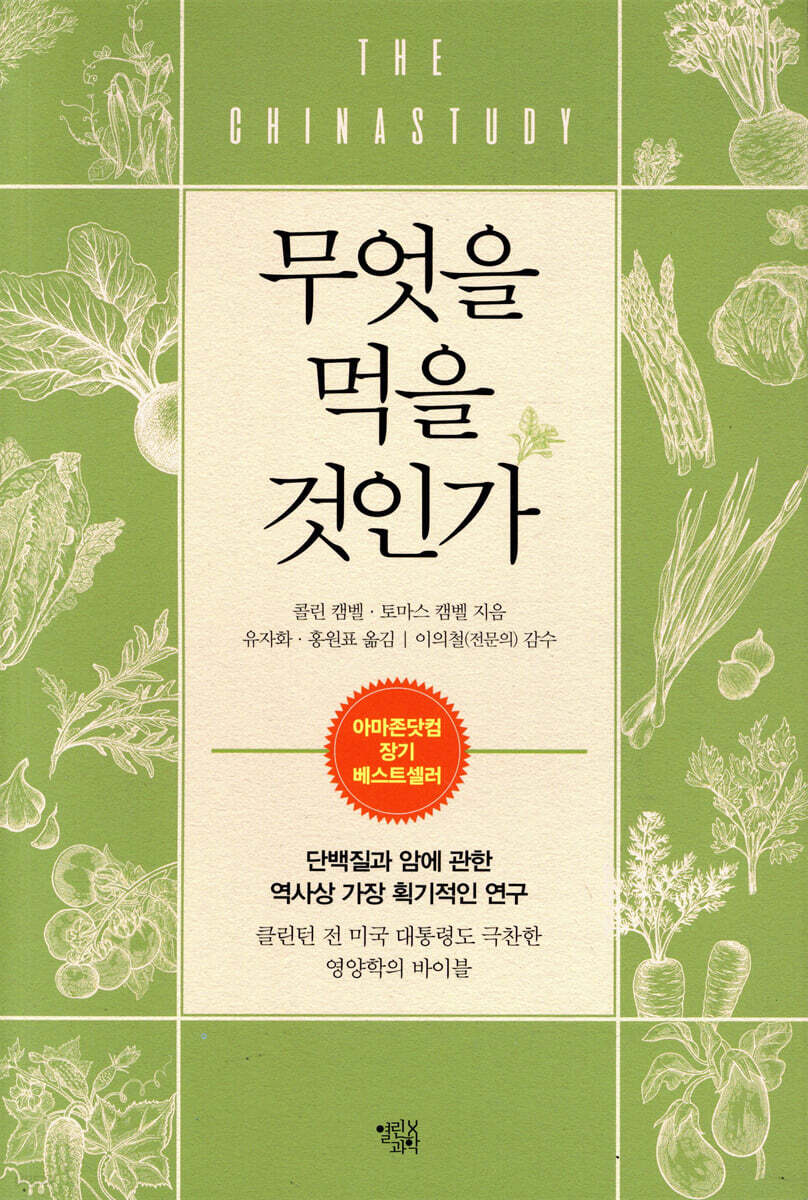
What to eat
 |
Description
Book Introduction
The One Health Book That Changed Millions of Lives
Setting a new standard in nutrition and health
Since the 1980s, cancer has remained the leading cause of death in Koreans.
Deaths from ischemic heart disease and cerebral infarction, which are caused by blockage of the heart and cerebral blood vessels, are also increasing exponentially.
No matter what measures are taken, people's health continues to deteriorate.
The United States spends more money on health care than any other country in the world, yet two-thirds of its population is obese, and more than 15 million people have diabetes, a number that is growing rapidly.
Just as 40 years ago, heart disease remains the leading cause of death, and the war against cancer, which began in the 1970s, has been a dismal failure.
Half of Americans have health problems that require prescription medication every week.
Colin Campbell, a leading expert in the American nutrition world, points out that excessive protein intake is behind this.
In his "The China Study," which he conducted for over 20 years in rural China, he concluded that proteins act as a "cancer switch" that turns cancer on and off.
What's even more surprising is that plant-based proteins don't cause cancer, only animal-based proteins do.
This book, which sets a new standard for nutrition and health, is a revised and expanded edition of "What to Eat," published in 2012, reflecting the original's revisions and additions.
Considered the single health book that has changed millions of lives, this book dispels countless myths and misinformation about health while offering a concise and clear message of hope.
If you want to be healthy, change what you eat.
This book will guide modern people who are at risk of obesity and adult diseases that are spreading like an epidemic due to the Western diet to find wise and practical solutions.
Setting a new standard in nutrition and health
Since the 1980s, cancer has remained the leading cause of death in Koreans.
Deaths from ischemic heart disease and cerebral infarction, which are caused by blockage of the heart and cerebral blood vessels, are also increasing exponentially.
No matter what measures are taken, people's health continues to deteriorate.
The United States spends more money on health care than any other country in the world, yet two-thirds of its population is obese, and more than 15 million people have diabetes, a number that is growing rapidly.
Just as 40 years ago, heart disease remains the leading cause of death, and the war against cancer, which began in the 1970s, has been a dismal failure.
Half of Americans have health problems that require prescription medication every week.
Colin Campbell, a leading expert in the American nutrition world, points out that excessive protein intake is behind this.
In his "The China Study," which he conducted for over 20 years in rural China, he concluded that proteins act as a "cancer switch" that turns cancer on and off.
What's even more surprising is that plant-based proteins don't cause cancer, only animal-based proteins do.
This book, which sets a new standard for nutrition and health, is a revised and expanded edition of "What to Eat," published in 2012, reflecting the original's revisions and additions.
Considered the single health book that has changed millions of lives, this book dispels countless myths and misinformation about health while offering a concise and clear message of hope.
If you want to be healthy, change what you eat.
This book will guide modern people who are at risk of obesity and adult diseases that are spreading like an epidemic due to the Western diet to find wise and practical solutions.
- You can preview some of the book's contents.
Preview
index
Recommendation
Acknowledgements
Acknowledgments for the Revised and Expanded Edition
Reviewer's note
Recommendation 1 Howard Lehman
Recommendation 2 John Robbins
introduction
PART 1 Lessons from China
Chapter 1 Health, What's the Problem?
Should humans suffer from disease? | Oh, it wasn't meant to be... | Spending money to ruin your health? | Why are people so confused? | Dietary toxicity | Empty promises of the future
Chapter 2 Misconceptions about Protein
What is Good Protein? | Protein Deficiency in Third World Children | International Programs to Address Nutritional Deficiencies | Surprising Discoveries About Protein
Chapter 3 Turn off the dark switch
Hotdog Missile | How Protein Affects Cancer | Three Stages of Cancer Development | Proteins and the Onset of Cancer
Protein and the Accelerator of Cancer | Plant Protein Was Different | The Final Chapter | Different Cancers, Different Carcinogens | Huge Implications
Chapter 4 Lessons from China
Snapshot of Time | Creating a Cancer Map | The Grand Prix of Epidemiology | Chinese and American Foods | Diseases of Poverty and Affluence | The Secret of Cholesterol | Animal Protein and Cholesterol | The Meaning of the 30% Fat Recommendation
A report on fat and cancer | Does dietary fiber interfere with iron absorption? | Plant antioxidants keep us young | The truth about the Atkins diet | The truth about carbs | The secret relationship between calories and weight
Genes and Physique | Proteins Are Triggers That Control Cancer
PART 2 Plenty of Diseases
Chapter 5 Heart Disease
Medical Reports from Korean War Veterans | Why Do People Have Heart Attacks? | Cases Outside the U.S. | Leading Research | Heart Disease is the Leading Cause of Death | Is Heart Surgery the Best Option? | The World's Best Heart Centers | Treatments Without Drugs or Surgery | Lifestyle Changes
Chapter 6 Obesity
The Seriousness of Childhood Obesity | Adult Obesity: An Economic Black Hole | What's the Solution to Obesity? | Why a Plant-Based Diet Is Effective | How Much Exercise Do You Need to Lose Weight? | A Correct Understanding of Obesity
Chapter 7 Diabetes
The Two Faces of the Devil | Diabetes and Obesity: Half-Siblings | Cross-Cross-Comparative Studies | Treating Incurable Diseases | Deep-Seed Lifestyle Habits
Chapter 8 Breast cancer, prostate cancer, and colon cancer
A Family Story | Breast Cancer Risk Factors | Genetic Fatalism | Screening and Non-Nutritional Prevention | Endocrine Disorders and Breast Cancer | Hormone Replacement Therapy | President Bush's Colonoscopy | Geographic Imbalances | Colon Cancer and Dietary Fiber | Colon Cancer and Milk | Diseases of Affluence and Prostate Cancer | The Mechanism of Prostate Cancer | Onishi's Prostate Cancer Research | Join Us
Chapter 9 Autoimmune Diseases
Immunity to Foreign Substances | Immunity to Your Own Body | Type 1 Diabetes | Does Milk Cause Type 1 Diabetes? | Multiple Sclerosis | Commonalities of Autoimmune Diseases
Chapter 10 Diseases of the Bone, Kidney, Eye, and Brain
Osteoporosis | Kidney Stones | Eye Disease | Mind-Changing Foods
PART 3 Healthy Nutrition Guidelines
Chapter 11 Eating Right: 8 Principles of Food and Health
Principle 1 Nutrition is the complex interaction of many foods | Principle 2 Supplements are not a panacea for health | Principle 3 Nutrients from plant foods are better than those from animal foods | Principle 4 Genes do not cause disease on their own | Principle 5 Nutrients can modulate the harmful effects of toxic chemicals | Principle 6 Nutrients can not only prevent disease but also halt or treat its progression | Principle 7 Nutrients that are effective for one disease are also effective for others | Principle 8 Good nutrition makes our bodies healthy, and all parts are interconnected | Nutrition for whom? | Wholeness and holism
Chapter 12 What should I eat?
Supplements | Should I Stop Eating Meat Completely? | The Joy of a Plant-Based Diet | Changing Your Eating Habits
Vegetarian and Vegan vs. Plant-Based Diet
Glenn's Advice
PART 4 Health for Whom?
Chapter 13 The Dark Side of Science
What is Nutrition? | Shocking Facts | Reports Manipulating Health Information | Power and Interest | A Stern Warning | American Cancer Institute | Fabricated Information | Traitors in Organizations | Why the Truth Is Distorted
Chapter 14 Scientific Reductionism
Nutrient Reductionism | Nurses Who Enjoy Meat | Fat as an Indicator of Animal Products | Results of a $100 Million Study | Nutrition Misinformation | The Role of Science | Opportunity for a Rebound?
Chapter 15: Symbiosis between Business and Science
Corporate espionage | Conjugated linoleic acid | Industrial science | Powerful interests | Technological manipulation and marketing | How much vitamin C is in an orange? | The relentless misuse of science
Chapter 16 Whose Government Is This?
Nutrient Recommendations | Protein Recommendations | Sugar-Coated Reports | Corporate Influence | Regressive Nutrition Policy
Where Does Nutrition Research Funding Come From? | School Lunch Programs
Chapter 17 Eating Habits and Health
Vegetable Doctor | Can Cabbage and Broccoli Cure Disease? | A Two-Credit Nutrition Course | McDougall's Challenge | The Pharmaceutical Industry and Medical Education | McDougall's Choice
On the publication of the revised and expanded edition
Chapter 18: The Collapsed Ivory Tower
The Collapse of Academic Freedom at Cornell University | What's Eroding Academic Freedom | Ideal Academics
Chapter 19 History Repeats Itself
Review of the revised and expanded edition
main
Search
Acknowledgements
Acknowledgments for the Revised and Expanded Edition
Reviewer's note
Recommendation 1 Howard Lehman
Recommendation 2 John Robbins
introduction
PART 1 Lessons from China
Chapter 1 Health, What's the Problem?
Should humans suffer from disease? | Oh, it wasn't meant to be... | Spending money to ruin your health? | Why are people so confused? | Dietary toxicity | Empty promises of the future
Chapter 2 Misconceptions about Protein
What is Good Protein? | Protein Deficiency in Third World Children | International Programs to Address Nutritional Deficiencies | Surprising Discoveries About Protein
Chapter 3 Turn off the dark switch
Hotdog Missile | How Protein Affects Cancer | Three Stages of Cancer Development | Proteins and the Onset of Cancer
Protein and the Accelerator of Cancer | Plant Protein Was Different | The Final Chapter | Different Cancers, Different Carcinogens | Huge Implications
Chapter 4 Lessons from China
Snapshot of Time | Creating a Cancer Map | The Grand Prix of Epidemiology | Chinese and American Foods | Diseases of Poverty and Affluence | The Secret of Cholesterol | Animal Protein and Cholesterol | The Meaning of the 30% Fat Recommendation
A report on fat and cancer | Does dietary fiber interfere with iron absorption? | Plant antioxidants keep us young | The truth about the Atkins diet | The truth about carbs | The secret relationship between calories and weight
Genes and Physique | Proteins Are Triggers That Control Cancer
PART 2 Plenty of Diseases
Chapter 5 Heart Disease
Medical Reports from Korean War Veterans | Why Do People Have Heart Attacks? | Cases Outside the U.S. | Leading Research | Heart Disease is the Leading Cause of Death | Is Heart Surgery the Best Option? | The World's Best Heart Centers | Treatments Without Drugs or Surgery | Lifestyle Changes
Chapter 6 Obesity
The Seriousness of Childhood Obesity | Adult Obesity: An Economic Black Hole | What's the Solution to Obesity? | Why a Plant-Based Diet Is Effective | How Much Exercise Do You Need to Lose Weight? | A Correct Understanding of Obesity
Chapter 7 Diabetes
The Two Faces of the Devil | Diabetes and Obesity: Half-Siblings | Cross-Cross-Comparative Studies | Treating Incurable Diseases | Deep-Seed Lifestyle Habits
Chapter 8 Breast cancer, prostate cancer, and colon cancer
A Family Story | Breast Cancer Risk Factors | Genetic Fatalism | Screening and Non-Nutritional Prevention | Endocrine Disorders and Breast Cancer | Hormone Replacement Therapy | President Bush's Colonoscopy | Geographic Imbalances | Colon Cancer and Dietary Fiber | Colon Cancer and Milk | Diseases of Affluence and Prostate Cancer | The Mechanism of Prostate Cancer | Onishi's Prostate Cancer Research | Join Us
Chapter 9 Autoimmune Diseases
Immunity to Foreign Substances | Immunity to Your Own Body | Type 1 Diabetes | Does Milk Cause Type 1 Diabetes? | Multiple Sclerosis | Commonalities of Autoimmune Diseases
Chapter 10 Diseases of the Bone, Kidney, Eye, and Brain
Osteoporosis | Kidney Stones | Eye Disease | Mind-Changing Foods
PART 3 Healthy Nutrition Guidelines
Chapter 11 Eating Right: 8 Principles of Food and Health
Principle 1 Nutrition is the complex interaction of many foods | Principle 2 Supplements are not a panacea for health | Principle 3 Nutrients from plant foods are better than those from animal foods | Principle 4 Genes do not cause disease on their own | Principle 5 Nutrients can modulate the harmful effects of toxic chemicals | Principle 6 Nutrients can not only prevent disease but also halt or treat its progression | Principle 7 Nutrients that are effective for one disease are also effective for others | Principle 8 Good nutrition makes our bodies healthy, and all parts are interconnected | Nutrition for whom? | Wholeness and holism
Chapter 12 What should I eat?
Supplements | Should I Stop Eating Meat Completely? | The Joy of a Plant-Based Diet | Changing Your Eating Habits
Vegetarian and Vegan vs. Plant-Based Diet
Glenn's Advice
PART 4 Health for Whom?
Chapter 13 The Dark Side of Science
What is Nutrition? | Shocking Facts | Reports Manipulating Health Information | Power and Interest | A Stern Warning | American Cancer Institute | Fabricated Information | Traitors in Organizations | Why the Truth Is Distorted
Chapter 14 Scientific Reductionism
Nutrient Reductionism | Nurses Who Enjoy Meat | Fat as an Indicator of Animal Products | Results of a $100 Million Study | Nutrition Misinformation | The Role of Science | Opportunity for a Rebound?
Chapter 15: Symbiosis between Business and Science
Corporate espionage | Conjugated linoleic acid | Industrial science | Powerful interests | Technological manipulation and marketing | How much vitamin C is in an orange? | The relentless misuse of science
Chapter 16 Whose Government Is This?
Nutrient Recommendations | Protein Recommendations | Sugar-Coated Reports | Corporate Influence | Regressive Nutrition Policy
Where Does Nutrition Research Funding Come From? | School Lunch Programs
Chapter 17 Eating Habits and Health
Vegetable Doctor | Can Cabbage and Broccoli Cure Disease? | A Two-Credit Nutrition Course | McDougall's Challenge | The Pharmaceutical Industry and Medical Education | McDougall's Choice
On the publication of the revised and expanded edition
Chapter 18: The Collapsed Ivory Tower
The Collapse of Academic Freedom at Cornell University | What's Eroding Academic Freedom | Ideal Academics
Chapter 19 History Repeats Itself
Review of the revised and expanded edition
main
Search
Publisher's Review
The most groundbreaking study in history on proteins and cancer
The bible of nutrition, praised even by former President Clinton
Proteins, a trigger for cancer development
Since the 1980s, cancer has remained the leading cause of death in Koreans.
Deaths from ischemic heart disease and cerebral infarction, which are caused by blockage of the heart and cerebral blood vessels, are also increasing exponentially.
No matter what measures are taken, people's health continues to deteriorate.
The United States spends more money on health care than any other country in the world, yet two-thirds of its population is obese, and more than 15 million people have diabetes, a number that is growing rapidly.
Just as 40 years ago, heart disease remains the leading cause of death, and the war against cancer, which began in the 1970s, has been a dismal failure.
Half of Americans have health problems that require prescription medication every week.
Colin Campbell, a leading expert in the American nutrition world, points out that excessive protein intake is behind this.
In his "The China Study," which he conducted for over 20 years in rural China, he concluded that proteins act as a "cancer switch" that turns cancer on and off.
What's even more surprising is that plant-based proteins don't cause cancer, only animal-based proteins do.
It would not be an exaggeration to say that current nutrition is protein nutrition, worshipping protein.
When we think of healthy and nutritious food, we all think of protein, meat, poultry, fish, eggs, and milk.
It has become common knowledge that protein is good for the body.
However, our bodies do not need that much of these foods and proteins.
Rather, if you consume more than necessary, various chronic diseases, including cancer, can occur.
The conclusion of Campbell's research is that proteins act as a 'carcinogenic switch' that turns cancer development on and off.
Consuming more than 10 percent of your calories from protein increases your risk of cancer.
Colin Campbell's solution to this is simple.
It's about checking what you're eating now and changing it.
And it proposes a new eating habit called 'wholefood, plant-based diet; WFPB diet'.
A study on China praised by the New York Times
In the early 1970s, China's most powerful leader, Zhou Enlai, was battling cancer.
Diagnosed with a terminal illness, he embarked on a nationwide survey to gather information about his little-known illness.
We began by examining mortality rates for 12 types of cancer across 2,400 provinces and 880 million people, representing 96 percent of China's total population.
It was a biomedical research project of unprecedented scale, with 650,000 participants.
The results were astonishing.
The regional variation in major cancers was as much as 100 times.
Meanwhile, in Long Island, New York, a year-long, heavily funded study was underway to determine why breast cancer rates were higher than in other areas.
What percentage of cases could have caused such a stir? The study found that breast cancer rates in two areas of Long Island were only 10 to 20 percent higher than the state average.
This was also a surprising result when compared to the situation in China, where cancer incidence rates vary by as much as 100-fold (10,000 percent) depending on the region.
Dr. Colin Campbell, who was building a reputation in the field of nutrition at the time, believed that since the Chinese were genetically homogeneous, these differences must have been caused by environmental factors.
Why is cancer so prevalent only in some rural areas of China? Why is the cancer rate in China so significantly lower than in the United States? To obtain unprecedented, comprehensive information on food, lifestyle, and disease, Dr. Colin Campbell overcame numerous obstacles from the CIA and the Chinese government in 1983, recruiting top Chinese experts and Professor Richard Peto of Oxford, a world-renowned epidemiologist, to assemble a world-class research team.
This is the first joint project attempted between China and the United States during the Cold War.
The New York Times called this study, the most extensive and rigorous in history, both quantitatively and qualitatively, “the Grand Prix of epidemiology.”
Dr. Colin Campbell's groundbreaking "The China Study" yielded over 8,000 statistically significant findings, concluding that the key was the diet of rural Chinese.
Americans get 15 to 16 percent of their total calories from protein, most of which comes from animal products.
However, in rural China, where cancer rates are low, only 9 to 10 percent of total calories come from protein, and only 10 percent of those calories come from animal products.
Based on this research, Dr. Colin Campbell was able to identify the causative agent that triggers cancer and many adult diseases.
Colin Campbell's research on China, which began in 1983, has resulted in over 350 published papers, numerous awards including the American Cancer Society Award, and has been featured in major American media outlets such as The New York Times and USA Today, and has even been made into a documentary.
The one and only health book that sets a new standard for nutrition and health.
Amidst the flood of health information, people's interest in health is growing, but few people actually know how to maintain their health.
Colin Campbell, who has designed and led large-scale research projects on nutrition and health for nearly 60 years, reveals the relationship between nutrients in food and disease in this book, presenting both the prospects and the reality of diet and health.
Understanding the scientific evidence that shows that diet is one of our most powerful weapons in the fight against disease is not only crucial for improving our individual health, but also has tremendous implications for society as a whole.
This is because the interests of the government, academia, and related industries are intertwined surrounding our diet.
Governments, the scientific community, the medical community, corporations, and the mass media promote profit over health, technology over food, and confusion over truth.
Much of the confusion surrounding nutrition is created legally, shrouded in secrecy, and spread unsuspected by researchers, politicians, and journalists.
Therefore, we must understand why society is so dominated by misinformation and why we are making such huge mistakes in promoting health and treating disease.
As a world-renowned expert in this field, Colin Campbell provides concrete examples from his own experience of how academia, the medical community, and government are influenced by the livestock industry.
It is important to know not only the many scientific facts about food and health, but also these dark realities of our society.
Because in the midst of so much conflicting information, we ultimately have to make the final choice ourselves.
This book, which sets a new standard for nutrition and health, is a revised and expanded edition of "What to Eat," published in 2012, reflecting the original's revisions and additions.
Considered the single health book that has changed millions of lives, this book dispels countless myths and misinformation about health while offering a concise and clear message of hope.
If you want to be healthy, change what you eat.
This book will guide modern people who are at risk of obesity and adult diseases that are spreading like an epidemic due to the Western diet to find wise and practical solutions.
The bible of nutrition, praised even by former President Clinton
Proteins, a trigger for cancer development
Since the 1980s, cancer has remained the leading cause of death in Koreans.
Deaths from ischemic heart disease and cerebral infarction, which are caused by blockage of the heart and cerebral blood vessels, are also increasing exponentially.
No matter what measures are taken, people's health continues to deteriorate.
The United States spends more money on health care than any other country in the world, yet two-thirds of its population is obese, and more than 15 million people have diabetes, a number that is growing rapidly.
Just as 40 years ago, heart disease remains the leading cause of death, and the war against cancer, which began in the 1970s, has been a dismal failure.
Half of Americans have health problems that require prescription medication every week.
Colin Campbell, a leading expert in the American nutrition world, points out that excessive protein intake is behind this.
In his "The China Study," which he conducted for over 20 years in rural China, he concluded that proteins act as a "cancer switch" that turns cancer on and off.
What's even more surprising is that plant-based proteins don't cause cancer, only animal-based proteins do.
It would not be an exaggeration to say that current nutrition is protein nutrition, worshipping protein.
When we think of healthy and nutritious food, we all think of protein, meat, poultry, fish, eggs, and milk.
It has become common knowledge that protein is good for the body.
However, our bodies do not need that much of these foods and proteins.
Rather, if you consume more than necessary, various chronic diseases, including cancer, can occur.
The conclusion of Campbell's research is that proteins act as a 'carcinogenic switch' that turns cancer development on and off.
Consuming more than 10 percent of your calories from protein increases your risk of cancer.
Colin Campbell's solution to this is simple.
It's about checking what you're eating now and changing it.
And it proposes a new eating habit called 'wholefood, plant-based diet; WFPB diet'.
A study on China praised by the New York Times
In the early 1970s, China's most powerful leader, Zhou Enlai, was battling cancer.
Diagnosed with a terminal illness, he embarked on a nationwide survey to gather information about his little-known illness.
We began by examining mortality rates for 12 types of cancer across 2,400 provinces and 880 million people, representing 96 percent of China's total population.
It was a biomedical research project of unprecedented scale, with 650,000 participants.
The results were astonishing.
The regional variation in major cancers was as much as 100 times.
Meanwhile, in Long Island, New York, a year-long, heavily funded study was underway to determine why breast cancer rates were higher than in other areas.
What percentage of cases could have caused such a stir? The study found that breast cancer rates in two areas of Long Island were only 10 to 20 percent higher than the state average.
This was also a surprising result when compared to the situation in China, where cancer incidence rates vary by as much as 100-fold (10,000 percent) depending on the region.
Dr. Colin Campbell, who was building a reputation in the field of nutrition at the time, believed that since the Chinese were genetically homogeneous, these differences must have been caused by environmental factors.
Why is cancer so prevalent only in some rural areas of China? Why is the cancer rate in China so significantly lower than in the United States? To obtain unprecedented, comprehensive information on food, lifestyle, and disease, Dr. Colin Campbell overcame numerous obstacles from the CIA and the Chinese government in 1983, recruiting top Chinese experts and Professor Richard Peto of Oxford, a world-renowned epidemiologist, to assemble a world-class research team.
This is the first joint project attempted between China and the United States during the Cold War.
The New York Times called this study, the most extensive and rigorous in history, both quantitatively and qualitatively, “the Grand Prix of epidemiology.”
Dr. Colin Campbell's groundbreaking "The China Study" yielded over 8,000 statistically significant findings, concluding that the key was the diet of rural Chinese.
Americans get 15 to 16 percent of their total calories from protein, most of which comes from animal products.
However, in rural China, where cancer rates are low, only 9 to 10 percent of total calories come from protein, and only 10 percent of those calories come from animal products.
Based on this research, Dr. Colin Campbell was able to identify the causative agent that triggers cancer and many adult diseases.
Colin Campbell's research on China, which began in 1983, has resulted in over 350 published papers, numerous awards including the American Cancer Society Award, and has been featured in major American media outlets such as The New York Times and USA Today, and has even been made into a documentary.
The one and only health book that sets a new standard for nutrition and health.
Amidst the flood of health information, people's interest in health is growing, but few people actually know how to maintain their health.
Colin Campbell, who has designed and led large-scale research projects on nutrition and health for nearly 60 years, reveals the relationship between nutrients in food and disease in this book, presenting both the prospects and the reality of diet and health.
Understanding the scientific evidence that shows that diet is one of our most powerful weapons in the fight against disease is not only crucial for improving our individual health, but also has tremendous implications for society as a whole.
This is because the interests of the government, academia, and related industries are intertwined surrounding our diet.
Governments, the scientific community, the medical community, corporations, and the mass media promote profit over health, technology over food, and confusion over truth.
Much of the confusion surrounding nutrition is created legally, shrouded in secrecy, and spread unsuspected by researchers, politicians, and journalists.
Therefore, we must understand why society is so dominated by misinformation and why we are making such huge mistakes in promoting health and treating disease.
As a world-renowned expert in this field, Colin Campbell provides concrete examples from his own experience of how academia, the medical community, and government are influenced by the livestock industry.
It is important to know not only the many scientific facts about food and health, but also these dark realities of our society.
Because in the midst of so much conflicting information, we ultimately have to make the final choice ourselves.
This book, which sets a new standard for nutrition and health, is a revised and expanded edition of "What to Eat," published in 2012, reflecting the original's revisions and additions.
Considered the single health book that has changed millions of lives, this book dispels countless myths and misinformation about health while offering a concise and clear message of hope.
If you want to be healthy, change what you eat.
This book will guide modern people who are at risk of obesity and adult diseases that are spreading like an epidemic due to the Western diet to find wise and practical solutions.
GOODS SPECIFICS
- Date of issue: December 31, 2020
- Page count, weight, size: 552 pages | 792g | 153*224*26mm
- ISBN13: 9788992985789
- ISBN10: 8992985789
You may also like
카테고리
korean


korean

![GQ KOREA Mark (Monthly): December [2025]](http://librairie.coreenne.fr/cdn/shop/files/8ef265dbbfbf186523ed75ba7319009d.jpg?v=1765340328&width=3840)


