

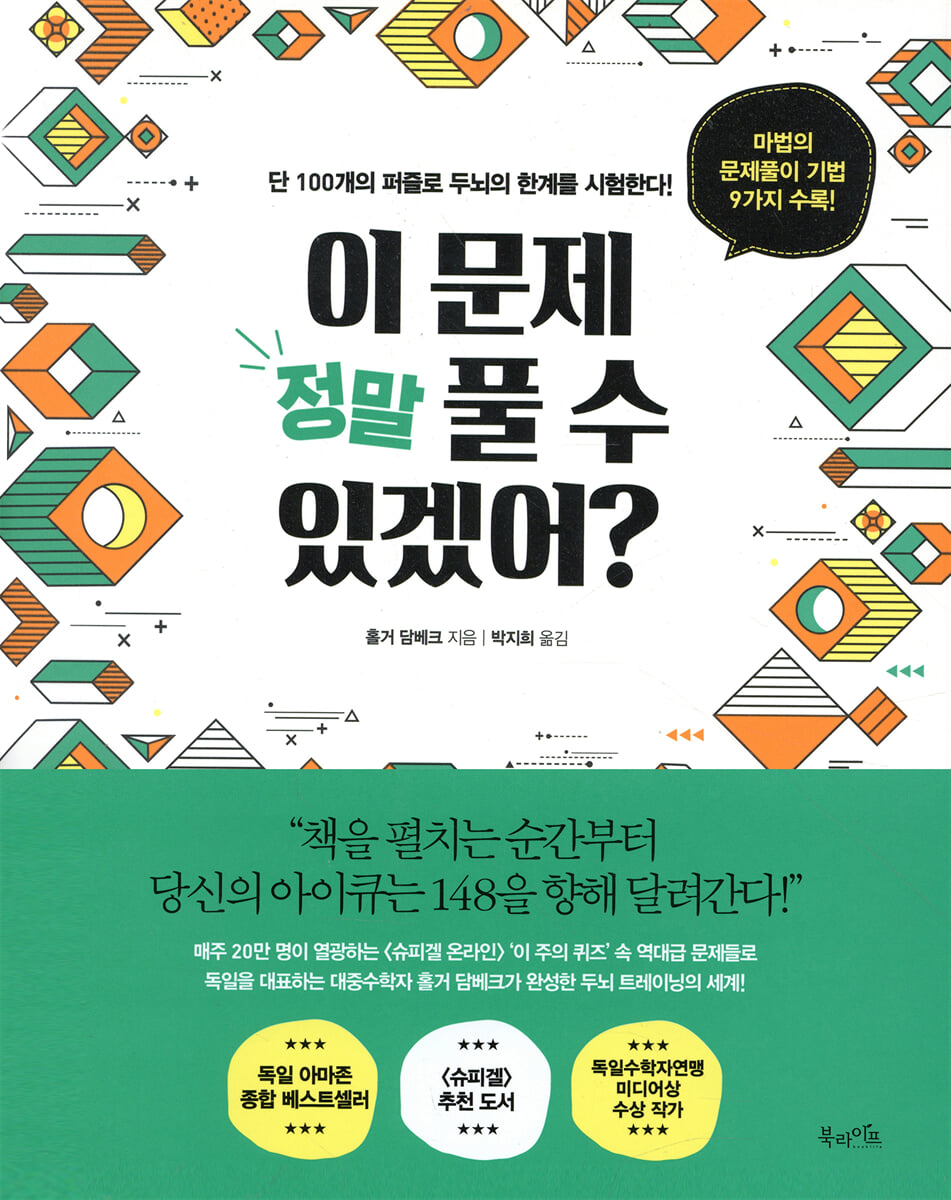
Can you really solve this problem?
 |
Description
Book Introduction
Your brain can solve more quizzes than you think! The thrill of overcoming "Can you solve this problem?" is back! The brain develops as a result of experience and adapts to the environment. Neuroscientists call this characteristic “brain plasticity.” Even a brain that has unexpectedly degenerated or aged can recover its function through training. Quizzes are one of the most enjoyable and classic ways to dramatically improve human abilities by leveraging this brain plasticity. Most quizzes require you to think outside the box and find the answer. The brain develops by experiencing different ways of thinking and receiving new stimulation just by solving quizzes. Let's solve the following problem. What number do you get if you add the numbers from 1 to 100? Friedrich Gauss, a genius German mathematician, encountered this problem as a boy and developed a new solution. Instead of adding them in order from 1, we matched them in pairs like 1+100, 2+99, 3+98, and found the answer 101×50=5,050. Now, quizzes are not just a way to kill time. It is a brain development tool that brings out new ideas and accelerates abilities. In this extension, "Can You Solve This?", which opened a new horizon for quizzes, returns this year with even more ingenious problems compiled by German math columnist Holger Dambek. He is a leading German mathematics columnist who writes the 'Quiz of the Week' series for Germany's [Spiegel Online] and is loved by 200,000 readers. Holger Dambek presents problems across a wide range of fields, including mathematics, science, and logic, ranging from puzzles by renowned quiz developers like Sam Lloyd and Martin Gardner to his own creations. "Can You Really Solve This Problem?" is a book that compiles only 100 of the most interesting and ingenious problems he has created over the past five years. It became a huge hit, becoming a bestseller on Amazon Germany immediately after its publication. |
- You can preview some of the book's contents.
Preview
index
prolog
9 Keys to Solving Any Problem
Chapter 1 Classic Quiz
_Classic questions long loved by quiz enthusiasts
01 What shape will appear next?
02 Can you accurately measure the weight of chocolate without a scale?
03 Let's find the time when the clock hands are exactly symmetrical.
04 One gangster survives.
Why is that?
05 Wine mixed with water, or water mixed with wine, which one?
06 Don't light the fuse hastily.
07 Can you cross the desert with only limited water and food?
08 What happens when you throw a stone from a boat into a lake?
09 Can I get a cheaper chain?
10 Make the right amount of sauce! Cooking Hard 3
11 When introverts and extroverts meet
12 In which box are the apples and oranges?
13 What happens when two mathematicians who love quizzes meet?
14 Four travelers and an old cloud bridge
Chapter 2 Creative Problems
_More sophisticated and detailed questions that test us
15 Running here and there… How far did Bello run?
16 A superpowered cat who travels with a can hanging from its tail
17 What is the missing number in the following numbers?
18 Berliners with the same number of hairs on their heads
19 Which switch should I press to turn on the desired light?
20 A slightly different way of calculating fractions than before
21 How to protect your parcel from thieves?
22 A knight who can never move under any circumstances
23 The slower you go, the more you win.
What should I do?
24 Smart Logic Dwarfs Who Solve Problems Easily
Find the box containing 25 11g beads!
Chapter 3: Logical Reasoning Problems
_Who is telling the truth?
26 A stolen painting, who is the thief?
27 A consistent liar from beginning to end
28 If three logicians go to a bar
29 Four Soccer Teams in a Strange Town
30 Liars at the Dinner Table
31 A tribe of liars living on a remote island
32 One Traveler, Two Questions, and Three Ghosts
33 A wise man in trouble with just one sentence
34 Which of the three people met during the shipwreck is the liar?
35 3 prisoners and 5 hats
36 How to Keep Your Job in a Bankrupt Kingdom
37 What must happen to free the Smurfs?
Chapter 4: Problems with Lines
_You need eyes that can see everything in three dimensions!
38 Make two squares from one square
39 What is the length of the seamless spiral that wraps around the cylinder?
Is 40 won an open or closed shape?
41 Let's put tiles on the endless hallway.
42 Finding the radius of a semicircle using arithmetic and geometry
43 Farmer and a Tree, Triangle Ranch
44 Making triangles, squares, and two pyramids
45 Can you find the angle of a broken line in a cube?
46 How many disks of radius 1 cover a disk of radius 2?
47 A sphere that fits exactly inside a cube
48 Everything that can be covered with carpet
Chapter 5: Brain Games with Numbers
_How familiar can you become with numbers?
49 Guess the ages of a family of four
50 randomly arranged numbers, what is the missing number?
51 Can you solve math problems with a broken calculator?
How many numbers are divisible by 52 45?
53 Can I become a mental arithmetic genius?
54 What is the following formula? Forty + ten + ten = sixty
Find the number that changes its order when multiplied by 55 and 6.
56 Find out what numbers they are hiding from each other!
Find out which magician is telling the truth with the magic of the number 57!
58 Forget the calculations you've learned so far! This is a slightly strange calculation.
59 After the two brothers divide the money, how much will the younger sister have?
A man doubled his lottery winnings thanks to a clerk who confused 60 euros and cents.
Chapter 6 Probability Problems
_Everything in the world is ultimately a game of probability.
61 What is the probability that there will be a daughter in the homestay family?
62 Spy training in public places
63 The world's largest table tennis tournament
Table Tennis Match Between 64-Year-Olds: Who Lost in the Second Match?
65 How to Survive a Game of Russian Roulette
66 How fast should you run to win a race?
67 A chess game between six players. Who will win?
68 Lotto debate on increasing odds of winning
69 Interesting World Cup friendly matches held in 2016
70 Ten Thieves Who Don't Trust Each Other
71 How to divide 20 boxes of apples equally
Chapter 7: Problems Concerning Movement
_Transportation that inspired me to create this interesting quiz
Two bicycles running on the 72 bridge
Can a car that is 73 hours late catch the ferry on time?
74 How many steps are there in an escalator?
75 A woman riding a bicycle and the wind blowing steadily
Two men going upstream and a floating hat
77 A city tour that visits six cities
78 Classic Bus Club's regular outing
79 Casanova, who always uses the same subway station, suspects coincidence.
80 Running race on an escalator going up
81 What does it take for one aircraft to circle the Earth?
82 Secrets of Passenger Ships Departing Simultaneously
Chapter 8: The Hardest Problems
_How long will it take you to solve this problem?
83 Who can take more money with 50 coins?
84 Match the color of the hat to increase your chances of winning
85 How many times does a glass have to be dropped before it breaks?
86 500 students and 500 lockers
87 Can a car without fuel drive around the island?
88 tables, two thieves, and a mountain of coins
89 A problem that almost no one can solve, 0 and 1
How many people should I shake hands with at the 90th party?
91 crazy difficulty problems, 50 clocks and tables
Chapter 9: Problems that Develop Imagination
_Plus Quiz for People Who Think Out of the Box
92 What Happens While You Sleep? A Woman with Intermittent Sleep
93 Save the poor chick who fell into the hole!
94 What secrets does the man who died in the desert have?
95 Strange Drivers Who Drive While Listening to the Radio
96 Why did the customer who entered the bar say thank you when he saw the gun?
97 A strange combination on a hill
98 Horn Concert on a Picturesque California Beach
What I learned on the stairs of the 99th hospital building
Why did a woman who went to work wearing new shoes suddenly die?
9 Keys to Solving Any Problem
Chapter 1 Classic Quiz
_Classic questions long loved by quiz enthusiasts
01 What shape will appear next?
02 Can you accurately measure the weight of chocolate without a scale?
03 Let's find the time when the clock hands are exactly symmetrical.
04 One gangster survives.
Why is that?
05 Wine mixed with water, or water mixed with wine, which one?
06 Don't light the fuse hastily.
07 Can you cross the desert with only limited water and food?
08 What happens when you throw a stone from a boat into a lake?
09 Can I get a cheaper chain?
10 Make the right amount of sauce! Cooking Hard 3
11 When introverts and extroverts meet
12 In which box are the apples and oranges?
13 What happens when two mathematicians who love quizzes meet?
14 Four travelers and an old cloud bridge
Chapter 2 Creative Problems
_More sophisticated and detailed questions that test us
15 Running here and there… How far did Bello run?
16 A superpowered cat who travels with a can hanging from its tail
17 What is the missing number in the following numbers?
18 Berliners with the same number of hairs on their heads
19 Which switch should I press to turn on the desired light?
20 A slightly different way of calculating fractions than before
21 How to protect your parcel from thieves?
22 A knight who can never move under any circumstances
23 The slower you go, the more you win.
What should I do?
24 Smart Logic Dwarfs Who Solve Problems Easily
Find the box containing 25 11g beads!
Chapter 3: Logical Reasoning Problems
_Who is telling the truth?
26 A stolen painting, who is the thief?
27 A consistent liar from beginning to end
28 If three logicians go to a bar
29 Four Soccer Teams in a Strange Town
30 Liars at the Dinner Table
31 A tribe of liars living on a remote island
32 One Traveler, Two Questions, and Three Ghosts
33 A wise man in trouble with just one sentence
34 Which of the three people met during the shipwreck is the liar?
35 3 prisoners and 5 hats
36 How to Keep Your Job in a Bankrupt Kingdom
37 What must happen to free the Smurfs?
Chapter 4: Problems with Lines
_You need eyes that can see everything in three dimensions!
38 Make two squares from one square
39 What is the length of the seamless spiral that wraps around the cylinder?
Is 40 won an open or closed shape?
41 Let's put tiles on the endless hallway.
42 Finding the radius of a semicircle using arithmetic and geometry
43 Farmer and a Tree, Triangle Ranch
44 Making triangles, squares, and two pyramids
45 Can you find the angle of a broken line in a cube?
46 How many disks of radius 1 cover a disk of radius 2?
47 A sphere that fits exactly inside a cube
48 Everything that can be covered with carpet
Chapter 5: Brain Games with Numbers
_How familiar can you become with numbers?
49 Guess the ages of a family of four
50 randomly arranged numbers, what is the missing number?
51 Can you solve math problems with a broken calculator?
How many numbers are divisible by 52 45?
53 Can I become a mental arithmetic genius?
54 What is the following formula? Forty + ten + ten = sixty
Find the number that changes its order when multiplied by 55 and 6.
56 Find out what numbers they are hiding from each other!
Find out which magician is telling the truth with the magic of the number 57!
58 Forget the calculations you've learned so far! This is a slightly strange calculation.
59 After the two brothers divide the money, how much will the younger sister have?
A man doubled his lottery winnings thanks to a clerk who confused 60 euros and cents.
Chapter 6 Probability Problems
_Everything in the world is ultimately a game of probability.
61 What is the probability that there will be a daughter in the homestay family?
62 Spy training in public places
63 The world's largest table tennis tournament
Table Tennis Match Between 64-Year-Olds: Who Lost in the Second Match?
65 How to Survive a Game of Russian Roulette
66 How fast should you run to win a race?
67 A chess game between six players. Who will win?
68 Lotto debate on increasing odds of winning
69 Interesting World Cup friendly matches held in 2016
70 Ten Thieves Who Don't Trust Each Other
71 How to divide 20 boxes of apples equally
Chapter 7: Problems Concerning Movement
_Transportation that inspired me to create this interesting quiz
Two bicycles running on the 72 bridge
Can a car that is 73 hours late catch the ferry on time?
74 How many steps are there in an escalator?
75 A woman riding a bicycle and the wind blowing steadily
Two men going upstream and a floating hat
77 A city tour that visits six cities
78 Classic Bus Club's regular outing
79 Casanova, who always uses the same subway station, suspects coincidence.
80 Running race on an escalator going up
81 What does it take for one aircraft to circle the Earth?
82 Secrets of Passenger Ships Departing Simultaneously
Chapter 8: The Hardest Problems
_How long will it take you to solve this problem?
83 Who can take more money with 50 coins?
84 Match the color of the hat to increase your chances of winning
85 How many times does a glass have to be dropped before it breaks?
86 500 students and 500 lockers
87 Can a car without fuel drive around the island?
88 tables, two thieves, and a mountain of coins
89 A problem that almost no one can solve, 0 and 1
How many people should I shake hands with at the 90th party?
91 crazy difficulty problems, 50 clocks and tables
Chapter 9: Problems that Develop Imagination
_Plus Quiz for People Who Think Out of the Box
92 What Happens While You Sleep? A Woman with Intermittent Sleep
93 Save the poor chick who fell into the hole!
94 What secrets does the man who died in the desert have?
95 Strange Drivers Who Drive While Listening to the Radio
96 Why did the customer who entered the bar say thank you when he saw the gun?
97 A strange combination on a hill
98 Horn Concert on a Picturesque California Beach
What I learned on the stairs of the 99th hospital building
Why did a woman who went to work wearing new shoes suddenly die?
Into the book
The experience of being immersed in problem solving brings tremendous joy.
There is definitely a popular appeal to mathematics.
When we take a quiz, our brain starts working in a different way than usual.
The reason math is fun isn't just because the answer to a problem you couldn't solve suddenly flashes into your mind.
As I said before, mathematics, above all, saves us from having to do cumbersome calculations.
Because there are many creative and elegant ways to solve problems other than the ones we learned without much thought in school.
--- p.7, from 'Prologue'
8.
The Drawer Principle - Organize and Unpack
We've all probably had the experience of spending all day organizing and sorting things.
Then you will know how helpful drawers are for storage.
The same applies to mathematical thinking! Let's understand how the drawer principle works by solving the following example.
There are four different colored ski poles in the gym basement storage.
White, red, blue, green.
The sticks are all the same length.
The sports club was about to take out a few sticks when the electricity in the warehouse went out, rendering everything invisible.
How many sticks do you need to take to get at least two of the same color?
This problem involves four drawers containing different colors.
If you randomly take out a few sticks, put them out into a bright area, and put them in a drawer, the fifth ski stick will definitely be a duplicate of at least one of the previous ones.
Because the drawer that holds the fifth stick will inevitably contain one stick.
--- p.26, from '9 Keys to Solving Any Problem'
19 Which switch should I press to turn on the desired light?
Let's say you are alone in the basement of a building.
There is no one in the building except you.
There are three switches on the basement wall, all of which are in the 'off' position.
This switch can be used to turn the lights on the first floor of the building on and off.
But there is absolutely no clue as to which switch is connected to which light.
In the basement, you cannot visually check which lights on the first floor are on, and you can only go up and down once to check the lights on the first floor.
How do I figure out which switch is connected to which light?
--- p.66, from 'Chapter 2 Creative Problems'
49 Guess the ages of a family of four
A father, mother, and two daughters live together.
My father is two years older than my mother.
If you multiply the ages of all four family members, you get 44,950.
What are the ages of each of the four family members?
--- p.126, from 'Chapter 5 Brain Games with Numbers'
78 Classic Bus Club's regular outing
As is the case every year, the Classic Bus Club decided to hold a party this year as well.
We were to depart by bus from a large parking lot on the outskirts of the city, and enjoy a sumptuous meal in the nearby walled gardens.
Each classic bus that departed from the parking lot had an equal number of members on board.
But before long, ten buses broke down and were stopped.
Members who were on the broken-down bus had to split up and board the remaining buses.
We decided to only allow one additional person to board each of the remaining buses, and fortunately, all members were able to board the bus.
After lunch, 15 more buses would not start and were unavailable for boarding.
Members who had boarded the bus that broke down on the way to the city wall had no choice but to board the remaining buses.
Now, on each bus returning to the departure point, there are exactly three more people on board than when it first departed.
How many members of the Classic Bus Club attended the outing?
There is definitely a popular appeal to mathematics.
When we take a quiz, our brain starts working in a different way than usual.
The reason math is fun isn't just because the answer to a problem you couldn't solve suddenly flashes into your mind.
As I said before, mathematics, above all, saves us from having to do cumbersome calculations.
Because there are many creative and elegant ways to solve problems other than the ones we learned without much thought in school.
--- p.7, from 'Prologue'
8.
The Drawer Principle - Organize and Unpack
We've all probably had the experience of spending all day organizing and sorting things.
Then you will know how helpful drawers are for storage.
The same applies to mathematical thinking! Let's understand how the drawer principle works by solving the following example.
There are four different colored ski poles in the gym basement storage.
White, red, blue, green.
The sticks are all the same length.
The sports club was about to take out a few sticks when the electricity in the warehouse went out, rendering everything invisible.
How many sticks do you need to take to get at least two of the same color?
This problem involves four drawers containing different colors.
If you randomly take out a few sticks, put them out into a bright area, and put them in a drawer, the fifth ski stick will definitely be a duplicate of at least one of the previous ones.
Because the drawer that holds the fifth stick will inevitably contain one stick.
--- p.26, from '9 Keys to Solving Any Problem'
19 Which switch should I press to turn on the desired light?
Let's say you are alone in the basement of a building.
There is no one in the building except you.
There are three switches on the basement wall, all of which are in the 'off' position.
This switch can be used to turn the lights on the first floor of the building on and off.
But there is absolutely no clue as to which switch is connected to which light.
In the basement, you cannot visually check which lights on the first floor are on, and you can only go up and down once to check the lights on the first floor.
How do I figure out which switch is connected to which light?
--- p.66, from 'Chapter 2 Creative Problems'
49 Guess the ages of a family of four
A father, mother, and two daughters live together.
My father is two years older than my mother.
If you multiply the ages of all four family members, you get 44,950.
What are the ages of each of the four family members?
--- p.126, from 'Chapter 5 Brain Games with Numbers'
78 Classic Bus Club's regular outing
As is the case every year, the Classic Bus Club decided to hold a party this year as well.
We were to depart by bus from a large parking lot on the outskirts of the city, and enjoy a sumptuous meal in the nearby walled gardens.
Each classic bus that departed from the parking lot had an equal number of members on board.
But before long, ten buses broke down and were stopped.
Members who were on the broken-down bus had to split up and board the remaining buses.
We decided to only allow one additional person to board each of the remaining buses, and fortunately, all members were able to board the bus.
After lunch, 15 more buses would not start and were unavailable for boarding.
Members who had boarded the bus that broke down on the way to the city wall had no choice but to board the remaining buses.
Now, on each bus returning to the departure point, there are exactly three more people on board than when it first departed.
How many members of the Classic Bus Club attended the outing?
--- p.168, from 'Chapter 7 Problems Concerning Movement'
Publisher's Review
More exciting! More original! More challenging!
100 puzzles that will awaken your brain's sleeping math skills, creativity, logic, and imagination!
"Can You Really Solve This Problem?" is divided into nine chapters.
Each chapter covers a different genre, from classic quizzes that any quiz fanatic will recognize to questions that require creative imagination.
There are some simple problems that can be solved with just a little thought, but there are also some extremely difficult problems that are so difficult that it's hard to even get a clue even after spending hours solving them.
Among them, particularly difficult problems were marked separately with a picture of a light bulb.
Anyone who wants to test their limits can confidently take on the challenge.
Holger Dambek also offers nine quiz-solving tips for those new to quizzing.
There are common-sense tips such as not giving up and keeping thinking, analyzing the problem precisely, thinking as simply as possible, and thinking differently, as well as tips that use reverse thinking methods such as solving indirectly and applying the drawer principle.
I highly recommend reading this before diving into the world of problem solving, as at least one of these nine tips can be applied to any problem.
Quizzes not only develop brain power, but also provide the joy of achieving a goal each time you solve a problem.
The moment you focus on a problem and immerse yourself in the book, the complex worries of life will disappear, leaving only you and the problem in a wondrous experience.
Holger Dambek hopes that this book will bring readers the pure joy of mathematics and science, saying:
I hope you enjoy the 100 problems in this book.
And I hope to have as many experiences as possible of finding an elegant way out of a situation where there seems to be no clue.
Readers who felt the thrill of "Can You Solve This Problem?" will find even greater brain-sparking fun in this book.
100 puzzles that will awaken your brain's sleeping math skills, creativity, logic, and imagination!
"Can You Really Solve This Problem?" is divided into nine chapters.
Each chapter covers a different genre, from classic quizzes that any quiz fanatic will recognize to questions that require creative imagination.
There are some simple problems that can be solved with just a little thought, but there are also some extremely difficult problems that are so difficult that it's hard to even get a clue even after spending hours solving them.
Among them, particularly difficult problems were marked separately with a picture of a light bulb.
Anyone who wants to test their limits can confidently take on the challenge.
Holger Dambek also offers nine quiz-solving tips for those new to quizzing.
There are common-sense tips such as not giving up and keeping thinking, analyzing the problem precisely, thinking as simply as possible, and thinking differently, as well as tips that use reverse thinking methods such as solving indirectly and applying the drawer principle.
I highly recommend reading this before diving into the world of problem solving, as at least one of these nine tips can be applied to any problem.
Quizzes not only develop brain power, but also provide the joy of achieving a goal each time you solve a problem.
The moment you focus on a problem and immerse yourself in the book, the complex worries of life will disappear, leaving only you and the problem in a wondrous experience.
Holger Dambek hopes that this book will bring readers the pure joy of mathematics and science, saying:
I hope you enjoy the 100 problems in this book.
And I hope to have as many experiences as possible of finding an elegant way out of a situation where there seems to be no clue.
Readers who felt the thrill of "Can You Solve This Problem?" will find even greater brain-sparking fun in this book.
GOODS SPECIFICS
- Date of publication: August 26, 2019
- Page count, weight, size: 312 pages | 546g | 205*215*30mm
- ISBN13: 9791188850723
- ISBN10: 1188850725
You may also like
카테고리
korean


korean

![ELLE 엘르 스페셜 에디션 A형 : 12월 [2025]](http://librairie.coreenne.fr/cdn/shop/files/b8e27a3de6c9538896439686c6b0e8fb.jpg?v=1766436872&width=3840)


