

Making a knot
 |
Description
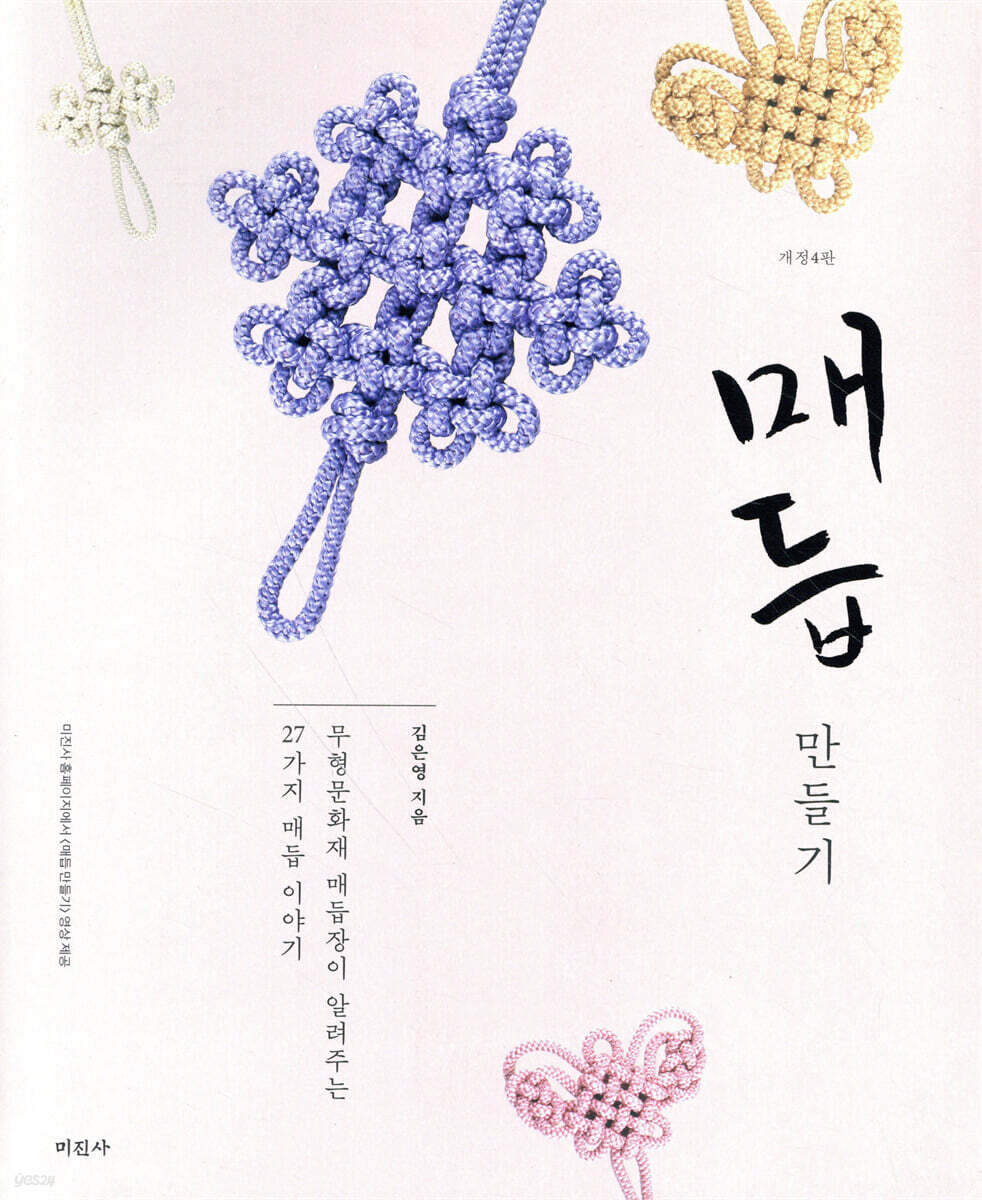
Book Introduction
From beginners to experts, create beautiful traditional Korean knots. The revised 4th edition is back, more friendly and robust. Our country's knotting is a folk craft that has been passed down from fingertip to fingertip, and its use has reached every corner of daily life. This book was written by Kim Eun-young, a Seoul City Intangible Cultural Asset knot master, to popularize traditional knots. Anyone interested in knots can learn easily and enjoyably through the history and uses of knots, as well as the process of tying 27 different types of knots, using color photos, friendly explanations, illustrations that help with understanding, and videos. The video can be downloaded from the Mijinsa website - Readers' Space - Notices. Furthermore, it includes designs for ornaments and household items that utilize knots so that you can actively utilize knots to beautifully decorate your surroundings. In particular, this revised 4th edition has been further enhanced with illustrations and guidance lines that help understand the knot-tying process and movements, and includes a wide variety of images of knot artifacts and works of art, allowing you to see how knots were traditionally used and how they can be applied to our lives. |
index
The fun of knots
Knowing the knots
Origin and development of knots
Knots in the World
History of Knots
Knot material, string
Types of knots
Types of alcohol
Uses of knots and tassels
tying a knot
1.
Annual salary knot
2.
Dorae Knot
3.
Guidore knot
4.
raw knot
5.
Glasses knot
6.
Garakji knot
7.
wing knot
8.
Chrysanthemum knot
9.
Dongsimgyeolmaedneot
10.
Samjeongja knot
11.
Chickadee knot
12.
Plum knot
13.
Paris knot
14.
butterfly knot
15.
Jangmae knot
16.
Three-piece knot
17.
Eggplant cushion knot
18.
bee knot
19.
Kondigi knot
20.
cicada knot
21.
Seok's knot
22.
Inverted butterfly knot
23.
Butterfly knot
24.
Chilbo knot
25.
Abalone knot
26.
Railing knot
27.
Sambalchang knot, Obalchang knot
Using knots
Symbols of knots and tassels
Knot pattern
Uses of knots
Knowing the knots
Origin and development of knots
Knots in the World
History of Knots
Knot material, string
Types of knots
Types of alcohol
Uses of knots and tassels
tying a knot
1.
Annual salary knot
2.
Dorae Knot
3.
Guidore knot
4.
raw knot
5.
Glasses knot
6.
Garakji knot
7.
wing knot
8.
Chrysanthemum knot
9.
Dongsimgyeolmaedneot
10.
Samjeongja knot
11.
Chickadee knot
12.
Plum knot
13.
Paris knot
14.
butterfly knot
15.
Jangmae knot
16.
Three-piece knot
17.
Eggplant cushion knot
18.
bee knot
19.
Kondigi knot
20.
cicada knot
21.
Seok's knot
22.
Inverted butterfly knot
23.
Butterfly knot
24.
Chilbo knot
25.
Abalone knot
26.
Railing knot
27.
Sambalchang knot, Obalchang knot
Using knots
Symbols of knots and tassels
Knot pattern
Uses of knots
Detailed image
Into the book
One of the fun things about knotting is making an exact replica of an old knot relic and imagining what kind of person it was to have this relic.
There is a work of art with a meticulously tied knot in the glasses store at my in-laws' house.
I was grateful that my mother-in-law readily gave me her cherished glasses case to work on, but the words she spoke about the case were even more precious.
It was a glasses case that my mother-in-law made for my father-in-law by embroidering on a piece of paper that my father-in-law had written.
While looking at glasses, I got the idea of making a collection of Joseon Dynasty scholars' knotted accessories, so I tried making a belt for the robe, ear pouch, a fan weight, and a badge.
I thought about having people carry around a house number instead of their current resident registration card, but I don't think it would go well with a suit.
Nowadays, men only wear suits, ties, shirts, and cufflinks to look stylish, but we don't know how stylishly men in the Joseon Dynasty dressed up in every detail.
We can guess by looking at the relics that remain today or by looking at the clothes and accessories of the commoners of that era in Hyewon's folk paintings.
The men's ceremonial belts were also colorful; high-ranking officials used red belts, scholars used green belts, junior officials and junior officials used gray belts, and junior officials used purple belts.
Every time I touch and look at my ancestors' belongings, I think they lived a truly stylish life, and I think it would be a good idea to study and research that.
++++++++++
Knots were also widely used in men's and women's accessories during the Joseon Dynasty.
Men's tassels and tassels completed the look of the dopo, an outer garment worn when going out, and the resident registration card, similar to today's resident registration card, also needed tassels and tassels to be attached to the waist belt.
In addition, various knots and tassels were needed, such as the fan knot that only those who held official positions could tie, pocket strap tassels, eyeglass case straps, brush pouches, and tobacco pouches.
There were many knot decorations on military uniforms, and even swords, swords, lances, and gunpowder barrels had to be decorated with knots and tassels.
Knots for women include norigae, earring tassels, pocket knots, jobawi, tassels used to decorate nambawi, tassel decorations for ayam, waist belts, incense pouches, and spoon holder knots used by young women preparing for marriage.
In addition, musical instruments were decorated with tassels and knots (tassels and knots used on flags and palanquins), and gold and silver-crowned court clothes were decorated with things like tattalgisul (a decoration made of silk strings draped over the back of old clothing).
++++++++++
The names of the knots are all taken from various objects, flowers, and insects that we see and use all the time.
That is, ginger, butterfly, dragonfly, chrysanthemum, bee, chick, magpie, cicada, bean, jeogori, button, lotus bud, etc., and the Seok knot, named after the character 'Seok' in the Buddha pattern, seems to have been used mainly in temples.
In this way, we can see just how close our traditional knots were to people's lives from the names of the knots.
++++++++++
The name of the raw knot comes from its shape, which resembles the shape of ginger, with three small circles. In the Daegu and Namwon regions, it is called the Jeongja (井字) knot.
It is the basic knot for many knots, including the Gajibangseok, Seoksi, Samjeongja, Janggu, Chick, and Beolmae knot. Since it is possible to tie it sideways as many times as you want as long as you can use only the right braid, it was often used in China to express the Chinese characters (壽, 福) in knots.
Our country's four-color knot and railing knot follow the same principle.
++++++++++
The Garakji knot is a knot used in both the East and the West. It is made into a circle like a Garakji or spread out to form a flower shape and used to decorate curtains.
It is made of complementary colors to create a decorative effect similar to beads, and because the string is short, it also serves to hide the connection between knots when connecting to another string.
There is a work of art with a meticulously tied knot in the glasses store at my in-laws' house.
I was grateful that my mother-in-law readily gave me her cherished glasses case to work on, but the words she spoke about the case were even more precious.
It was a glasses case that my mother-in-law made for my father-in-law by embroidering on a piece of paper that my father-in-law had written.
While looking at glasses, I got the idea of making a collection of Joseon Dynasty scholars' knotted accessories, so I tried making a belt for the robe, ear pouch, a fan weight, and a badge.
I thought about having people carry around a house number instead of their current resident registration card, but I don't think it would go well with a suit.
Nowadays, men only wear suits, ties, shirts, and cufflinks to look stylish, but we don't know how stylishly men in the Joseon Dynasty dressed up in every detail.
We can guess by looking at the relics that remain today or by looking at the clothes and accessories of the commoners of that era in Hyewon's folk paintings.
The men's ceremonial belts were also colorful; high-ranking officials used red belts, scholars used green belts, junior officials and junior officials used gray belts, and junior officials used purple belts.
Every time I touch and look at my ancestors' belongings, I think they lived a truly stylish life, and I think it would be a good idea to study and research that.
++++++++++
Knots were also widely used in men's and women's accessories during the Joseon Dynasty.
Men's tassels and tassels completed the look of the dopo, an outer garment worn when going out, and the resident registration card, similar to today's resident registration card, also needed tassels and tassels to be attached to the waist belt.
In addition, various knots and tassels were needed, such as the fan knot that only those who held official positions could tie, pocket strap tassels, eyeglass case straps, brush pouches, and tobacco pouches.
There were many knot decorations on military uniforms, and even swords, swords, lances, and gunpowder barrels had to be decorated with knots and tassels.
Knots for women include norigae, earring tassels, pocket knots, jobawi, tassels used to decorate nambawi, tassel decorations for ayam, waist belts, incense pouches, and spoon holder knots used by young women preparing for marriage.
In addition, musical instruments were decorated with tassels and knots (tassels and knots used on flags and palanquins), and gold and silver-crowned court clothes were decorated with things like tattalgisul (a decoration made of silk strings draped over the back of old clothing).
++++++++++
The names of the knots are all taken from various objects, flowers, and insects that we see and use all the time.
That is, ginger, butterfly, dragonfly, chrysanthemum, bee, chick, magpie, cicada, bean, jeogori, button, lotus bud, etc., and the Seok knot, named after the character 'Seok' in the Buddha pattern, seems to have been used mainly in temples.
In this way, we can see just how close our traditional knots were to people's lives from the names of the knots.
++++++++++
The name of the raw knot comes from its shape, which resembles the shape of ginger, with three small circles. In the Daegu and Namwon regions, it is called the Jeongja (井字) knot.
It is the basic knot for many knots, including the Gajibangseok, Seoksi, Samjeongja, Janggu, Chick, and Beolmae knot. Since it is possible to tie it sideways as many times as you want as long as you can use only the right braid, it was often used in China to express the Chinese characters (壽, 福) in knots.
Our country's four-color knot and railing knot follow the same principle.
++++++++++
The Garakji knot is a knot used in both the East and the West. It is made into a circle like a Garakji or spread out to form a flower shape and used to decorate curtains.
It is made of complementary colors to create a decorative effect similar to beads, and because the string is short, it also serves to hide the connection between knots when connecting to another string.
--- From the text
Publisher's Review
In Korea, the rope used to tie knots was called dahoe (多繪), and these knots and ropes were widely used for decoration in everyday life.
As we entered the Joseon Dynasty through the Three Kingdoms Period and the Goryeo Dynasty, its uses became more diverse and the user base expanded, so much so that there was no place in everyday life where it was not used.
Looking at the uses of knots gives us a glimpse into the lives of our ancestors, which is also part of the fun of learning about knots.
"Knot Making" is divided into three chapters.
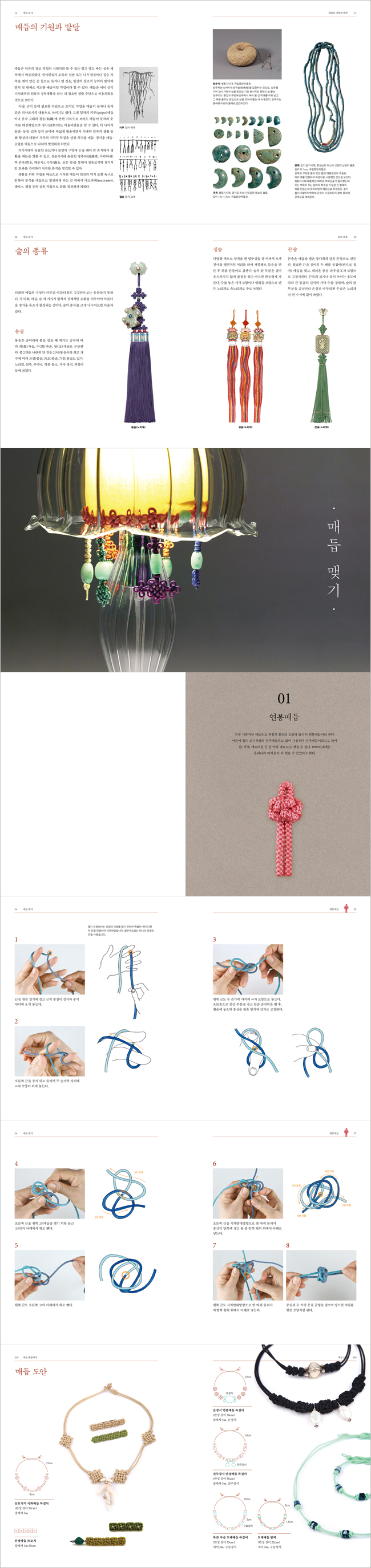
The first chapter, "Knowing Knots," provides a comprehensive overview of knots, from their origins, the differences between Chinese, Japanese, and Western knots and Korean knots, the historical flow of Korean knots, the material used for knots, and the types and uses of knots and tassels.
Ornamental knots originated from the desire to make life more beautiful, and have evolved significantly, including the complex process of dyeing silk threads in beautiful colors. These beautiful knots can be seen in the revised 4th edition, enhanced with photographs.
The second chapter, "Tying Knots," introduces 27 knot tying methods in detail, step by step.
With photos, illustrations, guidelines, helpful explanations, and even video references, even beginners can become knot experts in no time by following along step by step.
The video can be downloaded from the Mijinsa website - Readers' Space - Notices.
The third chapter of the revised 4th edition, "Using Knots," has more to see.
A variety of reference photos showing applicable knot patterns and examples of modern knot applications will provide a great resource for learning how to use knots in your daily life and decorate your surroundings.
Above all, this book contains the long-standing expertise of Kim Eun-young, a Seoul City Intangible Cultural Asset knot maker, and is even more heartwarming because it allows readers to learn about the meaning of knots and the mindset and attitude toward the wisdom of our ancestors.
We hope that you will fully enjoy the joy and beauty of knots through the 4th edition of 'Knot Making'.
As we entered the Joseon Dynasty through the Three Kingdoms Period and the Goryeo Dynasty, its uses became more diverse and the user base expanded, so much so that there was no place in everyday life where it was not used.
Looking at the uses of knots gives us a glimpse into the lives of our ancestors, which is also part of the fun of learning about knots.
"Knot Making" is divided into three chapters.
The first chapter, "Knowing Knots," provides a comprehensive overview of knots, from their origins, the differences between Chinese, Japanese, and Western knots and Korean knots, the historical flow of Korean knots, the material used for knots, and the types and uses of knots and tassels.
Ornamental knots originated from the desire to make life more beautiful, and have evolved significantly, including the complex process of dyeing silk threads in beautiful colors. These beautiful knots can be seen in the revised 4th edition, enhanced with photographs.
The second chapter, "Tying Knots," introduces 27 knot tying methods in detail, step by step.
With photos, illustrations, guidelines, helpful explanations, and even video references, even beginners can become knot experts in no time by following along step by step.
The video can be downloaded from the Mijinsa website - Readers' Space - Notices.
The third chapter of the revised 4th edition, "Using Knots," has more to see.
A variety of reference photos showing applicable knot patterns and examples of modern knot applications will provide a great resource for learning how to use knots in your daily life and decorate your surroundings.
Above all, this book contains the long-standing expertise of Kim Eun-young, a Seoul City Intangible Cultural Asset knot maker, and is even more heartwarming because it allows readers to learn about the meaning of knots and the mindset and attitude toward the wisdom of our ancestors.
We hope that you will fully enjoy the joy and beauty of knots through the 4th edition of 'Knot Making'.
GOODS SPECIFICS
- Date of issue: March 7, 2016
- Page count, weight, size: 272 pages | 672g | 190*230*16mm
- ISBN13: 9788940805213
- ISBN10: 8940805216
You may also like
카테고리
korean


korean

![GQ KOREA Mark (Monthly): December [2025]](http://librairie.coreenne.fr/cdn/shop/files/8ef265dbbfbf186523ed75ba7319009d.jpg?v=1765340328&width=3840)


