

One more slow curve
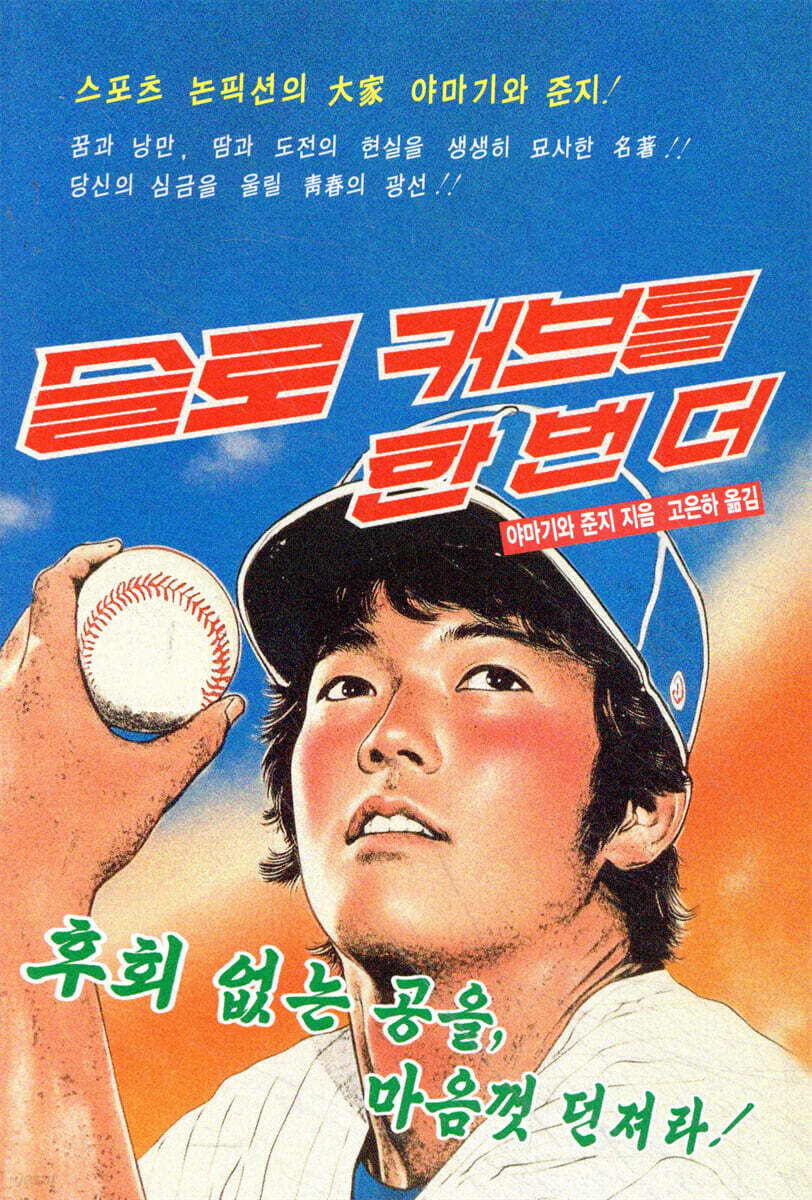 |
Description
Book Introduction
Can just one ball change a life?
Junji Yamagiwa, a master of sports nonfiction, wrote "Slow Curve One More Time", a realistic work that depicts the romantic lives of those who were separated by "one ball" and "a moment's choice."
A dramatic moment for a batter who had never hit a home run before, a college student who suddenly thought about going to the Olympics and winning a gold medal, a record of 26 minutes and 49 seconds fighting for a big title at the top of the table...
Eight stories that sharply cut and carve out the brilliant moments of sports.
Junji Yamagiwa, a master of sports nonfiction, wrote "Slow Curve One More Time", a realistic work that depicts the romantic lives of those who were separated by "one ball" and "a moment's choice."
A dramatic moment for a batter who had never hit a home run before, a college student who suddenly thought about going to the Olympics and winning a gold medal, a record of 26 minutes and 49 seconds fighting for a big title at the top of the table...
Eight stories that sharply cut and carve out the brilliant moments of sports.
- You can preview some of the book's contents.
Preview
index
August Cocktail Rays
Enatsu's 21 wards
One Man's Olympics
Number 94
The City Boxer
Superman of Kimnasium
One more slow curve
Paul Bolter
Enatsu's 21 wards
One Man's Olympics
Number 94
The City Boxer
Superman of Kimnasium
One more slow curve
Paul Bolter
Detailed image
.jpg)
Into the book
'Game' - what a fun word. Just as everyone can draw at least one novel from their own life, every game has at least one scene that's constantly being recalled.
Is it because life is like a game, or is it because games are a microcosm of life?
--- From "August Cocktail Rays"
“I never thought it might be difficult.
I thought I could win if I pitched.
It's always been like that.
I usually lost because I wasn't good at pitching.
If you throw calmly, you can win.
That's all."
--- From "August Cocktail Rays"
When Yoshihiko Takahashi struck out, Enatsu headed to the mound.
And for about 26 minutes, Enatsu had to go back and forth like crazy on the borderline between 'winner' and 'loser' on the mound at Osaka Stadium.
--- From "Enatsu's 21 verses"
It is no exaggeration to say that his pride sustained him throughout his 13 years of professional career.
That's what it means to guard the mound.
A pitcher must believe in himself to become a pitcher.
--- From "Enatsu's 21 verses"
We've all probably had moments where we look at a bar of soap that has become completely thin and round after being used for a long time and feel like telling it to wait a little longer.
As it is worn and shaved every day, its new and fresh appearance disappears in an instant.
As if - you can think of it there.
Isn't it just like me?
As we live our lives routinely, so routinely, and pass the days without a second thought, we become surprisingly shallow and round.
--- From "One Man's Olympics"
There are days when you get stuck when you do it alone.
To avoid that from happening, I made a sort of training contract with myself.
Today, we make a contract in advance to decide how many times we will row.
Every time I felt like I didn't want to do it, I told myself that it was a breach of contract and that I wouldn't be able to win the gold medal.
I kept telling myself that.
If I just do it one more time, I can win the gold medal······.
--- From "One Man's Olympics"
Just a few summers ago, I thought dreams and hopes were definitely my own.
But as each summer season passed, my vivid dreams and hopes seemed to melt away in the heat.
Kuroda discovered that even when dreams melt away, sweat flows.
--- From "Number 94"
There are people who climb the stairs brilliantly and blindly to be called winners.
There are people who fall behind.
If there is a clear difference in strength and ability, you will fall behind.
But there are also those who are left behind not because of strength, but because of differences in attitude towards life.
--- From "Number 94"
Experiencing the world through diverse endeavors might ultimately lead to a long journey. He came to think of it as "boxing and all."
Things like boxing, it's nothing special anyway.
--- From "The City Boxer"
I think it was when I was in elementary school.
When I told my new friend that I was boxing, his eyes lit up.
At that moment, his friend's sparkling eyes became a mirror to Gasgai.
I thought I wanted to be perfect in the mirror.
There are times when people can only protect themselves in relationships with others, and most people live that way.
--- From "The City Boxer"
There may be days when cars don't sell, but there's never a day when squash is forgotten.
Even though I avoided making plans with my coworkers, I didn't skip training.
--- From "Superman of Gymnasium"
You can't win if you're cowardly.
--- From "Superman of Gymnasium"
He played with his opponents with his skills.
If a weakness is revealed, they attack it relentlessly.
When he found a flaw, he bit and hung on to it.
The ball game would originally have this appearance.
It is also a subject that reflects the aspects of human life that we cannot help but live with.
--- From "Superman of Gymnasium"
The point is, the senior said.
“When you’re on home plate, you have to make sure you get into the lower part of the zone.
If the slow curve goes high, you're guaranteed to get hit.
You have to throw it low so it doesn't bounce.
This doesn't have to be a strike.
“That way, you can take away the batter’s timing, and that way, you can break his will to hit.”
-- From "One More Slow Curve"
“When a crisis comes…” said Shunsuke Kawabata.
“You can just run away.”
--- From "One More Slow Curve"
The company, the field, and the dormitory.
Days continued with only that peak going back and forth.
I hardly ever drank alcohol.
I didn't have any particular hobbies.
I repeated a strict routine every single day.
He kept holding onto the pole and running, and as a result, increasing his records became the rhythm of his life.
--- From "Paul Bolter"
Hemingway wrote this line in one of his short stories.
“Sports teaches you how to win fairly, and sports also teaches you how to lose with dignity.
therefore······"
And he continues to say:
“Sports teaches you everything, that is, life.”
Is it because life is like a game, or is it because games are a microcosm of life?
--- From "August Cocktail Rays"
“I never thought it might be difficult.
I thought I could win if I pitched.
It's always been like that.
I usually lost because I wasn't good at pitching.
If you throw calmly, you can win.
That's all."
--- From "August Cocktail Rays"
When Yoshihiko Takahashi struck out, Enatsu headed to the mound.
And for about 26 minutes, Enatsu had to go back and forth like crazy on the borderline between 'winner' and 'loser' on the mound at Osaka Stadium.
--- From "Enatsu's 21 verses"
It is no exaggeration to say that his pride sustained him throughout his 13 years of professional career.
That's what it means to guard the mound.
A pitcher must believe in himself to become a pitcher.
--- From "Enatsu's 21 verses"
We've all probably had moments where we look at a bar of soap that has become completely thin and round after being used for a long time and feel like telling it to wait a little longer.
As it is worn and shaved every day, its new and fresh appearance disappears in an instant.
As if - you can think of it there.
Isn't it just like me?
As we live our lives routinely, so routinely, and pass the days without a second thought, we become surprisingly shallow and round.
--- From "One Man's Olympics"
There are days when you get stuck when you do it alone.
To avoid that from happening, I made a sort of training contract with myself.
Today, we make a contract in advance to decide how many times we will row.
Every time I felt like I didn't want to do it, I told myself that it was a breach of contract and that I wouldn't be able to win the gold medal.
I kept telling myself that.
If I just do it one more time, I can win the gold medal······.
--- From "One Man's Olympics"
Just a few summers ago, I thought dreams and hopes were definitely my own.
But as each summer season passed, my vivid dreams and hopes seemed to melt away in the heat.
Kuroda discovered that even when dreams melt away, sweat flows.
--- From "Number 94"
There are people who climb the stairs brilliantly and blindly to be called winners.
There are people who fall behind.
If there is a clear difference in strength and ability, you will fall behind.
But there are also those who are left behind not because of strength, but because of differences in attitude towards life.
--- From "Number 94"
Experiencing the world through diverse endeavors might ultimately lead to a long journey. He came to think of it as "boxing and all."
Things like boxing, it's nothing special anyway.
--- From "The City Boxer"
I think it was when I was in elementary school.
When I told my new friend that I was boxing, his eyes lit up.
At that moment, his friend's sparkling eyes became a mirror to Gasgai.
I thought I wanted to be perfect in the mirror.
There are times when people can only protect themselves in relationships with others, and most people live that way.
--- From "The City Boxer"
There may be days when cars don't sell, but there's never a day when squash is forgotten.
Even though I avoided making plans with my coworkers, I didn't skip training.
--- From "Superman of Gymnasium"
You can't win if you're cowardly.
--- From "Superman of Gymnasium"
He played with his opponents with his skills.
If a weakness is revealed, they attack it relentlessly.
When he found a flaw, he bit and hung on to it.
The ball game would originally have this appearance.
It is also a subject that reflects the aspects of human life that we cannot help but live with.
--- From "Superman of Gymnasium"
The point is, the senior said.
“When you’re on home plate, you have to make sure you get into the lower part of the zone.
If the slow curve goes high, you're guaranteed to get hit.
You have to throw it low so it doesn't bounce.
This doesn't have to be a strike.
“That way, you can take away the batter’s timing, and that way, you can break his will to hit.”
-- From "One More Slow Curve"
“When a crisis comes…” said Shunsuke Kawabata.
“You can just run away.”
--- From "One More Slow Curve"
The company, the field, and the dormitory.
Days continued with only that peak going back and forth.
I hardly ever drank alcohol.
I didn't have any particular hobbies.
I repeated a strict routine every single day.
He kept holding onto the pole and running, and as a result, increasing his records became the rhythm of his life.
--- From "Paul Bolter"
Hemingway wrote this line in one of his short stories.
“Sports teaches you how to win fairly, and sports also teaches you how to lose with dignity.
therefore······"
And he continues to say:
“Sports teaches you everything, that is, life.”
--- From "Paul Bolter"
Publisher's Review
Run, youth! Seize success!
A masterpiece by Junji Yamagiwa, a master of sports nonfiction!
The Japanese Nonfiction Award-winning work, "Slow Curve Once More," has been published!
The rays of youth fly beautifully and surely across the night sky
A single book that captivatingly depicts effort and passion, victory and achievement, defeat and frustration.
Hemingway wrote.
“Sports teaches you everything, that is, life.”
That is why it is undeniable that sports resemble life.
Challenging your limits, working hard and sweating to achieve victory, and eventually getting frustrated, making ridiculous mistakes, or hitting a huge wall, but never giving up and moving forward again.
Perhaps the reason we are so passionate about sports is not because of the victory itself, but because we want to see the players move forward toward tomorrow without being discouraged by defeat.
But how difficult it is to fight and move forward.
A single ball can send the fate of someone standing on the mound or at the plate to hell.
It's not just the ball.
One punch in the ring, one arm-busting stroke, one swing against the wall, one jump soaring into infinity—all of these desperate efforts can be ended in one fell swoop.
Junji Yamagiwa captures the lives of those who dedicated their dazzling youth to pursuing their passions in "Slow Curve Once More."
Among them, there are superstars who were recognized by everyone, and there are those who ended their careers without ever receiving a single spotlight.
Even those who reach the top feel a sense of emptiness.
But to repeat the same phrase again, fighting, moving forward, regardless of the outcome, is indescribably difficult.
“Not one person in a thousand does what he wants to do.
Charles Bukowski's words, "My defeat will soon be my victory," are absolutely true.
The run of those who risk their bodies and lives for one thing cannot but be a victory, even if it ends in a fall.
The genre of Yamagiwa Junji, a penmanship that simultaneously captures the times and the individual
Junji Yamagiwa, a master of sports nonfiction who is being introduced to Korea for the first time but is already well known to everyone.
He began his career as a writer by publishing reports while attending the Faculty of Law at Chuo University. He used the pen name Junji Yamagiwa instead of his real name, Susumu Inuzuka, and had been consistently writing character reportages since the 1970s, before he became known.
And from then on, his talent as a writer was recognized for his insightful perspective, detailed descriptions, and expressiveness that made the reader immersed in his writing.
Afterwards, in 1980, he published "Enatsu no 21" under the pen name Junji Yamagiwa in the first issue of "Sports Graphic Number" published by Bungei Shunju, and the work became a great success, quickly establishing his status as a master.
He won the Japan Nonfiction Award in 1981 for "Slow Curve Once More," which included "Enatsu's 21 Sentences," and has consistently published works on the theme of sports, regardless of the sport.
His most representative work, "One More Slow Curve," contains eight stories of athletes struggling in various sports, including baseball, boxing, rowing, squash, and pole vaulting.
Yamagiwa Junji uses flowing language to sculpt the turbulent hearts and chain-like training of those standing in the midst of a cold world divided only into winners and losers.
Even if it may not be to your taste, his writing is so excellent that even those who don't like sports are drawn to his writing.
The 1970s and 1980s, when this article was written, were also a time when all types of sports were popular in Japan.
Sports were an indispensable part of Japanese life at the time, thanks to the expansion of leisure culture resulting from economic growth, the establishment of sports infrastructure through successive hosting of the Olympic Games, the widespread availability of television for watching broadcasts, and the immense popularity of sports manga such as “Ashita no Joe” and “Star of the Giants.”
Junji Yamagiwa delved into the lives of athletes in this era and showed a cross-section of an era.
The individual's efforts and passion, along with the prosperity and support that could fully support them.
《Slow Curve Once More》 shows that a well-written reportage can also serve as a historical document.
Quiet sentences and a unique lingering feeling that will make you want to read them again and again.
Cross-sections of decisive moments woven by Junji Yamagiwa
August Cocktail Rays
“Everyone has failures.
In the summer of 1979, a first baseman dropped a ball.”
A fierce battle that went on to the 18th inning that will forever be remembered in Japanese high school baseball history.
Koshien, the dream of every high school baseball player, is where a first baseman misses a powerless fly ball, a batter who has never hit a home run before hits a game-tying home run, and the pitchers for both teams throw a combined 465 pitches.
A dazzling performance by those who gave their all for victory.
The trajectory of youth flying toward the cocktail rays of August is so beautiful.
Enatsu's 21 wards
“A pitcher can only become a pitcher if he believes in himself.”
Game 7 of the 1979 Japan Series, 4-3.
Yutaka Enatsu, the first professional closing pitcher in world professional baseball, takes the mound in the 7th inning to protect the one-run lead.
However, in the bottom of the 9th, the last inning, they face a crisis with the bases loaded and no outs.
The pitches he threw in the bottom of the 9th were 21 pitches, or to be exact, a fight that lasted 26 minutes and 49 seconds.
An artistic short story that captures the dramatic situation and the heart of the closing pitcher who saved the one-run victory.
"One Man's Olympics"
“That day, he decided to go to the Olympics and win a gold medal.”
If you live your life routinely, so routinely, you will eventually find yourself becoming shallow and round.
Is it possible for an ordinary person, shocked by his own insensibility, to suddenly decide to compete in the Olympics and win a gold medal? A young man who had failed the college entrance exam three times but had been going with the flow suddenly finds himself aiming for a gold medal in rowing.
And he devoted his twenties to the sport of rowing.
Number 94
“When you realize it, it’s too late…….
“I usually do that.”
A high school student who was active as the team's ace caught the coach's eye and joined the prestigious Yomiuri Giants.
After a while of partying loudly and bragging to his friends, he begins to experience the cold and bitter taste of the professional world.
Why does it seem like dreams and hopes will always be with you when you're young?
The aftertaste of the courage and skills I thought would be mine forever melting away is always bitter and bitter.
The City Boxer
“Perhaps a perfume that smells like blood would suit this guy.”
Is unwavering dedication to your goals the only way to achieve success? A boy who had been boxing since childhood, but never listened to his coach or trained diligently.
He was building an undefeated record, but he quit boxing due to a certain incident.
Years later, the boy who wanted to be noticed by people becomes a young man and returns to the path of boxing.
A boxer who thought he could do it without any hungry spirit finally becomes the main event star.
"Superman of Gymnasium"
“There may be days when cars don’t sell, but there’s never a day when squash is forgotten.”
Could a man who injured his knee playing badminton achieve a 135-match winning streak in squash? Could a man who never lost a match in an official match also be a car salesman? This short story depicts the prime of the career of Seiji Sakamoto, a Japanese squash champion who excelled at both.
"One more slow curve"
“There’s no way I could become a hero or anything like that.
“Life doesn’t unfold like a cartoon.”
The ace pitcher from a high school that had no connection to Koshien.
He is a high school student who enjoys throwing curveballs with an un-ace-like speed and taking advantage of the batters' timing.
A pitcher who wonders why he doesn't have a girlfriend even though he doesn't practice his swing, a batter who lacks even the ability to execute basic tactics, and a rookie manager who leads them.
Can they beat other teams that hit long balls and have strong arms?
Paul Bolter
“Making new records, that’s great.
But what does that mean?”
The pole vault, or pole vault, has a roughly calculated height limit based on physical condition.
A person with a body height of 171 centimeters and a weight of 60 kilograms is bound to hear people say that they can only run this far (or that they can only run that far).
We can only try to reach that limit, and even go beyond it.
The great challenge and record of a human being who painfully but steadily advanced toward his limit becomes tears along with the rain.
A masterpiece by Junji Yamagiwa, a master of sports nonfiction!
The Japanese Nonfiction Award-winning work, "Slow Curve Once More," has been published!
The rays of youth fly beautifully and surely across the night sky
A single book that captivatingly depicts effort and passion, victory and achievement, defeat and frustration.
Hemingway wrote.
“Sports teaches you everything, that is, life.”
That is why it is undeniable that sports resemble life.
Challenging your limits, working hard and sweating to achieve victory, and eventually getting frustrated, making ridiculous mistakes, or hitting a huge wall, but never giving up and moving forward again.
Perhaps the reason we are so passionate about sports is not because of the victory itself, but because we want to see the players move forward toward tomorrow without being discouraged by defeat.
But how difficult it is to fight and move forward.
A single ball can send the fate of someone standing on the mound or at the plate to hell.
It's not just the ball.
One punch in the ring, one arm-busting stroke, one swing against the wall, one jump soaring into infinity—all of these desperate efforts can be ended in one fell swoop.
Junji Yamagiwa captures the lives of those who dedicated their dazzling youth to pursuing their passions in "Slow Curve Once More."
Among them, there are superstars who were recognized by everyone, and there are those who ended their careers without ever receiving a single spotlight.
Even those who reach the top feel a sense of emptiness.
But to repeat the same phrase again, fighting, moving forward, regardless of the outcome, is indescribably difficult.
“Not one person in a thousand does what he wants to do.
Charles Bukowski's words, "My defeat will soon be my victory," are absolutely true.
The run of those who risk their bodies and lives for one thing cannot but be a victory, even if it ends in a fall.
The genre of Yamagiwa Junji, a penmanship that simultaneously captures the times and the individual
Junji Yamagiwa, a master of sports nonfiction who is being introduced to Korea for the first time but is already well known to everyone.
He began his career as a writer by publishing reports while attending the Faculty of Law at Chuo University. He used the pen name Junji Yamagiwa instead of his real name, Susumu Inuzuka, and had been consistently writing character reportages since the 1970s, before he became known.
And from then on, his talent as a writer was recognized for his insightful perspective, detailed descriptions, and expressiveness that made the reader immersed in his writing.
Afterwards, in 1980, he published "Enatsu no 21" under the pen name Junji Yamagiwa in the first issue of "Sports Graphic Number" published by Bungei Shunju, and the work became a great success, quickly establishing his status as a master.
He won the Japan Nonfiction Award in 1981 for "Slow Curve Once More," which included "Enatsu's 21 Sentences," and has consistently published works on the theme of sports, regardless of the sport.
His most representative work, "One More Slow Curve," contains eight stories of athletes struggling in various sports, including baseball, boxing, rowing, squash, and pole vaulting.
Yamagiwa Junji uses flowing language to sculpt the turbulent hearts and chain-like training of those standing in the midst of a cold world divided only into winners and losers.
Even if it may not be to your taste, his writing is so excellent that even those who don't like sports are drawn to his writing.
The 1970s and 1980s, when this article was written, were also a time when all types of sports were popular in Japan.
Sports were an indispensable part of Japanese life at the time, thanks to the expansion of leisure culture resulting from economic growth, the establishment of sports infrastructure through successive hosting of the Olympic Games, the widespread availability of television for watching broadcasts, and the immense popularity of sports manga such as “Ashita no Joe” and “Star of the Giants.”
Junji Yamagiwa delved into the lives of athletes in this era and showed a cross-section of an era.
The individual's efforts and passion, along with the prosperity and support that could fully support them.
《Slow Curve Once More》 shows that a well-written reportage can also serve as a historical document.
Quiet sentences and a unique lingering feeling that will make you want to read them again and again.
Cross-sections of decisive moments woven by Junji Yamagiwa
August Cocktail Rays
“Everyone has failures.
In the summer of 1979, a first baseman dropped a ball.”
A fierce battle that went on to the 18th inning that will forever be remembered in Japanese high school baseball history.
Koshien, the dream of every high school baseball player, is where a first baseman misses a powerless fly ball, a batter who has never hit a home run before hits a game-tying home run, and the pitchers for both teams throw a combined 465 pitches.
A dazzling performance by those who gave their all for victory.
The trajectory of youth flying toward the cocktail rays of August is so beautiful.
Enatsu's 21 wards
“A pitcher can only become a pitcher if he believes in himself.”
Game 7 of the 1979 Japan Series, 4-3.
Yutaka Enatsu, the first professional closing pitcher in world professional baseball, takes the mound in the 7th inning to protect the one-run lead.
However, in the bottom of the 9th, the last inning, they face a crisis with the bases loaded and no outs.
The pitches he threw in the bottom of the 9th were 21 pitches, or to be exact, a fight that lasted 26 minutes and 49 seconds.
An artistic short story that captures the dramatic situation and the heart of the closing pitcher who saved the one-run victory.
"One Man's Olympics"
“That day, he decided to go to the Olympics and win a gold medal.”
If you live your life routinely, so routinely, you will eventually find yourself becoming shallow and round.
Is it possible for an ordinary person, shocked by his own insensibility, to suddenly decide to compete in the Olympics and win a gold medal? A young man who had failed the college entrance exam three times but had been going with the flow suddenly finds himself aiming for a gold medal in rowing.
And he devoted his twenties to the sport of rowing.
Number 94
“When you realize it, it’s too late…….
“I usually do that.”
A high school student who was active as the team's ace caught the coach's eye and joined the prestigious Yomiuri Giants.
After a while of partying loudly and bragging to his friends, he begins to experience the cold and bitter taste of the professional world.
Why does it seem like dreams and hopes will always be with you when you're young?
The aftertaste of the courage and skills I thought would be mine forever melting away is always bitter and bitter.
The City Boxer
“Perhaps a perfume that smells like blood would suit this guy.”
Is unwavering dedication to your goals the only way to achieve success? A boy who had been boxing since childhood, but never listened to his coach or trained diligently.
He was building an undefeated record, but he quit boxing due to a certain incident.
Years later, the boy who wanted to be noticed by people becomes a young man and returns to the path of boxing.
A boxer who thought he could do it without any hungry spirit finally becomes the main event star.
"Superman of Gymnasium"
“There may be days when cars don’t sell, but there’s never a day when squash is forgotten.”
Could a man who injured his knee playing badminton achieve a 135-match winning streak in squash? Could a man who never lost a match in an official match also be a car salesman? This short story depicts the prime of the career of Seiji Sakamoto, a Japanese squash champion who excelled at both.
"One more slow curve"
“There’s no way I could become a hero or anything like that.
“Life doesn’t unfold like a cartoon.”
The ace pitcher from a high school that had no connection to Koshien.
He is a high school student who enjoys throwing curveballs with an un-ace-like speed and taking advantage of the batters' timing.
A pitcher who wonders why he doesn't have a girlfriend even though he doesn't practice his swing, a batter who lacks even the ability to execute basic tactics, and a rookie manager who leads them.
Can they beat other teams that hit long balls and have strong arms?
Paul Bolter
“Making new records, that’s great.
But what does that mean?”
The pole vault, or pole vault, has a roughly calculated height limit based on physical condition.
A person with a body height of 171 centimeters and a weight of 60 kilograms is bound to hear people say that they can only run this far (or that they can only run that far).
We can only try to reach that limit, and even go beyond it.
The great challenge and record of a human being who painfully but steadily advanced toward his limit becomes tears along with the rain.
GOODS SPECIFICS
- Date of issue: June 30, 2025
- Page count, weight, size: 392 pages | 300g | 117*172*17mm
- ISBN13: 9791198972538
- ISBN10: 119897253X
You may also like
카테고리
korean


korean

![GQ KOREA Mark (Monthly): December [2025]](http://librairie.coreenne.fr/cdn/shop/files/8ef265dbbfbf186523ed75ba7319009d.jpg?v=1765340328&width=3840)


