

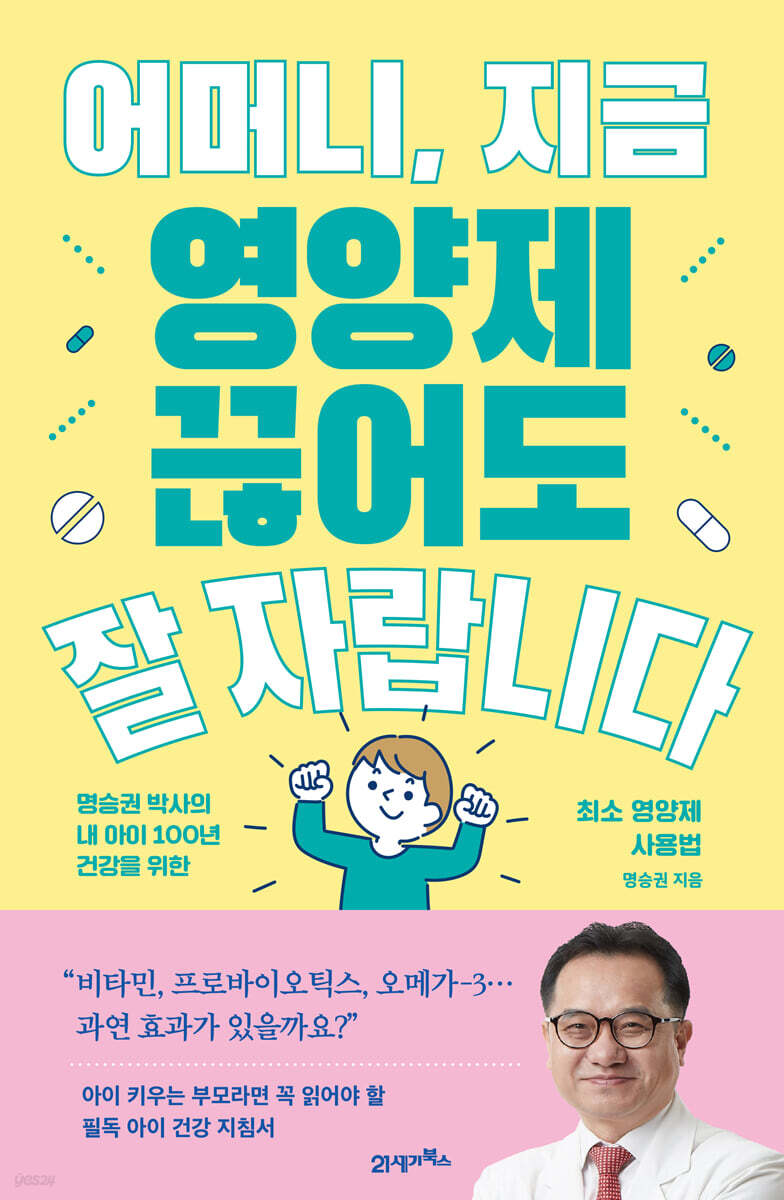
Mom, you'll grow well even if you stop taking the supplements now.
 |
Description
Book Introduction
“A nutritional revolution for our children: choose wisely and raise them strong!” We'll give you a guide to the right nutrients to help your child grow up healthy! Because the child doesn't eat well, is shorter than his peers, gets sick a lot, etc... Parents, concerned about their children, seek out various nutritional supplements and health functional foods, such as vitamins and probiotics. However, with so many health products on the market, it is confusing whether they are all exaggerated claims or have side effects. "Mom, Your Child Will Grow Well Even If You Stop Taking Supplements Now" is the one and only must-read guide to children's health for parents raising children. Dr. Myeong Seung-kwon reveals the truth and misunderstandings about children's supplements that no one has ever told you before. By learning about the precise functions and effects, recommended intake, and medical validity of health functional foods, including vitamins, antioxidants, red ginseng, omega-3 fatty acids, probiotics, and calcium, commonly given to children, we can take a step closer to a nutritional revolution for our children. |
- You can preview some of the book's contents.
Preview
index
Entering
Part 1: The Betrayal of Nutritional Supplements That Makes Mothers Cry
Chapter 1: The Children's Nutritional Supplement Craze
Are our children malnourished?
Why the Children's Nutrition Supplement Market Is Growing Despite a Declining Birth Rate
US Warning on Children's and Adolescents' Supplements
Nutritional supplements! They are both food and medicine.
Chapter 2: The Recommended Intakes We Know Are Wrong
A global vitamin D deficiency pandemic?
Is Vitamin D Deficiency Really a Pandemic?
Know your recommended intake right away
Chapter 3 The effect of nutritional supplements is not an experience
We need to confirm the evidence through medical research!
What We Misunderstand About Disease
Let's examine the medical basis for taking nutritional supplements.
Part 2: Supplements are not medicine
Vitamin of Life
Are vitamin C supplements necessary?
Does vitamin D deficiency cause stunted growth?
Will taking vitamin A improve my eyesight?
Will it help the baby if the mother takes vitamin B?
Vitamin E, important for growing children
Should I supplement with calcium for bone health?
Do omega-3 fatty acids improve brain function?
The most popular nutritional supplement, probiotics
Is magnesium good for eye twitching and insomnia?
Antioxidants that prevent disease
Does zinc reduce child mortality?
Do children need iron supplements?
Is red ginseng a panacea?
In conclusion
References
Part 1: The Betrayal of Nutritional Supplements That Makes Mothers Cry
Chapter 1: The Children's Nutritional Supplement Craze
Are our children malnourished?
Why the Children's Nutrition Supplement Market Is Growing Despite a Declining Birth Rate
US Warning on Children's and Adolescents' Supplements
Nutritional supplements! They are both food and medicine.
Chapter 2: The Recommended Intakes We Know Are Wrong
A global vitamin D deficiency pandemic?
Is Vitamin D Deficiency Really a Pandemic?
Know your recommended intake right away
Chapter 3 The effect of nutritional supplements is not an experience
We need to confirm the evidence through medical research!
What We Misunderstand About Disease
Let's examine the medical basis for taking nutritional supplements.
Part 2: Supplements are not medicine
Vitamin of Life
Are vitamin C supplements necessary?
Does vitamin D deficiency cause stunted growth?
Will taking vitamin A improve my eyesight?
Will it help the baby if the mother takes vitamin B?
Vitamin E, important for growing children
Should I supplement with calcium for bone health?
Do omega-3 fatty acids improve brain function?
The most popular nutritional supplement, probiotics
Is magnesium good for eye twitching and insomnia?
Antioxidants that prevent disease
Does zinc reduce child mortality?
Do children need iron supplements?
Is red ginseng a panacea?
In conclusion
References
Detailed image

Into the book
This book aims to answer these questions from an evidence-based medicine perspective.
We will also explore whether vitamin D deficiency is truly a pandemic, whether the current concept of recommended intake is scientifically or medically sound, how the correct concept should change, and how medical research results should be understood and interpreted.
In this article, we will examine whether children's intake of vitamin C, vitamin D, vitamin A, vitamin B, vitamin E, calcium, omega-3 fatty acids, probiotics, magnesium, antioxidants, zinc, iron, and red ginseng in the form of nutritional supplements or health functional foods rather than food is beneficial to their health, based on the latest clinical trials and meta-analyses that synthesize these.
--- p.7
In summary, the current recommended intake is incorrectly defined as excessive intake, corresponding to the top 2.5% of healthy people who consume extremely high amounts of a particular nutrient.
I think it's time for nutrition-related fields, such as medicine, nutrition, epidemiology, and public health, to come together and redefine the concept and definition of recommended intake.
--- p.48
In summary, the disease usually gets better on its own over time.
There is also something called the placebo effect, and if multiple actions or treatments are performed simultaneously or if it has not yet been proven in standard medicine, the effect cannot be determined.
Likewise, just because we take a supplement or use a particular method and our symptoms or illness improve, we cannot conclude that the method is effective.
Nutritional supplements also need to be medically tested for their effectiveness on a large number of people.
--- p.54~55
Is there sufficient medical evidence to support the idea that supplementing children aged 3 to 6 with vitamin D, rather than through food or sunlight, improves their height and other health outcomes? A 2020 meta-analysis published in the Cochrane Database of Systematic Reviews15, which synthesized three clinical trials, found little to no difference in height growth in infants and toddlers under 5 years who received vitamin D supplements compared to those who received no supplements or a placebo.
Infants who received vitamin D supplements for 6 months were 0.66 cm taller than those who did not, but this was not statistically significant and was not considered clinically relevant.
--- p.92
In conclusion, I concluded that there is insufficient evidence to support the effectiveness of probiotics in treating chronic constipation in children.
A 2023 meta-analysis of 17 clinical trials in children published in the journal Clinical Nutrition also concluded that there was no evidence that probiotics helped with constipation. 52 The effects of probiotics, including the type of probiotic, the type of mixture included in the probiotic product, and the appropriate amount and duration, were unclear.
--- p.149
[Dr. Pippo's Conclusion] Many health-related articles and health-related Internet sites, both in Korea and abroad, explain that magnesium can help improve insomnia and help you sleep better.
However, this is only a hypothesis or theory, and there are not enough clinical trials on humans to draw any conclusions.
Especially for children, there are no clinical trials, so it is difficult to apply the results of some clinical trials conducted on adults.
Not only magnesium, but also various nutritional supplements and all health functional foods must have their efficacy and safety sufficiently proven through clinical trials, not just theories or hypotheses.
In conclusion, there is insufficient clinical evidence to support the use of magnesium for insomnia.
--- p.164
[Dr. Pippo's Conclusion] There is a hypothesis that red ginseng helps immunity, but there is very little clinical evidence that taking red ginseng or ginseng is effective in treating upper respiratory tract infections in children.
There have been two published clinical trials on the effectiveness of ADHD treatments, but not a single meta-analysis.
So, at present, there are not enough clinical trials or study subjects to draw any conclusions about whether red ginseng is beneficial to children's health.
--- p.190
So, starting in 2009, I began conducting research using meta-analysis to determine whether major health functional foods that many people consume, such as vitamins, antioxidants, omega-3 fatty acids, calcium, and high-dose vitamin D, are truly beneficial to health by preventing or treating diseases. I published many papers in international academic journals.
The bottom line is that there is currently no evidence that most health functional foods are beneficial to health and, in fact, they may increase mortality or the risk of some cancers, so they should not be consumed.
We will also explore whether vitamin D deficiency is truly a pandemic, whether the current concept of recommended intake is scientifically or medically sound, how the correct concept should change, and how medical research results should be understood and interpreted.
In this article, we will examine whether children's intake of vitamin C, vitamin D, vitamin A, vitamin B, vitamin E, calcium, omega-3 fatty acids, probiotics, magnesium, antioxidants, zinc, iron, and red ginseng in the form of nutritional supplements or health functional foods rather than food is beneficial to their health, based on the latest clinical trials and meta-analyses that synthesize these.
--- p.7
In summary, the current recommended intake is incorrectly defined as excessive intake, corresponding to the top 2.5% of healthy people who consume extremely high amounts of a particular nutrient.
I think it's time for nutrition-related fields, such as medicine, nutrition, epidemiology, and public health, to come together and redefine the concept and definition of recommended intake.
--- p.48
In summary, the disease usually gets better on its own over time.
There is also something called the placebo effect, and if multiple actions or treatments are performed simultaneously or if it has not yet been proven in standard medicine, the effect cannot be determined.
Likewise, just because we take a supplement or use a particular method and our symptoms or illness improve, we cannot conclude that the method is effective.
Nutritional supplements also need to be medically tested for their effectiveness on a large number of people.
--- p.54~55
Is there sufficient medical evidence to support the idea that supplementing children aged 3 to 6 with vitamin D, rather than through food or sunlight, improves their height and other health outcomes? A 2020 meta-analysis published in the Cochrane Database of Systematic Reviews15, which synthesized three clinical trials, found little to no difference in height growth in infants and toddlers under 5 years who received vitamin D supplements compared to those who received no supplements or a placebo.
Infants who received vitamin D supplements for 6 months were 0.66 cm taller than those who did not, but this was not statistically significant and was not considered clinically relevant.
--- p.92
In conclusion, I concluded that there is insufficient evidence to support the effectiveness of probiotics in treating chronic constipation in children.
A 2023 meta-analysis of 17 clinical trials in children published in the journal Clinical Nutrition also concluded that there was no evidence that probiotics helped with constipation. 52 The effects of probiotics, including the type of probiotic, the type of mixture included in the probiotic product, and the appropriate amount and duration, were unclear.
--- p.149
[Dr. Pippo's Conclusion] Many health-related articles and health-related Internet sites, both in Korea and abroad, explain that magnesium can help improve insomnia and help you sleep better.
However, this is only a hypothesis or theory, and there are not enough clinical trials on humans to draw any conclusions.
Especially for children, there are no clinical trials, so it is difficult to apply the results of some clinical trials conducted on adults.
Not only magnesium, but also various nutritional supplements and all health functional foods must have their efficacy and safety sufficiently proven through clinical trials, not just theories or hypotheses.
In conclusion, there is insufficient clinical evidence to support the use of magnesium for insomnia.
--- p.164
[Dr. Pippo's Conclusion] There is a hypothesis that red ginseng helps immunity, but there is very little clinical evidence that taking red ginseng or ginseng is effective in treating upper respiratory tract infections in children.
There have been two published clinical trials on the effectiveness of ADHD treatments, but not a single meta-analysis.
So, at present, there are not enough clinical trials or study subjects to draw any conclusions about whether red ginseng is beneficial to children's health.
--- p.190
So, starting in 2009, I began conducting research using meta-analysis to determine whether major health functional foods that many people consume, such as vitamins, antioxidants, omega-3 fatty acids, calcium, and high-dose vitamin D, are truly beneficial to health by preventing or treating diseases. I published many papers in international academic journals.
The bottom line is that there is currently no evidence that most health functional foods are beneficial to health and, in fact, they may increase mortality or the risk of some cancers, so they should not be consumed.
--- p.195
Publisher's Review
“What if the nutritional supplements I trusted and fed my child are actually harming their health?”
The truth about the misuse of children's nutritional supplements revealed by Dr. Pippo, the nation's top doctor!
For parents raising children, the thing they worry about most is, of course, their children's health.
When your child doesn't eat well, is shorter than their peers, or gets sick often, many of you may have thought, "Should I give them some vitamins?" and bought nutritional supplements.
But what if most of the nutritional supplements we eat lack medical evidence to support their health benefits, and in some cases, they actually threaten our children's health?
"Mom, You'll Grow Well Even If You Stop Taking Supplements Now" is a book written by Dr. Seung-Kwon Myeong, an evidence-based medicine expert who has protected children's health and safety through "Beep Beep! Our Body X-Files", and contains the minimum nutritional supplement usage tips that parents raising children must know.
Starting with an explanation of nutritional supplements and health functional foods, we will cover vitamin D, vitamin C, vitamin A, vitamin B, and vitamin E.
We provide information on the functions and effects of various popular children's nutritional supplements and health functional foods, including omega-3, probiotics, magnesium, zinc, iron, and red ginseng, as well as clinical trial results, based on the latest reliable medical knowledge.
This is the one and only must-read guide to children's health for parents raising children. It will certainly be of great help in making wise choices from the abundance of children's nutritional supplements and raising healthy children.
“If you are concerned about your child’s health and well-being with children’s nutritional supplements, be sure to pay attention!”
How to Use Minimum Child Nutritional Supplements for Parents Who Are Obsessed with Children
In Part 1, we will learn about the recommended intake of nutritional supplements.
The authors argue that current recommended intakes are excessively high and without medical justification, and are based on a consensus of experts with insufficient evidence rather than on medically and clinically sound research.
An example is the pandemic of vitamin D deficiency.
The authors say that the current recommended intake is incorrectly defined as the excessive intake of the top 2.5% of people who consume extremely high amounts of a particular nutrient, which has led to the epidemic of vitamin D deficiency, and that it is time to redefine the concept and definition of the recommended intake.
In Part 2, we will take a closer look at popular children's nutritional supplements based on reliable meta-analysis.
When you think of "nutritional supplements," what comes to mind first? The nutritional supplement most often sought after by parents of growing children is vitamin D. The idea that vitamin D strengthens bones and promotes growth has long been considered common knowledge.
However, a meta-analysis published in 2020 that synthesized three clinical trials found little difference in height between infants and toddlers who received vitamin D supplements and those who did not.
What about the trendy nutritional supplement, "antioxidant supplements"? Antioxidants, which are called antioxidants because they help prevent various diseases by blocking the oxidative effects of reactive oxygen species, can taking them in supplement form yield the same results? The conclusion: those who took antioxidant supplements actually had a 5% higher mortality rate than those who didn't.
Regularly taking antioxidant supplements can reduce reactive oxygen species, lowering defense functions and potentially increasing mortality rates.
This book was written to help parents who want to raise their children healthily by informing them of the correct way to consume children's nutritional supplements and the reality of nutritional supplement misuse.
The author's accurate analysis and sobering insight, which shatter the stereotype that nutritional supplements are unconditionally good and beneficial for health, can provide the most fundamental and sustainable solution for our children's health.
The truth about the misuse of children's nutritional supplements revealed by Dr. Pippo, the nation's top doctor!
For parents raising children, the thing they worry about most is, of course, their children's health.
When your child doesn't eat well, is shorter than their peers, or gets sick often, many of you may have thought, "Should I give them some vitamins?" and bought nutritional supplements.
But what if most of the nutritional supplements we eat lack medical evidence to support their health benefits, and in some cases, they actually threaten our children's health?
"Mom, You'll Grow Well Even If You Stop Taking Supplements Now" is a book written by Dr. Seung-Kwon Myeong, an evidence-based medicine expert who has protected children's health and safety through "Beep Beep! Our Body X-Files", and contains the minimum nutritional supplement usage tips that parents raising children must know.
Starting with an explanation of nutritional supplements and health functional foods, we will cover vitamin D, vitamin C, vitamin A, vitamin B, and vitamin E.
We provide information on the functions and effects of various popular children's nutritional supplements and health functional foods, including omega-3, probiotics, magnesium, zinc, iron, and red ginseng, as well as clinical trial results, based on the latest reliable medical knowledge.
This is the one and only must-read guide to children's health for parents raising children. It will certainly be of great help in making wise choices from the abundance of children's nutritional supplements and raising healthy children.
“If you are concerned about your child’s health and well-being with children’s nutritional supplements, be sure to pay attention!”
How to Use Minimum Child Nutritional Supplements for Parents Who Are Obsessed with Children
In Part 1, we will learn about the recommended intake of nutritional supplements.
The authors argue that current recommended intakes are excessively high and without medical justification, and are based on a consensus of experts with insufficient evidence rather than on medically and clinically sound research.
An example is the pandemic of vitamin D deficiency.
The authors say that the current recommended intake is incorrectly defined as the excessive intake of the top 2.5% of people who consume extremely high amounts of a particular nutrient, which has led to the epidemic of vitamin D deficiency, and that it is time to redefine the concept and definition of the recommended intake.
In Part 2, we will take a closer look at popular children's nutritional supplements based on reliable meta-analysis.
When you think of "nutritional supplements," what comes to mind first? The nutritional supplement most often sought after by parents of growing children is vitamin D. The idea that vitamin D strengthens bones and promotes growth has long been considered common knowledge.
However, a meta-analysis published in 2020 that synthesized three clinical trials found little difference in height between infants and toddlers who received vitamin D supplements and those who did not.
What about the trendy nutritional supplement, "antioxidant supplements"? Antioxidants, which are called antioxidants because they help prevent various diseases by blocking the oxidative effects of reactive oxygen species, can taking them in supplement form yield the same results? The conclusion: those who took antioxidant supplements actually had a 5% higher mortality rate than those who didn't.
Regularly taking antioxidant supplements can reduce reactive oxygen species, lowering defense functions and potentially increasing mortality rates.
This book was written to help parents who want to raise their children healthily by informing them of the correct way to consume children's nutritional supplements and the reality of nutritional supplement misuse.
The author's accurate analysis and sobering insight, which shatter the stereotype that nutritional supplements are unconditionally good and beneficial for health, can provide the most fundamental and sustainable solution for our children's health.
GOODS SPECIFICS
- Date of issue: August 12, 2024
- Page count, weight, size: 204 pages | 152*233*20mm
- ISBN13: 9791171176908
- ISBN10: 1171176902
You may also like
카테고리
korean


korean

![GQ KOREA Mark (Monthly): December [2025]](http://librairie.coreenne.fr/cdn/shop/files/8ef265dbbfbf186523ed75ba7319009d.jpg?v=1765340328&width=3840)


