

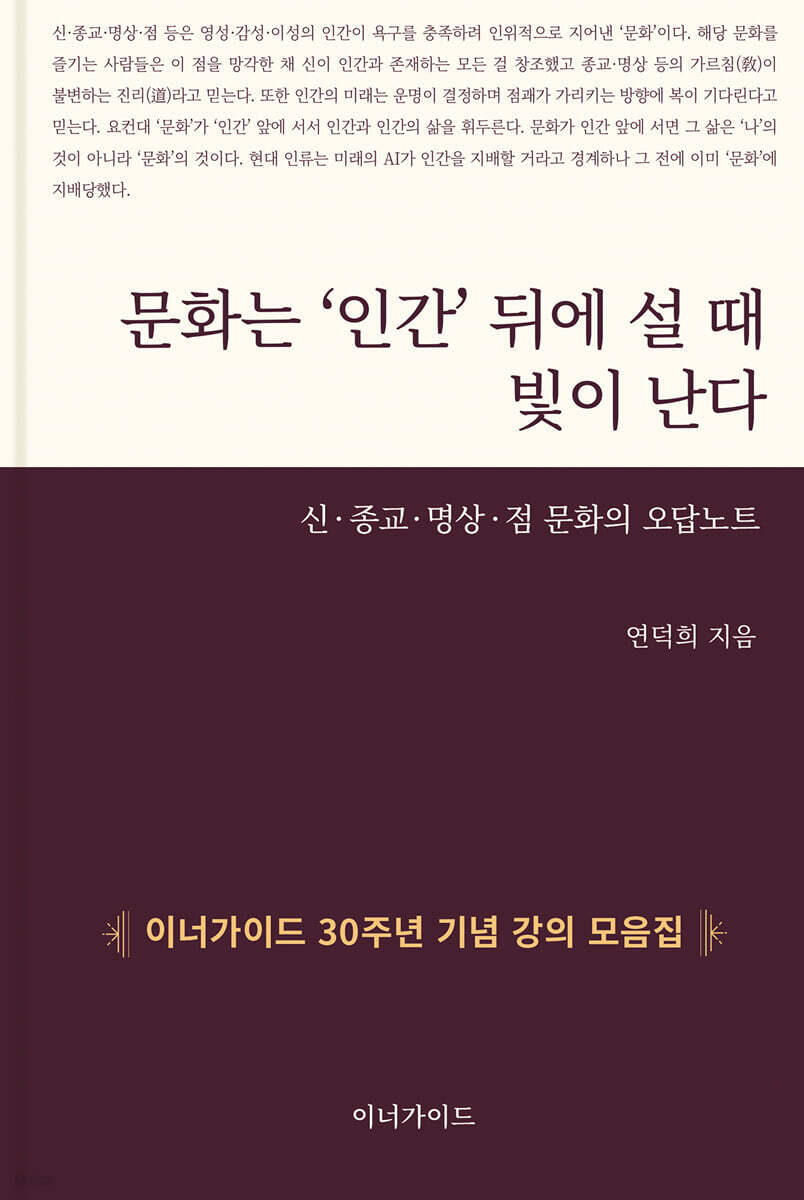
Culture shines when it stands behind 'humanity'
 |
Description
Book Introduction
[God] A god proven by human emotions, reason, or the five senses is definitely fake.
God did not exist in the first place; he was created by human hands.
The moment you believe that a specific object is 'God', you will soon have to endure mental, physical, and material damage.
[God in Religion] As humanity became aware of 'me' and reason developed, they began to doubt the existence of God.
It's only natural since you said something exists when it doesn't.
In a religious culture in crisis, God was relocated to a space that could not be perceived by the five human senses, and human morality was planted in the empty space he left behind.
In short, the 'God' of religious culture refers to two things: a God who exists externally with personality (primitive religion) and human morality (higher religion).
[Dot] In the dot culture that examines human life, there is no trace of living, breathing humans anywhere.
There are only 'numbers' and methods of calculating numbers.
In short, the dot culture has numbers in front and people behind.
‘Human’ and ‘life’ are not things that can be measured by numbers or anything like that.
It is the atypical thing that makes the possible impossible and the impossible possible.
Isn't it time to look at the 'human' itself, which has been pushed aside by numbers?
God did not exist in the first place; he was created by human hands.
The moment you believe that a specific object is 'God', you will soon have to endure mental, physical, and material damage.
[God in Religion] As humanity became aware of 'me' and reason developed, they began to doubt the existence of God.
It's only natural since you said something exists when it doesn't.
In a religious culture in crisis, God was relocated to a space that could not be perceived by the five human senses, and human morality was planted in the empty space he left behind.
In short, the 'God' of religious culture refers to two things: a God who exists externally with personality (primitive religion) and human morality (higher religion).
[Dot] In the dot culture that examines human life, there is no trace of living, breathing humans anywhere.
There are only 'numbers' and methods of calculating numbers.
In short, the dot culture has numbers in front and people behind.
‘Human’ and ‘life’ are not things that can be measured by numbers or anything like that.
It is the atypical thing that makes the possible impossible and the impossible possible.
Isn't it time to look at the 'human' itself, which has been pushed aside by numbers?
- You can preview some of the book's contents.
Preview
Into the book
For example, in the primitive religious cultures of the East and the West, gods and humans lived together and all human lives were 'directly' controlled by God.
Given the level of reason at the time, this structure would have been the best.
By creating an imaginary space that cannot be reached with the body, such as heaven, the kingdom of heaven, or the afterlife, and placing a god there that cannot be perceived by the five senses, it became something that could not be seen, touched, or visited, 'naturally'.
If something clearly exists and can be seen and touched, it becomes a lie, and the absurd lie that “believing without seeing is true” has become the standard of faith.
It's something that doesn't exist in the first place, so you can't see it or touch it, but isn't it a really clever solution to make it a 'natural' thing?
--- p.19
For example, which do you think is more cultic: the indigenous faith of a grandmother who prays for the well-being of her family by placing a bowl of water on a kimchi crock early in the morning, or the faith of a priest belonging to an orthodox religious order who extorts spiritual, physical, and material benefits from his followers? From the perspective of the orthodox religious order, the grandmother's faith is clearly heretical.
But it is not a pseudo-religion or a crime.
On the other hand, the faith of a priest who transmits the teachings of an orthodox church is clearly not heresy.
But we call him a cult.
In short, the judgment of a cult is not determined by its leader, doctrine, or religious group.
The problem is using religious culture for crime.
What's your opinion? It doesn't matter to me whether you believe in Jesus, Buddha, or some indigenous god.
It doesn't matter whether the religious culture you enjoy is orthodox or heretical.
The problem is only the criminal acts that seek personal gain through religious culture.
--- p.54
When spirituality stands before emotion and reason, there can be no quarrels or taking sides.
All quarrels and divisions arise from division (discrimination, dichotomies), and division arises from looking at objects with emotion and reason.
Love that fails to embrace differences is clear evidence that it is not a matter of spirituality, but of emotion and reason.
At least in religious culture, we must prioritize spiritual love that embraces all of these, rather than worldly love that is obsessed with emotion, reason, distinction (discrimination, partisanship), and profit.
For example, the change in modern Catholicism to bless same-sex couples is absolutely unacceptable with today's level of sensibility and reason.
Some cry that the end of the world has come or say they will convert to another religion.
I fully understand their resentment and anger, but they are not qualified to believe in Catholicism, so I hope they will quickly convert to a new religion that suits their standards.
The Catholic Church does not bless homosexuality itself in order to acknowledge and encourage it.
Whether of this type or that type, it is a 'human' who is embraced and embraced with spirituality, and a 'human' who deserves to be loved is embraced and blessed.
If we look at the Catholic Church's decision from a spiritual perspective, there is no problem at all.
This incident is evidence that spirituality is at the forefront, at least in the modern Catholic Church.
If this incident has shaken your faith and belief, then that level of faith and belief is not worth keeping, it is a fake, and it is proof that you are living a religious life based on reason and emotion, not spirituality.
Given the level of reason at the time, this structure would have been the best.
By creating an imaginary space that cannot be reached with the body, such as heaven, the kingdom of heaven, or the afterlife, and placing a god there that cannot be perceived by the five senses, it became something that could not be seen, touched, or visited, 'naturally'.
If something clearly exists and can be seen and touched, it becomes a lie, and the absurd lie that “believing without seeing is true” has become the standard of faith.
It's something that doesn't exist in the first place, so you can't see it or touch it, but isn't it a really clever solution to make it a 'natural' thing?
--- p.19
For example, which do you think is more cultic: the indigenous faith of a grandmother who prays for the well-being of her family by placing a bowl of water on a kimchi crock early in the morning, or the faith of a priest belonging to an orthodox religious order who extorts spiritual, physical, and material benefits from his followers? From the perspective of the orthodox religious order, the grandmother's faith is clearly heretical.
But it is not a pseudo-religion or a crime.
On the other hand, the faith of a priest who transmits the teachings of an orthodox church is clearly not heresy.
But we call him a cult.
In short, the judgment of a cult is not determined by its leader, doctrine, or religious group.
The problem is using religious culture for crime.
What's your opinion? It doesn't matter to me whether you believe in Jesus, Buddha, or some indigenous god.
It doesn't matter whether the religious culture you enjoy is orthodox or heretical.
The problem is only the criminal acts that seek personal gain through religious culture.
--- p.54
When spirituality stands before emotion and reason, there can be no quarrels or taking sides.
All quarrels and divisions arise from division (discrimination, dichotomies), and division arises from looking at objects with emotion and reason.
Love that fails to embrace differences is clear evidence that it is not a matter of spirituality, but of emotion and reason.
At least in religious culture, we must prioritize spiritual love that embraces all of these, rather than worldly love that is obsessed with emotion, reason, distinction (discrimination, partisanship), and profit.
For example, the change in modern Catholicism to bless same-sex couples is absolutely unacceptable with today's level of sensibility and reason.
Some cry that the end of the world has come or say they will convert to another religion.
I fully understand their resentment and anger, but they are not qualified to believe in Catholicism, so I hope they will quickly convert to a new religion that suits their standards.
The Catholic Church does not bless homosexuality itself in order to acknowledge and encourage it.
Whether of this type or that type, it is a 'human' who is embraced and embraced with spirituality, and a 'human' who deserves to be loved is embraced and blessed.
If we look at the Catholic Church's decision from a spiritual perspective, there is no problem at all.
This incident is evidence that spirituality is at the forefront, at least in the modern Catholic Church.
If this incident has shaken your faith and belief, then that level of faith and belief is not worth keeping, it is a fake, and it is proof that you are living a religious life based on reason and emotion, not spirituality.
--- p.73
GOODS SPECIFICS
- Date of issue: December 11, 2024
- Page count, weight, size: 216 pages | 152*225*20mm
- ISBN13: 9791197745805
- ISBN10: 1197745807
You may also like
카테고리
korean


korean

![GQ KOREA Mark (Monthly): December [2025]](http://librairie.coreenne.fr/cdn/shop/files/8ef265dbbfbf186523ed75ba7319009d.jpg?v=1765340328&width=3840)


