

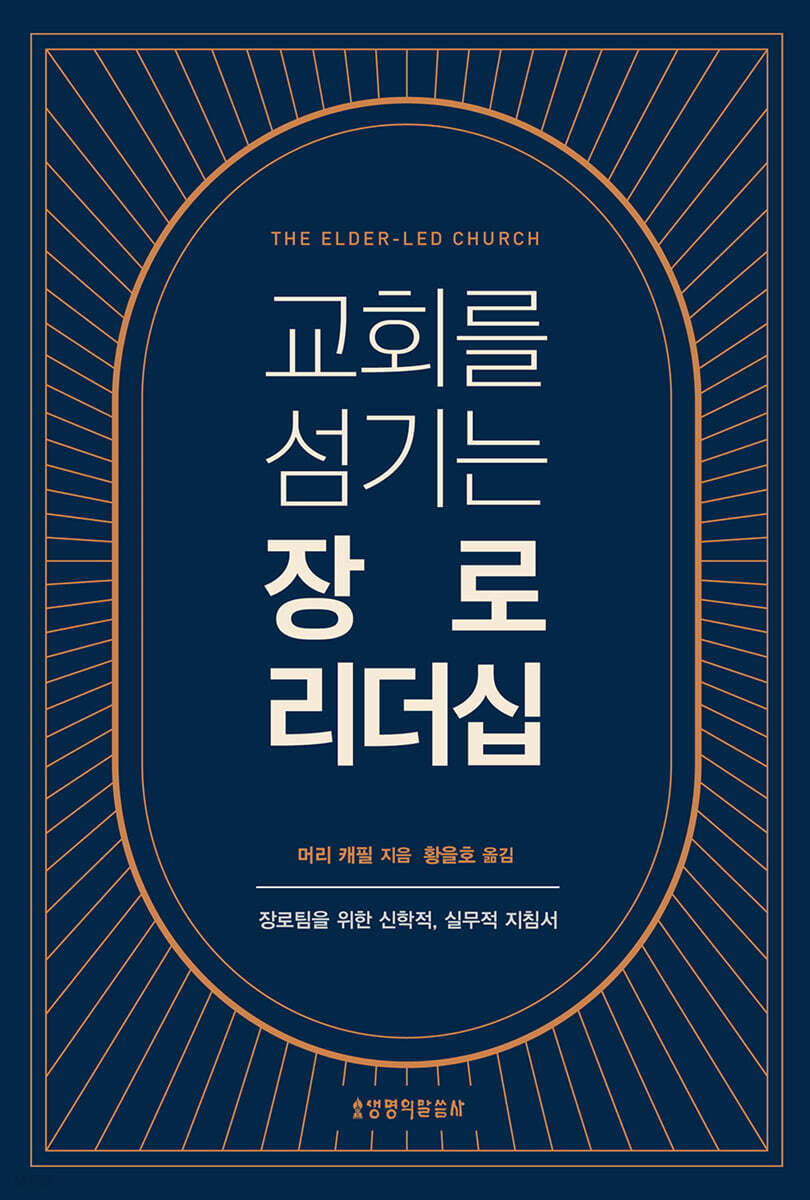
Elder Leadership Serving the Church
 |
Description
Book Introduction
Elder Leadership Renewing the Church
Not alone, but 'together',
The path to a healthy church created by the elders' team
The concerns faced by elders
Elders in Korean churches are key leaders who have been closely watching over the church for a long time.
Although he has been more faithful than anyone else in his worship and ministry, he harbors concerns that are difficult to express in the field.
This is because various responsibilities are concentrated on the elders, including church council operations and decision-making structures, communication and partnership with pastors, the burden of departmental ministry and administrative work, care for the congregation, and ministry to the next generation.
Even though we do our best for the church, we often get lost when faced with the question, “How should I serve now?”
Moreover, although we have heard a lot about the character and qualifications of individual elders, we have had few opportunities to learn how elders should lead the church as a "team."
Not alone, but 'together',
The path to a healthy church created by the elders' team
The concerns faced by elders
Elders in Korean churches are key leaders who have been closely watching over the church for a long time.
Although he has been more faithful than anyone else in his worship and ministry, he harbors concerns that are difficult to express in the field.
This is because various responsibilities are concentrated on the elders, including church council operations and decision-making structures, communication and partnership with pastors, the burden of departmental ministry and administrative work, care for the congregation, and ministry to the next generation.
Even though we do our best for the church, we often get lost when faced with the question, “How should I serve now?”
Moreover, although we have heard a lot about the character and qualifications of individual elders, we have had few opportunities to learn how elders should lead the church as a "team."
- You can preview some of the book's contents.
Preview
index
Recommended Preface
Acknowledgements
Entering
PART 1 Elders are leaders
1.
The Office of Elders in the Bible
2.
top leader
3.
Leadership as a Team
4.
Cultivating new leaders
PART 2 Big Picture Leadership: Leading the Whole Church
5.
Leadership with Clear Theology
6.
Leadership with a Gospel Vision
7.
Leadership with Effective Structure
PART 3: Representative Ministry Leadership Shaping Church Ministry
8.
Mission Leadership: Spreading the Gospel Locally and Globally
9.
Sunday Leadership: Word and Worship
10.
Shepherd Leadership: Care and Discipleship
PART 4: Exceptional Leadership Revealed in the Field
11.
Elders leading the field
12.
When the elders meet
References
main
Acknowledgements
Entering
PART 1 Elders are leaders
1.
The Office of Elders in the Bible
2.
top leader
3.
Leadership as a Team
4.
Cultivating new leaders
PART 2 Big Picture Leadership: Leading the Whole Church
5.
Leadership with Clear Theology
6.
Leadership with a Gospel Vision
7.
Leadership with Effective Structure
PART 3: Representative Ministry Leadership Shaping Church Ministry
8.
Mission Leadership: Spreading the Gospel Locally and Globally
9.
Sunday Leadership: Word and Worship
10.
Shepherd Leadership: Care and Discipleship
PART 4: Exceptional Leadership Revealed in the Field
11.
Elders leading the field
12.
When the elders meet
References
main
Detailed image

Into the book
In fact, personal character is one of the key qualifications for eldership.
However, if we follow the guidance of Scripture, when we examine the role of elders, we must primarily examine the group of elders and the joint ministry they perform as a team.
Our fundamental question is not what kind of person an elder is and what he should do, but what kind of people elders are and what he should do.
The team's perspective is a tremendous encouragement to pastors and elders.
The work we are called to do is never something we are called to do alone.
Not everyone needs to have all the gifts or all the time they need.
We rely on each other, set direction together, share leadership responsibilities, leverage each other's strengths, pray together, cry together, make difficult decisions together, and rejoice together as the Lord blesses His church.
--- 「1.
From “Eldership as Spoken in the Bible”
Some people are natural leaders, but there is another kind of leader, and perhaps the more common kind is not the natural leader, but the one who has learned to lead.
These people may not be willing leaders, but they have learned to take initiative, think more strategically, and lead others along.
Leadership abilities developed in this way often stem from gifts in other ministries.
Some people may have a special gift for working with children.
He loves children, spends time with them, and is deeply involved in children's ministry.
His passion for the ministry drives him to think about it, read about it, receive mentoring and encouragement, and come up with new ideas to improve the ministry.
So he has no choice but to take on a more proactive role.
As time goes by, he develops more and more and eventually proves quite adept at leading the entire ministry.
Because they are not born leaders, but rather learned leadership.
--- 「2.
Among the "Top Leaders"
Over the years, I've repeatedly taken on the role of team leader, wanting to rethink, organize, change, and start something.
So I usually just wrote simple documents.
After taking the time to think about the problem, I write down my ideas on paper and give them to the elders.
What happens next is always interesting.
Sometimes (but not often), elders will look at the idea and say, “That’s really great, let’s do it!”
But more often than not, one of the elders immediately asks, “So what are we going to do about this?”
Then I am shocked to realize that despite all my endless thinking, praying, and trying, I have completely overlooked something fundamental.
Other times, ideas are received like a balloon, and I have to eat humility pie on the way home, to mix up the metaphor.
But sometimes, that balloon gets inflated again.
Someone else comes up with the idea and everyone thinks it's great.
Eating the pie of humility again.
Maybe the idea took time to gain traction, or maybe the timing wasn't right initially.
The most common thing is to think about the idea for a long time, revise and improve it, and then eventually adopt it.
This is the benefit of team leadership with a leader.
The results are better than a team of elders without a leader, and better than a single leader without review or input from others.
--- 「3.
From “Leadership as a Team”
He noted that it is more common for people to grow into leadership roles as they spend time in ministry.
They participate in ministry and develop leadership skills.
Sometimes that growth happens quite naturally, but if a church wants it to be sustainable, it must intentionally create leadership development pathways.
A leadership path (or pipeline, as it is often called) is a way to help people move from lower levels of leadership responsibility to higher levels.
It's unfair to throw someone who isn't an experienced leader into the difficult situation of having to take on a key leadership role.
But if such a person starts at a low level of leadership, he may develop leadership skills he never imagined possible.
--- 「4.
From “Cultivating New Leaders”
Every church must set boundaries on theological issues.
Martin Luther said, “Here I stand.
“I have no other choice,” he is reported to have said.
His conscience was bound to him to stand his ground even if it meant upsetting those in high places, dividing the church, and even losing his life.
It was 'worth risking one's life to protect.'
Some problems are like that.
But not all problems are like that.
Some issues are fundamental to the gospel and make it stand or fall, but many, while important, are not "worth risking your life for."
Elders face the challenge of distinguishing between what is what.
Some churches consider almost everything to be of primary importance, while others have very few issues they must adhere to.
…the problems that need to be addressed seem endless.
Consider, for example, the following classic argument:
--- 「5.
From “Leadership with Clear Theology”
In this chapter, we will explore the core elements of a clear theological vision for ministry—or, more simply, the elements of a clear gospel vision.
If this isn't clear, nothing else will be clear.
The elder team should not assume that if the theology is correct, everything else will be correct.
Elders should also not assume that the practice of their church ministry will automatically flow from their theology.
And we shouldn't assume that everyone will see this the same way.
Church leaders must establish and develop a gospel vision based on the Bible.
--- 「6.
From “Leadership with a Gospel Vision”
Elders must face up to where the church is in this life cycle.
Are we still a living organism, possessing a vibrant gospel movement and inspiring vision? The only way to avoid the constant movement from birth to death is to continually renew our gospel vision.
Each generation of the church must rediscover its purpose for existing, discover the mission field God has placed before it, reframe its gospel vision for ministry, and renew its church culture.
--- 「7.
From “Leadership with Effective Structure”
This time, let's imagine a different church, a different team of elders, and a different vehicle.
Once again, all the usual packages are safely in place.
But this time the missionary box is not visible.
Thankfully, this is invisible for the best of reasons.
In their journey, missions are no longer an added ministry.
Rather, it is the engine that moves the entire load.
It's under the hood of your vehicle and powers everything it does.
There is no way it could fall to the side or be left behind.
That's what moves everything.
--- 「8.
From “Missionary Leadership: Spreading the Gospel Locally and Globally”
What happens in corporate worship sets the tone for church life.
If worship doesn't become part of the culture, it's difficult to integrate anything into church life.
For example, if we want a church that is outward-looking and mission-focused, as described in the previous chapter, but on Sundays it is almost entirely inward-looking, we are sending the message that missions are secondary and not essential.
If we want to build a warm and caring church community, but our worship is rigid and impersonal, we're in for an uphill battle, as this representative ministry sends a different message.
Sunday should reflect our values.
--- 「9.
From “Sunday Leadership: Word and Worship”
The point of identifying at least eight means of care is that elders should consider the rich diversity of caregiving practices throughout the life of the church.
The New Testament does not have a model of care that applies equally to everyone.
Caregiving strategies that are preferred by oneself (e.g.
It should not be narrowed down to groups (e.g., atrium, mentoring, small groups, etc.).
Rather, we should think about how we can best provide care to different types of people.
Caring for young people may be very different from caring for older people, and caring for a single woman may be different from caring for a married man.
Caring for someone who is already very well supported spiritually will be different than caring for someone who is asking for help.
--- 「10.
From “Shepherd Leadership: Care and Discipleship”
It will be revealed constantly and naturally in the conversations of the elders.
When an elder visits, participates in a small group, or leads a portion of a worship service, the church's gospel vision will influence the way he speaks.
They will essentially reflect the theological position of the church, speak according to the culture within which it is established, and communicate in accordance with the church's view of ministry.
…So, what language do you use in your church? How do you talk to people about the lost, other churches, your community, the gospel, the Bible, sin, gender, sexuality, and many other core issues? Have you found effective ways to communicate the beliefs you most passionately espouse?
--- 「11.
Among the “Elders Leading the Field”
For church elders, meetings are a central part of their work.
It is not only a necessary evil, but also an essential good.
Elders must meet to do the work of shepherds, overseers, leaders, and stewards.
They gather to pray, reflect, make decisions, and set direction.
In many ways, the quality of their meetings determines the quality of their leadership, which in turn determines the quality of church life.
So how can we transform a long, painful meeting (one you hope will be canceled) into a valuable one? In this chapter, we'll explore five essential elements.
These five topics will synthesize much of what we have considered so far.
Many of the elders' tasks and responsibilities are gathered in the meeting.
However, if we follow the guidance of Scripture, when we examine the role of elders, we must primarily examine the group of elders and the joint ministry they perform as a team.
Our fundamental question is not what kind of person an elder is and what he should do, but what kind of people elders are and what he should do.
The team's perspective is a tremendous encouragement to pastors and elders.
The work we are called to do is never something we are called to do alone.
Not everyone needs to have all the gifts or all the time they need.
We rely on each other, set direction together, share leadership responsibilities, leverage each other's strengths, pray together, cry together, make difficult decisions together, and rejoice together as the Lord blesses His church.
--- 「1.
From “Eldership as Spoken in the Bible”
Some people are natural leaders, but there is another kind of leader, and perhaps the more common kind is not the natural leader, but the one who has learned to lead.
These people may not be willing leaders, but they have learned to take initiative, think more strategically, and lead others along.
Leadership abilities developed in this way often stem from gifts in other ministries.
Some people may have a special gift for working with children.
He loves children, spends time with them, and is deeply involved in children's ministry.
His passion for the ministry drives him to think about it, read about it, receive mentoring and encouragement, and come up with new ideas to improve the ministry.
So he has no choice but to take on a more proactive role.
As time goes by, he develops more and more and eventually proves quite adept at leading the entire ministry.
Because they are not born leaders, but rather learned leadership.
--- 「2.
Among the "Top Leaders"
Over the years, I've repeatedly taken on the role of team leader, wanting to rethink, organize, change, and start something.
So I usually just wrote simple documents.
After taking the time to think about the problem, I write down my ideas on paper and give them to the elders.
What happens next is always interesting.
Sometimes (but not often), elders will look at the idea and say, “That’s really great, let’s do it!”
But more often than not, one of the elders immediately asks, “So what are we going to do about this?”
Then I am shocked to realize that despite all my endless thinking, praying, and trying, I have completely overlooked something fundamental.
Other times, ideas are received like a balloon, and I have to eat humility pie on the way home, to mix up the metaphor.
But sometimes, that balloon gets inflated again.
Someone else comes up with the idea and everyone thinks it's great.
Eating the pie of humility again.
Maybe the idea took time to gain traction, or maybe the timing wasn't right initially.
The most common thing is to think about the idea for a long time, revise and improve it, and then eventually adopt it.
This is the benefit of team leadership with a leader.
The results are better than a team of elders without a leader, and better than a single leader without review or input from others.
--- 「3.
From “Leadership as a Team”
He noted that it is more common for people to grow into leadership roles as they spend time in ministry.
They participate in ministry and develop leadership skills.
Sometimes that growth happens quite naturally, but if a church wants it to be sustainable, it must intentionally create leadership development pathways.
A leadership path (or pipeline, as it is often called) is a way to help people move from lower levels of leadership responsibility to higher levels.
It's unfair to throw someone who isn't an experienced leader into the difficult situation of having to take on a key leadership role.
But if such a person starts at a low level of leadership, he may develop leadership skills he never imagined possible.
--- 「4.
From “Cultivating New Leaders”
Every church must set boundaries on theological issues.
Martin Luther said, “Here I stand.
“I have no other choice,” he is reported to have said.
His conscience was bound to him to stand his ground even if it meant upsetting those in high places, dividing the church, and even losing his life.
It was 'worth risking one's life to protect.'
Some problems are like that.
But not all problems are like that.
Some issues are fundamental to the gospel and make it stand or fall, but many, while important, are not "worth risking your life for."
Elders face the challenge of distinguishing between what is what.
Some churches consider almost everything to be of primary importance, while others have very few issues they must adhere to.
…the problems that need to be addressed seem endless.
Consider, for example, the following classic argument:
--- 「5.
From “Leadership with Clear Theology”
In this chapter, we will explore the core elements of a clear theological vision for ministry—or, more simply, the elements of a clear gospel vision.
If this isn't clear, nothing else will be clear.
The elder team should not assume that if the theology is correct, everything else will be correct.
Elders should also not assume that the practice of their church ministry will automatically flow from their theology.
And we shouldn't assume that everyone will see this the same way.
Church leaders must establish and develop a gospel vision based on the Bible.
--- 「6.
From “Leadership with a Gospel Vision”
Elders must face up to where the church is in this life cycle.
Are we still a living organism, possessing a vibrant gospel movement and inspiring vision? The only way to avoid the constant movement from birth to death is to continually renew our gospel vision.
Each generation of the church must rediscover its purpose for existing, discover the mission field God has placed before it, reframe its gospel vision for ministry, and renew its church culture.
--- 「7.
From “Leadership with Effective Structure”
This time, let's imagine a different church, a different team of elders, and a different vehicle.
Once again, all the usual packages are safely in place.
But this time the missionary box is not visible.
Thankfully, this is invisible for the best of reasons.
In their journey, missions are no longer an added ministry.
Rather, it is the engine that moves the entire load.
It's under the hood of your vehicle and powers everything it does.
There is no way it could fall to the side or be left behind.
That's what moves everything.
--- 「8.
From “Missionary Leadership: Spreading the Gospel Locally and Globally”
What happens in corporate worship sets the tone for church life.
If worship doesn't become part of the culture, it's difficult to integrate anything into church life.
For example, if we want a church that is outward-looking and mission-focused, as described in the previous chapter, but on Sundays it is almost entirely inward-looking, we are sending the message that missions are secondary and not essential.
If we want to build a warm and caring church community, but our worship is rigid and impersonal, we're in for an uphill battle, as this representative ministry sends a different message.
Sunday should reflect our values.
--- 「9.
From “Sunday Leadership: Word and Worship”
The point of identifying at least eight means of care is that elders should consider the rich diversity of caregiving practices throughout the life of the church.
The New Testament does not have a model of care that applies equally to everyone.
Caregiving strategies that are preferred by oneself (e.g.
It should not be narrowed down to groups (e.g., atrium, mentoring, small groups, etc.).
Rather, we should think about how we can best provide care to different types of people.
Caring for young people may be very different from caring for older people, and caring for a single woman may be different from caring for a married man.
Caring for someone who is already very well supported spiritually will be different than caring for someone who is asking for help.
--- 「10.
From “Shepherd Leadership: Care and Discipleship”
It will be revealed constantly and naturally in the conversations of the elders.
When an elder visits, participates in a small group, or leads a portion of a worship service, the church's gospel vision will influence the way he speaks.
They will essentially reflect the theological position of the church, speak according to the culture within which it is established, and communicate in accordance with the church's view of ministry.
…So, what language do you use in your church? How do you talk to people about the lost, other churches, your community, the gospel, the Bible, sin, gender, sexuality, and many other core issues? Have you found effective ways to communicate the beliefs you most passionately espouse?
--- 「11.
Among the “Elders Leading the Field”
For church elders, meetings are a central part of their work.
It is not only a necessary evil, but also an essential good.
Elders must meet to do the work of shepherds, overseers, leaders, and stewards.
They gather to pray, reflect, make decisions, and set direction.
In many ways, the quality of their meetings determines the quality of their leadership, which in turn determines the quality of church life.
So how can we transform a long, painful meeting (one you hope will be canceled) into a valuable one? In this chapter, we'll explore five essential elements.
These five topics will synthesize much of what we have considered so far.
Many of the elders' tasks and responsibilities are gathered in the meeting.
--- 「12.
From “When the Elders Meet”
From “When the Elders Meet”
Publisher's Review
A Book to Fill the Gap in Elder Leadership
Murray Capil's book, "Elder Leadership in the Church," was written to fill this gap.
The author points out that among the numerous leadership and eldership-related books, there are few that truly address "how an elder team should lead a church." To this end, he systematically guides readers through the entire spectrum of elder leadership, from biblical foundations to practical ministry.
The author first examines the biblical origins of the office of elder and then presents a leadership structure designed to enable elders to lead the church as a team rather than as individuals.
Next, it details the three core leadership tasks that elders must possess to properly establish the church: 'theological clarity, establishment of a gospel-centered vision, and oversight of church organization and daily life.' It also provides direction on how the church's central ministries, such as 'local and global missions, word and worship, care, and discipleship training,' can function healthily under the leadership of the elder team.
Finally, it provides specific guidance on how the elders' team should exercise leadership in meetings, communication, and field ministry, emphasizing that establishing clarity and health in the church is the elders' unique mission.
A comprehensive guide to church service by the elders' team.
"Elder Leadership for Serving the Church" is a comprehensive guide that goes beyond the virtues of individual elders and addresses how the entire elder team should serve the church.
From core ministries like worship, missions, and discipleship training to the practicalities of church operations, it presents strategies that can be applied directly in the field and helps resolve the practical burdens and concerns of elders.
This book clearly shows the direction of how elders should care for the saints and how they should take responsibility for the future of the church together.
This book will be a must-read, offering the most biblical and realistic answers to the questions elders and pastors ask, “Is this really the right way to serve?” and “Where should we start rebuilding?”
▶ I recommend it
* Current elders who want to establish a healthy church
* Church leaders who want to serve in the same direction as the pastor
* Elder candidates who want to learn the role while preparing for the eldership
* Small and medium-sized or pioneering churches that are introducing or reorganizing the elder system
* Pastors looking for church retreat and church leadership training materials
Murray Capil's book, "Elder Leadership in the Church," was written to fill this gap.
The author points out that among the numerous leadership and eldership-related books, there are few that truly address "how an elder team should lead a church." To this end, he systematically guides readers through the entire spectrum of elder leadership, from biblical foundations to practical ministry.
The author first examines the biblical origins of the office of elder and then presents a leadership structure designed to enable elders to lead the church as a team rather than as individuals.
Next, it details the three core leadership tasks that elders must possess to properly establish the church: 'theological clarity, establishment of a gospel-centered vision, and oversight of church organization and daily life.' It also provides direction on how the church's central ministries, such as 'local and global missions, word and worship, care, and discipleship training,' can function healthily under the leadership of the elder team.
Finally, it provides specific guidance on how the elders' team should exercise leadership in meetings, communication, and field ministry, emphasizing that establishing clarity and health in the church is the elders' unique mission.
A comprehensive guide to church service by the elders' team.
"Elder Leadership for Serving the Church" is a comprehensive guide that goes beyond the virtues of individual elders and addresses how the entire elder team should serve the church.
From core ministries like worship, missions, and discipleship training to the practicalities of church operations, it presents strategies that can be applied directly in the field and helps resolve the practical burdens and concerns of elders.
This book clearly shows the direction of how elders should care for the saints and how they should take responsibility for the future of the church together.
This book will be a must-read, offering the most biblical and realistic answers to the questions elders and pastors ask, “Is this really the right way to serve?” and “Where should we start rebuilding?”
▶ I recommend it
* Current elders who want to establish a healthy church
* Church leaders who want to serve in the same direction as the pastor
* Elder candidates who want to learn the role while preparing for the eldership
* Small and medium-sized or pioneering churches that are introducing or reorganizing the elder system
* Pastors looking for church retreat and church leadership training materials
GOODS SPECIFICS
- Date of issue: November 24, 2025
- Page count, weight, size: 344 pages | 490g | 145*215*20mm
- ISBN13: 9788904190034
- ISBN10: 8904190037
You may also like
카테고리
korean


korean

![ELLE 엘르 스페셜 에디션 A형 : 12월 [2025]](http://librairie.coreenne.fr/cdn/shop/files/b8e27a3de6c9538896439686c6b0e8fb.jpg?v=1766436872&width=3840)


