

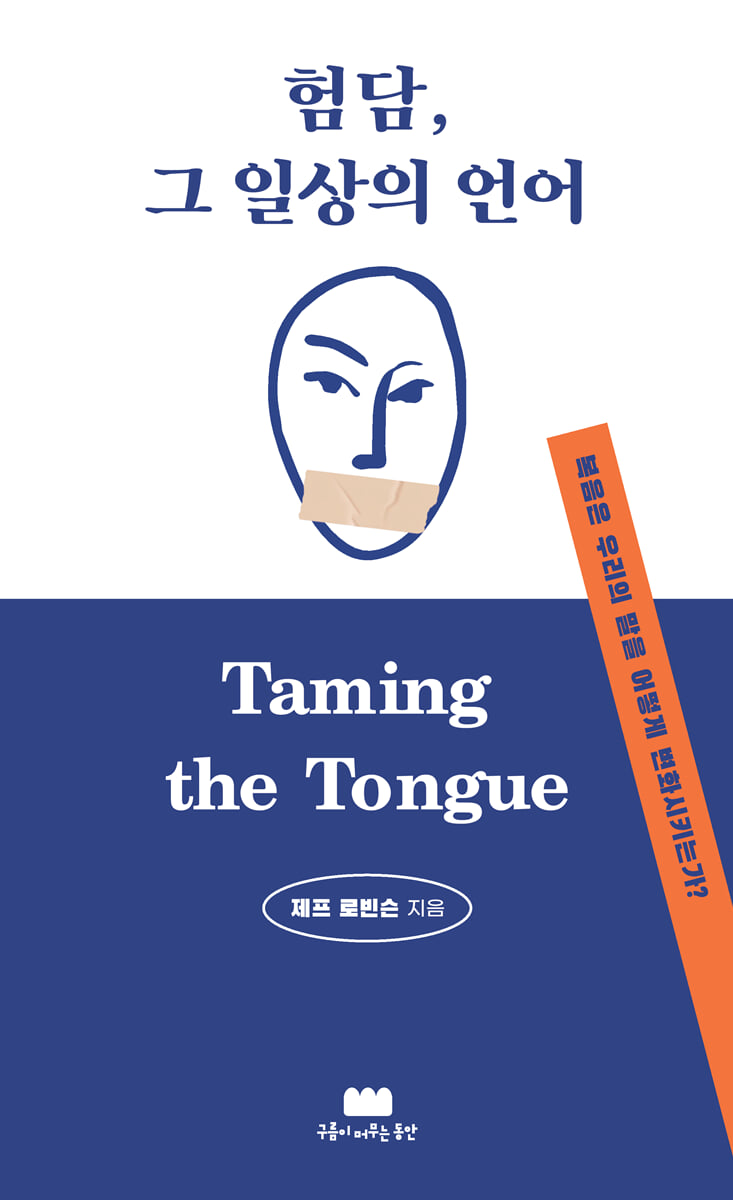
Gossip, the language of everyday life
 |
Description
Book Introduction
Why do we gossip about people around us?
More than just warm words to your beloved family
Should we be the first to pour out blame and anger?
Breaking down your relationship
From the habit of anger, blame, and gossip
A book to help you get out
We always regret saying the wrong thing.
I tend to tell other people's secrets easily, I'm overly critical of everything, and I try to lead the conversation by being the main character when I should be listening.
These speaking habits are not easily changed.
The same goes for gossiping and slandering others, and getting angry easily over small things.
Before we know it, the wrong attitude towards words has become a part of our lives.
Jeff Robinson's "Gossip: The Language of Everyday Life" is a book that keenly analyzes the problems related to speech that occur around us and explains from a biblical perspective how to properly tame (tame) our speech.
It's not simply about teaching you 'how not to gossip' or 'how to speak well'.
To speak correctly means first of all to correct our lives.
So we need the life-changing power of God and the light of life that illuminates the darkness.
“I’m only saying this to you.
“Don’t ever tell anyone else.”
Gossip disguised as worry, conversations meant to satisfy interest, and stories of secrets that cannot be kept.
All of this takes place within a church filled with love.
Relationships broken by our words are difficult to repair.
So, while this book is good to read and pray alone, it is even more beneficial to read and share it with your church community (you can read more about gossip, sarcasm, flattery, and boasting in Chapter 3 of this book).
God loves us.
That is why He reveals to us the problems we have.
If you have been causing suffering to yourself and others with your bad language habits, it is time to learn good language habits.
Is your relationship with your wife (or husband) deteriorating, especially due to frequent slips of the tongue? Are you struggling to say what you need to say due to difficulties in interpersonal relationships? Does every conversation you have with everyone begin with criticism and end with gossip? If so, you need to see how the gospel can transform your speech through this book.
You will discover that our speech is layered with sin, self-centeredness, anger, arrogance, pride, and other traits that are not sanctified by the words of Jesus Christ.
And you will meet the God who restores.
God's language can be learned anew.
More than just warm words to your beloved family
Should we be the first to pour out blame and anger?
Breaking down your relationship
From the habit of anger, blame, and gossip
A book to help you get out
We always regret saying the wrong thing.
I tend to tell other people's secrets easily, I'm overly critical of everything, and I try to lead the conversation by being the main character when I should be listening.
These speaking habits are not easily changed.
The same goes for gossiping and slandering others, and getting angry easily over small things.
Before we know it, the wrong attitude towards words has become a part of our lives.
Jeff Robinson's "Gossip: The Language of Everyday Life" is a book that keenly analyzes the problems related to speech that occur around us and explains from a biblical perspective how to properly tame (tame) our speech.
It's not simply about teaching you 'how not to gossip' or 'how to speak well'.
To speak correctly means first of all to correct our lives.
So we need the life-changing power of God and the light of life that illuminates the darkness.
“I’m only saying this to you.
“Don’t ever tell anyone else.”
Gossip disguised as worry, conversations meant to satisfy interest, and stories of secrets that cannot be kept.
All of this takes place within a church filled with love.
Relationships broken by our words are difficult to repair.
So, while this book is good to read and pray alone, it is even more beneficial to read and share it with your church community (you can read more about gossip, sarcasm, flattery, and boasting in Chapter 3 of this book).
God loves us.
That is why He reveals to us the problems we have.
If you have been causing suffering to yourself and others with your bad language habits, it is time to learn good language habits.
Is your relationship with your wife (or husband) deteriorating, especially due to frequent slips of the tongue? Are you struggling to say what you need to say due to difficulties in interpersonal relationships? Does every conversation you have with everyone begin with criticism and end with gossip? If so, you need to see how the gospel can transform your speech through this book.
You will discover that our speech is layered with sin, self-centeredness, anger, arrogance, pride, and other traits that are not sanctified by the words of Jesus Christ.
And you will meet the God who restores.
God's language can be learned anew.
- You can preview some of the book's contents.
Preview
index
Book Recommendations _Paul David Tripp
introduction.
Why I Wrote a Book About Horses
Chapter 1.
God's Word and Our Word
Where things go wrong | Where everything is set right | No more worries
Chapter 2.
There's a problem with our language.
Proverbs: A Treatise on Speech | James 3: A Small Delay, a Huge Impact | Matthew 12: An X-Ray of the Heart
Chapter 3.
How can words become weapons?
Gossip and slander | Criticizing words | Sarcasm | Boasting and flattery | Lies and deception | Angry words and complaints | Swearing | Careless words
Chapter 4.
Words can save lives
Words of Grace Are Words of Life | Words of Life That Contain the Beauty of the Gospel
Chapter 5.
You also need to look at the way you speak
Another Name for Speech: Humility | Ten Ways to Handle Minefield Conversations
Chapter 6.
Writing goes faster and further
Chapter 7.
Advice for Talkative People
conclusion.
Our language can change
Appendix 1.
Twelve Signs of a Fighting Person _Kevin DeYoung
Appendix 2.
Study Guide
Appendix 3.
Memorization Verses About Horses
Americas
introduction.
Why I Wrote a Book About Horses
Chapter 1.
God's Word and Our Word
Where things go wrong | Where everything is set right | No more worries
Chapter 2.
There's a problem with our language.
Proverbs: A Treatise on Speech | James 3: A Small Delay, a Huge Impact | Matthew 12: An X-Ray of the Heart
Chapter 3.
How can words become weapons?
Gossip and slander | Criticizing words | Sarcasm | Boasting and flattery | Lies and deception | Angry words and complaints | Swearing | Careless words
Chapter 4.
Words can save lives
Words of Grace Are Words of Life | Words of Life That Contain the Beauty of the Gospel
Chapter 5.
You also need to look at the way you speak
Another Name for Speech: Humility | Ten Ways to Handle Minefield Conversations
Chapter 6.
Writing goes faster and further
Chapter 7.
Advice for Talkative People
conclusion.
Our language can change
Appendix 1.
Twelve Signs of a Fighting Person _Kevin DeYoung
Appendix 2.
Study Guide
Appendix 3.
Memorization Verses About Horses
Americas
Into the book
More importantly, the ability to speak is inextricably linked to the mind.
The mind clearly reveals who we are and why we act the way we do.
The mind governs all human actions, reactions, and interactions, from the most trivial and insignificant to the most dramatic and life-altering decisions.
The speaker's heart is revealed in his words.
--- p.18
The mind thinks.
Words are a way of expressing our thoughts to God and others.
The heart desires.
Words are a way to clearly express that desire.
The heart loves.
That love is revealed to God and to those around us every day, whether intentionally or not.
The heart worships.
Words reveal what rules our minds.
--- p.19
Pastor, you talk too much.
There are so many.
It's always about the pastor himself.
What the pastor knows, what he thinks, who he knows, what he likes, what he has done, and what he wants to do in the future.
But they don't listen to other people very well and don't give others a chance to speak.
--- p.23
Jesus says that every word is important.
Bitter words come from a bitter heart.
Criticizing words come from a critical mind, and flattering words come from a deceitful mind.
Slanderous words come from a heart that does not have the love of Jesus.
What we say tells us what is controlling our minds.
Whatever dominates our mind becomes our speech.
--- p.82
The Bible describes gossip as something that destroys relationships and tears apart even the closest of friends.
When you hear gossip about your friends, those words plant doubts in your heart and build up a wall of distrust.
Likewise, when a friend gossips about someone in front of you, you might wonder if that friend will gossip about you in front of others too.
--- p.99
The one who accuses becomes a judge who judges the law illegally.
Instead of being judged by the Word of God, the accuser becomes the judge of the Word himself.
What lies beneath the surface of slander and gossip? It's the twin pillars of narcissism: self-love and self-aggrandizement.
When we gossip and slander others, we tear others down and elevate ourselves.
--- p.101
Curiosity itself is good and constructive, but it's a different story when we use the information we have to tear others down.
1 Timothy 5:13 links gossip with troublemakers.
Such people do not suppress their curiosity and let it run wild.
--- p.102
Muttering and complaining are very serious sins because, as Paul said, they are testing God.
Complaining is like saying I could do better with my life.
Complaining is the verbal expression of dissatisfaction.
Behind complaints lies this state of mind.
“I hate the current situation and think it’s unfair.
If I could write the script of my life, it would be so much better and I would be so much happier.
Ultimately, expressing discontent can be seen as a subtle way of questioning God's wisdom and governance.
--- p.134
When Christians use foul language, it grieves the Holy Spirit who lives within us.
In the following verse 31, Paul mentions words that grieve the Holy Spirit and cause division.
Not only slander and gossip, but also malicious words and abusive language grieve the Holy Spirit who lives within us and hinder our fellowship with the holy God.
--- p.141
Gracious words are different from flattery.
In fact, these two can be said to be polar opposites.
The Bible is sharply critical of flattery.
Abu is self-centered.
Flattery is the act of praising another person for the purpose of making oneself stand out.
--- p.171
When there is a problem with speech, it is because there was a problem with the mind before that.
Pray that my heart may be overwhelmed by God's grace, that I may not forget the perilous situation I was in, and that I may remember once again how patiently God waited for me.
--- p.201
Let's consider that all ten thousand words we pour out every day are opportunities to commit sin.
And what if those words reveal what's in your heart? Is your heart filled with love, joy, peace, patience, kindness, goodness, faithfulness, gentleness, and self-control?
--- p.267
Do you often criticize? Does your criticism result in any change in the other person?
The mind clearly reveals who we are and why we act the way we do.
The mind governs all human actions, reactions, and interactions, from the most trivial and insignificant to the most dramatic and life-altering decisions.
The speaker's heart is revealed in his words.
--- p.18
The mind thinks.
Words are a way of expressing our thoughts to God and others.
The heart desires.
Words are a way to clearly express that desire.
The heart loves.
That love is revealed to God and to those around us every day, whether intentionally or not.
The heart worships.
Words reveal what rules our minds.
--- p.19
Pastor, you talk too much.
There are so many.
It's always about the pastor himself.
What the pastor knows, what he thinks, who he knows, what he likes, what he has done, and what he wants to do in the future.
But they don't listen to other people very well and don't give others a chance to speak.
--- p.23
Jesus says that every word is important.
Bitter words come from a bitter heart.
Criticizing words come from a critical mind, and flattering words come from a deceitful mind.
Slanderous words come from a heart that does not have the love of Jesus.
What we say tells us what is controlling our minds.
Whatever dominates our mind becomes our speech.
--- p.82
The Bible describes gossip as something that destroys relationships and tears apart even the closest of friends.
When you hear gossip about your friends, those words plant doubts in your heart and build up a wall of distrust.
Likewise, when a friend gossips about someone in front of you, you might wonder if that friend will gossip about you in front of others too.
--- p.99
The one who accuses becomes a judge who judges the law illegally.
Instead of being judged by the Word of God, the accuser becomes the judge of the Word himself.
What lies beneath the surface of slander and gossip? It's the twin pillars of narcissism: self-love and self-aggrandizement.
When we gossip and slander others, we tear others down and elevate ourselves.
--- p.101
Curiosity itself is good and constructive, but it's a different story when we use the information we have to tear others down.
1 Timothy 5:13 links gossip with troublemakers.
Such people do not suppress their curiosity and let it run wild.
--- p.102
Muttering and complaining are very serious sins because, as Paul said, they are testing God.
Complaining is like saying I could do better with my life.
Complaining is the verbal expression of dissatisfaction.
Behind complaints lies this state of mind.
“I hate the current situation and think it’s unfair.
If I could write the script of my life, it would be so much better and I would be so much happier.
Ultimately, expressing discontent can be seen as a subtle way of questioning God's wisdom and governance.
--- p.134
When Christians use foul language, it grieves the Holy Spirit who lives within us.
In the following verse 31, Paul mentions words that grieve the Holy Spirit and cause division.
Not only slander and gossip, but also malicious words and abusive language grieve the Holy Spirit who lives within us and hinder our fellowship with the holy God.
--- p.141
Gracious words are different from flattery.
In fact, these two can be said to be polar opposites.
The Bible is sharply critical of flattery.
Abu is self-centered.
Flattery is the act of praising another person for the purpose of making oneself stand out.
--- p.171
When there is a problem with speech, it is because there was a problem with the mind before that.
Pray that my heart may be overwhelmed by God's grace, that I may not forget the perilous situation I was in, and that I may remember once again how patiently God waited for me.
--- p.201
Let's consider that all ten thousand words we pour out every day are opportunities to commit sin.
And what if those words reveal what's in your heart? Is your heart filled with love, joy, peace, patience, kindness, goodness, faithfulness, gentleness, and self-control?
--- p.267
Do you often criticize? Does your criticism result in any change in the other person?
--- p.288
Publisher's Review
Features of this book
- A concrete, biblical guide to how the gospel transforms speech.
- A book for believers who are experiencing difficulties in their relationships due to mistakes in their words.
- A guide to living as a Christian who comforts and encourages others.
- A good book to use as a teaching material for faith training related to speaking in churches and gatherings.
Target audience
- Christians who want to stop anger, gossip, and criticism
- A believer struggling with interpersonal problems caused by words
- Readers who have lost trust at work and at home due to frequent verbal mistakes
- A Christian who wants to warmly comfort others
- Pastors and teachers who want to teach people how to speak like Christians
- A concrete, biblical guide to how the gospel transforms speech.
- A book for believers who are experiencing difficulties in their relationships due to mistakes in their words.
- A guide to living as a Christian who comforts and encourages others.
- A good book to use as a teaching material for faith training related to speaking in churches and gatherings.
Target audience
- Christians who want to stop anger, gossip, and criticism
- A believer struggling with interpersonal problems caused by words
- Readers who have lost trust at work and at home due to frequent verbal mistakes
- A Christian who wants to warmly comfort others
- Pastors and teachers who want to teach people how to speak like Christians
GOODS SPECIFICS
- Date of issue: June 30, 2024
- Page count, weight, size: 320 pages | 110*183*19mm
- ISBN13: 9791198267658
- ISBN10: 1198267658
You may also like
카테고리
korean


korean

![ELLE 엘르 스페셜 에디션 A형 : 12월 [2025]](http://librairie.coreenne.fr/cdn/shop/files/b8e27a3de6c9538896439686c6b0e8fb.jpg?v=1766436872&width=3840)


