

human abolition
 |
Description
Book Introduction
C.
S. Lewis's prophetic critique of civilization!
Liddell Memorial Lectures, University of Durham, UK
An apologetic book that brilliantly defends the moral law (natural law)!
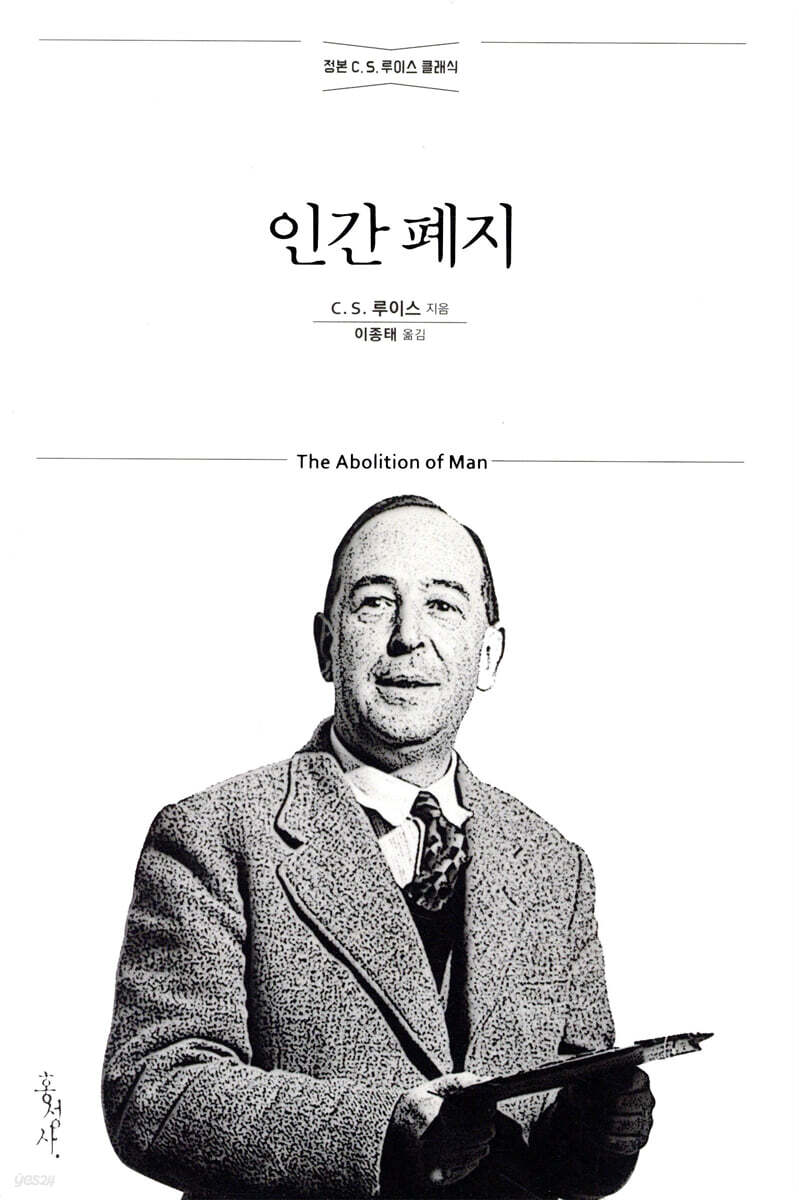
"The Abolition of Man" is a lecture given by the author at Durham University in February 1943, and was published by Oxford University Press in the same year under the title "The Abolition of Man."
The author raised the issue of relativism and subjectivism being instilled in students without any restraint in the educational curriculum symbolized by 'The Control of Language' and 'The Reading and Writing of English', which were used as elementary school textbooks at the time.
In an age where the idea that 'there are no more absolute values or absolute standards in this world' dominates life, we come to realize that the statement that 'everything is relative' also has a hidden intention to make that proposition the 'absolute'.
This is a contradiction in itself.
The author explores the contradictions of relativism and subjectivism, which only “absolutely allow” the logic that “there is no absolute value.”
It also directly challenges the ideas of the antinomians who idolize human reason and seek to abolish everything other than reason and science, that is, the moral laws (natural laws) that humanity has observed so far, as mere outdated customs.
They warn that if we change into humans who emphasize only the head (reason) as they intend and claim, we will ultimately be destroyed by the 'abolition of humanity' rather than the abolition of morality.
S. Lewis's prophetic critique of civilization!
Liddell Memorial Lectures, University of Durham, UK
An apologetic book that brilliantly defends the moral law (natural law)!
"The Abolition of Man" is a lecture given by the author at Durham University in February 1943, and was published by Oxford University Press in the same year under the title "The Abolition of Man."
The author raised the issue of relativism and subjectivism being instilled in students without any restraint in the educational curriculum symbolized by 'The Control of Language' and 'The Reading and Writing of English', which were used as elementary school textbooks at the time.
In an age where the idea that 'there are no more absolute values or absolute standards in this world' dominates life, we come to realize that the statement that 'everything is relative' also has a hidden intention to make that proposition the 'absolute'.
This is a contradiction in itself.
The author explores the contradictions of relativism and subjectivism, which only “absolutely allow” the logic that “there is no absolute value.”
It also directly challenges the ideas of the antinomians who idolize human reason and seek to abolish everything other than reason and science, that is, the moral laws (natural laws) that humanity has observed so far, as mere outdated customs.
They warn that if we change into humans who emphasize only the head (reason) as they intend and claim, we will ultimately be destroyed by the 'abolition of humanity' rather than the abolition of morality.
index
1.
A person without a heart
2.
do
3.
human abolition
4.
(Appendix) Examples of Tao
commentary
A person without a heart
2.
do
3.
human abolition
4.
(Appendix) Examples of Tao
commentary
Into the book
I myself don't like playing with children.
But I, who acknowledge the 'Tao', admit that this is my flaw.
Just as someone who is tone-deaf or color-blind admits it as a flaw in themselves.
Since our approval and disapproval are thus recognitions of objective values and responses to objective order, our emotional states can be either harmonious with reason (when we like what we ought to approve) or disharmonious (when we recognize that we ought to like something but cannot).
No emotion in itself is a judgment.
In that sense, all emotions and feelings are independent of logic.
However, it can be rational or irrational depending on whether it conforms to reason or not.
The heart can never replace the head.
But the heart can and must obey the head.
_Page 29, from 'The Man Without a Chest'
You can't keep 'seeing through' things forever.
The purpose of looking through something is to see something through it.
The reason transparent windows are good is because the street or garden beyond them is an opaque object.
But what if even that garden were to be penetrated? Trying to "penetrate" the first principle is futile.
To see through everything means that everything is transparent.
But a world that is completely transparent is ultimately an invisible world.
So, to 'see through' everything is ultimately to say that one sees nothing at all.
_Pages 93-94, from 'Human Abolition'
But I, who acknowledge the 'Tao', admit that this is my flaw.
Just as someone who is tone-deaf or color-blind admits it as a flaw in themselves.
Since our approval and disapproval are thus recognitions of objective values and responses to objective order, our emotional states can be either harmonious with reason (when we like what we ought to approve) or disharmonious (when we recognize that we ought to like something but cannot).
No emotion in itself is a judgment.
In that sense, all emotions and feelings are independent of logic.
However, it can be rational or irrational depending on whether it conforms to reason or not.
The heart can never replace the head.
But the heart can and must obey the head.
_Page 29, from 'The Man Without a Chest'
You can't keep 'seeing through' things forever.
The purpose of looking through something is to see something through it.
The reason transparent windows are good is because the street or garden beyond them is an opaque object.
But what if even that garden were to be penetrated? Trying to "penetrate" the first principle is futile.
To see through everything means that everything is transparent.
But a world that is completely transparent is ultimately an invisible world.
So, to 'see through' everything is ultimately to say that one sees nothing at all.
_Pages 93-94, from 'Human Abolition'
--- From the text
Publisher's Review
The original C is presented with a new design.
S. Lewis Classic
British C.
The original C.S. Lewis book, which has signed a formal copyright agreement with the Lewis Society and brought the joy of reading Lewis to Korea,
S. Lewis Classic'.
The Lewis Classic, which has set the standard for definitive editions with outstanding translations and meticulous editing, has a new cover.
C., the greatest Christian apologist and English literature scholar of the 20th century.
S. Lewis's works are divided into five categories: 'Apologetics', 'Novels', 'Confessions', 'Essays', and 'Prose and Letters', helping readers understand the full scope of Lewis's thought more intuitively.
Apologetics: Mere Christianity, The Problem of Pain, Miracles, and The Abolition of Man
Novels: The Screwtape Letters, The Divorce of Heaven and Hell, Till We Have Faces, The Pilgrim's Return, Off the Silent Planet, Perelandra, The Terrible Power
Confession _ 『Unexpected Joy』『Considered Sorrow』
Essays: The Last Night of the World, The Weight of Glory, Christian Reflection, God in the Dock, Misreading, Preface to Paradise Lost
Prose and Letters _ Psalm Reflections, Four Loves, Private Prayer, Your Friend, Lewis, Lewis to the Children of Narnia
S. Lewis Classic
British C.
The original C.S. Lewis book, which has signed a formal copyright agreement with the Lewis Society and brought the joy of reading Lewis to Korea,
S. Lewis Classic'.
The Lewis Classic, which has set the standard for definitive editions with outstanding translations and meticulous editing, has a new cover.
C., the greatest Christian apologist and English literature scholar of the 20th century.
S. Lewis's works are divided into five categories: 'Apologetics', 'Novels', 'Confessions', 'Essays', and 'Prose and Letters', helping readers understand the full scope of Lewis's thought more intuitively.
Apologetics: Mere Christianity, The Problem of Pain, Miracles, and The Abolition of Man
Novels: The Screwtape Letters, The Divorce of Heaven and Hell, Till We Have Faces, The Pilgrim's Return, Off the Silent Planet, Perelandra, The Terrible Power
Confession _ 『Unexpected Joy』『Considered Sorrow』
Essays: The Last Night of the World, The Weight of Glory, Christian Reflection, God in the Dock, Misreading, Preface to Paradise Lost
Prose and Letters _ Psalm Reflections, Four Loves, Private Prayer, Your Friend, Lewis, Lewis to the Children of Narnia
GOODS SPECIFICS
- Date of publication: February 22, 2019
- Page count, weight, size: 124 pages | 318g | 134*202*20mm
- ISBN13: 9788936513511
- ISBN10: 8936513516
You may also like
카테고리
korean


korean

![GQ KOREA Mark (Monthly): December [2025]](http://librairie.coreenne.fr/cdn/shop/files/8ef265dbbfbf186523ed75ba7319009d.jpg?v=1765340328&width=3840)


