

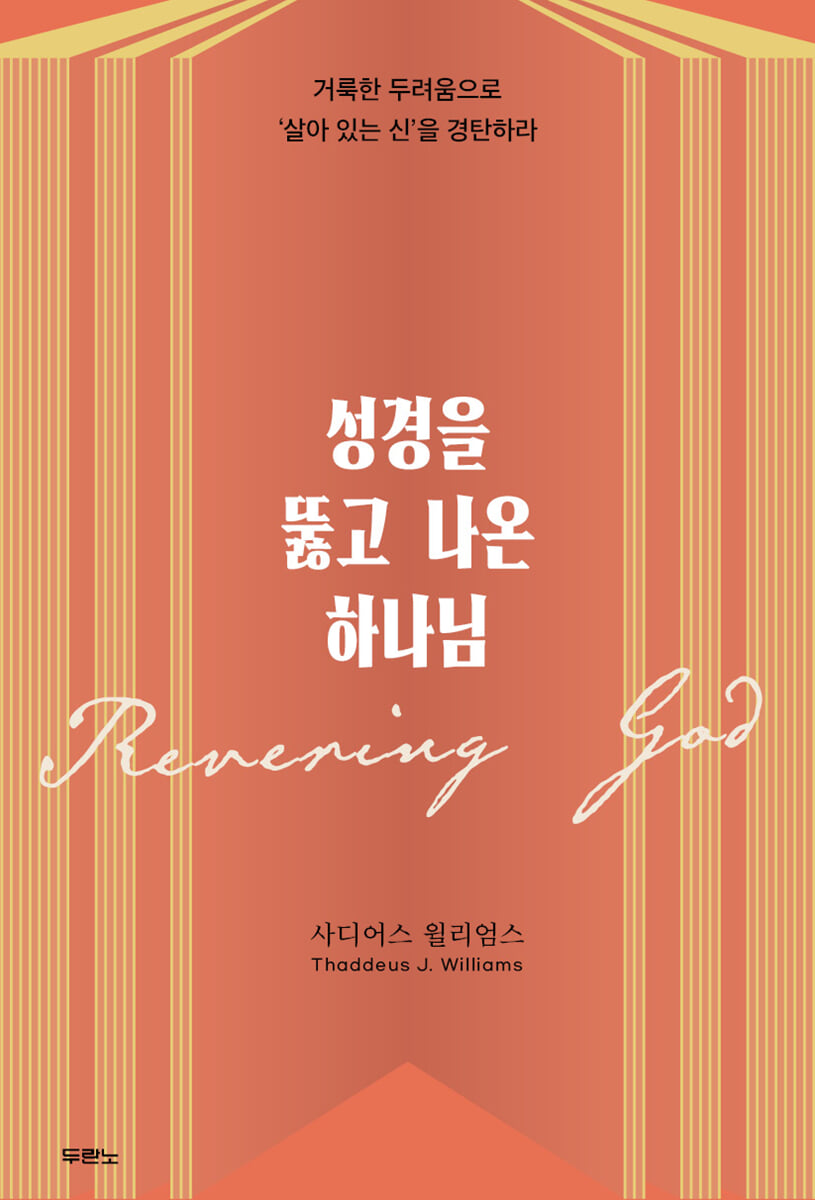
God who broke through the Bible
 |
Description
Book Introduction
How did we come to believe in such a 'small God'?
vaguely abstracted and worldly edited
A sharp dissection of the modern view of God!
The greatest reason for human existence is to glorify God and enjoy Him.
But for many today, the Christian God is nothing more than a vague, benevolent being who bestows blessings, an enlarged version of one's own ego projected into heaven, or a difficult-to-please judge.
Who, exactly, is the God we believe in? A powerful invitation is being sent to today's Christians, a generation that no longer wonders about God or seeks to understand Him, a generation that has lost its sense of awe.
In "The Courage Not to Follow Your Heart," Sardius Williams, who interpreted popular catchphrases of modern society through a biblical lens, now creatively and broadly explores the core theological topics.
Interesting interpretations of cultural content, such as Camus' novel and film "Joker" and Michelangelo's Sistine Chapel ceiling, as well as various sociological, psychological, and scientific research materials, add intellectual sophistication to theological depth.
Above all, it is an excellent guide that leads our entire being to a life of loving and worshipping God.
vaguely abstracted and worldly edited
A sharp dissection of the modern view of God!
The greatest reason for human existence is to glorify God and enjoy Him.
But for many today, the Christian God is nothing more than a vague, benevolent being who bestows blessings, an enlarged version of one's own ego projected into heaven, or a difficult-to-please judge.
Who, exactly, is the God we believe in? A powerful invitation is being sent to today's Christians, a generation that no longer wonders about God or seeks to understand Him, a generation that has lost its sense of awe.
In "The Courage Not to Follow Your Heart," Sardius Williams, who interpreted popular catchphrases of modern society through a biblical lens, now creatively and broadly explores the core theological topics.
Interesting interpretations of cultural content, such as Camus' novel and film "Joker" and Michelangelo's Sistine Chapel ceiling, as well as various sociological, psychological, and scientific research materials, add intellectual sophistication to theological depth.
Above all, it is an excellent guide that leads our entire being to a life of loving and worshipping God.
- You can preview some of the book's contents.
Preview
index
How to read this book
prolog.
Come, to the seat of theology!
Part 1.
A trustworthy God
: He speaks the truth
1.
The Silent Universe, the Speaking God
2.
Now, come out of the swamp of intellectual laziness.
3.
Let go of the arrogance of trying to be the standard of truth yourself.
4.
The Bible, a light that awakens confused minds
5.
Entrust everything to Him who knows everything
Part 2.
God who gives us joy
: He gives satisfaction
6.
Lose the sense of taste
7.
The joy of calling the Creator Father
8.
When God feels distant
9.
Someone who hides sometimes because they love
10.
The more I follow my heart, the more joy disappears
Part 3.
God who has won
: He reigns
11.
How far will God rule?
12.
Where is He when suffering and evil prevail?
13.
The Solution to Anxiety: Descending from the Throne of God
14.
There is no such thing as 'accidental' in this world.
15.
Call upon the Almighty Father in the pit of life
Part 4.
God who loves forever
: He is the Father, the Son, and the Holy Spirit.
16.
The Creator who is not bound by time and space
17.
Is he a selfish god who monopolizes all the glory?
18.
Join the dance of love of the triune God
19.
The God of Love Encountered in Objective Morality
20.
Stand against the cunning schemes of the Red Trinity.
Part 5.
God of salvation
: He saves sinners
21.
The gospel always begins with bad news.
22.
The Cross, Where God's Wrath and Love Meet
23.
Stop my own holy toil
24.
To what extent does grace intervene in the salvation of sinners?
25.
There is no failure in His plan of salvation.
Part 6.
God the Artist
: He creates beauty
26.
Blind believers who chose to push God away
27.
The human consciousness is designed with extraordinary mystery.
28.
Go to the One who created the stars that decorate the sky.
29.
All the wonders of life, the beacon that leads us to Him
30.
God's Masterpieces That Speak of Jesus Through Life
Epilogue.
With all my being, I will fear this God.
Acknowledgements
main
prolog.
Come, to the seat of theology!
Part 1.
A trustworthy God
: He speaks the truth
1.
The Silent Universe, the Speaking God
2.
Now, come out of the swamp of intellectual laziness.
3.
Let go of the arrogance of trying to be the standard of truth yourself.
4.
The Bible, a light that awakens confused minds
5.
Entrust everything to Him who knows everything
Part 2.
God who gives us joy
: He gives satisfaction
6.
Lose the sense of taste
7.
The joy of calling the Creator Father
8.
When God feels distant
9.
Someone who hides sometimes because they love
10.
The more I follow my heart, the more joy disappears
Part 3.
God who has won
: He reigns
11.
How far will God rule?
12.
Where is He when suffering and evil prevail?
13.
The Solution to Anxiety: Descending from the Throne of God
14.
There is no such thing as 'accidental' in this world.
15.
Call upon the Almighty Father in the pit of life
Part 4.
God who loves forever
: He is the Father, the Son, and the Holy Spirit.
16.
The Creator who is not bound by time and space
17.
Is he a selfish god who monopolizes all the glory?
18.
Join the dance of love of the triune God
19.
The God of Love Encountered in Objective Morality
20.
Stand against the cunning schemes of the Red Trinity.
Part 5.
God of salvation
: He saves sinners
21.
The gospel always begins with bad news.
22.
The Cross, Where God's Wrath and Love Meet
23.
Stop my own holy toil
24.
To what extent does grace intervene in the salvation of sinners?
25.
There is no failure in His plan of salvation.
Part 6.
God the Artist
: He creates beauty
26.
Blind believers who chose to push God away
27.
The human consciousness is designed with extraordinary mystery.
28.
Go to the One who created the stars that decorate the sky.
29.
All the wonders of life, the beacon that leads us to Him
30.
God's Masterpieces That Speak of Jesus Through Life
Epilogue.
With all my being, I will fear this God.
Acknowledgements
main
Into the book
When I say that a theologian must be a fighter, I do not mean physical violence or any other form of violence that harms others.
Rather, it is what Paul meant when he said, “By the Spirit put to death the deeds of the body” (Rom. 8:13, ESV), “Put to death your members which are on the earth” (Col. 3:5), and “Those who belong to Christ Jesus have crucified the flesh with its passions and desires” (Gal. 5:24).
A good theologian is not perfect, but he truly “mortifies sin,” as the Puritans put it. He works hard to kill every stubborn sin that threatens his heart by the power of the Holy Spirit.
The quickest way to separate the head from the heart, the surest way to render sound doctrine powerless, the shortest path to spiritual barrenness and the wasteland of nihilism, is to leave sin unmortal in our daily lives.
The English Puritan John Owen said it better:
“The life, vitality, and comfort of our religious life depend to a great extent on the mortification of our sins.
… … If we do not kill sin, God’s love and grace will be blocked by sin and will not be able to shine through.
I don't feel privileged to have been adopted as his child.
… … kill sin.
Otherwise sin will kill you.”
--- p.31
Who, after all, is a theologian? A theologian is a fool, a fanatic, a nerd, a fighter, and a slave.
If we serve self and our own position, if we forget our need for God's grace at all times, if we tolerate chronic sin, if we let the Bible gather dust, if we rest on our knowledge of God rather than on knowing and rejoicing in Him, if we arrogantly pretend to know Him, then we fail in the sacred work of theology.
Perhaps all of this can be summed up in one word: awe.
A theologian is a person who fears God.
How much reverence can there be in someone who loves their own intellect more than God with their intellect? How much reverence can there be in someone who merely mutters the inspired Word of God, who leaves their sins unpunished, who values their own honor above the honor of their Creator? They are undoubtedly far from reverent.
Such a person is breaking one of the most repeated commandments in the Bible, appearing over 300 times.
It is a command to “call” Jehovah, that is, to fear, revere, and be amazed before the Lord.
There is nothing more precious than seeking the Creator with awe, subduing our pride, and bringing us deep joy and life.
From now on, we will marvel at the God who speaks the truth, satisfies us, rules us, loves us, saves sinners, and creates beauty.
--- pp.36-37
“Thus says the Lord.” Dear friend, do not take this verse lightly.
Life and death depend on this phrase, so don't miss its profound meaning.
Try a dark virtual experiment.
If there is no God who speaks, what are you left with? How can you answer the existential questions that grip us, even in our most serious moments, and sometimes in our most trancelike ones? Science can tell us how the universe works, but it cannot answer a single question of "why."
We thank God for giving us science, but the pressing question of why remains unanswered even with all the science available.
Needless to say, entertainment, alcohol, orgasms, money, and persistent self-analysis have no answer.
It may be tempting to delegate the answer to the question of why to politicians.
But in the 20th century, hundreds of millions of people fell victim to the delusions of totalitarianism.
Their ghosts cry out in one voice, “Do not sell your soul, resist!”
So we sometimes want to turn inward.
The universe may be silent, ideologies may lie, but doesn't our heart know the way? But those who advise us, "The answer lies within," are either trying to sell us something by flattering our ego, or they haven't delved deep enough to see the contradictions and corruptions that lurk deep within us.
“The human heart is deceitful above all things, and desperately wicked; who can know it?” Jer 17:9
Thankfully, “God is not human, that he should lie” (Numbers 23:19).
“Your word, O LORD, is forever settled in heaven; your faithfulness endures to all generations” (Psalm 119:89-90).
Since God exists and speaks, we will never be lost in the universe trying to answer the question of why.
In the silent universe that Camus speaks of, there is no need to reach the conclusion of suicide.
Deep trust becomes possible.
We can trust Him, who is infinitely more trustworthy than all human beings, including scientists, politicians, and ourselves.
--- pp.51-52
Galileo Galilei was much more awe-inspiring than today's televangelists.
He said, “God, who gave us sense, reason, and intellect, would not want us to use them.”
God has given you intelligence, so don't keep it quiet.
The very concept that thinking is an act of glorifying God helped spark the Scientific Revolution over 400 years ago.
Sadly, today's Christian world has largely lost the tenacious curiosity and truth-seeking vision of Galileo, Tycho Brahe, Isaac Newton, Johannes Kepler, and Francis Bacon.
There are too many people who retreat into purely subjective faith and chase only superficial Jesus buzz.
Os Guinness pointed out the fundamental problem with this:
“Most evangelicals don’t think at all.
… … It has always been a sin not to love the Lord our God with all our heart and soul, but also with all our mind [thought, intellect].
… … Even though it is a sin, we have been pretending that it is not a sin but rather piety.”
If we were to survey Christians anonymously to see what sins they struggle with, the list would be long: pride, lust, gossip, selfishness, laziness, lying, and more.
However, from a biblical perspective, there is one evil that should definitely be on the list, but perhaps should be left out.
It's intellectual laziness.
God could have created us brainless, but he deliberately created us in his rational image.
So intellectual laziness becomes a sin of not fearing Him.
--- pp.58-59
So why do finite expedients often seem so unbearably sweet, and God so insipid? Is it because, objectively, sin is more satisfying than God? No.
The problem is not that God is not sweet and bland, but that our sense of taste has become perverted.
So sin is perceived as delicious, and infinite glory as dull.
How can we become bored in a worldly sense? How can we pursue joy more thoroughly, rather than chasing fleeting, temporary solutions? How can we delight in God more? A good place to start is simply by seeking more joy.
Trillian Newbell advises:
“Today, you and I can ask the Lord to enlarge our hearts.
Then, you will no longer be obsessed with dust and end up in death and sorrow, but will run toward life and receive a broad heart filled with truth.
God will surely do so.
He delights in giving us good things and is infinitely faithful.”
Pray to God to supernaturally restore your soul's sense of taste.
Then you will feel His original sweetness that gives you satisfaction, nourishment, and joy.
Pray that the sins you love will make you sick.
Sin is inherently like that.
Open your heart to the Holy Spirit, the third person of the Trinity.
When you ask Him, He works to bring order to your emotions.
It makes us enjoy Jesus more and hate sin more.
This is the first step to enjoying true joy, as it is boring enough to win awards by worldly standards.
--- pp.106-107
There are times when you feel dissatisfied and God seems distant.
The reason He sometimes allows such dissatisfaction and distance is not because He ignores your joy.
Rather, it is because He has made up His mind very firmly to satisfy you.
Say it again.
The reason God is hidden is to give you the greatest and deepest satisfaction and joy.
God's hiding and your eternal happiness are not contradictory.
The former is one of the many sovereign means by which God brings about the latter.
God is happy when you are happy (Zeph 3:17), and He cannot help but be happy.
So there can be no failure for Him who wants to give you infinite happiness.
God, who is omniscient, knows exactly what will make you happy.
It is he himself.
He knows exactly 'when' you will receive the greatest happiness from Him.
This is when you are infinitely thirsty.
The soggy cookies symbolize sin, the substitute for God.
He knows exactly how to make you realize that sin and satisfaction are utterly distant from each other.
Finally we come to a conclusion.
God is hiding to make us happy.
We must be careful not to confuse the happiness he gives us with the brief burst of dopamine from the pleasure receptors in our brains.
God can and does work eternal satisfaction through our temporary dissatisfaction.
Knowing this, we can be content even in dissatisfying situations.
John Piper's conclusion is similar.
“God is equally worthy of worship and glory whether we thirst for Him or feast on Him.
After all, our food is Him.
Longing is a form of worship when God is far away, and a feast is a form of worship when He is near.
The soul that savors God above all else, when His appearance becomes distant and dim, longs and waits, hungry and thirsty.
Then, when His image becomes close and clear, we experience a feast and satisfaction.”
--- pp.132-133
It's easy to pray, like the self-satisfied Pharisee, "I am not like other people..." (Luke 18:11), referring to the Hitlerites, murderers, con artists, child abusers, and misanthropes of history.
But the cold hard truth is that we too have sinned against an infinite God and deserve His infinite wrath.
So, like the tax collector who beat his breast, let us cry out, “God, be merciful to me a sinner!” (Luke 18:13).
When we rely on the mercy of God the Father, He gives us Jesus.
Jesus, our propitiation [Greek: “hilasmos”] (1 John 2:1-2), suffered wrath in our place.
Even we who have broken the law will not face God's wrath if we are in Jesus.
Every last bullet fired by God's justice was pierced into Jesus' body on the cross.
We stand behind Him without a single scratch, and the magazines of the righteous executioners are empty.
Christ met the standard that God's justice demands on our behalf.
If we remove His wrath from our view of God, the cross of Christ becomes nothing more than a mere demonstration of God's love.
But the cross is where God's righteous wrath and ultimate love meet for sinners like us.
--- pp.266-267
There are also those whose hearts, heads, and hands have grown equally.
Their humanity is truly magnificent and astonishing.
It may not be as simple as God, but the more you center your life on God, the more unified you will become.
They are not just loving, or just creative, or just powerful, but they are creative with love, and they love creatively.
Be powerful and creative in your love, be powerful and creative in your love.
In short, they are well integrated.
Their caricatures of the soul are not comical but gloriously full of substance.
Consider the biblical command to integrate one's self around Christ.
“Make every effort to add to your faith virtue; to virtue, knowledge; to knowledge, self-control; to self-control, perseverance; to perseverance, godliness; to godliness, brotherly kindness; and to brotherly kindness, love. For if these things are yours and abound, they will keep you from being barren or unfruitful in the knowledge of our Lord Jesus Christ” (2 Peter 1:5-8).
As you can see, the Christian life isn't just about growing big and cramming in theological terms.
It is about expanding the whole person.
It is to add faith, virtue, knowledge, self-control, patience, godliness, brotherly kindness, and love.
“But the fruit of the Spirit is love, joy, peace, patience, kindness, goodness, faithfulness, gentleness and self-control” (Galatians 5:22-23).
The Greek word for “fruit” is “karpos” and is singular.
The singular fruit that the Holy Spirit produces in our lives is manifested in various ways, such as love, joy, and peace.
Rather, it is what Paul meant when he said, “By the Spirit put to death the deeds of the body” (Rom. 8:13, ESV), “Put to death your members which are on the earth” (Col. 3:5), and “Those who belong to Christ Jesus have crucified the flesh with its passions and desires” (Gal. 5:24).
A good theologian is not perfect, but he truly “mortifies sin,” as the Puritans put it. He works hard to kill every stubborn sin that threatens his heart by the power of the Holy Spirit.
The quickest way to separate the head from the heart, the surest way to render sound doctrine powerless, the shortest path to spiritual barrenness and the wasteland of nihilism, is to leave sin unmortal in our daily lives.
The English Puritan John Owen said it better:
“The life, vitality, and comfort of our religious life depend to a great extent on the mortification of our sins.
… … If we do not kill sin, God’s love and grace will be blocked by sin and will not be able to shine through.
I don't feel privileged to have been adopted as his child.
… … kill sin.
Otherwise sin will kill you.”
--- p.31
Who, after all, is a theologian? A theologian is a fool, a fanatic, a nerd, a fighter, and a slave.
If we serve self and our own position, if we forget our need for God's grace at all times, if we tolerate chronic sin, if we let the Bible gather dust, if we rest on our knowledge of God rather than on knowing and rejoicing in Him, if we arrogantly pretend to know Him, then we fail in the sacred work of theology.
Perhaps all of this can be summed up in one word: awe.
A theologian is a person who fears God.
How much reverence can there be in someone who loves their own intellect more than God with their intellect? How much reverence can there be in someone who merely mutters the inspired Word of God, who leaves their sins unpunished, who values their own honor above the honor of their Creator? They are undoubtedly far from reverent.
Such a person is breaking one of the most repeated commandments in the Bible, appearing over 300 times.
It is a command to “call” Jehovah, that is, to fear, revere, and be amazed before the Lord.
There is nothing more precious than seeking the Creator with awe, subduing our pride, and bringing us deep joy and life.
From now on, we will marvel at the God who speaks the truth, satisfies us, rules us, loves us, saves sinners, and creates beauty.
--- pp.36-37
“Thus says the Lord.” Dear friend, do not take this verse lightly.
Life and death depend on this phrase, so don't miss its profound meaning.
Try a dark virtual experiment.
If there is no God who speaks, what are you left with? How can you answer the existential questions that grip us, even in our most serious moments, and sometimes in our most trancelike ones? Science can tell us how the universe works, but it cannot answer a single question of "why."
We thank God for giving us science, but the pressing question of why remains unanswered even with all the science available.
Needless to say, entertainment, alcohol, orgasms, money, and persistent self-analysis have no answer.
It may be tempting to delegate the answer to the question of why to politicians.
But in the 20th century, hundreds of millions of people fell victim to the delusions of totalitarianism.
Their ghosts cry out in one voice, “Do not sell your soul, resist!”
So we sometimes want to turn inward.
The universe may be silent, ideologies may lie, but doesn't our heart know the way? But those who advise us, "The answer lies within," are either trying to sell us something by flattering our ego, or they haven't delved deep enough to see the contradictions and corruptions that lurk deep within us.
“The human heart is deceitful above all things, and desperately wicked; who can know it?” Jer 17:9
Thankfully, “God is not human, that he should lie” (Numbers 23:19).
“Your word, O LORD, is forever settled in heaven; your faithfulness endures to all generations” (Psalm 119:89-90).
Since God exists and speaks, we will never be lost in the universe trying to answer the question of why.
In the silent universe that Camus speaks of, there is no need to reach the conclusion of suicide.
Deep trust becomes possible.
We can trust Him, who is infinitely more trustworthy than all human beings, including scientists, politicians, and ourselves.
--- pp.51-52
Galileo Galilei was much more awe-inspiring than today's televangelists.
He said, “God, who gave us sense, reason, and intellect, would not want us to use them.”
God has given you intelligence, so don't keep it quiet.
The very concept that thinking is an act of glorifying God helped spark the Scientific Revolution over 400 years ago.
Sadly, today's Christian world has largely lost the tenacious curiosity and truth-seeking vision of Galileo, Tycho Brahe, Isaac Newton, Johannes Kepler, and Francis Bacon.
There are too many people who retreat into purely subjective faith and chase only superficial Jesus buzz.
Os Guinness pointed out the fundamental problem with this:
“Most evangelicals don’t think at all.
… … It has always been a sin not to love the Lord our God with all our heart and soul, but also with all our mind [thought, intellect].
… … Even though it is a sin, we have been pretending that it is not a sin but rather piety.”
If we were to survey Christians anonymously to see what sins they struggle with, the list would be long: pride, lust, gossip, selfishness, laziness, lying, and more.
However, from a biblical perspective, there is one evil that should definitely be on the list, but perhaps should be left out.
It's intellectual laziness.
God could have created us brainless, but he deliberately created us in his rational image.
So intellectual laziness becomes a sin of not fearing Him.
--- pp.58-59
So why do finite expedients often seem so unbearably sweet, and God so insipid? Is it because, objectively, sin is more satisfying than God? No.
The problem is not that God is not sweet and bland, but that our sense of taste has become perverted.
So sin is perceived as delicious, and infinite glory as dull.
How can we become bored in a worldly sense? How can we pursue joy more thoroughly, rather than chasing fleeting, temporary solutions? How can we delight in God more? A good place to start is simply by seeking more joy.
Trillian Newbell advises:
“Today, you and I can ask the Lord to enlarge our hearts.
Then, you will no longer be obsessed with dust and end up in death and sorrow, but will run toward life and receive a broad heart filled with truth.
God will surely do so.
He delights in giving us good things and is infinitely faithful.”
Pray to God to supernaturally restore your soul's sense of taste.
Then you will feel His original sweetness that gives you satisfaction, nourishment, and joy.
Pray that the sins you love will make you sick.
Sin is inherently like that.
Open your heart to the Holy Spirit, the third person of the Trinity.
When you ask Him, He works to bring order to your emotions.
It makes us enjoy Jesus more and hate sin more.
This is the first step to enjoying true joy, as it is boring enough to win awards by worldly standards.
--- pp.106-107
There are times when you feel dissatisfied and God seems distant.
The reason He sometimes allows such dissatisfaction and distance is not because He ignores your joy.
Rather, it is because He has made up His mind very firmly to satisfy you.
Say it again.
The reason God is hidden is to give you the greatest and deepest satisfaction and joy.
God's hiding and your eternal happiness are not contradictory.
The former is one of the many sovereign means by which God brings about the latter.
God is happy when you are happy (Zeph 3:17), and He cannot help but be happy.
So there can be no failure for Him who wants to give you infinite happiness.
God, who is omniscient, knows exactly what will make you happy.
It is he himself.
He knows exactly 'when' you will receive the greatest happiness from Him.
This is when you are infinitely thirsty.
The soggy cookies symbolize sin, the substitute for God.
He knows exactly how to make you realize that sin and satisfaction are utterly distant from each other.
Finally we come to a conclusion.
God is hiding to make us happy.
We must be careful not to confuse the happiness he gives us with the brief burst of dopamine from the pleasure receptors in our brains.
God can and does work eternal satisfaction through our temporary dissatisfaction.
Knowing this, we can be content even in dissatisfying situations.
John Piper's conclusion is similar.
“God is equally worthy of worship and glory whether we thirst for Him or feast on Him.
After all, our food is Him.
Longing is a form of worship when God is far away, and a feast is a form of worship when He is near.
The soul that savors God above all else, when His appearance becomes distant and dim, longs and waits, hungry and thirsty.
Then, when His image becomes close and clear, we experience a feast and satisfaction.”
--- pp.132-133
It's easy to pray, like the self-satisfied Pharisee, "I am not like other people..." (Luke 18:11), referring to the Hitlerites, murderers, con artists, child abusers, and misanthropes of history.
But the cold hard truth is that we too have sinned against an infinite God and deserve His infinite wrath.
So, like the tax collector who beat his breast, let us cry out, “God, be merciful to me a sinner!” (Luke 18:13).
When we rely on the mercy of God the Father, He gives us Jesus.
Jesus, our propitiation [Greek: “hilasmos”] (1 John 2:1-2), suffered wrath in our place.
Even we who have broken the law will not face God's wrath if we are in Jesus.
Every last bullet fired by God's justice was pierced into Jesus' body on the cross.
We stand behind Him without a single scratch, and the magazines of the righteous executioners are empty.
Christ met the standard that God's justice demands on our behalf.
If we remove His wrath from our view of God, the cross of Christ becomes nothing more than a mere demonstration of God's love.
But the cross is where God's righteous wrath and ultimate love meet for sinners like us.
--- pp.266-267
There are also those whose hearts, heads, and hands have grown equally.
Their humanity is truly magnificent and astonishing.
It may not be as simple as God, but the more you center your life on God, the more unified you will become.
They are not just loving, or just creative, or just powerful, but they are creative with love, and they love creatively.
Be powerful and creative in your love, be powerful and creative in your love.
In short, they are well integrated.
Their caricatures of the soul are not comical but gloriously full of substance.
Consider the biblical command to integrate one's self around Christ.
“Make every effort to add to your faith virtue; to virtue, knowledge; to knowledge, self-control; to self-control, perseverance; to perseverance, godliness; to godliness, brotherly kindness; and to brotherly kindness, love. For if these things are yours and abound, they will keep you from being barren or unfruitful in the knowledge of our Lord Jesus Christ” (2 Peter 1:5-8).
As you can see, the Christian life isn't just about growing big and cramming in theological terms.
It is about expanding the whole person.
It is to add faith, virtue, knowledge, self-control, patience, godliness, brotherly kindness, and love.
“But the fruit of the Spirit is love, joy, peace, patience, kindness, goodness, faithfulness, gentleness and self-control” (Galatians 5:22-23).
The Greek word for “fruit” is “karpos” and is singular.
The singular fruit that the Holy Spirit produces in our lives is manifested in various ways, such as love, joy, and peace.
--- pp.363-364
Publisher's Review
Deep theology meets the reality we stand on!
Sardius Williams, a devout evangelical philosophical theologian
Rich and dense research, interpretation, and insight
Find the 'real God' that God speaks of!
When you truly open your eyes to the living God, you cannot help but be amazed and in awe.
Free yourself from the heavy burden of being 'me' by marveling at the Creator God.
Experience daily reformation by fully embracing the God the Bible speaks of.
Witness the transformed lives of prominent Christian intellectuals and utilize practical training materials to believe in and enjoy the living God in every corner of your life!
Sardius Williams, a devout evangelical philosophical theologian
Rich and dense research, interpretation, and insight
Find the 'real God' that God speaks of!
When you truly open your eyes to the living God, you cannot help but be amazed and in awe.
Free yourself from the heavy burden of being 'me' by marveling at the Creator God.
Experience daily reformation by fully embracing the God the Bible speaks of.
Witness the transformed lives of prominent Christian intellectuals and utilize practical training materials to believe in and enjoy the living God in every corner of your life!
GOODS SPECIFICS
- Date of issue: November 26, 2025
- Page count, weight, size: 408 pages | 514g | 142*206*25mm
- ISBN13: 9788953152007
- ISBN10: 8953152003
You may also like
카테고리
korean


korean

![GQ KOREA Mark (Monthly): December [2025]](http://librairie.coreenne.fr/cdn/shop/files/8ef265dbbfbf186523ed75ba7319009d.jpg?v=1765340328&width=3840)


