

The protagonist in the background
 |
Description
Book Introduction
Comforting the living while relieving the sorrow of the dead
The Last Street Behind Good's Story
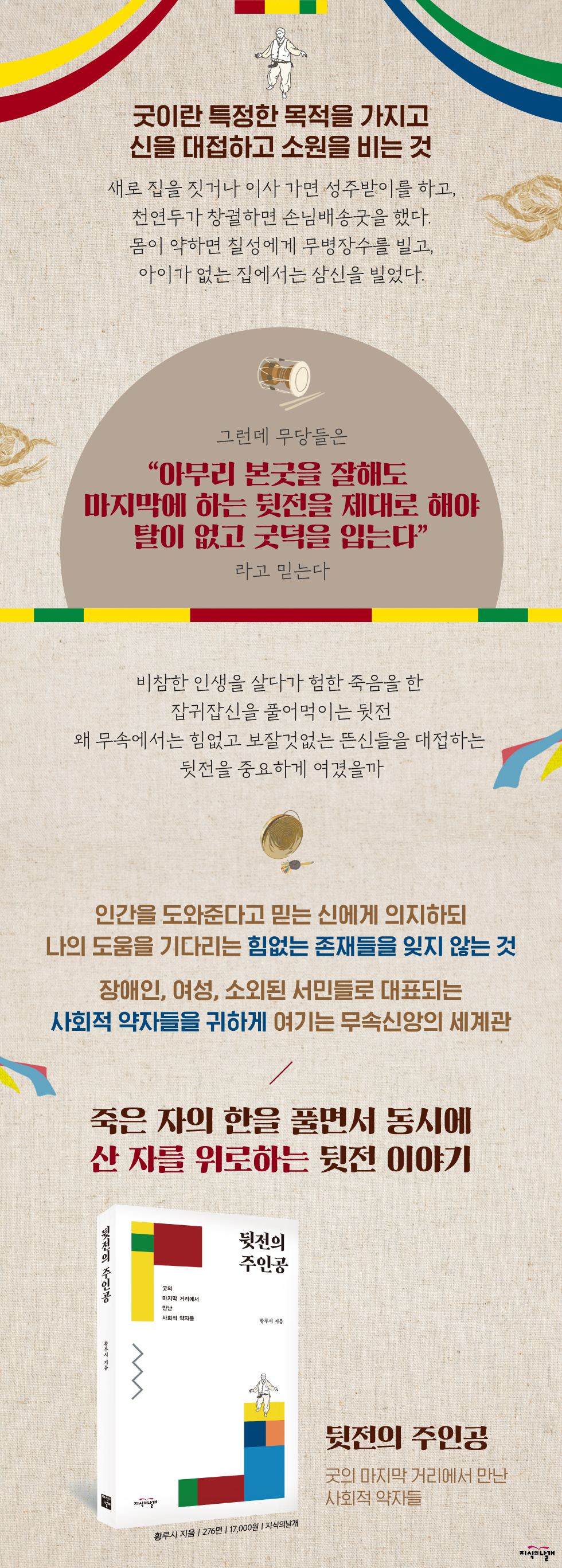
Good is done to obtain what one desires from a god who has power in a specific area.
However, at the very end of this ritual, evil spirits and gods who have no connection to me and no power are called together and treated together.
The back porch, which is also used to mean 'the back, the next turn', may not seem important at all, but shamans believe that no matter how well the main ritual is performed, only the last back porch can be performed properly to avoid trouble and receive good fortune.
Where does this strong belief come from?
The author, who has studied shamanism for over 30 years as a folklorist, says that the backstage is the core of gut.
The evil spirits who lived miserable lives and died cruel deaths are considered socially disadvantaged.
They are the disabled represented by Gibari, Cheonsangbaragi, and Anwaekgopsadeungi; women such as Golmaegi Halmae, Haesanmo, and daughters-in-law who committed suicide due to the hardships of their in-laws; and the marginalized common people of the same era, such as soldiers and fishermen.
Behind the scenes, the shaman reenacts their deaths in the form of a play, releasing them from their misery.
The floating gods, who 'come out of gratitude when invited and come out of spite when told not to come', fill their hungry stomachs at the gut stage, dance to their heart's content, and return comforted.
Remembering and actively resolving the pain and suffering of those who were left behind due to unresolved pain and suffering during their lifetime is a secondary priority.
Relying on the gods who believe in helping humans, but not forgetting the helpless, small beings who await our help, and thus a life where the dead and the living coexist, is the world that shamanism aims for.
The Last Street Behind Good's Story
Good is done to obtain what one desires from a god who has power in a specific area.
However, at the very end of this ritual, evil spirits and gods who have no connection to me and no power are called together and treated together.
The back porch, which is also used to mean 'the back, the next turn', may not seem important at all, but shamans believe that no matter how well the main ritual is performed, only the last back porch can be performed properly to avoid trouble and receive good fortune.
Where does this strong belief come from?
The author, who has studied shamanism for over 30 years as a folklorist, says that the backstage is the core of gut.
The evil spirits who lived miserable lives and died cruel deaths are considered socially disadvantaged.
They are the disabled represented by Gibari, Cheonsangbaragi, and Anwaekgopsadeungi; women such as Golmaegi Halmae, Haesanmo, and daughters-in-law who committed suicide due to the hardships of their in-laws; and the marginalized common people of the same era, such as soldiers and fishermen.
Behind the scenes, the shaman reenacts their deaths in the form of a play, releasing them from their misery.
The floating gods, who 'come out of gratitude when invited and come out of spite when told not to come', fill their hungry stomachs at the gut stage, dance to their heart's content, and return comforted.
Remembering and actively resolving the pain and suffering of those who were left behind due to unresolved pain and suffering during their lifetime is a secondary priority.
Relying on the gods who believe in helping humans, but not forgetting the helpless, small beings who await our help, and thus a life where the dead and the living coexist, is the world that shamanism aims for.
- You can preview some of the book's contents.
Preview
index
Small Book, Big Thanks · 5
Enter: To become a shaman with a clear mind · 7
Chapter 1: What is a Backseat?
1.
All good things end in the afterlife · 16
2.
The Hidden Meaning That Overturns Dictionary Definitions · 17
3.
Backstreet Space · 19
4.
The Deity of the Backstage · 23
5.
What is a ghost and a god? · 27
6.
There was a separate shaman behind the scenes · 33
7.
The back row has a different way of doing good · 34
8.
The backseat is a play · 36
9.
Why Comedy? · 39
10. Why is the backstage important? · 40
Chapter 2: Personal experiences with the backstage
1.
Seoul Backseat · 44
2.
Hwanghae-do Madanggut · 63
3.
East Coast Street Dance · 70
4.
The Backstory of Jangmal Dodanggut · 83
Chapter 3: Background Characters Read in the Text
1.
Gyeonggi Province, Seoul area behind · 95
2.
Hwanghae-do Madanggut and Yongsingut · 118
3.
East Coast Byeolsingut Street Gut · 141
4.
Suncheon Ssitgimgut Samseolyanggut · 200
Chapter 4: Analysis of People Left Behind as Socially Underprivileged
1.
Those in the background are the socially disadvantaged · 218
2.
Disabled · 222
3.
Female · 234
4.
The Marginalized Common People of Our Time · 241
Chapter 5: The world view of shamanism through the backstage
1.
The Power of the Powerless · 254
2.
Reconciliation with the Marginalized · 256
3.
Viewing Women Through a Realist Perspective · 260
4.
Making Peace with Yourself · 265
Coming Out: The Backstage of the Backstage · 269
References · 274
Enter: To become a shaman with a clear mind · 7
Chapter 1: What is a Backseat?
1.
All good things end in the afterlife · 16
2.
The Hidden Meaning That Overturns Dictionary Definitions · 17
3.
Backstreet Space · 19
4.
The Deity of the Backstage · 23
5.
What is a ghost and a god? · 27
6.
There was a separate shaman behind the scenes · 33
7.
The back row has a different way of doing good · 34
8.
The backseat is a play · 36
9.
Why Comedy? · 39
10. Why is the backstage important? · 40
Chapter 2: Personal experiences with the backstage
1.
Seoul Backseat · 44
2.
Hwanghae-do Madanggut · 63
3.
East Coast Street Dance · 70
4.
The Backstory of Jangmal Dodanggut · 83
Chapter 3: Background Characters Read in the Text
1.
Gyeonggi Province, Seoul area behind · 95
2.
Hwanghae-do Madanggut and Yongsingut · 118
3.
East Coast Byeolsingut Street Gut · 141
4.
Suncheon Ssitgimgut Samseolyanggut · 200
Chapter 4: Analysis of People Left Behind as Socially Underprivileged
1.
Those in the background are the socially disadvantaged · 218
2.
Disabled · 222
3.
Female · 234
4.
The Marginalized Common People of Our Time · 241
Chapter 5: The world view of shamanism through the backstage
1.
The Power of the Powerless · 254
2.
Reconciliation with the Marginalized · 256
3.
Viewing Women Through a Realist Perspective · 260
4.
Making Peace with Yourself · 265
Coming Out: The Backstage of the Backstage · 269
References · 274
Detailed image
Into the book
The last good thing to do is the back seat.
The backstage ritual is a ritual in which, after entertaining all the gods that the shaman believes in over several days, they come out of the gutcheong and release the wandering evil spirits.
Shamans believe that no matter how well they perform the main ritual, they will not suffer any harm and will receive good fortune only if they properly perform the last ritual.
In the end, the most important thing for a shaman to clear his/her mind is what is at the back.
The belief that the last part of the ritual is the most important and that no matter how well the ritual is performed, if the evil spirits are not properly exorcised, it will be ineffective is an absolute belief among most shamans.
Where does this strong belief come from?
--- p.11
Ghosts and spirits without specific functions are not objects of people's wishes.
They are beings who are not included in the ranks of gods who are treated as independent gods, so they do not even have names.
They are simply called ghosts, evil spirits, guardian spirits, and spirit mountains.
They came in droves, 'welcoming the sound of the floating good deeds,' so they weren't even officially invited.
In this situation, the deities in the background have no connection with the people performing the rituals.
Since he is not an ancestor of the family and is not specifically from our village, it is equally irrelevant to look into blood ties or regional ties.
But in the good field, the back is very important.
Shamans say that no matter how well a ritual is performed, if the aftermath is done incorrectly, there will be repercussions.
So, no shaman can take the back seat.
In Seoul, there was a separate shaman for the backstage, and in the east coast region, male shamans who performed street rituals received a separate share.
I thought it was such an important good.
--- pp.26-27
Kim Jang-gil's inner strength was best demonstrated in the seafood restaurant.
The scene of childbirth, which even women are good at imitating, was described so specifically that it was hard to believe that what actually came out from under her skirt was a red plastic bucket.
"Oh my, oh my, come down, come down a little, oh my." Kim Jang-gil groaned in pain, and since the baby still wouldn't come out, he called the grandmothers and aunts together to give them strength and encouragement, turning the beach in broad daylight into a delivery room.
'It's coming out, it's coming out!' Finally, with the encouragement of all mothers, the baby came into the world.
The shamanistic ritual where all the villagers' babies were born literally became a festival ground.
--- pp.80-81
Where else can you find the seeds of the disabled?
If you can't use one leg or one arm, you're considered disabled.
Byeongsin Nanbongga is a folk song that is a type of love song.
It's originally a cheerful song, but because the first line starts with the word "retard," the singer imitates the word "retard."
However, the first line of the song of the disabled begins with the declaration that there is no such thing as a disabled person.
It is based on the premise that there is no distinction between disabled and non-disabled people, that anyone can become disabled at any moment, and that disability cannot be a criterion for distinguishing people.
Although the lyrics are completely out of touch with reality, this creates an atmosphere where people with disabilities are not discriminated against, at least in the playground.
--- p.131
There are many female characters in the background.
They are all marginalized people at home.
An old woman who loses her femininity and is ridiculed after giving birth to thirteen daughters, a mother who gives in to the power and authority of men, becomes pregnant, gives birth to a baby with difficulty, and the baby soon dies, and a woman commits suicide after enduring a difficult life as a married woman.
The female divers who risked their lives diving and eventually lost their lives, and the women who suffered accidents while collecting seaweed or kelp from rocks, died from the hardships of their labor.
In traditional society, women were considered weaker and had a lower status than men.
However, the women who appear in the background are typical socially disadvantaged people who do not have any of the following: family, economic, or social conditions.
--- pp.220-221
Good is a ritual that seeks reconciliation with numerous beings.
The process of inviting various gods and meeting and reconciling gods and humans is called gut.
It is also good for life and death to reconcile.
And in the process, humans and humans become reconciled.
The final chapter of this great reconciliation is what takes a back seat.
The evil spirits that appear in the background are beings who were unable to live a proper human life.
Social prejudice alienated them and made them unhappy.
Disability was perceived as the fault or sin of the disabled person, and women's suffering was taken for granted in a male-dominated society.
The common people, who were unable to escape inherited poverty and suffered from the threat of survival due to the caste system, were also marginalized.
The backstage is where they can open up about the pain they have hidden their entire lives and publicly express their wishes.
The backstage ritual is a ritual in which, after entertaining all the gods that the shaman believes in over several days, they come out of the gutcheong and release the wandering evil spirits.
Shamans believe that no matter how well they perform the main ritual, they will not suffer any harm and will receive good fortune only if they properly perform the last ritual.
In the end, the most important thing for a shaman to clear his/her mind is what is at the back.
The belief that the last part of the ritual is the most important and that no matter how well the ritual is performed, if the evil spirits are not properly exorcised, it will be ineffective is an absolute belief among most shamans.
Where does this strong belief come from?
--- p.11
Ghosts and spirits without specific functions are not objects of people's wishes.
They are beings who are not included in the ranks of gods who are treated as independent gods, so they do not even have names.
They are simply called ghosts, evil spirits, guardian spirits, and spirit mountains.
They came in droves, 'welcoming the sound of the floating good deeds,' so they weren't even officially invited.
In this situation, the deities in the background have no connection with the people performing the rituals.
Since he is not an ancestor of the family and is not specifically from our village, it is equally irrelevant to look into blood ties or regional ties.
But in the good field, the back is very important.
Shamans say that no matter how well a ritual is performed, if the aftermath is done incorrectly, there will be repercussions.
So, no shaman can take the back seat.
In Seoul, there was a separate shaman for the backstage, and in the east coast region, male shamans who performed street rituals received a separate share.
I thought it was such an important good.
--- pp.26-27
Kim Jang-gil's inner strength was best demonstrated in the seafood restaurant.
The scene of childbirth, which even women are good at imitating, was described so specifically that it was hard to believe that what actually came out from under her skirt was a red plastic bucket.
"Oh my, oh my, come down, come down a little, oh my." Kim Jang-gil groaned in pain, and since the baby still wouldn't come out, he called the grandmothers and aunts together to give them strength and encouragement, turning the beach in broad daylight into a delivery room.
'It's coming out, it's coming out!' Finally, with the encouragement of all mothers, the baby came into the world.
The shamanistic ritual where all the villagers' babies were born literally became a festival ground.
--- pp.80-81
Where else can you find the seeds of the disabled?
If you can't use one leg or one arm, you're considered disabled.
Byeongsin Nanbongga is a folk song that is a type of love song.
It's originally a cheerful song, but because the first line starts with the word "retard," the singer imitates the word "retard."
However, the first line of the song of the disabled begins with the declaration that there is no such thing as a disabled person.
It is based on the premise that there is no distinction between disabled and non-disabled people, that anyone can become disabled at any moment, and that disability cannot be a criterion for distinguishing people.
Although the lyrics are completely out of touch with reality, this creates an atmosphere where people with disabilities are not discriminated against, at least in the playground.
--- p.131
There are many female characters in the background.
They are all marginalized people at home.
An old woman who loses her femininity and is ridiculed after giving birth to thirteen daughters, a mother who gives in to the power and authority of men, becomes pregnant, gives birth to a baby with difficulty, and the baby soon dies, and a woman commits suicide after enduring a difficult life as a married woman.
The female divers who risked their lives diving and eventually lost their lives, and the women who suffered accidents while collecting seaweed or kelp from rocks, died from the hardships of their labor.
In traditional society, women were considered weaker and had a lower status than men.
However, the women who appear in the background are typical socially disadvantaged people who do not have any of the following: family, economic, or social conditions.
--- pp.220-221
Good is a ritual that seeks reconciliation with numerous beings.
The process of inviting various gods and meeting and reconciling gods and humans is called gut.
It is also good for life and death to reconcile.
And in the process, humans and humans become reconciled.
The final chapter of this great reconciliation is what takes a back seat.
The evil spirits that appear in the background are beings who were unable to live a proper human life.
Social prejudice alienated them and made them unhappy.
Disability was perceived as the fault or sin of the disabled person, and women's suffering was taken for granted in a male-dominated society.
The common people, who were unable to escape inherited poverty and suffered from the threat of survival due to the caste system, were also marginalized.
The backstage is where they can open up about the pain they have hidden their entire lives and publicly express their wishes.
--- pp.257-258
Publisher's Review
Why shamans attach importance to the "backstage" ritual performed at the end of a gut.
The term 'back', which means 'back, later turn, behind', is a Korean folk term that refers to the final street that concludes a gut, the process of sending off all the gods invited to the gut.
Gut is a ritual in which various gods are invited and treated through a priest called a shaman, and then good fortune is prayed for and evil spirits are driven away.
Just as one prays to the gods of the seven stars for health and longevity when building a new house or moving, a gut is a ritual to obtain what one desires from a god with power in a specific area. However, at the very end of the gut, in the backstage part, one summons and treats together the evil spirits and gods that have no connection to oneself and no power.
Shamans believe that no matter how well they perform the main ritual, they will not suffer any harm and will receive good fortune only if they properly perform the last ritual.
Where does this strong belief come from?
Shamanism's warm gaze toward the socially disadvantaged
The author, who has studied shamanism for a long time as a folklorist, says that the backstage is the core of gut.
Treating gods well is the basis of gut, but shamanism also values small and insignificant beings.
This is because the things in life often start from small, insignificant things rather than big ones.
The ghosts and gods who appear in the background are typical socially disadvantaged people who lived miserable lives and died rough deaths.
The visually impaired, referred to as those who can't walk because they can't walk, those who crawl, and those who are blind, come to the back after 'welcoming the sound of the floating shaman'.
Women such as the old woman who lost her femininity after giving birth to thirteen children, the mother who died from excessive bleeding during childbirth, and the daughter-in-law who committed suicide due to her mother-in-law's harsh treatment are also regular customers who are left behind.
The film also features the marginalized common people of the time, such as soldiers who lost their lives protecting their country and fishermen who were swept away by waves and died while fishing at sea.
Behind the scenes, the shaman reenacts their deaths in the form of a play, releasing them from their misery.
The floating gods who 'come when invited out of gratitude and come when told not to come even though they are annoyed' return home after dancing to their heart's content at the gut stage and receiving comfort.
The backstage of comforting the living while relieving the sorrow of the dead
The biggest reason why shamanism was able to survive in the Joseon Dynasty, which was dominated by Confucianism, was because shamanism embraced the countless painful deaths that were not able to receive Confucian ancestral rites.
He remembered and actively helped to resolve the pain and suffering of those who had not been resolved while alive.
But behind the scenes, it is not only the evil spirits who are comforted.
The audience watching the performance together also discovers aspects of their own past and present in the protagonist in the background.
In this way, you can objectively look at your own life and develop the strength to finally laugh about it.
The wisdom of overcoming and escaping from a dead end with laughter is a life wisdom that the people have acquired while overcoming countless adversities.
Relying on the gods who believe in helping humans, but not forgetting the helpless, small beings who await our help, and thus a life where the dead and the living coexist, is the world that shamanism aims for.
The term 'back', which means 'back, later turn, behind', is a Korean folk term that refers to the final street that concludes a gut, the process of sending off all the gods invited to the gut.
Gut is a ritual in which various gods are invited and treated through a priest called a shaman, and then good fortune is prayed for and evil spirits are driven away.
Just as one prays to the gods of the seven stars for health and longevity when building a new house or moving, a gut is a ritual to obtain what one desires from a god with power in a specific area. However, at the very end of the gut, in the backstage part, one summons and treats together the evil spirits and gods that have no connection to oneself and no power.
Shamans believe that no matter how well they perform the main ritual, they will not suffer any harm and will receive good fortune only if they properly perform the last ritual.
Where does this strong belief come from?
Shamanism's warm gaze toward the socially disadvantaged
The author, who has studied shamanism for a long time as a folklorist, says that the backstage is the core of gut.
Treating gods well is the basis of gut, but shamanism also values small and insignificant beings.
This is because the things in life often start from small, insignificant things rather than big ones.
The ghosts and gods who appear in the background are typical socially disadvantaged people who lived miserable lives and died rough deaths.
The visually impaired, referred to as those who can't walk because they can't walk, those who crawl, and those who are blind, come to the back after 'welcoming the sound of the floating shaman'.
Women such as the old woman who lost her femininity after giving birth to thirteen children, the mother who died from excessive bleeding during childbirth, and the daughter-in-law who committed suicide due to her mother-in-law's harsh treatment are also regular customers who are left behind.
The film also features the marginalized common people of the time, such as soldiers who lost their lives protecting their country and fishermen who were swept away by waves and died while fishing at sea.
Behind the scenes, the shaman reenacts their deaths in the form of a play, releasing them from their misery.
The floating gods who 'come when invited out of gratitude and come when told not to come even though they are annoyed' return home after dancing to their heart's content at the gut stage and receiving comfort.
The backstage of comforting the living while relieving the sorrow of the dead
The biggest reason why shamanism was able to survive in the Joseon Dynasty, which was dominated by Confucianism, was because shamanism embraced the countless painful deaths that were not able to receive Confucian ancestral rites.
He remembered and actively helped to resolve the pain and suffering of those who had not been resolved while alive.
But behind the scenes, it is not only the evil spirits who are comforted.
The audience watching the performance together also discovers aspects of their own past and present in the protagonist in the background.
In this way, you can objectively look at your own life and develop the strength to finally laugh about it.
The wisdom of overcoming and escaping from a dead end with laughter is a life wisdom that the people have acquired while overcoming countless adversities.
Relying on the gods who believe in helping humans, but not forgetting the helpless, small beings who await our help, and thus a life where the dead and the living coexist, is the world that shamanism aims for.
GOODS SPECIFICS
- Publication date: July 15, 2021
- Page count, weight, size: 276 pages | 392g | 129*215*20mm
- ISBN13: 9788920037528
- ISBN10: 8920037523
You may also like
카테고리
korean


korean

![GQ KOREA Mark (Monthly): December [2025]](http://librairie.coreenne.fr/cdn/shop/files/8ef265dbbfbf186523ed75ba7319009d.jpg?v=1765340328&width=3840)


