

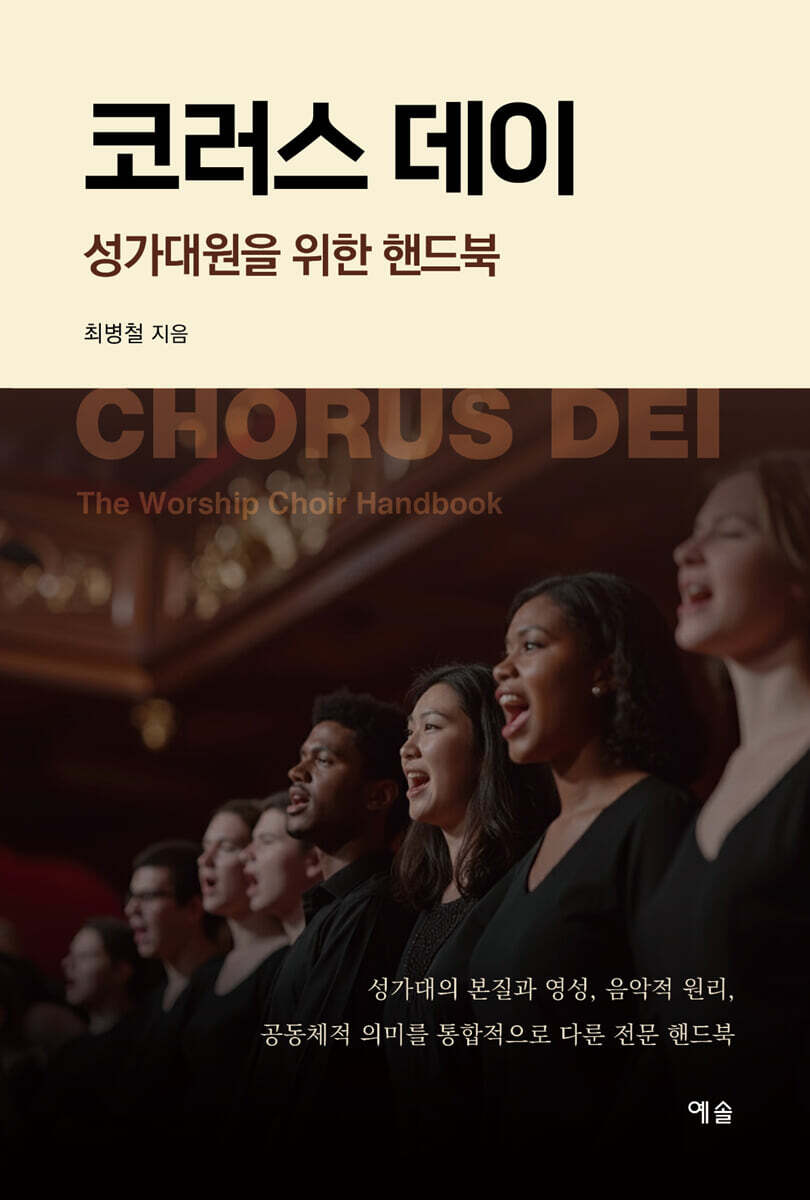
Chorus Day
 |
Description
Book Introduction
A must-read for choir members in worship communities!
This book is a professional handbook that comprehensively covers the essence, spirituality, musical principles, and communal meaning of the choir.
Keywords such as ‘Chorus Day (God’s choir)’, ‘community of worshiping voices’, ‘theology of lyrics’, and ‘congregationalism’ give us an idea of the contents of this book.
This is a guidebook that practically restores the praise ministry of the Korean church by reestablishing the history and philosophy of the choir, vocal training, choral harmony, and the essence of worship. It is also a spiritual guidebook that purifies both the mind and voice. It is a “must-read for choir members” recommended to all choir members.
This book is a professional handbook that comprehensively covers the essence, spirituality, musical principles, and communal meaning of the choir.
Keywords such as ‘Chorus Day (God’s choir)’, ‘community of worshiping voices’, ‘theology of lyrics’, and ‘congregationalism’ give us an idea of the contents of this book.
This is a guidebook that practically restores the praise ministry of the Korean church by reestablishing the history and philosophy of the choir, vocal training, choral harmony, and the essence of worship. It is also a spiritual guidebook that purifies both the mind and voice. It is a “must-read for choir members” recommended to all choir members.
index
preface
PART I: Vocalization and Music
Chapter 1: Introduction to Chorus
1.
sound
1) Four types of musical voices 2) 'Intention' determines the direction of sound
2.
vocalization
1) Four major vocal mechanisms 2) Five basic principles of vocal music
3.
Vocal Evaluation Criteria for Choral Ensembles
1) Pitch 2) Attack and release 3) Blend 4) Balance 5) Sound quality 6) Diction 7) Expression
4.
Musical communication between conductor and choir members
1) The conductor is the 'visible sound' 2) The choir members are the 'audible conductor' 3) The center of communication is 'breathing'
4) Hand-eye communication 5) Trust 6) Spiritual guidance
5.
Understanding the part
1) Soprano 2) Alto 3) Tenor 4) Bass 5) Relationship between external and internal voices 6) Composition of members in the part
6.
Understanding space
1) Choir location 2) Chapel acoustics and congregational quality
7.
Choir microphone use
1) The physical structure of raw and amplified sound 2) How the human ear and brain perceive sound 3) Key points that people overlook
Chapter 2: Understanding Music
1.
music
1) Elements of music 2) Music genre
2.
Music and Human Behavior
3.
The effect of music
1) Temporary effect 2) Permanent effect
4.
Music and Emotion
1) The law of expectation 2) The meaning of expressive time
PART II: THE HISTORY AND ROLE OF THE CHORUS
Chapter 1: The History of the Choir
1.
Choir in the Old Testament
1) The institutional beginnings of the choir 2) The choir in synagogue worship
2.
The Synagogue Tradition that Continued into the New Testament Church
1) New praise after the resurrection 2) “Psalms, hymns, and spiritual songs” 3) Worship without instruments 4) The voice of the community, “One Voice”
5) The centrality of lyrics - praise was the proclamation of the gospel 6) Praise and ethics 7) The spiritual spirit of praise in the early church
3.
The Choir of the Medieval Church and the Formation of Gregorian Chant
1) The monastic movement and the institutionalization of the choir 2) The formation and characteristics of Gregorian chant 3) From ‘sung words’ to ‘audible music’
4) Theological meaning of the lyrics 5) Lessons for church choirs today
4.
The Reformation and the Restoration of Congregational Praise
1) Luther 2) The revolution in congregational praise 3) Luther's music theology 4) Calvin 5) The common theology of Luther and Calvin 6) The changing role of the choir
5.
Choirs in modern and contemporary churches
1) Bach 2) Wesley 3) The Great Awakening and Gospel Music 4) The 20th Century 5) The Challenges of Modern Choirs
6) Diversity in Worship, But One Center 7) Restoring the Choir's Identity 8) Lessons for Church Choirs Today
Chapter 2 The Choir's Mission and Role in Worship
1.
The position of the choir within the structure of worship
1) The position of the choir in the flow of worship is the 'position of response' 2) The theological meaning of call and response 3) The sermon before the sermon
4) Praise is at the center of worship. 5) The choir's praise is the congregation's 'representative response.' 6) The 'bridge of sound' between call and response.
7) Interaction with the congregation
2.
Balance between music and words
1) Emotions are a gift, but not the center. 2) The purpose of music is to make truth more apparent.
3) The dangers of letting emotions take over 4) Word-centered musical interpretation 5) The balance between artistry and piety
6) From emotion to truth, from truth to emotion
3.
The choir's praise is the community's confession.
1) The church is a 'community that sings together'. 2) 'One voice' is not monotony but harmony.
3) Harmony reveals the theology of the church 4) Praise as a communal confession 5) The choir is the 'face of the community'
6) Unity of heart beyond unity of voice 7) Spiritual message of community harmony 8) Spiritual attitude of the choir
9) Choir participation in worship
4.
The ministry and practice of the choir
1) Preparation and practice of the choir 2) Relationships among the conductor, accompanist, and members 3) Practical principles of choir practice
4) Song selection and interpretation
5.
The Future of the Choir
1) The environment of worship changes, but the essence of worship does not. 2) The future mission of the choir.
3) The changing worship environment and the challenges of the choir 4) Suggestions for future worship
supplement
Choir Seminar Textbook
"Why is Singing Healing?" Seminar Textbook
Seminar Textbook for "Biblical Healing Music Ministry"
A list of helpful hymns for each time
References
index
PART I: Vocalization and Music
Chapter 1: Introduction to Chorus
1.
sound
1) Four types of musical voices 2) 'Intention' determines the direction of sound
2.
vocalization
1) Four major vocal mechanisms 2) Five basic principles of vocal music
3.
Vocal Evaluation Criteria for Choral Ensembles
1) Pitch 2) Attack and release 3) Blend 4) Balance 5) Sound quality 6) Diction 7) Expression
4.
Musical communication between conductor and choir members
1) The conductor is the 'visible sound' 2) The choir members are the 'audible conductor' 3) The center of communication is 'breathing'
4) Hand-eye communication 5) Trust 6) Spiritual guidance
5.
Understanding the part
1) Soprano 2) Alto 3) Tenor 4) Bass 5) Relationship between external and internal voices 6) Composition of members in the part
6.
Understanding space
1) Choir location 2) Chapel acoustics and congregational quality
7.
Choir microphone use
1) The physical structure of raw and amplified sound 2) How the human ear and brain perceive sound 3) Key points that people overlook
Chapter 2: Understanding Music
1.
music
1) Elements of music 2) Music genre
2.
Music and Human Behavior
3.
The effect of music
1) Temporary effect 2) Permanent effect
4.
Music and Emotion
1) The law of expectation 2) The meaning of expressive time
PART II: THE HISTORY AND ROLE OF THE CHORUS
Chapter 1: The History of the Choir
1.
Choir in the Old Testament
1) The institutional beginnings of the choir 2) The choir in synagogue worship
2.
The Synagogue Tradition that Continued into the New Testament Church
1) New praise after the resurrection 2) “Psalms, hymns, and spiritual songs” 3) Worship without instruments 4) The voice of the community, “One Voice”
5) The centrality of lyrics - praise was the proclamation of the gospel 6) Praise and ethics 7) The spiritual spirit of praise in the early church
3.
The Choir of the Medieval Church and the Formation of Gregorian Chant
1) The monastic movement and the institutionalization of the choir 2) The formation and characteristics of Gregorian chant 3) From ‘sung words’ to ‘audible music’
4) Theological meaning of the lyrics 5) Lessons for church choirs today
4.
The Reformation and the Restoration of Congregational Praise
1) Luther 2) The revolution in congregational praise 3) Luther's music theology 4) Calvin 5) The common theology of Luther and Calvin 6) The changing role of the choir
5.
Choirs in modern and contemporary churches
1) Bach 2) Wesley 3) The Great Awakening and Gospel Music 4) The 20th Century 5) The Challenges of Modern Choirs
6) Diversity in Worship, But One Center 7) Restoring the Choir's Identity 8) Lessons for Church Choirs Today
Chapter 2 The Choir's Mission and Role in Worship
1.
The position of the choir within the structure of worship
1) The position of the choir in the flow of worship is the 'position of response' 2) The theological meaning of call and response 3) The sermon before the sermon
4) Praise is at the center of worship. 5) The choir's praise is the congregation's 'representative response.' 6) The 'bridge of sound' between call and response.
7) Interaction with the congregation
2.
Balance between music and words
1) Emotions are a gift, but not the center. 2) The purpose of music is to make truth more apparent.
3) The dangers of letting emotions take over 4) Word-centered musical interpretation 5) The balance between artistry and piety
6) From emotion to truth, from truth to emotion
3.
The choir's praise is the community's confession.
1) The church is a 'community that sings together'. 2) 'One voice' is not monotony but harmony.
3) Harmony reveals the theology of the church 4) Praise as a communal confession 5) The choir is the 'face of the community'
6) Unity of heart beyond unity of voice 7) Spiritual message of community harmony 8) Spiritual attitude of the choir
9) Choir participation in worship
4.
The ministry and practice of the choir
1) Preparation and practice of the choir 2) Relationships among the conductor, accompanist, and members 3) Practical principles of choir practice
4) Song selection and interpretation
5.
The Future of the Choir
1) The environment of worship changes, but the essence of worship does not. 2) The future mission of the choir.
3) The changing worship environment and the challenges of the choir 4) Suggestions for future worship
supplement
Choir Seminar Textbook
"Why is Singing Healing?" Seminar Textbook
Seminar Textbook for "Biblical Healing Music Ministry"
A list of helpful hymns for each time
References
index
Publisher's Review
Part I covers vocalization and music.
Chapter 1 introduces the fundamentals of choral singing, presenting acoustical knowledge about sound and vocalization, musical communication between conductor and members, understanding between parts, and the use of space and microphones in the choir.
Chapter 2 covers the impact of music on human emotions and behavior through understanding music, the practical functions of musical elements, and practical tips for hymn interpretation using the concept of 'expressive time.'
Part II covers the history and role of the choir.
Chapter 1 provides a consistent insight into the history of the choir, encompassing the Old and New Testaments, the Middle Ages and the Reformation, and the modern and contemporary churches.
Chapter 2 deals with the mission and worshipful role of the choir, offering a balanced reflection on the balance between music and words, and on the important place of 'emotion' in worship.
The author explains this with the principle of “from emotion to truth, from truth to emotion.”
It also includes suggestions for the perspective of viewing praise as a confession of the community and the actual and future vision of choir ministry.
The appendix contains practical resources for church choirs, choirs, and healing music ministries, including materials the author has used in various external seminars.
Also included is a 'List of Hymns to Help You in Times of Need', planned and produced by the author himself, and a QR code that allows you to listen directly to the hymns on YouTube.
The choir is a 'community of sound' refined through words and prayer.
"Chorus Day" covers the essence of praise, the science of vocalization, musical harmony, and the spirituality of worship, guiding each person to stand before God as a "worshiper who serves with his voice."
Therefore, this book is a guidebook that practically restores the praise ministry of the Korean church by reestablishing the history and philosophy of the choir, vocal training, choral harmony, and the essence of worship. It is also a spiritual guidebook that purifies both the mind and voice. It is a “must-read for choir members” recommended to all choir members.
Chapter 1 introduces the fundamentals of choral singing, presenting acoustical knowledge about sound and vocalization, musical communication between conductor and members, understanding between parts, and the use of space and microphones in the choir.
Chapter 2 covers the impact of music on human emotions and behavior through understanding music, the practical functions of musical elements, and practical tips for hymn interpretation using the concept of 'expressive time.'
Part II covers the history and role of the choir.
Chapter 1 provides a consistent insight into the history of the choir, encompassing the Old and New Testaments, the Middle Ages and the Reformation, and the modern and contemporary churches.
Chapter 2 deals with the mission and worshipful role of the choir, offering a balanced reflection on the balance between music and words, and on the important place of 'emotion' in worship.
The author explains this with the principle of “from emotion to truth, from truth to emotion.”
It also includes suggestions for the perspective of viewing praise as a confession of the community and the actual and future vision of choir ministry.
The appendix contains practical resources for church choirs, choirs, and healing music ministries, including materials the author has used in various external seminars.
Also included is a 'List of Hymns to Help You in Times of Need', planned and produced by the author himself, and a QR code that allows you to listen directly to the hymns on YouTube.
The choir is a 'community of sound' refined through words and prayer.
"Chorus Day" covers the essence of praise, the science of vocalization, musical harmony, and the spirituality of worship, guiding each person to stand before God as a "worshiper who serves with his voice."
Therefore, this book is a guidebook that practically restores the praise ministry of the Korean church by reestablishing the history and philosophy of the choir, vocal training, choral harmony, and the essence of worship. It is also a spiritual guidebook that purifies both the mind and voice. It is a “must-read for choir members” recommended to all choir members.
GOODS SPECIFICS
- Date of issue: November 24, 2025
- Page count, weight, size: 208 pages | 152*225*20mm
- ISBN13: 9788959160952
- ISBN10: 8959160954
You may also like
카테고리
korean


korean

![ELLE 엘르 스페셜 에디션 A형 : 12월 [2025]](http://librairie.coreenne.fr/cdn/shop/files/b8e27a3de6c9538896439686c6b0e8fb.jpg?v=1766436872&width=3840)


