

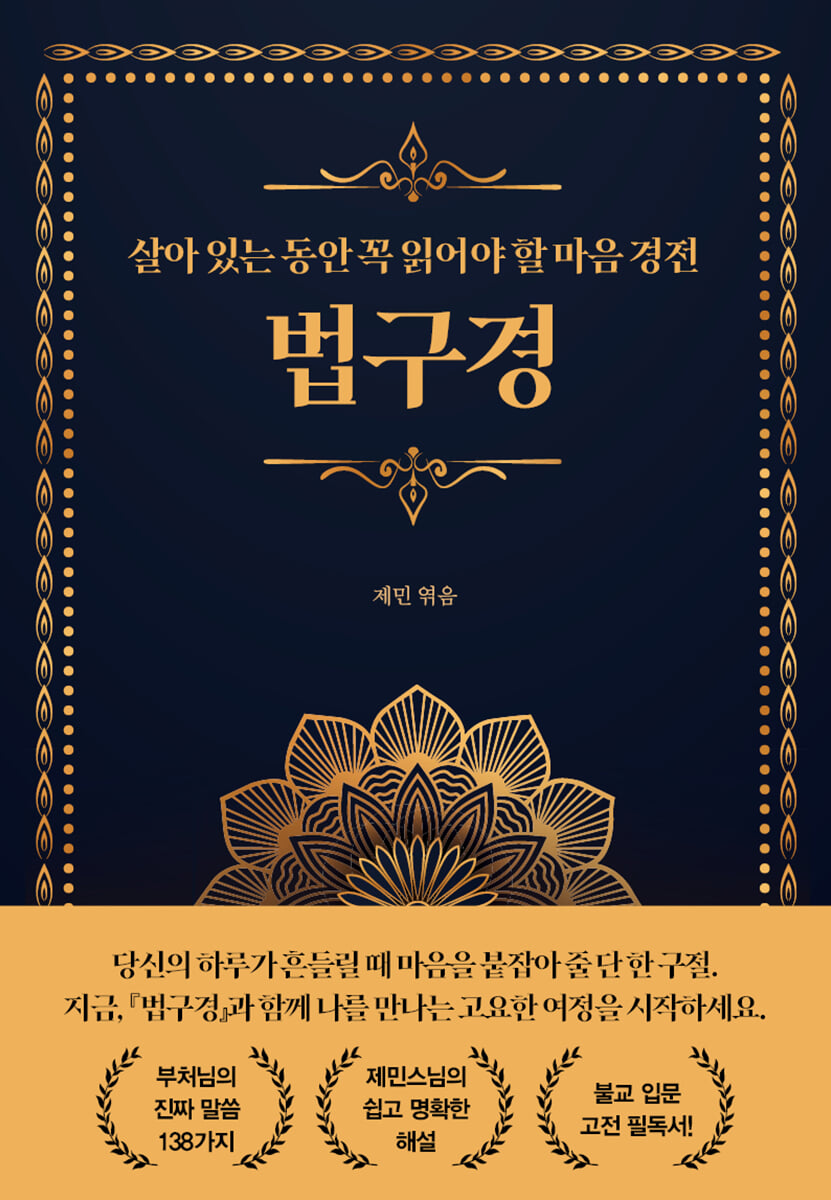
A must-read sutra for the mind while you are alive: The Dhammapada
 |
Description
Book Introduction
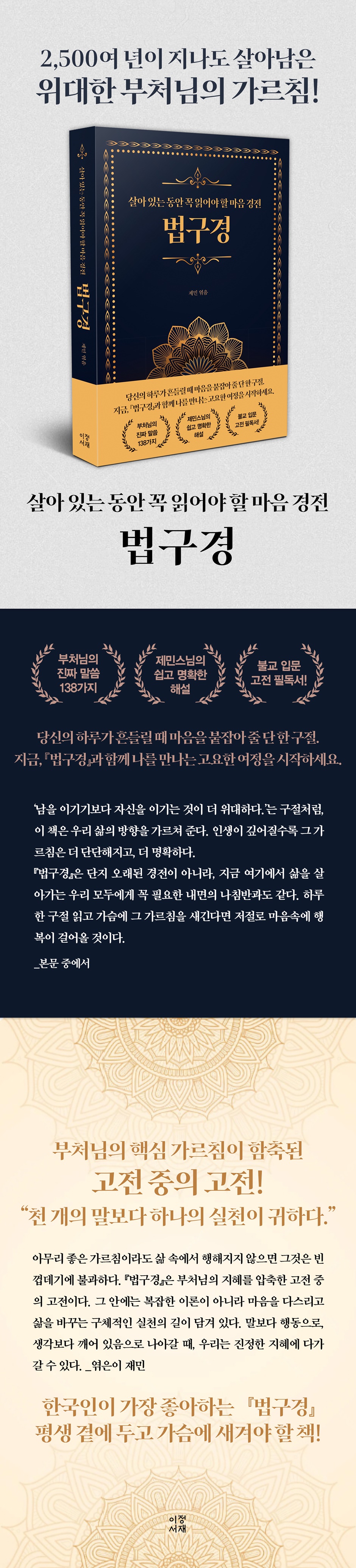
The immortal classic, the Dhammapada, which has been passed down for over 2,500 years and is a light within humanity.
A book with clear explanations by Monk Jemin, the head priest of Jeokseoksa Temple in Ganghwa Island!
The Dhammapada goes beyond the common belief in fortune-telling and offers a path to enlightenment that penetrates the root of suffering and opens it up.
This book, which explains the Buddha's core teachings, is not filled with philosophical concepts or complex theories, but is filled with clear language that can be put into practice immediately in life.
A book with clear explanations by Monk Jemin, the head priest of Jeokseoksa Temple in Ganghwa Island!
The Dhammapada goes beyond the common belief in fortune-telling and offers a path to enlightenment that penetrates the root of suffering and opens it up.
This book, which explains the Buddha's core teachings, is not filled with philosophical concepts or complex theories, but is filled with clear language that can be put into practice immediately in life.
- You can preview some of the book's contents.
Preview
index
Chapter 1: Understand Reality and Truth Correctly
The Appearance of the Buddha - 018 The Impermanence of All Things - 020 My Reins Are Mine - 022 The Unending Suffering of All Things - 024 The Anatta of All Dharmas - 026 The Holy Practitioner - 028 The Root of Desire - 031 Always Serve the Buddha - 033 Awaken to the Dharma - 037 Abandon Wrong Views - 039 Do Not Be Deceived by Wrong Teachings - 042 A Pure Mind - 044 Know My Folly - 047 Taboos - 049 Do Not Just Adorn the Outward Appearance - 052 The Pleasures of the Body - 055 Aging and Death - 057
Chapter 2: Abandon greed and anger and practice compassion and altruism.
Nirvana-062 I am a precious being-064 The right law-066 About sin-068 Faults-070 Karma-072 Happiness-074 Be careful with your mouth-076 Pure virtue-078 A wise person-080 The law of cause and effect-082 The three poisons-084 Do not seek your own happiness-086 A life without regrets-088 A worthwhile life-090 What it means to live-092 The value of good deeds-094 Do not repeat the same mistakes-096
Chapter 3: Speak kindly and truthfully.
The Fruit of Evil - 100 Thirst - 102 Be firm when avoiding evil - 104 Practice good deeds - 106 Do not take small evil deeds lightly - 108 Avoid bad things - 110 Do not be foolish - 112 Abandon the temptation of evil - 114 Do not become your own enemy - 116 Do not commit adultery - 118 The Law of Retribution - 120 Foolish people - 122 Do not lie - 124 The path to enlightenment - 126 The end of killing - 128 Do not criticize others - 130 The end of excessive drinking - 132 The end of evil speech - 134
Chapter 4: Practice Moral and Ethical Conduct
The True Brahmin - 138 Abandon Discrimination - 140 Do Not Expose Others' Faults - 142 Remove My Own Fouls - 144 Ten Kinds of Retribution - 146 Evil Begets Evil - 149 The Righteous Man - 151 Do Not Hold Love or Hatred in Your Heart - 153 Non-Attachment and Non-Attachment - 155 Anger is the Enemy of Happiness - 158 Do Not Slander Others - 160 Abandon Desire for Reason - 162 Fierce Practice - 164 Abandon Hatred and Anger - 166 Prajna - 168 The Eye of the Mind - 170 The One Who Has Deep Learning - 172 The One Who Has Clear Eyes - 174
Chapter 5: Jeongmyeong | Live with a good and pure heart
Practice the Dharma - 178 Cultivate your mind - 180 The path to enlightenment - 183 Practice compassion - 186 The lotus - 188 The path to joy - 190 What is death - 193 The true teacher - 196 Do not waste your life - 199 Wrong thoughts 1 - 202 Wrong thoughts 2 - 205 Inner respect 207 Be wary of me 209 Is there such a person - 211 Love me - 214 Control the six sense organs - 217 Do not be reckless - 220
Chapter 6: Jeong Jeong-jin | Always maintain a good heart and eliminate evil thoughts.
Concentration of the Mind 1-224 Concentration of the Mind 2 - 226 Set your mind straight - 229 The fat pig - 234 The true sword of Prajna - 237 Do not be lazy - 239 Control yourself well - 241 Practice - 243 The merits of practice - 245 Do not commit evil deeds - 248 Accumulate much virtue - 251 Make your mind pure - 253 Empty your mind - 255 Do not harm others - 257 Do not be angry - 259 Do not make others uncomfortable - 261 Be generous - 263
Chapter 7: Passion | Focus on your present self and clearly recognize your thoughts and emotions.
Do not take revenge - 268 Do not harm the virtuous - 270 Do not become a weed - 272 The price of evil deeds - 275 Do good deeds even if it is difficult - 278 Do not hate - 280 Give up greed - 282 Be patient - 285 Be detached - 287 Cut off attachments - 289 Those who have reached enlightenment - 292 Practice Zen meditation - 294 Immortal joy - 296 The energy of immortality and immortality - 298 Joy - 300 Control yourself well - 302 Stop the flames of craving - 30
Chapter 8 Correction | Lead my mind into quiet meditation
Abandon desire - 308 Find the nirvana within your heart - 310 The enlightened one - 312 Practice the Buddhist law with sincerity - 314 The meaning of aging - 316 What it means to be a saint - 319 Do not harm even a single life - 321 The thorns of life and death 323 Cut off craving and attachment - 325 Become one who has conquered yourself - 328 Surrender to yourself - 330 You are your own master - 332 No one is free from blame - 335 Good and evil - 338 The fleeting body - 340 A place to escape death - 342
The Appearance of the Buddha - 018 The Impermanence of All Things - 020 My Reins Are Mine - 022 The Unending Suffering of All Things - 024 The Anatta of All Dharmas - 026 The Holy Practitioner - 028 The Root of Desire - 031 Always Serve the Buddha - 033 Awaken to the Dharma - 037 Abandon Wrong Views - 039 Do Not Be Deceived by Wrong Teachings - 042 A Pure Mind - 044 Know My Folly - 047 Taboos - 049 Do Not Just Adorn the Outward Appearance - 052 The Pleasures of the Body - 055 Aging and Death - 057
Chapter 2: Abandon greed and anger and practice compassion and altruism.
Nirvana-062 I am a precious being-064 The right law-066 About sin-068 Faults-070 Karma-072 Happiness-074 Be careful with your mouth-076 Pure virtue-078 A wise person-080 The law of cause and effect-082 The three poisons-084 Do not seek your own happiness-086 A life without regrets-088 A worthwhile life-090 What it means to live-092 The value of good deeds-094 Do not repeat the same mistakes-096
Chapter 3: Speak kindly and truthfully.
The Fruit of Evil - 100 Thirst - 102 Be firm when avoiding evil - 104 Practice good deeds - 106 Do not take small evil deeds lightly - 108 Avoid bad things - 110 Do not be foolish - 112 Abandon the temptation of evil - 114 Do not become your own enemy - 116 Do not commit adultery - 118 The Law of Retribution - 120 Foolish people - 122 Do not lie - 124 The path to enlightenment - 126 The end of killing - 128 Do not criticize others - 130 The end of excessive drinking - 132 The end of evil speech - 134
Chapter 4: Practice Moral and Ethical Conduct
The True Brahmin - 138 Abandon Discrimination - 140 Do Not Expose Others' Faults - 142 Remove My Own Fouls - 144 Ten Kinds of Retribution - 146 Evil Begets Evil - 149 The Righteous Man - 151 Do Not Hold Love or Hatred in Your Heart - 153 Non-Attachment and Non-Attachment - 155 Anger is the Enemy of Happiness - 158 Do Not Slander Others - 160 Abandon Desire for Reason - 162 Fierce Practice - 164 Abandon Hatred and Anger - 166 Prajna - 168 The Eye of the Mind - 170 The One Who Has Deep Learning - 172 The One Who Has Clear Eyes - 174
Chapter 5: Jeongmyeong | Live with a good and pure heart
Practice the Dharma - 178 Cultivate your mind - 180 The path to enlightenment - 183 Practice compassion - 186 The lotus - 188 The path to joy - 190 What is death - 193 The true teacher - 196 Do not waste your life - 199 Wrong thoughts 1 - 202 Wrong thoughts 2 - 205 Inner respect 207 Be wary of me 209 Is there such a person - 211 Love me - 214 Control the six sense organs - 217 Do not be reckless - 220
Chapter 6: Jeong Jeong-jin | Always maintain a good heart and eliminate evil thoughts.
Concentration of the Mind 1-224 Concentration of the Mind 2 - 226 Set your mind straight - 229 The fat pig - 234 The true sword of Prajna - 237 Do not be lazy - 239 Control yourself well - 241 Practice - 243 The merits of practice - 245 Do not commit evil deeds - 248 Accumulate much virtue - 251 Make your mind pure - 253 Empty your mind - 255 Do not harm others - 257 Do not be angry - 259 Do not make others uncomfortable - 261 Be generous - 263
Chapter 7: Passion | Focus on your present self and clearly recognize your thoughts and emotions.
Do not take revenge - 268 Do not harm the virtuous - 270 Do not become a weed - 272 The price of evil deeds - 275 Do good deeds even if it is difficult - 278 Do not hate - 280 Give up greed - 282 Be patient - 285 Be detached - 287 Cut off attachments - 289 Those who have reached enlightenment - 292 Practice Zen meditation - 294 Immortal joy - 296 The energy of immortality and immortality - 298 Joy - 300 Control yourself well - 302 Stop the flames of craving - 30
Chapter 8 Correction | Lead my mind into quiet meditation
Abandon desire - 308 Find the nirvana within your heart - 310 The enlightened one - 312 Practice the Buddhist law with sincerity - 314 The meaning of aging - 316 What it means to be a saint - 319 Do not harm even a single life - 321 The thorns of life and death 323 Cut off craving and attachment - 325 Become one who has conquered yourself - 328 Surrender to yourself - 330 You are your own master - 332 No one is free from blame - 335 Good and evil - 338 The fleeting body - 340 A place to escape death - 342
Detailed image
Into the book
You are your own master and you are the one who can return to and rely on yourself.
Therefore, take the reins yourself.
--- p.22
Old age and death come without rest.
Time flows equally for everyone, and no one can stop it.
--- p.58
When you love yourself, you won't feel angry and your body and mind will be healthy.
Therefore, people who are good at controlling their anger can also achieve success.
--- p.81
It is more important to quickly break free from the pressures and regrets of the past and prepare yourself for the future.
--- p.97
If you think you have done something good, continue to do it and repeat it.
The energy you feel when doing good deeds will later bring you great fruition and joy.
--- p.106
The truth of the world is clear.
Words and actions are always followed by consequences.
If you do good deeds, happiness will come, and if you do bad deeds, suffering will come.
--- p.113
You can even touch poison with hands that are not injured.
If one has not been hurt, there is no reason to be poisoned, and so, a person who has not committed evil deeds will not suffer any painful retribution wherever he or she may be.
--- p.120
Don't say bad things to others.
Harsh words come back to me.
In the same way, evil words come back to you in a circle, bringing you pain.
--- p.134
Don't look at other people's mistakes or faults.
Don't even judge whether something is 'good' or 'bad'.
Look only at your own actions, and act with a clear distinction between good and evil.
--- p.145
Do not take to heart either love or hate.
It is painful to not be able to keep what you love, and it is also painful to keep what you hate.
--- p.153
Just as the night is long for a sleepless person and the road is long for a weary traveler, so the night road of life and death is long and distant for a foolish person who does not know the Dharma.
--- p.178
The long journey of life and death is over.
O Arhat, sorrow and suffering have ended, and all bonds have been freed, I have come to know that there is not the slightest suffering in this mind.
--- p.193
I am the most precious being in this world, if I truly love myself, I will love myself even once in three times.
You must stay awake and protect yourself.
--- p.214
If a person only eats and sleeps, gains weight, and spends all his time lazily, that foolish person will be no different from the dirty pigs in us, endlessly going back and forth in the womb and reincarnating.
--- p.234
A virtuous person who does not harm any living being and controls his body without any gaps can reach the immortal nirvana, where there can be no suffering.
--- p.302
A person who harms life cannot be called a saint. A virtuous person who has great compassion for all living beings and does not kill is called a saint.
--- p.321
To conquer oneself is a true victory, brighter than to conquer anyone else. He who has defeated himself and surrendered to himself will finally become the master of all things.
Therefore, take the reins yourself.
--- p.22
Old age and death come without rest.
Time flows equally for everyone, and no one can stop it.
--- p.58
When you love yourself, you won't feel angry and your body and mind will be healthy.
Therefore, people who are good at controlling their anger can also achieve success.
--- p.81
It is more important to quickly break free from the pressures and regrets of the past and prepare yourself for the future.
--- p.97
If you think you have done something good, continue to do it and repeat it.
The energy you feel when doing good deeds will later bring you great fruition and joy.
--- p.106
The truth of the world is clear.
Words and actions are always followed by consequences.
If you do good deeds, happiness will come, and if you do bad deeds, suffering will come.
--- p.113
You can even touch poison with hands that are not injured.
If one has not been hurt, there is no reason to be poisoned, and so, a person who has not committed evil deeds will not suffer any painful retribution wherever he or she may be.
--- p.120
Don't say bad things to others.
Harsh words come back to me.
In the same way, evil words come back to you in a circle, bringing you pain.
--- p.134
Don't look at other people's mistakes or faults.
Don't even judge whether something is 'good' or 'bad'.
Look only at your own actions, and act with a clear distinction between good and evil.
--- p.145
Do not take to heart either love or hate.
It is painful to not be able to keep what you love, and it is also painful to keep what you hate.
--- p.153
Just as the night is long for a sleepless person and the road is long for a weary traveler, so the night road of life and death is long and distant for a foolish person who does not know the Dharma.
--- p.178
The long journey of life and death is over.
O Arhat, sorrow and suffering have ended, and all bonds have been freed, I have come to know that there is not the slightest suffering in this mind.
--- p.193
I am the most precious being in this world, if I truly love myself, I will love myself even once in three times.
You must stay awake and protect yourself.
--- p.214
If a person only eats and sleeps, gains weight, and spends all his time lazily, that foolish person will be no different from the dirty pigs in us, endlessly going back and forth in the womb and reincarnating.
--- p.234
A virtuous person who does not harm any living being and controls his body without any gaps can reach the immortal nirvana, where there can be no suffering.
--- p.302
A person who harms life cannot be called a saint. A virtuous person who has great compassion for all living beings and does not kill is called a saint.
--- p.321
To conquer oneself is a true victory, brighter than to conquer anyone else. He who has defeated himself and surrendered to himself will finally become the master of all things.
--- p.330
Publisher's Review
[Author's Note]
In the name of Buddha, the 『Dhammapada』 is published. The 『Dhammapada』 is known to be the oldest of the Tripitaka Koreana.
The original name is 'Dhammapada'.
‘Pada’, meaning word, was added to ‘Dhamma’, which means law or truth.
That is, it means ‘words containing truth.’
Initially, these sutras were known to have been widely taught by the Buddha to the public in Pali, a secularized version of the ancient language Sanskrit, and they convey the sermons to the public in their original and accurate form.
Especially in Southern Buddhism, such as Myanmar, Cambodia, and Ceylon, where Theravada Buddhism exists, this 『Dhammapada』 is recognized as the state of enlightenment.
In the mid-19th century, Danish scholar Fauswel called the Dhammapada the “Bible of the East.”
Afterwards, the original text was published and translated into English, German, and French, and published in the United States, Europe, and around the world.
So to speak, the Dhammapada has become the most widely read Buddhist scripture along with the Bible.
It has been published quite a bit in our country as well.
However, every time I read a published book, I had a lot of trouble understanding it because it was difficult to convey the meaning between the original language and Korean.
This is because the unique meaning of the scriptures and the unique characteristics of Hangul each have different meanings.
In fact, the sutras were not written for academic study, but rather as teachings for the common people to read, practice, and personally understand the Buddha's will.
Therefore, the excessive difficulty of the scriptures can easily become a burden to the public when reading them.
To overcome these difficulties and make it easier for ordinary Buddhists to understand the sutras, we have provided brief titles and brief explanations.
It is for Buddhists to read and easily understand.
Books are made to be read.
A book full of difficult sentences is of no help.
The Dhammapada is a collection of proverbs consisting of 423 poems.
The 『Dhammapada』 was also abridged into 26 chapters based on its subject matter, containing only 8 chapters and 140 proverbs, each of which touches our hearts and moistens our minds.
In fact, when you read the 『Dhammapada』, each and every one of its contents is filled with an infinite flow of teachings that awaken our sleeping souls.
The more I read, the more my heart is moved, and the power of that 'enlightenment' is absolute.
This book is based on the original text, the Dhammapada Sutra, and has been translated into modern English. The Dhammapada Sutra is one of the most widely read Buddhist scriptures in the world, but it contains many passages that are difficult for the average Buddhist to understand. Therefore, brief commentary has been included to make it easier to understand.
It is a time when the fragrance melts and flows.
The sound of the fire bells is breaking the dawn with the sound of the wind.
Standing between the rocks and looking at the distant mountains, it seems as if an incarnation of Avalokitesvara Bodhisattva is walking into the deep morning sun.
The waves are crashing in.
It is the sound of all dharmas.
In the name of Buddha, the 『Dhammapada』 is published. The 『Dhammapada』 is known to be the oldest of the Tripitaka Koreana.
The original name is 'Dhammapada'.
‘Pada’, meaning word, was added to ‘Dhamma’, which means law or truth.
That is, it means ‘words containing truth.’
Initially, these sutras were known to have been widely taught by the Buddha to the public in Pali, a secularized version of the ancient language Sanskrit, and they convey the sermons to the public in their original and accurate form.
Especially in Southern Buddhism, such as Myanmar, Cambodia, and Ceylon, where Theravada Buddhism exists, this 『Dhammapada』 is recognized as the state of enlightenment.
In the mid-19th century, Danish scholar Fauswel called the Dhammapada the “Bible of the East.”
Afterwards, the original text was published and translated into English, German, and French, and published in the United States, Europe, and around the world.
So to speak, the Dhammapada has become the most widely read Buddhist scripture along with the Bible.
It has been published quite a bit in our country as well.
However, every time I read a published book, I had a lot of trouble understanding it because it was difficult to convey the meaning between the original language and Korean.
This is because the unique meaning of the scriptures and the unique characteristics of Hangul each have different meanings.
In fact, the sutras were not written for academic study, but rather as teachings for the common people to read, practice, and personally understand the Buddha's will.
Therefore, the excessive difficulty of the scriptures can easily become a burden to the public when reading them.
To overcome these difficulties and make it easier for ordinary Buddhists to understand the sutras, we have provided brief titles and brief explanations.
It is for Buddhists to read and easily understand.
Books are made to be read.
A book full of difficult sentences is of no help.
The Dhammapada is a collection of proverbs consisting of 423 poems.
The 『Dhammapada』 was also abridged into 26 chapters based on its subject matter, containing only 8 chapters and 140 proverbs, each of which touches our hearts and moistens our minds.
In fact, when you read the 『Dhammapada』, each and every one of its contents is filled with an infinite flow of teachings that awaken our sleeping souls.
The more I read, the more my heart is moved, and the power of that 'enlightenment' is absolute.
This book is based on the original text, the Dhammapada Sutra, and has been translated into modern English. The Dhammapada Sutra is one of the most widely read Buddhist scriptures in the world, but it contains many passages that are difficult for the average Buddhist to understand. Therefore, brief commentary has been included to make it easier to understand.
It is a time when the fragrance melts and flows.
The sound of the fire bells is breaking the dawn with the sound of the wind.
Standing between the rocks and looking at the distant mountains, it seems as if an incarnation of Avalokitesvara Bodhisattva is walking into the deep morning sun.
The waves are crashing in.
It is the sound of all dharmas.
GOODS SPECIFICS
- Date of issue: July 15, 2025
- Page count, weight, size: 344 pages | 135*195*20mm
- ISBN13: 9791198846044
- ISBN10: 1198846046
You may also like
카테고리
korean


korean

![ELLE 엘르 스페셜 에디션 A형 : 12월 [2025]](http://librairie.coreenne.fr/cdn/shop/files/b8e27a3de6c9538896439686c6b0e8fb.jpg?v=1766436872&width=3840)


