

Introduction to Protestant Theology
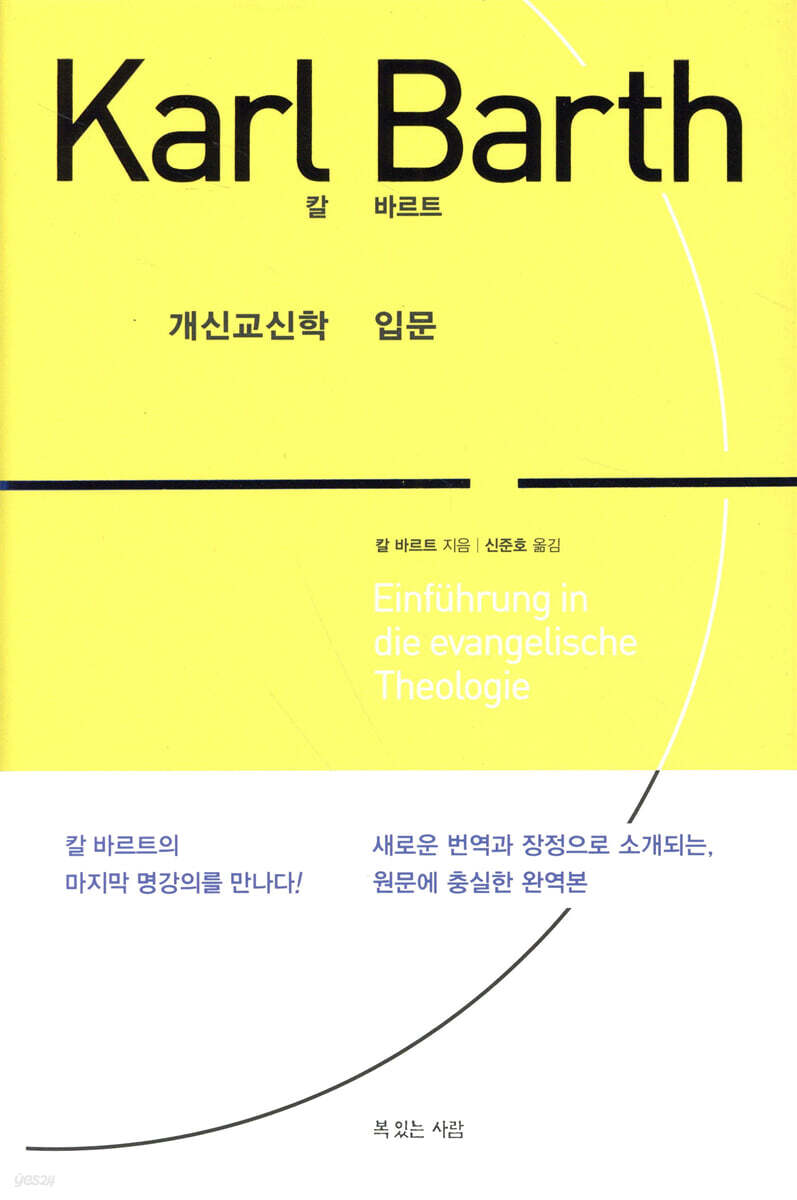 |
Description
Book Introduction
Meet Karl Barth's last famous lecture!
A complete translation faithful to the original text, presented with a new translation and cover.
Recommended by Professors Yoo Hae-mu, Jeong Mi-hyeon, and Kim Jin-hyeok
This book is the only introductory book that contains the essence of Karl Barth's theology!
This is the content of the last lecture given by Karl Barth, the greatest theologian of the 20th century, at the University of Basel in the winter of 1961-1962.
In this lecture, which concludes his 40-year teaching career, he concisely summarizes what he has pursued, learned, and argued in the field of 'Protestant theology.'
This book is the final work of the great old theologian and a key to exploring Barth's extensive Church Dogmatics as well as his broad theology.
According to Barth, among those who believe in God, “there is no one who is not a theologian,” so ultimately, the model of “true theology” that Barth shows in this book is the path that all Christians must learn and follow.
This book will be an excellent introductory text for those exploring the theology of Karl Barth, pastors and seminarians who study and teach theology, and all believers, allowing them to experience the true essence of theology.
A complete translation faithful to the original text, presented with a new translation and cover.
Recommended by Professors Yoo Hae-mu, Jeong Mi-hyeon, and Kim Jin-hyeok
This book is the only introductory book that contains the essence of Karl Barth's theology!
This is the content of the last lecture given by Karl Barth, the greatest theologian of the 20th century, at the University of Basel in the winter of 1961-1962.
In this lecture, which concludes his 40-year teaching career, he concisely summarizes what he has pursued, learned, and argued in the field of 'Protestant theology.'
This book is the final work of the great old theologian and a key to exploring Barth's extensive Church Dogmatics as well as his broad theology.
According to Barth, among those who believe in God, “there is no one who is not a theologian,” so ultimately, the model of “true theology” that Barth shows in this book is the path that all Christians must learn and follow.
This book will be an excellent introductory text for those exploring the theology of Karl Barth, pastors and seminarians who study and teach theology, and all believers, allowing them to experience the true essence of theology.
index
preface
01 What is ‘Protestant Theology’?
I The Place of Theology
02 Words
03 Witnesses
04 Community
05 Holy Spirit
II Theological Existence
06 Surprise
07 Embarrassment
08 Duty
09 Faith
III The Crisis of Theology
10 Solitude
11 Doubts
12 Tests
13 Hope
IV Theological Work
14 Prayer
15 studies
16 Service
17 Love
main
Translator's Note
01 What is ‘Protestant Theology’?
I The Place of Theology
02 Words
03 Witnesses
04 Community
05 Holy Spirit
II Theological Existence
06 Surprise
07 Embarrassment
08 Duty
09 Faith
III The Crisis of Theology
10 Solitude
11 Doubts
12 Tests
13 Hope
IV Theological Work
14 Prayer
15 studies
16 Service
17 Love
main
Translator's Note
Into the book
Protestant theology recognizes, understands, and articulates the God of the gospel, that is, the God who makes himself known in the gospel, who speaks to humanity, and who acts among and with humanity (in precisely the way that God himself directs!).
Protestant theology exists precisely where God becomes the object of human learning, where events occur in which He becomes the source and norm of theology.
--- p.11, 「01.
From "What is 'Protestant Theology'?"
It is clear that Protestant theology, a discipline that is humble, free, critical, and joyful before the God of the Gospel, becomes possible and real only within the powerful realm of the Holy Spirit.
At that time, Protestant theology becomes a pneumatological theology, and it stands in the courageous confidence that only the Holy Spirit is truth and alone asks and answers questions of truth.
How can theology become the human word (Logik) for the divine Logos (Logos)? It cannot do so on its own.
However, it can happen that the Holy Spirit comes upon and to theology.
At that time, theology could not block or control the Holy Spirit, but rather could only follow Him joyfully.
When theology without the Holy Spirit pushes its own agenda from the pulpit or the pulpit, from the printed page or in the “conversation” between theologians old and young, it becomes the most appalling of all the horrors of the earthly valleys.
The worst political commentary in the newspaper, the most clumsy romantic novel or film, the most evil nocturnal misdeeds of a scoundrel, are no worse than such a theology without the Holy Spirit.
--- p.64, 「05.
From "The Holy Spirit"
Theological work becomes right and useful before God and man only when it has passed through the fire again and again.
Theological works must always be exposed anew to this fire (this is the fire of God's love, but it is a burning, hot fire) and must pass through it.
Only what remains then? According to 1 Corinthians 3:12, only gold, silver, and precious stones? These are what please God and can save the church and the world.
Passing through that fire is the test.
In this trial… … even the deepest loneliness within theology, and the most extreme doubts that plague theology, are but child’s play.
Only when the theologian encounters God who opposes him throughout his journey can he encounter God who helps him.
Only by joyfully accepting this fact can the theologian also exist for God.
--- p.150-151, 「12.
From "Test"
The first fundamental act of theological work is prayer.
This fact will continue to be underscored in the subsequent developments.
Of course, theological work is from the beginning and continues without interruption to be study (Studium), and the entire theological work is service (Dienst). … … Moreover, theological work would be of no use if it were not an act of love… …
However, theological work must not only begin with prayer and be accompanied by prayer, but must also be carried out within prayer.
This is the special characteristic of theological work.
Protestant theology exists precisely where God becomes the object of human learning, where events occur in which He becomes the source and norm of theology.
--- p.11, 「01.
From "What is 'Protestant Theology'?"
It is clear that Protestant theology, a discipline that is humble, free, critical, and joyful before the God of the Gospel, becomes possible and real only within the powerful realm of the Holy Spirit.
At that time, Protestant theology becomes a pneumatological theology, and it stands in the courageous confidence that only the Holy Spirit is truth and alone asks and answers questions of truth.
How can theology become the human word (Logik) for the divine Logos (Logos)? It cannot do so on its own.
However, it can happen that the Holy Spirit comes upon and to theology.
At that time, theology could not block or control the Holy Spirit, but rather could only follow Him joyfully.
When theology without the Holy Spirit pushes its own agenda from the pulpit or the pulpit, from the printed page or in the “conversation” between theologians old and young, it becomes the most appalling of all the horrors of the earthly valleys.
The worst political commentary in the newspaper, the most clumsy romantic novel or film, the most evil nocturnal misdeeds of a scoundrel, are no worse than such a theology without the Holy Spirit.
--- p.64, 「05.
From "The Holy Spirit"
Theological work becomes right and useful before God and man only when it has passed through the fire again and again.
Theological works must always be exposed anew to this fire (this is the fire of God's love, but it is a burning, hot fire) and must pass through it.
Only what remains then? According to 1 Corinthians 3:12, only gold, silver, and precious stones? These are what please God and can save the church and the world.
Passing through that fire is the test.
In this trial… … even the deepest loneliness within theology, and the most extreme doubts that plague theology, are but child’s play.
Only when the theologian encounters God who opposes him throughout his journey can he encounter God who helps him.
Only by joyfully accepting this fact can the theologian also exist for God.
--- p.150-151, 「12.
From "Test"
The first fundamental act of theological work is prayer.
This fact will continue to be underscored in the subsequent developments.
Of course, theological work is from the beginning and continues without interruption to be study (Studium), and the entire theological work is service (Dienst). … … Moreover, theological work would be of no use if it were not an act of love… …
However, theological work must not only begin with prayer and be accompanied by prayer, but must also be carried out within prayer.
This is the special characteristic of theological work.
--- p.173, 「14.
From “Prayer”
From “Prayer”
Publisher's Review
The last lecture of Karl Barth, the great theological father of the 20th century!
Introduction to Protestant Theology is, as Karl Barth himself puts it, his final work.
In this book, Barth reflects on his past, when he devoted himself to theology and dogmatics in the twilight of his life, and presents the center and outline of the vast theology he pursued, learned, and attempted to assert.
So, although this book is chronologically the last lecture in Barth's life, it is an appropriate "introductory book" to start with for those who wish to explore the depth of God's word through his theology.
"Introduction to Protestant Theology" opens up a perspective on the entirety of Protestant theology, encompassing fundamentalism, evangelicalism, orthodoxy, and liberalism.
This book is a theologian's lifelong, earnest response to the Word of God revealing Himself in history, and furthermore, it is a "prayer."
Through this book, which serves as a guide to what “Protestant theology” should be and what attitude we should have as we embark on the path of theology, we will be able to correctly diagnose the crisis in the Korean church caused by the crisis in theology.
This is not a book to be read once and put aside. It is a book that should accompany us throughout our lives, not only as we explore Barth's Church Dogmatics but also Protestant theology in general.
characteristic
- An introductory book that compiles the theology of Karl Barth, the greatest theologian of the 20th century.
- Karl Barth's 『Church Dogmatics』 is an important book that serves as a key word for understanding his theology.
- The essence of Karl Barth's theology, presented in a faithful translation and new edition.
For readers
- Those who are interested in the theology of Karl Barth or are studying Karl Barth.
- Seminary students, pastors, and theologians who study and teach theology.
- All Christians who desire to know and believe in God correctly.
Introduction to Protestant Theology is, as Karl Barth himself puts it, his final work.
In this book, Barth reflects on his past, when he devoted himself to theology and dogmatics in the twilight of his life, and presents the center and outline of the vast theology he pursued, learned, and attempted to assert.
So, although this book is chronologically the last lecture in Barth's life, it is an appropriate "introductory book" to start with for those who wish to explore the depth of God's word through his theology.
"Introduction to Protestant Theology" opens up a perspective on the entirety of Protestant theology, encompassing fundamentalism, evangelicalism, orthodoxy, and liberalism.
This book is a theologian's lifelong, earnest response to the Word of God revealing Himself in history, and furthermore, it is a "prayer."
Through this book, which serves as a guide to what “Protestant theology” should be and what attitude we should have as we embark on the path of theology, we will be able to correctly diagnose the crisis in the Korean church caused by the crisis in theology.
This is not a book to be read once and put aside. It is a book that should accompany us throughout our lives, not only as we explore Barth's Church Dogmatics but also Protestant theology in general.
characteristic
- An introductory book that compiles the theology of Karl Barth, the greatest theologian of the 20th century.
- Karl Barth's 『Church Dogmatics』 is an important book that serves as a key word for understanding his theology.
- The essence of Karl Barth's theology, presented in a faithful translation and new edition.
For readers
- Those who are interested in the theology of Karl Barth or are studying Karl Barth.
- Seminary students, pastors, and theologians who study and teach theology.
- All Christians who desire to know and believe in God correctly.
GOODS SPECIFICS
- Date of publication: October 15, 2014
- Page count, weight, size: 232 pages | 137*210*20mm
- ISBN13: 9791170830191
- ISBN10: 1170830196
You may also like
카테고리
korean


korean

![GQ KOREA Mark (Monthly): December [2025]](http://librairie.coreenne.fr/cdn/shop/files/8ef265dbbfbf186523ed75ba7319009d.jpg?v=1765340328&width=3840)


