

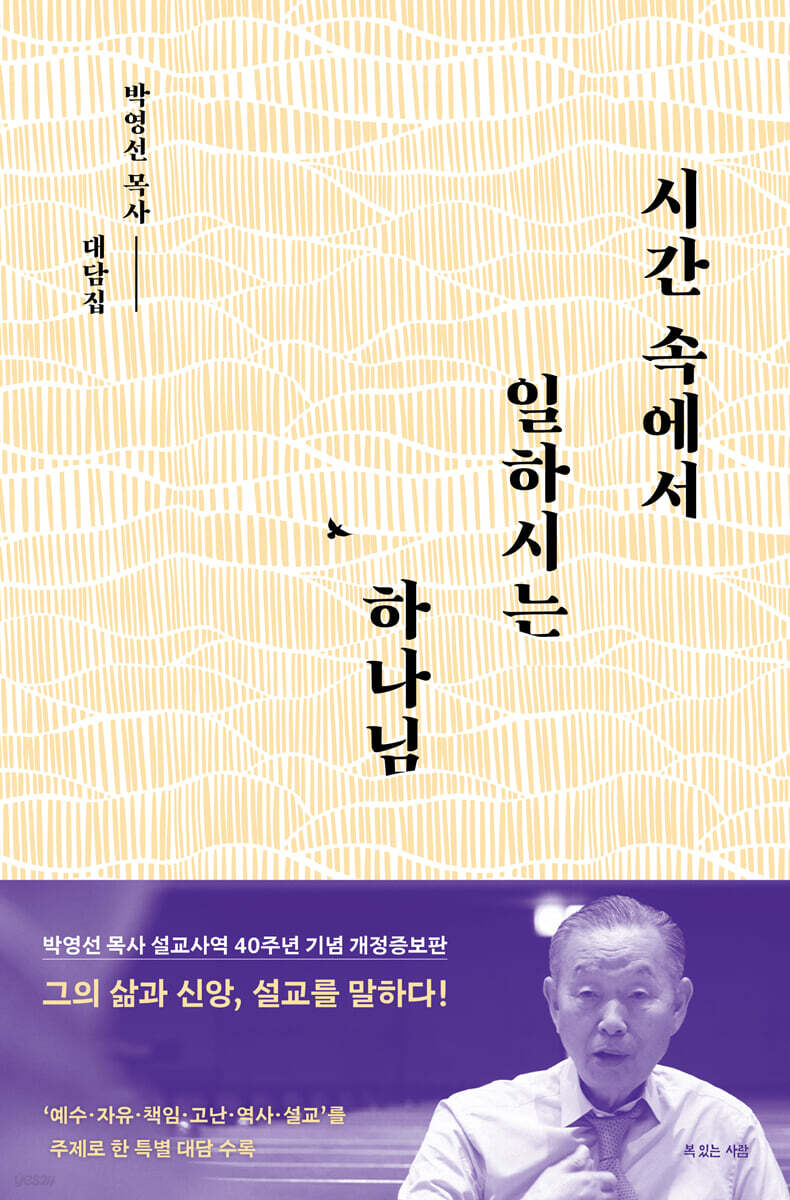
God who works in time
 |
Description
Book Introduction
Revised and Expanded Edition to Commemorate the 40th Anniversary of Pastor Park Young-sun's Preaching Ministry
“Talk about his life, faith, and sermons!”
Pastor Park Young-seon's second half of his preaching ministry and
Includes special conversations on the topics of 'Jesus, freedom, responsibility, suffering, history, and preaching.'
This book is a revised and expanded edition of “God Working in Time,” which contains the life, faith, and preaching ministry of Pastor Park Young-seon.
In addition to the existing content, this book includes a special interview conducted over eight sessions to commemorate the 40th anniversary of Pastor Park Young-sun's preaching ministry.
This will be an opportunity to take a three-dimensional look at the second half of Pastor Park Young-sun's preaching ministry, which has changed over the past ten years, following his first half.
Above all, through this book, readers will hear “honest confessions that reveal the inner struggles, anguish, and struggles of the soul” that form the basis of his sermons.
It will especially bring comfort and great empathy to Christians who struggle with pain, despair, and unresolved problems in life on their journey of faith.
“I believe this book is a testimony to the breadth and depth of what God creates in our journey of faith.
I have clearly walked a path that does not align with the universal faith of the Korean church in which I grew up.
The faith I learned in church was a path of conviction and example, but I was led down a path of worry and reflection.
We realize that rejection and doubt are also important processes and contents of faith.
Such things also happen because God, the Christian faith, and the existence of believers are greater and deeper than we think.
Therefore, not only clear faith, but also ambiguity and doubt were areas where God reigned and made Himself known.
“Through suffering, pain, and despair, God helps us realize the deeper meaning of our faith.”
“Talk about his life, faith, and sermons!”
Pastor Park Young-seon's second half of his preaching ministry and
Includes special conversations on the topics of 'Jesus, freedom, responsibility, suffering, history, and preaching.'
This book is a revised and expanded edition of “God Working in Time,” which contains the life, faith, and preaching ministry of Pastor Park Young-seon.
In addition to the existing content, this book includes a special interview conducted over eight sessions to commemorate the 40th anniversary of Pastor Park Young-sun's preaching ministry.
This will be an opportunity to take a three-dimensional look at the second half of Pastor Park Young-sun's preaching ministry, which has changed over the past ten years, following his first half.
Above all, through this book, readers will hear “honest confessions that reveal the inner struggles, anguish, and struggles of the soul” that form the basis of his sermons.
It will especially bring comfort and great empathy to Christians who struggle with pain, despair, and unresolved problems in life on their journey of faith.
“I believe this book is a testimony to the breadth and depth of what God creates in our journey of faith.
I have clearly walked a path that does not align with the universal faith of the Korean church in which I grew up.
The faith I learned in church was a path of conviction and example, but I was led down a path of worry and reflection.
We realize that rejection and doubt are also important processes and contents of faith.
Such things also happen because God, the Christian faith, and the existence of believers are greater and deeper than we think.
Therefore, not only clear faith, but also ambiguity and doubt were areas where God reigned and made Himself known.
“Through suffering, pain, and despair, God helps us realize the deeper meaning of our faith.”
- You can preview some of the book's contents.
Preview
index
Preface to the Revised and Expanded Edition
Preface to the first edition
Part 1 Grace and Faith
01 God works in time
02 The Holy Spirit became the center of the sermon.
03 Faith is not causality
04 The certainty of salvation is explained as being based on predestination.
05 Faith is knowing God
06 The mystery of the Holy Spirit lies in dependence.
07 The Church is under the rule of Christ
08 Now the Korean Church Must Prepare for the Future
09 It must be a sermon that captures the realities of life.
Part 2 Freedom and Love
10 Jesus Changes the World
11 Freedom, given to establish relationships
12 Responsibility, taking responsibility
13 Hardship, breaking the mold
14 History is God's work
15 Sermons: Connecting God's Will to Human Reality
Creative Preacher
Preacher of Grace
Preface to the first edition
Part 1 Grace and Faith
01 God works in time
02 The Holy Spirit became the center of the sermon.
03 Faith is not causality
04 The certainty of salvation is explained as being based on predestination.
05 Faith is knowing God
06 The mystery of the Holy Spirit lies in dependence.
07 The Church is under the rule of Christ
08 Now the Korean Church Must Prepare for the Future
09 It must be a sermon that captures the realities of life.
Part 2 Freedom and Love
10 Jesus Changes the World
11 Freedom, given to establish relationships
12 Responsibility, taking responsibility
13 Hardship, breaking the mold
14 History is God's work
15 Sermons: Connecting God's Will to Human Reality
Creative Preacher
Preacher of Grace
Into the book
[Cho Joo-seok] You said that faith is formed over time. From that perspective, what do you think the Korean church has missed?
[Park Young-sun] In the Korean church, the gospel is clearly tilted toward epistemology.
Because the gospel is only expressed in terms like “it is moving, brings peace, overflows, and…”, when I become discouraged or frustrated by something, my Christian faith itself shrinks.
My feelings, my convictions, my will have become the foundation.
At first they were confessed as fruits, but later they became the basis, not the fruits.
In fact, the gospel is “God exists, God is the Creator, God is the Judge, God loves us.”
“He created this earth and He created me, and He is good and unchanging,” is the only basis for optimism that only a Christian can have.
But the Korean church is lacking in this area.
It's too easy to say that the thrill of the gospel that comes from Christian faith can make your entire life prosperous.
It is 100 percent correct to say, “The gospel is moving.”
However, the Korean church has not been able to provide an answer to the question, “How does God require the world to live?”
It's like I'm just so moved that I suddenly feel like it's all over and all that's left is to tell other people.
So, evangelism has become a very important part of our faith.
But the richness of the Christian faith and the certainty of its inevitable victory are the very foundation of the gospel.
It is said that it is presupposed in God's being God, and that knowing this is the richness of the Christian faith.
The truth is that we must know God.
We must walk with God.
As the reformers argued, it means standing 'coram Deo', that is, 'before God'.
That is a joy and an honor.
It is a glory according to God's calling.
--- p.18-19, from “01 God Works in Time”
[Cho Joo-seok] When speaking about the Holy Spirit, he used specific examples such as David, Peter, and Paul.
They also confirmed that they were beings who could not be completely free from self-righteousness in the matter of their actions.
So how should we understand this doing?
[Park Young-sun] If you think of faith as a condition, it always goes to causality.
And when discussing the issue of justification in the matter of salvation, we make the mistake of viewing faith and works as opposing concepts.
Faith is not a law of causality, but a law of grace.
However, there is a law of cause and effect when it comes to obtaining salvation and living as God's people.
There is a causal law of obedience and disobedience, not a causal law of qualification and condition.
But that is not the law of cause and effect that determines fate.
As it is written in the last part of 1 Corinthians 15, God comes out as the one who gives us victory in Jesus Christ.
He gives us resurrection and victory over death.
So, we believe that obedience is not only a duty that we must do as believers, but also a glory and privilege that believers can choose.
By actively participating in the work that God leads, we actively participate in God's calling in Jesus, just as Jesus willingly became incarnate and suffered, and just as God the Son participated in the Father's joy.
But if you disobey, you cannot enjoy that joy and glory.
Even so, I believe that God will make all our results victorious.
[Cho Joo-seok] So, if we are wrong, we can think of the issue of faith as a matter of setting rules or regulations and putting them into practice.
For example, “You must evangelize twice a week” or “You must read a certain number of chapters of the Bible.”
If you do all that, you can say, “Ah, I did well in my religious life.”
What do you think about such risks?
[Park Young-sun] Discipline should not, in any way, force the laws of conduct, even passively.
As a concept of training, it is correct.
It can be actively used to set rules in terms of the concept of training and the level of achievement through training.
Training is a process that allows for joy and pride in the amount of achievements you make.
But legalistic thinking is always connected.
Because it becomes “I am different from you.”
It is truly dangerous to have a sense of satisfaction or confidence that is based on one's own beliefs.
--- p.155-156, from “06 The Mystery of Sanctification Lies in Dependence”
[Cho Joo-seok] I think the doubts we face in our religious life are also related to hardship.
[Park Young-sun] There is an expression called ‘night of the soul.’
They say it comes when faith is lost and everything becomes meaningless.
But we must think of faith this way.
Faith itself is not a methodology that I have, but God's methodology.
Faith is not my assurance, but God's declaration that He will work this way.
But those who are in doubt go back to the beginning and ask themselves whether God exists or not, and whether to believe in God or not.
When things are going well for me, God is God and my faith is faith-like, but when I am shaken in reality, it is natural to doubt not only God but also myself.
Isn't adolescence a time like that in our lives? "Are my parents really my parents?" "Can I live up to their expectations and goals?" Our own thoughts often differ from our parents' expectations.
So if you ask me what I think, I would say I don't know right now and I definitely don't like it.
Isn't adolescence the most crucial period for a person's growth? Without that resistance, one might not mature as a human being.
What we learn from those times is that there are limits.
That's the most important thing.
The reason we must realize our limitations is because they concretely create the essence of our own identity.
Knowing that there is neither that nor this, and that I am only this much, is not the limit.
Limits are what make you real, what you actually testify, what you actually do, and what you actually produce results.
What if you and I are indistinguishable, and objects and I are indistinguishable? Then, only ideas will float around, and there will be no real person, no place, no share.
They said my seat was like a piano keyboard.
If you press me, I should hear that sound.
Limits are that specific.
So, as I am united with others and things, God creates a song of praise and glory.
That is the ultimate purpose of creation.
We are going in that direction.
--- p.370, from “13 Hardships, Breaking the Frame”
[Cho Joo-seok] Even though “God did not give us power,” it seems easier for us to demand power than to serve.
[Park Young-sun] I think the biggest reason we aim to be a large church is because we want to have a numerical advantage and prove our role by sharing financially.
However, I believe that the church should have fellowship where its members can offer each other comfort and build solidarity.
The reason it is said, “The church is his body, the fullness of him who fills all in all” (Ephesians 1:23) is because it cannot reveal everything on its own.
It's like singing in a choir.
All who gather in one church reveal his abundance in the midst of numerous fellowships.
It's about participating in things I haven't experienced or done, sharing love, and being on the side of others.
This is what the Trinity, which has permitted the church, calls us to, into communion and close union with Him.
“Go and be Emmanuel among the people of the world.
Be a comfort and a hope to them.” When they see you, you should not be a religious person, but stand among them as a witness who makes them feel that this is what a human being ought to be.
This is how I understand the church.
--- p.400-401, from “14 History, God’s Work”
[Cho Joo-seok] He said this about the act of preaching.
“Preaching is the act of cooking edible food using the ingredients of the Bible.
When the time comes, you should boil some ramen.
“We must constantly provide food for the soul.” It occurred to me that a preacher is more like a housewife or mother than a professional chef.
[Park Young-sun] A preacher must be a person of his time.
This means that when you are born and preach, you are in the same environment and conditions as your audience.
So, the preacher should not think that he is in a holy place, separate from the audience.
The preacher must be incarnate.
It's about worrying and struggling together with them.
It's not that the preacher has all the answers.
There is an illustration that I often use in my sermons and in my faith counseling.
"If you go to a restaurant to eat, and you see a menu listing the calories for rice, meat, vegetables, etc., but no food comes out, how does that make sense? What if a preacher tells his audience that certain foods will give them energy, certain foods will make them fat, and certain foods are bad for them, and then ends the conversation?" They just show the menu and the food doesn't come out.
The fact that a meal is served is like confirming that God is holding me and guiding me today as well.
That's really a bowl of rice.
[Park Young-sun] In the Korean church, the gospel is clearly tilted toward epistemology.
Because the gospel is only expressed in terms like “it is moving, brings peace, overflows, and…”, when I become discouraged or frustrated by something, my Christian faith itself shrinks.
My feelings, my convictions, my will have become the foundation.
At first they were confessed as fruits, but later they became the basis, not the fruits.
In fact, the gospel is “God exists, God is the Creator, God is the Judge, God loves us.”
“He created this earth and He created me, and He is good and unchanging,” is the only basis for optimism that only a Christian can have.
But the Korean church is lacking in this area.
It's too easy to say that the thrill of the gospel that comes from Christian faith can make your entire life prosperous.
It is 100 percent correct to say, “The gospel is moving.”
However, the Korean church has not been able to provide an answer to the question, “How does God require the world to live?”
It's like I'm just so moved that I suddenly feel like it's all over and all that's left is to tell other people.
So, evangelism has become a very important part of our faith.
But the richness of the Christian faith and the certainty of its inevitable victory are the very foundation of the gospel.
It is said that it is presupposed in God's being God, and that knowing this is the richness of the Christian faith.
The truth is that we must know God.
We must walk with God.
As the reformers argued, it means standing 'coram Deo', that is, 'before God'.
That is a joy and an honor.
It is a glory according to God's calling.
--- p.18-19, from “01 God Works in Time”
[Cho Joo-seok] When speaking about the Holy Spirit, he used specific examples such as David, Peter, and Paul.
They also confirmed that they were beings who could not be completely free from self-righteousness in the matter of their actions.
So how should we understand this doing?
[Park Young-sun] If you think of faith as a condition, it always goes to causality.
And when discussing the issue of justification in the matter of salvation, we make the mistake of viewing faith and works as opposing concepts.
Faith is not a law of causality, but a law of grace.
However, there is a law of cause and effect when it comes to obtaining salvation and living as God's people.
There is a causal law of obedience and disobedience, not a causal law of qualification and condition.
But that is not the law of cause and effect that determines fate.
As it is written in the last part of 1 Corinthians 15, God comes out as the one who gives us victory in Jesus Christ.
He gives us resurrection and victory over death.
So, we believe that obedience is not only a duty that we must do as believers, but also a glory and privilege that believers can choose.
By actively participating in the work that God leads, we actively participate in God's calling in Jesus, just as Jesus willingly became incarnate and suffered, and just as God the Son participated in the Father's joy.
But if you disobey, you cannot enjoy that joy and glory.
Even so, I believe that God will make all our results victorious.
[Cho Joo-seok] So, if we are wrong, we can think of the issue of faith as a matter of setting rules or regulations and putting them into practice.
For example, “You must evangelize twice a week” or “You must read a certain number of chapters of the Bible.”
If you do all that, you can say, “Ah, I did well in my religious life.”
What do you think about such risks?
[Park Young-sun] Discipline should not, in any way, force the laws of conduct, even passively.
As a concept of training, it is correct.
It can be actively used to set rules in terms of the concept of training and the level of achievement through training.
Training is a process that allows for joy and pride in the amount of achievements you make.
But legalistic thinking is always connected.
Because it becomes “I am different from you.”
It is truly dangerous to have a sense of satisfaction or confidence that is based on one's own beliefs.
--- p.155-156, from “06 The Mystery of Sanctification Lies in Dependence”
[Cho Joo-seok] I think the doubts we face in our religious life are also related to hardship.
[Park Young-sun] There is an expression called ‘night of the soul.’
They say it comes when faith is lost and everything becomes meaningless.
But we must think of faith this way.
Faith itself is not a methodology that I have, but God's methodology.
Faith is not my assurance, but God's declaration that He will work this way.
But those who are in doubt go back to the beginning and ask themselves whether God exists or not, and whether to believe in God or not.
When things are going well for me, God is God and my faith is faith-like, but when I am shaken in reality, it is natural to doubt not only God but also myself.
Isn't adolescence a time like that in our lives? "Are my parents really my parents?" "Can I live up to their expectations and goals?" Our own thoughts often differ from our parents' expectations.
So if you ask me what I think, I would say I don't know right now and I definitely don't like it.
Isn't adolescence the most crucial period for a person's growth? Without that resistance, one might not mature as a human being.
What we learn from those times is that there are limits.
That's the most important thing.
The reason we must realize our limitations is because they concretely create the essence of our own identity.
Knowing that there is neither that nor this, and that I am only this much, is not the limit.
Limits are what make you real, what you actually testify, what you actually do, and what you actually produce results.
What if you and I are indistinguishable, and objects and I are indistinguishable? Then, only ideas will float around, and there will be no real person, no place, no share.
They said my seat was like a piano keyboard.
If you press me, I should hear that sound.
Limits are that specific.
So, as I am united with others and things, God creates a song of praise and glory.
That is the ultimate purpose of creation.
We are going in that direction.
--- p.370, from “13 Hardships, Breaking the Frame”
[Cho Joo-seok] Even though “God did not give us power,” it seems easier for us to demand power than to serve.
[Park Young-sun] I think the biggest reason we aim to be a large church is because we want to have a numerical advantage and prove our role by sharing financially.
However, I believe that the church should have fellowship where its members can offer each other comfort and build solidarity.
The reason it is said, “The church is his body, the fullness of him who fills all in all” (Ephesians 1:23) is because it cannot reveal everything on its own.
It's like singing in a choir.
All who gather in one church reveal his abundance in the midst of numerous fellowships.
It's about participating in things I haven't experienced or done, sharing love, and being on the side of others.
This is what the Trinity, which has permitted the church, calls us to, into communion and close union with Him.
“Go and be Emmanuel among the people of the world.
Be a comfort and a hope to them.” When they see you, you should not be a religious person, but stand among them as a witness who makes them feel that this is what a human being ought to be.
This is how I understand the church.
--- p.400-401, from “14 History, God’s Work”
[Cho Joo-seok] He said this about the act of preaching.
“Preaching is the act of cooking edible food using the ingredients of the Bible.
When the time comes, you should boil some ramen.
“We must constantly provide food for the soul.” It occurred to me that a preacher is more like a housewife or mother than a professional chef.
[Park Young-sun] A preacher must be a person of his time.
This means that when you are born and preach, you are in the same environment and conditions as your audience.
So, the preacher should not think that he is in a holy place, separate from the audience.
The preacher must be incarnate.
It's about worrying and struggling together with them.
It's not that the preacher has all the answers.
There is an illustration that I often use in my sermons and in my faith counseling.
"If you go to a restaurant to eat, and you see a menu listing the calories for rice, meat, vegetables, etc., but no food comes out, how does that make sense? What if a preacher tells his audience that certain foods will give them energy, certain foods will make them fat, and certain foods are bad for them, and then ends the conversation?" They just show the menu and the food doesn't come out.
The fact that a meal is served is like confirming that God is holding me and guiding me today as well.
That's really a bowl of rice.
--- p.448-449, from “Sermon 15: Connecting God’s Will to Human Reality”
Publisher's Review
Pastor Park Young-sun, "God's Zeal," Why Is His Sermons Reviving Our Times?
Pastor Park Young-sun is a representative preacher of our time, a "pastor of pastors" who has led countless pastors to crossroads of decision, and an author of dozens of books, including his masterpiece, "God's Zeal."
Having served as a preacher for over 40 years, he has recently been providing comfort and hope to many believers through online sermons and his YouTube channel.
Why is the Korean church, which has passed the revival period and is facing the challenges of the next era, paying attention to his sermons again?
In this book, the interviewer explains why his sermons are still so beloved by people from all walks of life, saying, “It may be because they provide a fresh answer to the frustration of those who still struggle to understand what faith and grace are.”
In addition, he notes the creativity of Pastor Park Young-sun's sermons.
“His sermons are filled with questions and answers he finds in the Bible.
“So the teachings on the life of salvation that he explored are unique and creative.”
In conclusion, what is the truth that Pastor Park Young-sun, as a preacher, is trying to convey to the younger generation?
“When I preach, it means that God is working today and asking me to proclaim what He is doing.
Every time I preach, I tell you how great God's promises and purposes are for humanity, its destiny, its value, its status, and its position, and how much He is working on them now.
This is my pride.”
characteristic
- Revised and expanded edition commemorating the 40th anniversary of Pastor Park Young-seon's preaching ministry.
Read his life, faith, and sermons in one book.
- Pastor Park Young-sun's second half sermon ministry and a special conversation on the topics of 'Jesus, freedom, responsibility, suffering, history, and preaching' have been added.
For readers
- Christians who struggle with pain, despair, and unresolved life problems on their journey of faith
- Those who are concerned about the direction in which this era and the church should move forward.
- Pastors, missionary group workers, and seminarians who proclaim and spread the word in the field
- Readers who enjoy Pastor Park Young-sun's books
Pastor Park Young-sun is a representative preacher of our time, a "pastor of pastors" who has led countless pastors to crossroads of decision, and an author of dozens of books, including his masterpiece, "God's Zeal."
Having served as a preacher for over 40 years, he has recently been providing comfort and hope to many believers through online sermons and his YouTube channel.
Why is the Korean church, which has passed the revival period and is facing the challenges of the next era, paying attention to his sermons again?
In this book, the interviewer explains why his sermons are still so beloved by people from all walks of life, saying, “It may be because they provide a fresh answer to the frustration of those who still struggle to understand what faith and grace are.”
In addition, he notes the creativity of Pastor Park Young-sun's sermons.
“His sermons are filled with questions and answers he finds in the Bible.
“So the teachings on the life of salvation that he explored are unique and creative.”
In conclusion, what is the truth that Pastor Park Young-sun, as a preacher, is trying to convey to the younger generation?
“When I preach, it means that God is working today and asking me to proclaim what He is doing.
Every time I preach, I tell you how great God's promises and purposes are for humanity, its destiny, its value, its status, and its position, and how much He is working on them now.
This is my pride.”
characteristic
- Revised and expanded edition commemorating the 40th anniversary of Pastor Park Young-seon's preaching ministry.
Read his life, faith, and sermons in one book.
- Pastor Park Young-sun's second half sermon ministry and a special conversation on the topics of 'Jesus, freedom, responsibility, suffering, history, and preaching' have been added.
For readers
- Christians who struggle with pain, despair, and unresolved life problems on their journey of faith
- Those who are concerned about the direction in which this era and the church should move forward.
- Pastors, missionary group workers, and seminarians who proclaim and spread the word in the field
- Readers who enjoy Pastor Park Young-sun's books
GOODS SPECIFICS
- Date of issue: September 25, 2023
- Page count, weight, size: 464 pages | 143*217*30mm
- ISBN13: 9791170830160
- ISBN10: 1170830161
You may also like
카테고리
korean


korean

![GQ KOREA Mark (Monthly): December [2025]](http://librairie.coreenne.fr/cdn/shop/files/8ef265dbbfbf186523ed75ba7319009d.jpg?v=1765340328&width=3840)


