

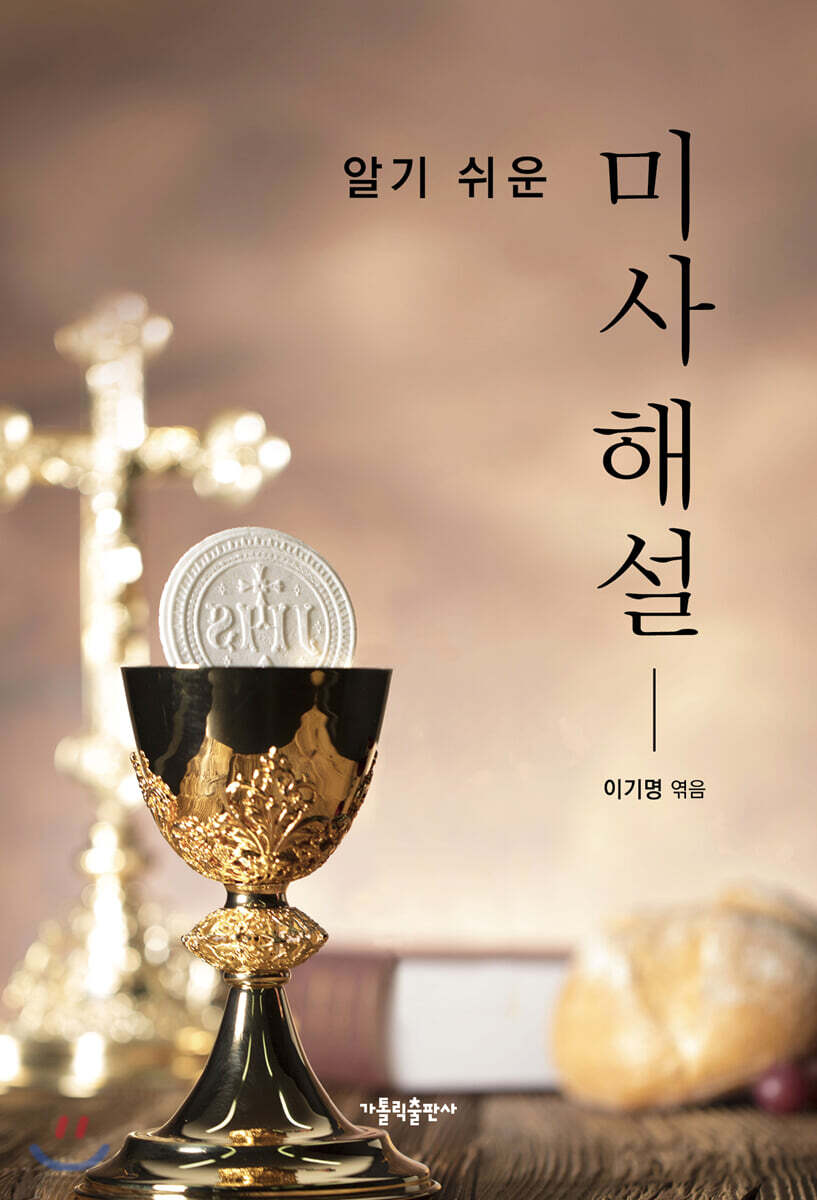
Easy-to-understand Mass commentary
 |
Description
Book Introduction
If you are a Catholic, you must attend Mass every week. Let's make the meaning of Mass easier to understand!
If you are a Catholic, you go to mass every week.
However, it seems that there are not many believers who properly understand the meaning of the Mass ceremony and attend the Mass.
If you do not properly understand the meaning contained in the Mass rite, you will have a vague understanding of the various rituals performed by the faithful during the Mass.
『Easy to Understand Mass Commentary』 published by Catholic Publishing House is a 'Mass Commentary' that kindly explains the Mass according to the order of the Mass so that even beginners who are not yet familiar with the Mass can easily become familiar with it.
Since its first edition in 1974, 『Easy-to-Understand Commentary on the Mass』, which has long been loved by Catholics beginning to attend Mass, has been refurbished and reissued in a new edition.
If you are a Catholic, you go to mass every week.
However, it seems that there are not many believers who properly understand the meaning of the Mass ceremony and attend the Mass.
If you do not properly understand the meaning contained in the Mass rite, you will have a vague understanding of the various rituals performed by the faithful during the Mass.
『Easy to Understand Mass Commentary』 published by Catholic Publishing House is a 'Mass Commentary' that kindly explains the Mass according to the order of the Mass so that even beginners who are not yet familiar with the Mass can easily become familiar with it.
Since its first edition in 1974, 『Easy-to-Understand Commentary on the Mass』, which has long been loved by Catholics beginning to attend Mass, has been refurbished and reissued in a new edition.
- You can preview some of the book's contents.
Preview
index
Introduction 7
Commentary on Mass Etiquette 15
Commencement Ceremony 19
Liturgy of the Word 25
Liturgy of the Eucharist 30
Prayer of Thanksgiving 34
Communion Rite 40
Ceremony 46
Offering color 49
Inside the Cathedral 54
Altar and Altar 56
Basilica, vestments 57
Church Feast Day Guide 58
Commentary on Mass Etiquette 15
Commencement Ceremony 19
Liturgy of the Word 25
Liturgy of the Eucharist 30
Prayer of Thanksgiving 34
Communion Rite 40
Ceremony 46
Offering color 49
Inside the Cathedral 54
Altar and Altar 56
Basilica, vestments 57
Church Feast Day Guide 58
Into the book
The Holy Mass is “This is my body given for you.
It is a reenactment of the Last Supper, where Jesus mystically offered his body and blood, saying, “Do this in remembrance of me” (Luke 22:19).
--- From the "Introduction"
The entrance hymn contains the profound meaning of the Mass that day, the meaning of the feast, and the supernatural orientation we should have.
--- From the 'Entrance Song' in the 'Opening Ceremony'
“The Lord be with you!” is the same greeting the resurrected Christ gave to his disciples each time he appeared to them: “Peace be with you.”
--- In the ‘Greetings’ section of the ‘Opening Ceremony’
The Gloria begins with the song of the angels in Bethlehem praising the birth of the Savior, then gives praise to God the Father, then praises the divinity of Christ, the Son of God, and praises his saving works and the glory he received because of them.
Then we end with praise and thanksgiving to the Holy Spirit and praise to the Trinity.
It is a confession of faith and a song of gratitude.
--- From the 'Great Glory Song' in the 'Opening Ceremony'
It is the culmination of the Liturgy of the Word, and is followed by special reverence before and after the reading of the Gospel.
When a priest bows toward the altar and prays before reading the Gospel, he is asking God to cleanse his heart and tongue to read the Gospel, as the Old Testament prophet Isaiah did.
--- From the ‘Gospel’ in the ‘Liturgy of the Word’
The Apostles' Creed is our response of faith to the message of the Gospel.
This prayer, along with the Lord's Prayer, has been used since the early days of the Church, and is the first prayer that new believers recite at baptism as a sign of their acceptance of the true faith of the Catholic Church.
--- From the ‘Confession of Faith - Apostles’ Creed’ in the ‘Liturgy of the Word’
Bread and wine are the food that we humans eat and live on, and they are the result of human labor, and they represent our lives.
Therefore, this gift is an offering of ourselves.
--- From the "Preparation of the Gifts - Offering of Bread" in the "Eucharistic Liturgy"
The reason we mix water with wine is to unite us in Christ and offer ourselves to God.
It is also meant to remind us of the blood and water that flowed from Jesus' ribs (heart) when he died on the cross.
--- From the "Preparation of Gifts - Preparation of the Chalice" in the "Eucharistic Liturgy"
The priest lifts the bread and looks up to heaven before blessing it, a sign of gratitude and offering.
This is because Jesus did so at the Last Supper, when he performed the miracle of multiplying the loaves, and when he raised Lazarus from the dead.
--- From the ‘Institution and Consecration of the Eucharist’ in the ‘Thanksgiving Prayer’
The priest divides the large host in half.
The priest's dividing the bread in half like this symbolizes Jesus breaking the bread and giving it to others at the Last Supper.
--- From the ‘Sharing of Bread’ section of the ‘Rite of Holy Communion’
We must welcome Christ, who comes to us through the Eucharist, with reverence and love, offer ourselves and everything to Jesus, and thank Him for coming down to us, who are so lowly.
It is a reenactment of the Last Supper, where Jesus mystically offered his body and blood, saying, “Do this in remembrance of me” (Luke 22:19).
--- From the "Introduction"
The entrance hymn contains the profound meaning of the Mass that day, the meaning of the feast, and the supernatural orientation we should have.
--- From the 'Entrance Song' in the 'Opening Ceremony'
“The Lord be with you!” is the same greeting the resurrected Christ gave to his disciples each time he appeared to them: “Peace be with you.”
--- In the ‘Greetings’ section of the ‘Opening Ceremony’
The Gloria begins with the song of the angels in Bethlehem praising the birth of the Savior, then gives praise to God the Father, then praises the divinity of Christ, the Son of God, and praises his saving works and the glory he received because of them.
Then we end with praise and thanksgiving to the Holy Spirit and praise to the Trinity.
It is a confession of faith and a song of gratitude.
--- From the 'Great Glory Song' in the 'Opening Ceremony'
It is the culmination of the Liturgy of the Word, and is followed by special reverence before and after the reading of the Gospel.
When a priest bows toward the altar and prays before reading the Gospel, he is asking God to cleanse his heart and tongue to read the Gospel, as the Old Testament prophet Isaiah did.
--- From the ‘Gospel’ in the ‘Liturgy of the Word’
The Apostles' Creed is our response of faith to the message of the Gospel.
This prayer, along with the Lord's Prayer, has been used since the early days of the Church, and is the first prayer that new believers recite at baptism as a sign of their acceptance of the true faith of the Catholic Church.
--- From the ‘Confession of Faith - Apostles’ Creed’ in the ‘Liturgy of the Word’
Bread and wine are the food that we humans eat and live on, and they are the result of human labor, and they represent our lives.
Therefore, this gift is an offering of ourselves.
--- From the "Preparation of the Gifts - Offering of Bread" in the "Eucharistic Liturgy"
The reason we mix water with wine is to unite us in Christ and offer ourselves to God.
It is also meant to remind us of the blood and water that flowed from Jesus' ribs (heart) when he died on the cross.
--- From the "Preparation of Gifts - Preparation of the Chalice" in the "Eucharistic Liturgy"
The priest lifts the bread and looks up to heaven before blessing it, a sign of gratitude and offering.
This is because Jesus did so at the Last Supper, when he performed the miracle of multiplying the loaves, and when he raised Lazarus from the dead.
--- From the ‘Institution and Consecration of the Eucharist’ in the ‘Thanksgiving Prayer’
The priest divides the large host in half.
The priest's dividing the bread in half like this symbolizes Jesus breaking the bread and giving it to others at the Last Supper.
--- From the ‘Sharing of Bread’ section of the ‘Rite of Holy Communion’
We must welcome Christ, who comes to us through the Eucharist, with reverence and love, offer ourselves and everything to Jesus, and thank Him for coming down to us, who are so lowly.
--- From 'Communion' in the 'Rite of Communion'
Publisher's Review
A revised edition reflecting new liturgical terminology has been published, along with fresh, detailed illustrations.
The most striking part of the new Easy-to-Understand Mass Commentary is the fresh and detailed illustrations.
It is not only the Mass ritual that is unfamiliar to beginners during Mass.
In fact, it is difficult for beginners to properly understand why all the objects and structures within the Mass space are there.
The revised edition of "Easy to Understand Mass Commentary" includes illustrations of everything that is visually encountered during Mass, including the internal structures of the cathedral, various objects on the altar and the pulpit, and even the vestments worn by the priest during Mass.
Throughout the book, we have reflected all the latest revisions to liturgical terminology, and have explained the rites within the Mass in easier-to-understand terms, making it easier to read.
The binding method of the book has also changed from the old saddle stitch binding to wireless binding, resulting in a sturdy book that does not wrinkle or lose its shape even when carried around for a long time.
Lastly, the order of the Mass, from the opening ceremony to the closing ceremony, is displayed on the book flaps so that it can be seen at a glance.
For beginners who have no idea how Mass is conducted, this booklet will be a very useful guide to Mass.
Mass lessons that even beginners can understand in no time.
For beginners, Mass is a time of repetition, of 'sitting down and standing up', and is a sacred but somewhat difficult and tense time.
We understand in our heads that Mass is a pious and joyful event because it is an encounter with Jesus, but in reality, we are busy following the order of the Mass in front of us.
In this situation, the Easy-to-Understand Mass Commentary will be of great help.
The unique feature of this book is that you can get a general idea of the flow of the Mass at a glance just by glancing at the table of contents.
The way to use this book is to carry it with you with a light heart every time you go to Mass on Sunday, and before Mass begins, look through the Mass order on the cover and read any parts you are curious about.
Just by making it a habit to read this book, your Mass time will become much easier.
Even longtime believers familiar with Mass should know some useful Mass facts.
The excitement and thrill I felt when attending Mass as a new believer tends to diminish in intensity as time passes and Mass becomes a daily routine.
The explanations about Mass that I heard during the catechumenate are already vague, and when I try to explain Mass to others, I find myself hesitating and trailing off without realizing it.
Even for long-time believers for whom attending Mass is deeply ingrained in their daily lives, this book, though thin, provides substantial knowledge.
If someone suddenly asks you to explain in one word why the priest bows before reading the Gospel, even a long-time believer would have a hard time explaining it right away.
This book clearly explains the reason: “We ask God to cleanse our hearts and tongues to read the Gospel.”
At the end of the book, we have included a list of must-know church holidays with brief explanations.
Understanding the Mass is preparation for receiving the grace of the Mass.
As we come closer to understanding the meaning of Mass and the significance it contains, we realize that Mass is not a time of tension, but rather a moment of grace that warms our souls.
Only by properly understanding the Mass can we properly prepare our hearts to receive the grace of the Mass.
So that the time when God and my soul meet within me may be more joyful and happy, I hope that I keep the “Easy-to-Understand Commentary on Mass” close at hand and open it often whenever I go to Mass.
The most striking part of the new Easy-to-Understand Mass Commentary is the fresh and detailed illustrations.
It is not only the Mass ritual that is unfamiliar to beginners during Mass.
In fact, it is difficult for beginners to properly understand why all the objects and structures within the Mass space are there.
The revised edition of "Easy to Understand Mass Commentary" includes illustrations of everything that is visually encountered during Mass, including the internal structures of the cathedral, various objects on the altar and the pulpit, and even the vestments worn by the priest during Mass.
Throughout the book, we have reflected all the latest revisions to liturgical terminology, and have explained the rites within the Mass in easier-to-understand terms, making it easier to read.
The binding method of the book has also changed from the old saddle stitch binding to wireless binding, resulting in a sturdy book that does not wrinkle or lose its shape even when carried around for a long time.
Lastly, the order of the Mass, from the opening ceremony to the closing ceremony, is displayed on the book flaps so that it can be seen at a glance.
For beginners who have no idea how Mass is conducted, this booklet will be a very useful guide to Mass.
Mass lessons that even beginners can understand in no time.
For beginners, Mass is a time of repetition, of 'sitting down and standing up', and is a sacred but somewhat difficult and tense time.
We understand in our heads that Mass is a pious and joyful event because it is an encounter with Jesus, but in reality, we are busy following the order of the Mass in front of us.
In this situation, the Easy-to-Understand Mass Commentary will be of great help.
The unique feature of this book is that you can get a general idea of the flow of the Mass at a glance just by glancing at the table of contents.
The way to use this book is to carry it with you with a light heart every time you go to Mass on Sunday, and before Mass begins, look through the Mass order on the cover and read any parts you are curious about.
Just by making it a habit to read this book, your Mass time will become much easier.
Even longtime believers familiar with Mass should know some useful Mass facts.
The excitement and thrill I felt when attending Mass as a new believer tends to diminish in intensity as time passes and Mass becomes a daily routine.
The explanations about Mass that I heard during the catechumenate are already vague, and when I try to explain Mass to others, I find myself hesitating and trailing off without realizing it.
Even for long-time believers for whom attending Mass is deeply ingrained in their daily lives, this book, though thin, provides substantial knowledge.
If someone suddenly asks you to explain in one word why the priest bows before reading the Gospel, even a long-time believer would have a hard time explaining it right away.
This book clearly explains the reason: “We ask God to cleanse our hearts and tongues to read the Gospel.”
At the end of the book, we have included a list of must-know church holidays with brief explanations.
Understanding the Mass is preparation for receiving the grace of the Mass.
As we come closer to understanding the meaning of Mass and the significance it contains, we realize that Mass is not a time of tension, but rather a moment of grace that warms our souls.
Only by properly understanding the Mass can we properly prepare our hearts to receive the grace of the Mass.
So that the time when God and my soul meet within me may be more joyful and happy, I hope that I keep the “Easy-to-Understand Commentary on Mass” close at hand and open it often whenever I go to Mass.
GOODS SPECIFICS
- Date of issue: September 20, 2020
- Page count, weight, size: 60 pages | 98g | 128*188*5mm
- ISBN13: 9788932117317
- ISBN10: 8932117314
You may also like
카테고리
korean


korean

![ELLE 엘르 스페셜 에디션 A형 : 12월 [2025]](http://librairie.coreenne.fr/cdn/shop/files/b8e27a3de6c9538896439686c6b0e8fb.jpg?v=1766436872&width=3840)


