

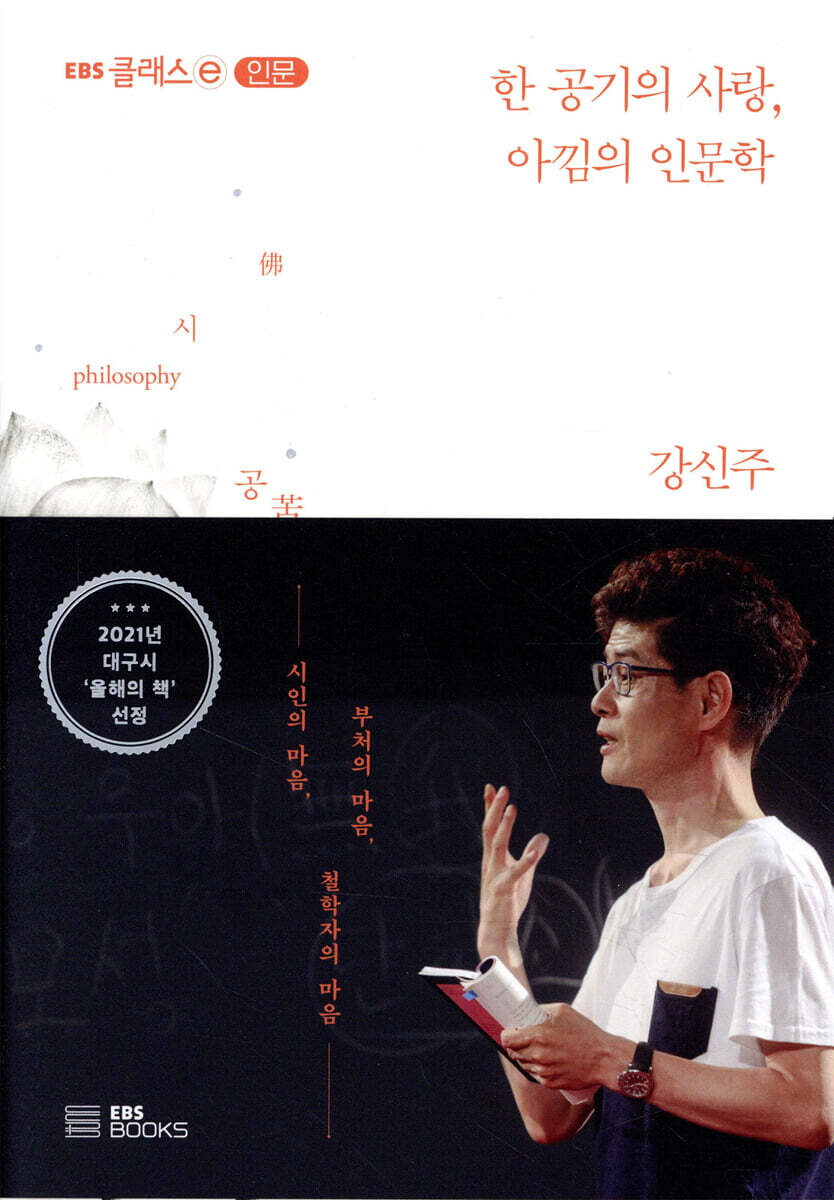
A Breath of Love, a Humanity of Care
 |
Description
Book Introduction
What you need from someone you love It's not two or three airs, it's 'one air of love.' Collaboration between 'EBS CLASSⓔ' and 'Philosopher Kang Shin-ju' A famous lecture you must listen to at least once in your life! If we are to be sensitive to the suffering of others, we should love them only as much as we love a bowl of rice. Even though we believe we love ourselves, the moment we become food for two or three people, we cannot help but increase the suffering of others. ―From “Love is as painful as it is painful” in Chapter 1 It is an era where the words “I love you” are familiar. But love keeps making us feel empty. It is time to deeply reflect on what it means to truly cherish someone, or in other words, what it means to 'cherish'. Can't you feel the pain of your loved one? Is your current love becoming a give-and-take affair? Philosopher Kang Shin-ju, who connects philosophy and life and connects with the public through heartfelt communication, presents her new book, "Love in a Breath of Air, Humanities of Generosity." Through eight core Buddhist words and Eastern and Western philosophy and literature, she invites readers to ask themselves questions about love and reflect on the meaning of love and generosity. This book was published concurrently with the 16-part series "Love in a Breath of Air, Humanities of Compassion" aired on the EBS TV lecture program [CLASSⓔ]. It delves deeper into the "Humanities of Love and Compassion," which resonated deeply through the TV lectures. |
- You can preview some of the book's contents.
Preview
index
preface
prolog
Lesson 1: Love is as painful as it is painful.
Lesson 2: Impermanence The moment I see impermanence, I am overcome with love.
The world can only be seen when the third principle of selflessness (無我) is not neglected, even in eternity or in the moment.
4. Stillness: The principle that only clear and calm water can easily produce ripples.
5th class: From the relationships that are created to the relationships that are created
The Master of the Sixth Class: Freedom is the ability to do anything, or rather, to stop doing anything.
Chapter 7 Love: I'm so tired, yet I'm so full.
If you see something that you need to cherish and care for in the 8th grade,
Epilogue
prolog
Lesson 1: Love is as painful as it is painful.
Lesson 2: Impermanence The moment I see impermanence, I am overcome with love.
The world can only be seen when the third principle of selflessness (無我) is not neglected, even in eternity or in the moment.
4. Stillness: The principle that only clear and calm water can easily produce ripples.
5th class: From the relationships that are created to the relationships that are created
The Master of the Sixth Class: Freedom is the ability to do anything, or rather, to stop doing anything.
Chapter 7 Love: I'm so tired, yet I'm so full.
If you see something that you need to cherish and care for in the 8th grade,
Epilogue
Detailed image

Into the book
This is an era in which the wisdom of generosity, condensed into ‘love in a breath of air,’ is more and more needed.
So many people are discouraged, so many people are doubting life, and so many people are committing suicide.
Even so many people have given up on love, and so many would rather be with a dog or cat than a human.
Human beings are giving up hope for humanity, that is, the hope for love and solidarity.
Despite the fact that there are countless people beside them who love them.
Isn't it because we have become two breaths of air, three breaths of air, and even a bowl of rice for the person we love, and we blindly believe that it is love?
---From the "Prologue"
Feeling the suffering of others! If we fully understand the teaching of "Ilche Gaego," we cannot be cruel to anything.
Rather, they not only have a desire to alleviate their suffering, but also try to directly reduce their suffering.
This is love.
Of course, people who truly feel the pain of others, or in other words, people who love others, are extremely wary of aggravating the pain of others with their words and actions.
'Will my words hurt her?' 'Will this behavior upset her?' In the end, the true slogan of someone who loves someone can only be one.
'At least I won't add to your suffering.'
--- p.36~37
Unfortunately, there are times when we say we love someone and even believe it ourselves, but we fail to truly feel the pain of the person we love.
This is what is called 'ideal love', 'love in name only', or 'fake love'.
(…) Can fake love be the same as genuine love, or love that produces action? What meaning is love if it doesn't involve feeling another's pain with one's whole being and responding immediately and spontaneously to alleviate that pain in some way? Fake or formal love only discourages the other person.
Because we cannot fully sense the other person's pain, all efforts to alleviate it miss the mark.
--- p.40
Our lives are usually about living today but not enjoying today.
It's very difficult to jump into today.
When I stay still, thoughts of yesterday, the day before yesterday, tomorrow, and the day after tomorrow come to mind.
But at this very moment, the beast called today sends us various Hermes to catch him.
It could be the sun, the wind, a flower, a valley, a lover, a family, or a friend.
--- p.62~63
Doesn't everything radiate impermanence everywhere? A baby shedding its newborn baby clothes, a husband with a hint of gray hair, a wife with a fleeting wrinkle around her eyes, a cat that prefers to lie by the window as it ages, a companion dog snuggles up in a sunny spot during a walk, fluffy clouds drifting aimlessly across the blue sky.
So, without turning your head, gaze upon the void, and seize the day without any fear.
If you want to live today with ‘fullness’ and ‘splendidness’ rather than ‘emptiness’ and ‘transience’.
How can love sprout in our hearts without feeling the impermanence?
This is the power of Siddhartha's last teaching, 'Impermanence of all things.'
--- p.78
The moment we think that a desk has the 'essence of sitting and reading a book' and a wooden Buddha has the 'essence of worshipping', we become conservatives.
The table commands us to sit, and the wooden Buddha commands us to worship him.
What freedom can there be in this situation, where we obey the dictates of things? Do you desire freedom? If so, all you need to do is engrave four words on your heart.
‘There is no self!’ There is no essence in all existence that we must follow.
We should not think of the cup as containing liquid as its absolute essence; we can also put flowers in the cup or put pretty beads in it.
--- p.110
Balance is essential to entering the middle path, the path of love, the path of compassion.
Just like when riding a bicycle, you need to practice turning the handlebars toward the moment when you are about to fall toward eternity, and turning the handlebars toward the moment when you are about to lean toward eternity.
Let's find what doesn't change in things that seem unchangeable, and what doesn't change in things that seem likely to change.
If we cannot grasp the reality of existence as neither eternal nor momentary, we cannot walk the middle path, the path of love, and the path of compassion.
--- p.132
It is clear why the continuation and repetition of encounters are dangerous.
Because it makes us forget that other encounters are quite possible.
Only by being open to the possibility of other encounters can we reflect and repent on the encounters we are repeating now.
Will continuing to live with this person make me happy and joyful? Will continuing to attend this school help me grow and become more beautiful? Will continuing to work at this job offer hope for my future? My own goodness and joy, not the good and evil of society, should be the standard for evaluating worth.
For this to be possible, we must not forget that each repeated encounter is just one of many that may arise.
--- p.215
At some point, you do what the other person wants, not what you want, and at other times, the other person does what you want, not what you want.
This is love and consideration.
This is precisely why one-sided consideration, one-sided love, or in other words, consideration or love that cannot be said “no!” is not true consideration or love.
It is only when you show consideration for someone, even though you may or may not be considerate, that it is truly consideration.
If you are considerate of someone because you cannot help but be considerate, this is fake consideration and, to put it harshly, can only be submission or obedience.
--- p.261
Rather than commanding you, I'd rather command myself! Rather than making you suffer, I'd rather make myself suffer! Rather than making your body move, I'd rather move mine! You rest, and I'll move! And so, I'll take all your toil and pain and bring it to me! This is where the concept of "care" differs from the concept of "love," which tends to remain limited to mere words or emotions.
Because generosity is an act of willingness to take on the effort and labor for or on behalf of that person, that is, an act that proves love.
--- p.287~277
It is truly a blessing to have something to cherish.
In any case, the objects of our cherishing fill our lives with joy by their very existence, provide meaning to our lives, and energize our lives.
Imagine not having anything to spare.
Life will turn dark and gloomy, and we who live such a life will fall into deep depression and lethargy.
The problem arises when the object of affection is a human being.
To care for another is to be happy and joyful in his stead, enduring his hardships, his sufferings, and his labors.
If we can carry someone's burden and even carry them on our backs with a smile on our face, then we have at least one person we care about.
--- p.301
For each of us, the person we cherish could be our mother, father, wife, husband, child, friend, pet dog, cat, or even a plant.
Whatever we cherish, let us not forget that we are but a 'piece of air' to its happiness.
If we fail to fill this 'one air of kite' like a farmer opening a water tap, the life of the person we cherish will fall into misery.
So, when good air, delicious food, comfortable sleep, warm sun, fresh breeze, beautiful music, great movies, nice restaurants, doctors and nurses, friends, etc. become healthy bonds for those we care about, we should get enough rest.
You should rest well, eat delicious food, and sleep well.
Because the time has come for us to fill the ‘one air of kite’.
--- p.327
Love, life, happiness, and freedom are not quantitative issues that can be measured with the words “enough is enough,” but qualitative issues.
Loved or not loved, lived well or not, happy or not happy, free or not free.
Let us now erase the phrase 'enough is enough' from our dictionary of life.
Because love, life, happiness, and freedom are all entirely qualitative, unrelated to other people's opinions, evaluations, wealth, or consumption levels.
To love well, to live properly, to be truly happy, and to be free, we must not be swayed by the messy self-satisfaction and mental triumph that comes with the premise of "enough is enough."
Rather, let's say that we still haven't properly experienced love, life, happiness, and freedom, and that we are still lacking.
Only then can we have hope to love properly, live properly, be happy properly, and be free properly.
So many people are discouraged, so many people are doubting life, and so many people are committing suicide.
Even so many people have given up on love, and so many would rather be with a dog or cat than a human.
Human beings are giving up hope for humanity, that is, the hope for love and solidarity.
Despite the fact that there are countless people beside them who love them.
Isn't it because we have become two breaths of air, three breaths of air, and even a bowl of rice for the person we love, and we blindly believe that it is love?
---From the "Prologue"
Feeling the suffering of others! If we fully understand the teaching of "Ilche Gaego," we cannot be cruel to anything.
Rather, they not only have a desire to alleviate their suffering, but also try to directly reduce their suffering.
This is love.
Of course, people who truly feel the pain of others, or in other words, people who love others, are extremely wary of aggravating the pain of others with their words and actions.
'Will my words hurt her?' 'Will this behavior upset her?' In the end, the true slogan of someone who loves someone can only be one.
'At least I won't add to your suffering.'
--- p.36~37
Unfortunately, there are times when we say we love someone and even believe it ourselves, but we fail to truly feel the pain of the person we love.
This is what is called 'ideal love', 'love in name only', or 'fake love'.
(…) Can fake love be the same as genuine love, or love that produces action? What meaning is love if it doesn't involve feeling another's pain with one's whole being and responding immediately and spontaneously to alleviate that pain in some way? Fake or formal love only discourages the other person.
Because we cannot fully sense the other person's pain, all efforts to alleviate it miss the mark.
--- p.40
Our lives are usually about living today but not enjoying today.
It's very difficult to jump into today.
When I stay still, thoughts of yesterday, the day before yesterday, tomorrow, and the day after tomorrow come to mind.
But at this very moment, the beast called today sends us various Hermes to catch him.
It could be the sun, the wind, a flower, a valley, a lover, a family, or a friend.
--- p.62~63
Doesn't everything radiate impermanence everywhere? A baby shedding its newborn baby clothes, a husband with a hint of gray hair, a wife with a fleeting wrinkle around her eyes, a cat that prefers to lie by the window as it ages, a companion dog snuggles up in a sunny spot during a walk, fluffy clouds drifting aimlessly across the blue sky.
So, without turning your head, gaze upon the void, and seize the day without any fear.
If you want to live today with ‘fullness’ and ‘splendidness’ rather than ‘emptiness’ and ‘transience’.
How can love sprout in our hearts without feeling the impermanence?
This is the power of Siddhartha's last teaching, 'Impermanence of all things.'
--- p.78
The moment we think that a desk has the 'essence of sitting and reading a book' and a wooden Buddha has the 'essence of worshipping', we become conservatives.
The table commands us to sit, and the wooden Buddha commands us to worship him.
What freedom can there be in this situation, where we obey the dictates of things? Do you desire freedom? If so, all you need to do is engrave four words on your heart.
‘There is no self!’ There is no essence in all existence that we must follow.
We should not think of the cup as containing liquid as its absolute essence; we can also put flowers in the cup or put pretty beads in it.
--- p.110
Balance is essential to entering the middle path, the path of love, the path of compassion.
Just like when riding a bicycle, you need to practice turning the handlebars toward the moment when you are about to fall toward eternity, and turning the handlebars toward the moment when you are about to lean toward eternity.
Let's find what doesn't change in things that seem unchangeable, and what doesn't change in things that seem likely to change.
If we cannot grasp the reality of existence as neither eternal nor momentary, we cannot walk the middle path, the path of love, and the path of compassion.
--- p.132
It is clear why the continuation and repetition of encounters are dangerous.
Because it makes us forget that other encounters are quite possible.
Only by being open to the possibility of other encounters can we reflect and repent on the encounters we are repeating now.
Will continuing to live with this person make me happy and joyful? Will continuing to attend this school help me grow and become more beautiful? Will continuing to work at this job offer hope for my future? My own goodness and joy, not the good and evil of society, should be the standard for evaluating worth.
For this to be possible, we must not forget that each repeated encounter is just one of many that may arise.
--- p.215
At some point, you do what the other person wants, not what you want, and at other times, the other person does what you want, not what you want.
This is love and consideration.
This is precisely why one-sided consideration, one-sided love, or in other words, consideration or love that cannot be said “no!” is not true consideration or love.
It is only when you show consideration for someone, even though you may or may not be considerate, that it is truly consideration.
If you are considerate of someone because you cannot help but be considerate, this is fake consideration and, to put it harshly, can only be submission or obedience.
--- p.261
Rather than commanding you, I'd rather command myself! Rather than making you suffer, I'd rather make myself suffer! Rather than making your body move, I'd rather move mine! You rest, and I'll move! And so, I'll take all your toil and pain and bring it to me! This is where the concept of "care" differs from the concept of "love," which tends to remain limited to mere words or emotions.
Because generosity is an act of willingness to take on the effort and labor for or on behalf of that person, that is, an act that proves love.
--- p.287~277
It is truly a blessing to have something to cherish.
In any case, the objects of our cherishing fill our lives with joy by their very existence, provide meaning to our lives, and energize our lives.
Imagine not having anything to spare.
Life will turn dark and gloomy, and we who live such a life will fall into deep depression and lethargy.
The problem arises when the object of affection is a human being.
To care for another is to be happy and joyful in his stead, enduring his hardships, his sufferings, and his labors.
If we can carry someone's burden and even carry them on our backs with a smile on our face, then we have at least one person we care about.
--- p.301
For each of us, the person we cherish could be our mother, father, wife, husband, child, friend, pet dog, cat, or even a plant.
Whatever we cherish, let us not forget that we are but a 'piece of air' to its happiness.
If we fail to fill this 'one air of kite' like a farmer opening a water tap, the life of the person we cherish will fall into misery.
So, when good air, delicious food, comfortable sleep, warm sun, fresh breeze, beautiful music, great movies, nice restaurants, doctors and nurses, friends, etc. become healthy bonds for those we care about, we should get enough rest.
You should rest well, eat delicious food, and sleep well.
Because the time has come for us to fill the ‘one air of kite’.
--- p.327
Love, life, happiness, and freedom are not quantitative issues that can be measured with the words “enough is enough,” but qualitative issues.
Loved or not loved, lived well or not, happy or not happy, free or not free.
Let us now erase the phrase 'enough is enough' from our dictionary of life.
Because love, life, happiness, and freedom are all entirely qualitative, unrelated to other people's opinions, evaluations, wealth, or consumption levels.
To love well, to live properly, to be truly happy, and to be free, we must not be swayed by the messy self-satisfaction and mental triumph that comes with the premise of "enough is enough."
Rather, let's say that we still haven't properly experienced love, life, happiness, and freedom, and that we are still lacking.
Only then can we have hope to love properly, live properly, be happy properly, and be free properly.
--- p.342~343
Publisher's Review
Eight keywords and eight poems of Buddhist philosophy,
Through important philosophical thoughts of the East and the West
Learning about 'Love in a Breath of Air' and 'The Spirit of Compassion'
This book talks about the 'spirit of love and care in one breath' using the keywords of suffering, impermanence, non-self, stillness, fate, master, love, and life.
Each topic begins with eight poems by poet Kim Seon-woo, and it delves into the core of the topic by encompassing important philosophical thoughts from the East and West, past and present, along with Buddhist thoughts such as Siddhartha, Nagarjuna, Imje, and Baekjang.
In the first chapter, ‘Suffering; Love is as painful as it is painful,’ we talk about the sensitivity to pain, which is a barometer of love.
We examine the reason why our lives are 'suffering', how alleviating that suffering is 'happiness', and how trying to alleviate the suffering of others is 'love', in connection with the meaning of things (the four things) and offering, and Maurice Merleau-Ponty's minimal violence.
In the second lecture, 'Impermanence (無常); The moment you see impermanence, you are overcome with love', it makes you realize the preciousness of the 'now' that will one day disappear, rather than 'transience' or 'emptiness'.
The obsession with 'eternity' contrasts with the sense of impermanence, and through Nietzsche's 'eternal return', we delve deep into the meaning of impermanence.
In the third lecture, ‘Anatta (無我); The world can only be seen when one is not biased towards either eternity or moment’, the teachings of ‘Jebeop-anatta’, which allows one to think freely by breaking free from obsession with essence, and the path of love and compassion through the ‘Middle Way’, which is not biased towards either short-sightedness or long-sightedness, are emphasized.
In the fourth lecture, 'Jeong (靜); The reason why ripples easily form in clear and still water', we examine the roots of afflictions and delusions through the boiling mind and the mind like still water, and through the 'mind that is not caught up in time and frame' spoken of by Huineng, the 'door of birth and death and the door of true nature' spoken of by Wonhyo, and the reason why one cannot remain in nirvana once one reaches it, we draw a picture of a human being who can respond to the minds of others and the world.
In the 5th lecture, ‘Inyeon (因緣); From created karma to created karma’, we examine ‘creation’ through the logic of dependent origination, the logic of karma, and the logic of cause and effect, and through Gilles Deleuze’s ‘Agentsman’ and Huineng’s first sermon, we discuss what kind of karma our existence is made up of, and what good karma and bad karma are.
In the 6th lecture, ‘Master; Freedom is the ability to do anything, or rather, to stop doing anything’, we talk about how to live as a ‘real self’ in the ‘real world’ through the life of a master, the freedom to say ‘no’, Spinoza’s ‘Relationship between Joy and Sorrow’, and Imje’s ‘Su-cheo-jak-ju Ip-cheo-gae-jin’.
In the 7th lecture, ‘Love; How can I be so full when I’m so tired?’, the heart of ‘care’ that wants to bear all of the pain and hardship of the other person is called ‘self-respect, self-love, and affection.’
Let’s take a look at it through the ‘Daily Abstinence from Work’ of Monk Baekjang.
In the 8th lecture, 'Life (生); If you see something to cherish and care for', the freedom of cherishing 'Love = Freedom', the language of cherishing 'I'm happy just by having you', the art of cherishing 'With the wisdom of acting', and the heart of cherishing 'Mulmang Muljojang' encompass the discussions so far and approach the core of 'cherishing'.
At the end of each chapter, a 'starting point' is provided, guiding readers to practice 'giving' in a more mature way than now.
“To become a bowl of rice for the person you love
Rebuilding the whole body,
It is the emotion and the intellect, or the heart and the head.
“It’s a matter of changing everything.”
When a child is hungry, a mother gives him a bowl of rice.
A child's hunger is sufficiently relieved by eating one bowl of rice.
As time passes and the child feels hungry again, he or she takes another sip of air and the hunger pain goes away.
But what if a mother were to feed her child two, three, or even a whole bowl of rice at once? The child would experience not the pangs of hunger, but the even greater pangs of fullness.
Love is the same.
We are all like rice in a bowl to someone.
When a loved one needs just a breath of love, we must be able to love them enough to fill them with just that much.
This is the 'love of one breath' based on the 'sensibility to pain' that philosopher Kang Shin-ju speaks of.
From the topic of the first lecture, 'Suffering', to the topic of the eighth lecture, 'Life', each keyword deeply addresses the questions, 'What is love?', 'What kind of person should I be to love?', and 'How can I become the master of my own life and truly love?'
The meaning of more than just love and care
This is precisely why ‘애’ is not completely translated as ‘사랑’.
Because the character '애' is a letter that can be read properly only when the meaning of 'cherish' is added to the meaning of 'love'.
The phrase 'I care for you!' means 'I won't treat you carelessly.'
In extreme terms, it means 'I will not use you, I will keep you.'
―From “Love in the 7th Chapter: How can it be so tiring yet so fulfilling?”
“What meaning does generosity have if not the capitalist attitude of trying to give because you received or trying to receive because you gave, or the will to resist with all your body the efficiency of ‘give and take’?” Philosopher Kang Shin-ju looks back at how the meaning of the word ‘love’ has been diluted and abused since it became commonly used in Korea, and focuses on the word ‘geum’, which contains the true meaning of ‘ae (愛)’.
In a capitalist system, relationships between friends, lovers, and even family members such as parents and children can easily become a 'give and take' relationship.
The 'giving' mentioned in this book is a word that carries a meaning beyond love, and is a way for all of us to move forward to a life of 'give and give and (...)', where we become Buddhas, poets, and philosophers, at least to others.
“Love is something that must be proven by action, something that must be expressed physically.”
Through important philosophical thoughts of the East and the West
Learning about 'Love in a Breath of Air' and 'The Spirit of Compassion'
This book talks about the 'spirit of love and care in one breath' using the keywords of suffering, impermanence, non-self, stillness, fate, master, love, and life.
Each topic begins with eight poems by poet Kim Seon-woo, and it delves into the core of the topic by encompassing important philosophical thoughts from the East and West, past and present, along with Buddhist thoughts such as Siddhartha, Nagarjuna, Imje, and Baekjang.
In the first chapter, ‘Suffering; Love is as painful as it is painful,’ we talk about the sensitivity to pain, which is a barometer of love.
We examine the reason why our lives are 'suffering', how alleviating that suffering is 'happiness', and how trying to alleviate the suffering of others is 'love', in connection with the meaning of things (the four things) and offering, and Maurice Merleau-Ponty's minimal violence.
In the second lecture, 'Impermanence (無常); The moment you see impermanence, you are overcome with love', it makes you realize the preciousness of the 'now' that will one day disappear, rather than 'transience' or 'emptiness'.
The obsession with 'eternity' contrasts with the sense of impermanence, and through Nietzsche's 'eternal return', we delve deep into the meaning of impermanence.
In the third lecture, ‘Anatta (無我); The world can only be seen when one is not biased towards either eternity or moment’, the teachings of ‘Jebeop-anatta’, which allows one to think freely by breaking free from obsession with essence, and the path of love and compassion through the ‘Middle Way’, which is not biased towards either short-sightedness or long-sightedness, are emphasized.
In the fourth lecture, 'Jeong (靜); The reason why ripples easily form in clear and still water', we examine the roots of afflictions and delusions through the boiling mind and the mind like still water, and through the 'mind that is not caught up in time and frame' spoken of by Huineng, the 'door of birth and death and the door of true nature' spoken of by Wonhyo, and the reason why one cannot remain in nirvana once one reaches it, we draw a picture of a human being who can respond to the minds of others and the world.
In the 5th lecture, ‘Inyeon (因緣); From created karma to created karma’, we examine ‘creation’ through the logic of dependent origination, the logic of karma, and the logic of cause and effect, and through Gilles Deleuze’s ‘Agentsman’ and Huineng’s first sermon, we discuss what kind of karma our existence is made up of, and what good karma and bad karma are.
In the 6th lecture, ‘Master; Freedom is the ability to do anything, or rather, to stop doing anything’, we talk about how to live as a ‘real self’ in the ‘real world’ through the life of a master, the freedom to say ‘no’, Spinoza’s ‘Relationship between Joy and Sorrow’, and Imje’s ‘Su-cheo-jak-ju Ip-cheo-gae-jin’.
In the 7th lecture, ‘Love; How can I be so full when I’m so tired?’, the heart of ‘care’ that wants to bear all of the pain and hardship of the other person is called ‘self-respect, self-love, and affection.’
Let’s take a look at it through the ‘Daily Abstinence from Work’ of Monk Baekjang.
In the 8th lecture, 'Life (生); If you see something to cherish and care for', the freedom of cherishing 'Love = Freedom', the language of cherishing 'I'm happy just by having you', the art of cherishing 'With the wisdom of acting', and the heart of cherishing 'Mulmang Muljojang' encompass the discussions so far and approach the core of 'cherishing'.
At the end of each chapter, a 'starting point' is provided, guiding readers to practice 'giving' in a more mature way than now.
“To become a bowl of rice for the person you love
Rebuilding the whole body,
It is the emotion and the intellect, or the heart and the head.
“It’s a matter of changing everything.”
When a child is hungry, a mother gives him a bowl of rice.
A child's hunger is sufficiently relieved by eating one bowl of rice.
As time passes and the child feels hungry again, he or she takes another sip of air and the hunger pain goes away.
But what if a mother were to feed her child two, three, or even a whole bowl of rice at once? The child would experience not the pangs of hunger, but the even greater pangs of fullness.
Love is the same.
We are all like rice in a bowl to someone.
When a loved one needs just a breath of love, we must be able to love them enough to fill them with just that much.
This is the 'love of one breath' based on the 'sensibility to pain' that philosopher Kang Shin-ju speaks of.
From the topic of the first lecture, 'Suffering', to the topic of the eighth lecture, 'Life', each keyword deeply addresses the questions, 'What is love?', 'What kind of person should I be to love?', and 'How can I become the master of my own life and truly love?'
The meaning of more than just love and care
This is precisely why ‘애’ is not completely translated as ‘사랑’.
Because the character '애' is a letter that can be read properly only when the meaning of 'cherish' is added to the meaning of 'love'.
The phrase 'I care for you!' means 'I won't treat you carelessly.'
In extreme terms, it means 'I will not use you, I will keep you.'
―From “Love in the 7th Chapter: How can it be so tiring yet so fulfilling?”
“What meaning does generosity have if not the capitalist attitude of trying to give because you received or trying to receive because you gave, or the will to resist with all your body the efficiency of ‘give and take’?” Philosopher Kang Shin-ju looks back at how the meaning of the word ‘love’ has been diluted and abused since it became commonly used in Korea, and focuses on the word ‘geum’, which contains the true meaning of ‘ae (愛)’.
In a capitalist system, relationships between friends, lovers, and even family members such as parents and children can easily become a 'give and take' relationship.
The 'giving' mentioned in this book is a word that carries a meaning beyond love, and is a way for all of us to move forward to a life of 'give and give and (...)', where we become Buddhas, poets, and philosophers, at least to others.
“Love is something that must be proven by action, something that must be expressed physically.”
GOODS SPECIFICS
- Date of publication: July 16, 2020
- Page count, weight, size: 352 pages | 552g | 145*210*30mm
- ISBN13: 9788954753890
- ISBN10: 8954753892
You may also like
카테고리
korean


korean

![GQ KOREA Mark (Monthly): December [2025]](http://librairie.coreenne.fr/cdn/shop/files/8ef265dbbfbf186523ed75ba7319009d.jpg?v=1765340328&width=3840)


