

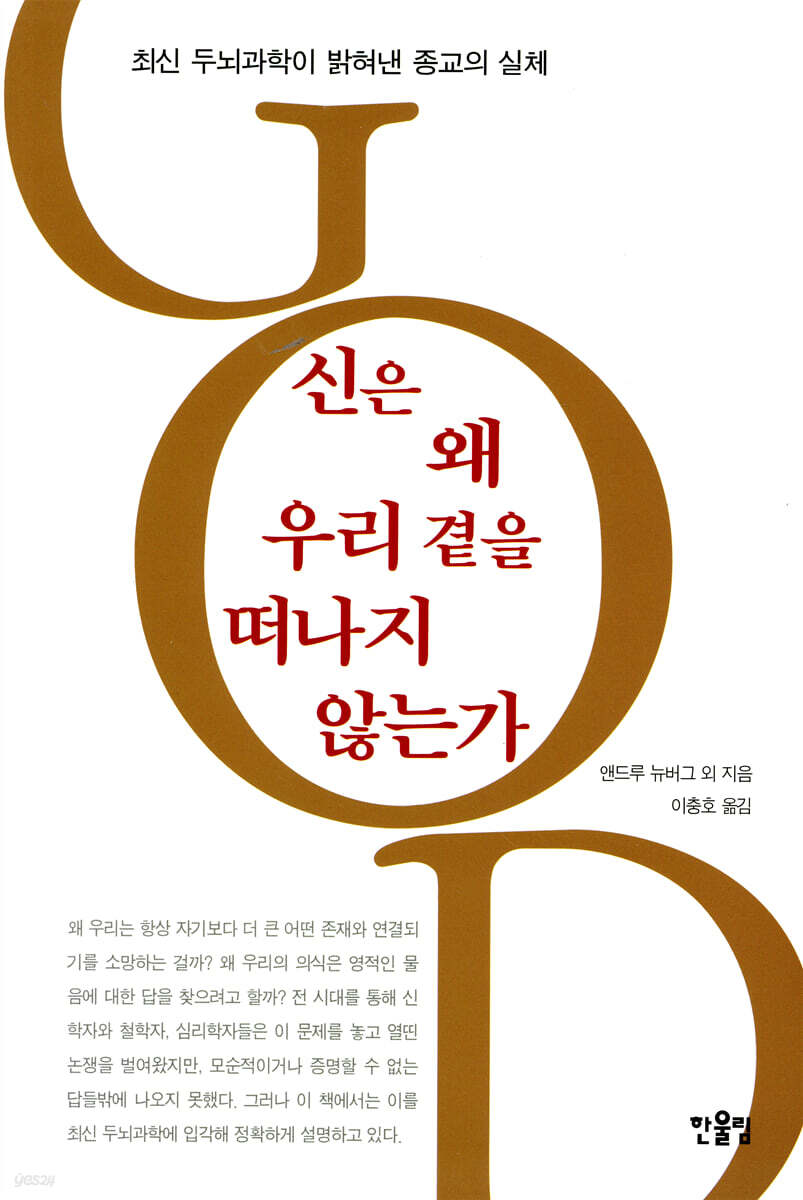
Why doesn't God leave us?
 |
Description
index
■ Translator's Preface
Chapter 1: A Photograph of God? - An Introduction to the Biology of Faith
Chapter 2: The Brain's Mechanism - The Science of Perception
What Makes Us Human: The Cerebral Cortex
combination of perceptions
Understand and respond to the world around you
How the brain creates its own mind
Chapter 3: The Structure of the Brain - How the Brain Creates the Mind
Excitatory and inhibitory systems
Autonomous states and spiritual experiences
The emotional brain: the limbic system
How the Mind Understands the World: Cognitive Operators
Chapter 4: Mythmaking - The Impulse to Create Stories and Beliefs
The Birth of a Myth
Chapter 5: Religious Ritual - The Physical Manifestation of Meaning
Oneness with consciousness
Evolutionary origins of consciousness
Neurobiology of Consciousness
The relationship between consciousness and myth
Chapter 6 Mysticism - The Biology of Transcendence
Definition of mysticism
Mysticism and Mental Health
The Neurobiology of Mystical Experiences
Absolute Unity, Evolution, and Self
Chapter 7: The Origins of Religion - The Persistence of a Great Concept
Religion and Control
The origins of religion
Window to God
Chapter 8: More Real than Reality - The Mind that Seeks the Absolute
The Science of Mystics
Is reality really the ultimate reality?
How the mind creates the self
Chapter 9: Why God Doesn't Leave Us - Metaphors of God and the Myths of Science
■ Note
■ References
■ Search
Chapter 1: A Photograph of God? - An Introduction to the Biology of Faith
Chapter 2: The Brain's Mechanism - The Science of Perception
What Makes Us Human: The Cerebral Cortex
combination of perceptions
Understand and respond to the world around you
How the brain creates its own mind
Chapter 3: The Structure of the Brain - How the Brain Creates the Mind
Excitatory and inhibitory systems
Autonomous states and spiritual experiences
The emotional brain: the limbic system
How the Mind Understands the World: Cognitive Operators
Chapter 4: Mythmaking - The Impulse to Create Stories and Beliefs
The Birth of a Myth
Chapter 5: Religious Ritual - The Physical Manifestation of Meaning
Oneness with consciousness
Evolutionary origins of consciousness
Neurobiology of Consciousness
The relationship between consciousness and myth
Chapter 6 Mysticism - The Biology of Transcendence
Definition of mysticism
Mysticism and Mental Health
The Neurobiology of Mystical Experiences
Absolute Unity, Evolution, and Self
Chapter 7: The Origins of Religion - The Persistence of a Great Concept
Religion and Control
The origins of religion
Window to God
Chapter 8: More Real than Reality - The Mind that Seeks the Absolute
The Science of Mystics
Is reality really the ultimate reality?
How the mind creates the self
Chapter 9: Why God Doesn't Leave Us - Metaphors of God and the Myths of Science
■ Note
■ References
■ Search
Into the book
SPECT imaging helped test this hypothesis by allowing us to see the actual brain activity of people who had spiritual experiences.
While the photographs don't prove our hypothesis beyond a shadow of a doubt, they do provide strong support by showing that the human brain behaves in a way that our theory predicts when spiritual acts occur.16 These encouraging results have rekindled our passion for research and heightened our interest in the intriguing questions that have arisen over the years of our research.
These questions include: Are humans biologically predisposed to myth-making? What is the neurological secret behind the power of religious ritual? Are the precognitions and intuitions of great religious mystics based on mental or emotional delusions, or are they the result of coherent sensory perceptions shaped by the normal neurological functioning of a sound and healthy mind? Could evolutionary factors like sexual interest or mating have influenced the biological development of religious ecstasy?
While the photographs don't prove our hypothesis beyond a shadow of a doubt, they do provide strong support by showing that the human brain behaves in a way that our theory predicts when spiritual acts occur.16 These encouraging results have rekindled our passion for research and heightened our interest in the intriguing questions that have arisen over the years of our research.
These questions include: Are humans biologically predisposed to myth-making? What is the neurological secret behind the power of religious ritual? Are the precognitions and intuitions of great religious mystics based on mental or emotional delusions, or are they the result of coherent sensory perceptions shaped by the normal neurological functioning of a sound and healthy mind? Could evolutionary factors like sexual interest or mating have influenced the biological development of religious ecstasy?
--- p.22
There is no doubt that the transcendental state that gives rise to religion is neurologically real.
Neuroscience predicts that such a thing happens, and it has been captured on film in our imaging studies as well as in the work of others.
The deeper question is this:
Are these experiences of oneness purely the result of neurological functioning (if so, mystical experiences would be reduced to mere flashes of neural signals)? Or are they genuine experiences, perceptible to the brain? Has the brain evolved the capacity to transcend material existence and experience higher planes of existence that actually exist?
Mystics clearly claim that they have experienced just such a reality.
It is said to be a world more real than the material world we believe in without a doubt, a dimension where there is no sense of space, no passage of time, no clear boundary between me and the universe, and where there is ample room for the actual existence of God.
There is no doubt that the transcendental state that gives rise to religion is neurologically real.
Neuroscience predicts that such a thing happens, and it has been captured on film in our imaging studies as well as in the work of others.
The deeper question is this:
Are these experiences of oneness purely the result of neurological functioning (if so, mystical experiences would be reduced to mere flashes of neural signals)? Or are they genuine experiences, perceptible to the brain? Has the brain evolved the capacity to transcend material existence and experience higher planes of existence that actually exist?
Mystics clearly claim that they have experienced just such a reality.
It is said to be a world more real than the material world we believe in without a doubt, a dimension where there is no sense of space, no passage of time, no clear boundary between me and the universe, and where there is ample room for the actual existence of God.
Neuroscience predicts that such a thing happens, and it has been captured on film in our imaging studies as well as in the work of others.
The deeper question is this:
Are these experiences of oneness purely the result of neurological functioning (if so, mystical experiences would be reduced to mere flashes of neural signals)? Or are they genuine experiences, perceptible to the brain? Has the brain evolved the capacity to transcend material existence and experience higher planes of existence that actually exist?
Mystics clearly claim that they have experienced just such a reality.
It is said to be a world more real than the material world we believe in without a doubt, a dimension where there is no sense of space, no passage of time, no clear boundary between me and the universe, and where there is ample room for the actual existence of God.
There is no doubt that the transcendental state that gives rise to religion is neurologically real.
Neuroscience predicts that such a thing happens, and it has been captured on film in our imaging studies as well as in the work of others.
The deeper question is this:
Are these experiences of oneness purely the result of neurological functioning (if so, mystical experiences would be reduced to mere flashes of neural signals)? Or are they genuine experiences, perceptible to the brain? Has the brain evolved the capacity to transcend material existence and experience higher planes of existence that actually exist?
Mystics clearly claim that they have experienced just such a reality.
It is said to be a world more real than the material world we believe in without a doubt, a dimension where there is no sense of space, no passage of time, no clear boundary between me and the universe, and where there is ample room for the actual existence of God.
--- p.203
Publisher's Review
Recent studies seek to elucidate the neural underpinnings of spiritual and paranormal experiences.
In other words, when we feel that we have encountered a reality that is, in some sense, higher than the reality of our everyday experiences, our brains become eager to figure out what has happened.
In particular, the authors of this book seek to identify what appears to be the brain's spiritual circuitry.
Significance of publication and planning intent
Dissecting human spirituality and religion with cutting-edge brain science
The issues of God and religion, which are subjects of spiritual pursuit and constant questioning for humans, are being dissected through cutting-edge science.
It is significant not only because it deals with brain science, which is said to be the last remaining area for science to uncover, but also because it arouses great interest by elucidating the neurobiological causes of the persistent occurrence of mystical transcendental experiences, including religious ones, even in modern society led by advanced scientific civilization.
A fiery debate sparked in the scientific and religious communities.
Why does God remain with humanity? Why does human consciousness seek answers to spiritual questions? Does God reside within the human brain? This book offers innovative interpretations and sharp debate on these questions.
It has already been featured on Newsweek's cover story, sparking controversy, and the Washington Post also published an article about the original book.
Therefore, while the readership of ordinary science books is limited to those interested in science, this book greatly expands its readership to include those interested in religion and the humanities.
Religious experience is merely a product of the brain and has little to do with anything outside the brain.
- Michael Persinger, Professor of Neuroscience, Laurentian University, Canada
Saying that the brain creates religion is like saying that the piano creates music.
Daniel Batson, Professor of Psychology, University of Kansas
This is a very important study in developing the relationship between science and religion.
It shows that the mind necessarily includes religious experience.
Father Ronald Murphy, Professor at Georgetown University
Illuminating the Neurobiological Mechanisms of Civilizational (Religious) Clash
This book reveals that different religions can either become brothers or lead to division and conflict.
All religions are united in the ultimate state of transcendence, and religious intolerance arises from the absolutization of only the lower levels of transcendent experience.
And he argues that this intolerance is a cultural phenomenon, rooted primarily in ignorance, fear, xenophobic prejudice, and racist nationalism.
Here we can discover the religious causes of the conflict between the United States and Afghanistan, which is sometimes seen as a clash between Christianity and Islam, and the basis for reconciliation and coexistence.
[Humanity and Science] Liberal Arts Science Series
A book that we confidently present as the first work in the series [Humanity and Science].
This liberal arts science series is centered on the relationship between humans and science, and is planned to be published with the intention of creating science with a human face, science that reads the times and society, and efforts to overcome the ills of blind scientific civilization and illuminate a bright future for humanity. The series is planned to publish books that are both relevant and essential to the general public.
Main contents
Why do we so desperately desire to connect with something greater than ourselves? Why does our consciousness seek answers to spiritual questions? Simply put, why does God remain with us? Throughout the ages, theologians, philosophers, and psychologists have debated these questions, but have yielded only contradictory or unprovable answers.
But in this groundbreaking book, Andrew Newberg and Eugene D'Aquili offer a simple, yet scientifically accurate explanation.
The religious impulses we feel have their roots in the brain.
Newberg and D'Aquili reached this revolutionary conclusion based on long-standing research on brain function and behavior, as well as on cutting-edge imaging techniques that examined the brains of meditating monks and nuns engaged in deep prayer.
They found that deep immersion in spiritual meditation causes unusual changes in brain activity, making transcendental religious experiences seem vivid and real.
In other words, the feeling that Buddhists call "oneness with the universe" and the experience that Franciscan nuns describe as a vivid, tangible sense of God's presence are not delusions, nor are they wishful thinking hallucinations, but rather the result of a series of neurological events that can be objectively observed, recorded, and photographed.
The inevitable conclusion from this is that God resides in the human brain.
In this book, Newberg and D'Aquili present a detailed account of their groundbreaking research in the field of neurotheology.
Neurotheology is a modern discipline that aims to uncover the complex relationship between spirituality and the brain.
In their research, they delve into fundamental questions such as: Are humans biologically programmed to create myths? What evolutionary relationship exists between religious ecstasy and sexual orgasm? What do near-death experiences tell us about the nature of spirituality? How do religious rituals create their own neurological environments?
They also argue that natural selection has strengthened the neural mechanisms that facilitate religious behavior because religious belief provides a significant survival advantage, which raises a crucial question:
Is religion simply a product of biological evolution, or is the human brain mysteriously endowed with a unique ability to approach and know God? In attempting to answer this question, they ultimately conclude that if the human brain continues as it is now, God will never leave our side.
This book exquisitely combines rigorous science with intuition about the nature of consciousness and spirituality, bridging the gap between faith and reason, mysticism and empirical data.
The neurobiological principles of how the brain perceives 'reality' are also fascinating.
This fascinating and surprising book attempts to explore both the biology of humanity's ongoing relationship with God and the miraculous.
In other words, when we feel that we have encountered a reality that is, in some sense, higher than the reality of our everyday experiences, our brains become eager to figure out what has happened.
In particular, the authors of this book seek to identify what appears to be the brain's spiritual circuitry.
Significance of publication and planning intent
Dissecting human spirituality and religion with cutting-edge brain science
The issues of God and religion, which are subjects of spiritual pursuit and constant questioning for humans, are being dissected through cutting-edge science.
It is significant not only because it deals with brain science, which is said to be the last remaining area for science to uncover, but also because it arouses great interest by elucidating the neurobiological causes of the persistent occurrence of mystical transcendental experiences, including religious ones, even in modern society led by advanced scientific civilization.
A fiery debate sparked in the scientific and religious communities.
Why does God remain with humanity? Why does human consciousness seek answers to spiritual questions? Does God reside within the human brain? This book offers innovative interpretations and sharp debate on these questions.
It has already been featured on Newsweek's cover story, sparking controversy, and the Washington Post also published an article about the original book.
Therefore, while the readership of ordinary science books is limited to those interested in science, this book greatly expands its readership to include those interested in religion and the humanities.
Religious experience is merely a product of the brain and has little to do with anything outside the brain.
- Michael Persinger, Professor of Neuroscience, Laurentian University, Canada
Saying that the brain creates religion is like saying that the piano creates music.
Daniel Batson, Professor of Psychology, University of Kansas
This is a very important study in developing the relationship between science and religion.
It shows that the mind necessarily includes religious experience.
Father Ronald Murphy, Professor at Georgetown University
Illuminating the Neurobiological Mechanisms of Civilizational (Religious) Clash
This book reveals that different religions can either become brothers or lead to division and conflict.
All religions are united in the ultimate state of transcendence, and religious intolerance arises from the absolutization of only the lower levels of transcendent experience.
And he argues that this intolerance is a cultural phenomenon, rooted primarily in ignorance, fear, xenophobic prejudice, and racist nationalism.
Here we can discover the religious causes of the conflict between the United States and Afghanistan, which is sometimes seen as a clash between Christianity and Islam, and the basis for reconciliation and coexistence.
[Humanity and Science] Liberal Arts Science Series
A book that we confidently present as the first work in the series [Humanity and Science].
This liberal arts science series is centered on the relationship between humans and science, and is planned to be published with the intention of creating science with a human face, science that reads the times and society, and efforts to overcome the ills of blind scientific civilization and illuminate a bright future for humanity. The series is planned to publish books that are both relevant and essential to the general public.
Main contents
Why do we so desperately desire to connect with something greater than ourselves? Why does our consciousness seek answers to spiritual questions? Simply put, why does God remain with us? Throughout the ages, theologians, philosophers, and psychologists have debated these questions, but have yielded only contradictory or unprovable answers.
But in this groundbreaking book, Andrew Newberg and Eugene D'Aquili offer a simple, yet scientifically accurate explanation.
The religious impulses we feel have their roots in the brain.
Newberg and D'Aquili reached this revolutionary conclusion based on long-standing research on brain function and behavior, as well as on cutting-edge imaging techniques that examined the brains of meditating monks and nuns engaged in deep prayer.
They found that deep immersion in spiritual meditation causes unusual changes in brain activity, making transcendental religious experiences seem vivid and real.
In other words, the feeling that Buddhists call "oneness with the universe" and the experience that Franciscan nuns describe as a vivid, tangible sense of God's presence are not delusions, nor are they wishful thinking hallucinations, but rather the result of a series of neurological events that can be objectively observed, recorded, and photographed.
The inevitable conclusion from this is that God resides in the human brain.
In this book, Newberg and D'Aquili present a detailed account of their groundbreaking research in the field of neurotheology.
Neurotheology is a modern discipline that aims to uncover the complex relationship between spirituality and the brain.
In their research, they delve into fundamental questions such as: Are humans biologically programmed to create myths? What evolutionary relationship exists between religious ecstasy and sexual orgasm? What do near-death experiences tell us about the nature of spirituality? How do religious rituals create their own neurological environments?
They also argue that natural selection has strengthened the neural mechanisms that facilitate religious behavior because religious belief provides a significant survival advantage, which raises a crucial question:
Is religion simply a product of biological evolution, or is the human brain mysteriously endowed with a unique ability to approach and know God? In attempting to answer this question, they ultimately conclude that if the human brain continues as it is now, God will never leave our side.
This book exquisitely combines rigorous science with intuition about the nature of consciousness and spirituality, bridging the gap between faith and reason, mysticism and empirical data.
The neurobiological principles of how the brain perceives 'reality' are also fascinating.
This fascinating and surprising book attempts to explore both the biology of humanity's ongoing relationship with God and the miraculous.
GOODS SPECIFICS
- Date of issue: November 30, 2001
- Page count, weight, size: 304 pages | 461g | Checking size
- ISBN13: 9788985777599
- ISBN10: 8985777599
You may also like
카테고리
korean


korean

![GQ KOREA Mark (Monthly): December [2025]](http://librairie.coreenne.fr/cdn/shop/files/8ef265dbbfbf186523ed75ba7319009d.jpg?v=1765340328&width=3840)


