

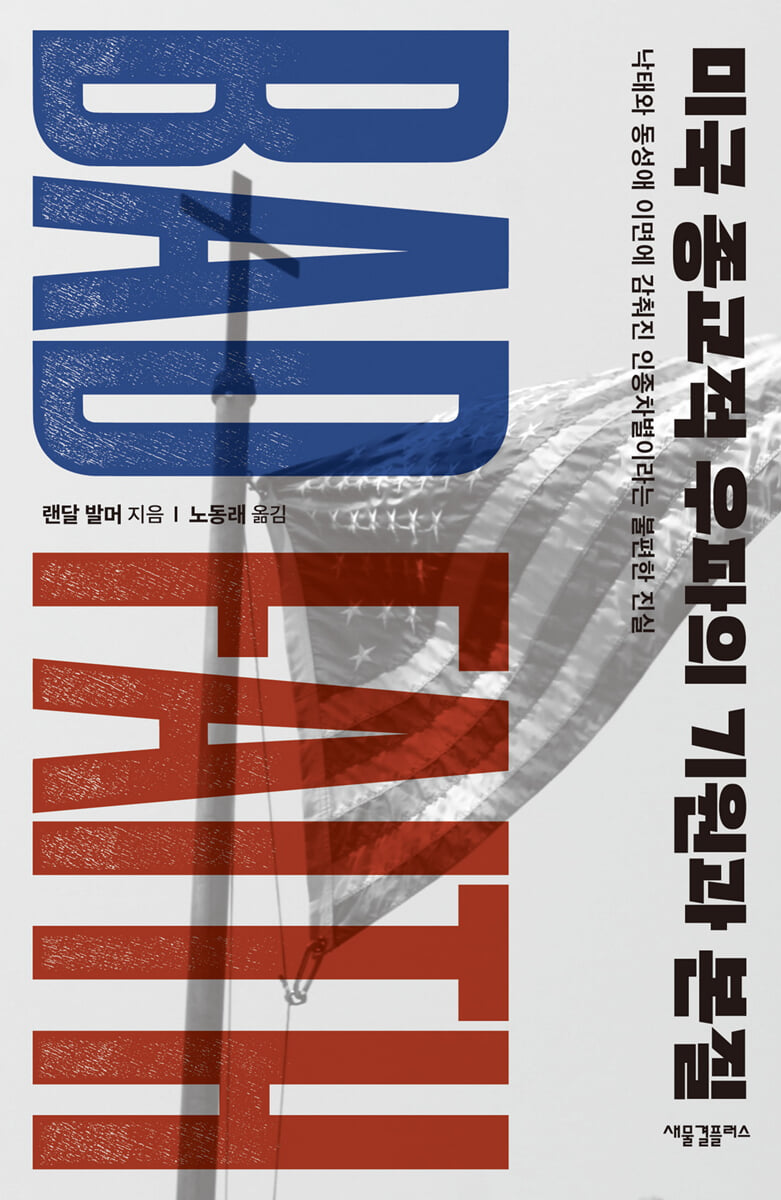
The Origins and Nature of the American Religious Right
 |
Description
Book Introduction
American (evangelical) Christianity is currently reeling from the far-right phenomenon.
A new 21st-century version of the “MAGA Gospel,” which replaces the name of the first Gospel in the New Testament, is creating a sensation among American Christians.
What are the roots of the American religious right? For a long time, the popular myth that "the religious right was born from the anti-abortion movement" was accepted as a given.
However, Professor Randall Balmer's masterpiece, "The Origins and Nature of the American Religious Right," exposes the shocking truth that the American religious right was not born from opposition to abortion, but rather from racist thinking and white supremacy, especially the defense of racial segregation in private Christian schools.
The author's assertion that opposition to abortion is nothing more than a "packaging tool" and a "myth" to mobilize the public sounds a deep alarm not only in the United States but also in Korean society.
Until the late 1970s, most evangelicals dismissed abortion as a major issue, dismissing it as a “Roman Catholic problem.”
Even the 1968 Evangelical Theologians Conference recognized the need and permissibility of abortion in certain circumstances, and the Southern Baptist Convention passed a resolution in the 1970s permitting abortion in certain circumstances, such as rape and incest.
Even after the 1973 Roe v. Wade decision, former Southern Baptist Convention president W.
A. Criswell expressed satisfaction with the ruling, stating that the baby's life begins at birth.
I recommend this book to anyone who has the courage to face the truth of history.
Pastors will read it carefully and deeply consider the role of the church, seminary students will use it as a broadening textbook to cultivate critical thinking, and young people in the church will be able to contemplate the future of the Korean church through heated discussions.
The author's message that true healing is only possible by facing the past and confronting it honestly demands deep reflection.
Now is the time to face the hidden truth through this book!
A new 21st-century version of the “MAGA Gospel,” which replaces the name of the first Gospel in the New Testament, is creating a sensation among American Christians.
What are the roots of the American religious right? For a long time, the popular myth that "the religious right was born from the anti-abortion movement" was accepted as a given.
However, Professor Randall Balmer's masterpiece, "The Origins and Nature of the American Religious Right," exposes the shocking truth that the American religious right was not born from opposition to abortion, but rather from racist thinking and white supremacy, especially the defense of racial segregation in private Christian schools.
The author's assertion that opposition to abortion is nothing more than a "packaging tool" and a "myth" to mobilize the public sounds a deep alarm not only in the United States but also in Korean society.
Until the late 1970s, most evangelicals dismissed abortion as a major issue, dismissing it as a “Roman Catholic problem.”
Even the 1968 Evangelical Theologians Conference recognized the need and permissibility of abortion in certain circumstances, and the Southern Baptist Convention passed a resolution in the 1970s permitting abortion in certain circumstances, such as rape and incest.
Even after the 1973 Roe v. Wade decision, former Southern Baptist Convention president W.
A. Criswell expressed satisfaction with the ruling, stating that the baby's life begins at birth.
I recommend this book to anyone who has the courage to face the truth of history.
Pastors will read it carefully and deeply consider the role of the church, seminary students will use it as a broadening textbook to cultivate critical thinking, and young people in the church will be able to contemplate the future of the Korean church through heated discussions.
The author's message that true healing is only possible by facing the past and confronting it honestly demands deep reflection.
Now is the time to face the hidden truth through this book!
- You can preview some of the book's contents.
Preview
index
introduction
Definitions and Terms
Part 1: Evangelicalism Before the Religious Right
Chapter 1: The Emergence of Progressive Evangelicalism
Chapter 2: The Shift in Generationalism
Chapter 3: Creating an Evangelical Subculture
Chapter 4: The Chicago Declaration and President Jimmy Carter
Part 2: The Abortion Myth and the Rise of the Religious Right
Chapter 5: The Abortion Myth
Chapter 6 What Really Happened?
Chapter 7 What Happened to Abortion?
Part 3 So what happened?
Chapter 8: The 1980 Presidential Election
Chapter 9: Why Are Abortion Myths a Problem?
Reviews
Further Reading
Definitions and Terms
Part 1: Evangelicalism Before the Religious Right
Chapter 1: The Emergence of Progressive Evangelicalism
Chapter 2: The Shift in Generationalism
Chapter 3: Creating an Evangelical Subculture
Chapter 4: The Chicago Declaration and President Jimmy Carter
Part 2: The Abortion Myth and the Rise of the Religious Right
Chapter 5: The Abortion Myth
Chapter 6 What Really Happened?
Chapter 7 What Happened to Abortion?
Part 3 So what happened?
Chapter 8: The 1980 Presidential Election
Chapter 9: Why Are Abortion Myths a Problem?
Reviews
Further Reading
Into the book
While it is true that many Southerners, including James Henley Thornwell and Robert Lewis Dabney, defended slavery, many Northern evangelicals sought to end the evils of slavery.
While some evangelicals were caught up in nativist sentiments, many more supported measures like public education, then known as common schools, to help immigrants and the less fortunate climb the upward ladder.
One author wrote in the Christian Spectator, “The common schools are the glory of our land.
“There, even the children of beggars learn to read, write and think for themselves,” he claimed.
Centuries later, we are tempted to impose 21st-century sensibilities on these evangelical reformers and, in the process, to conclude that some of their attitudes and approaches were familial, arrogant, and even colonialist.
19th century evangelicals weren't always right.
But it is also true that the Second Great Awakening energized an extraordinary mobilization of evangelicals on behalf of those whom Jesus called “the least of these.”
Driven by a desire to bring God's kingdom to this earth, they worked to alleviate suffering and achieve equality.
Of course, it was sometimes rough and imperfect, but the effort was steadfast.
Their faith was not an abstract faith.
Evangelicals before the Civil War understood, in Finney's words, that "God loves both godliness and humanity."
--- From "Chapter 1: The Emergence of Progressive Evangelicalism"
Despite its low budget and some missteps in the acting, "The Thief in the Night" was a huge hit with evangelical audiences.
And at this point I reveal that producer and director Donald Thompson was my Sunday school teacher.
“The Thief in the Night” was inspired by a Sunday evening sermon my father gave on the book of Revelation at the Westchester Evangelical Free Church in Des Moines, Iowa.
My father played the role of a “good” preacher in the film, a preacher who warned that Jesus would return at any moment.
The dispensational premillennial doctrine—that Jesus will return soon—effectively absolved American evangelicals of the responsibility for social reform and shifted their energies toward individual regeneration.
With very few exceptions, evangelicals stayed out of the political fray from the late 19th century until the 20th century was in full swing.
--- From "Chapter 2: The Shift in the Direction of Generationalism"
What were the political consequences of this retreat into the evangelical subculture? In the short term, evangelicals were largely apolitical in the mid-20th century.
They generally did not participate in political activity, especially not in an organized way.
There were a few vocal evangelicals, like Fighting Bob Shuler, Billy James Hargis, and Carl McIntire, but they were peripheral figures.
Many evangelicals during this period refused to register to vote, based on their premillennial beliefs and their convictions about the corruption of American society.
They say politics is the realm of Satan, and furthermore, this
I thought the world without was leaning towards judgment.
But why would you care?
--- From "Chapter 3: Creating an Evangelical Subculture"
Opposition to abortion is not widely established among evangelicals.
Falwell did not speak publicly about abortion until 1975, and by Falwell's own admission, did not speak publicly about abortion until February 26, 1978, more than five years after Roe v. Wade was decided.
In 2011, an early anti-abortion activist recalled how she was treated among evangelicals in the 1970s.
“While we evangelicals were hesitating,” Robert Case recalled, “Roman Catholics were carrying the torch of salvation for America’s unborn.”
He described a “cold” reception he received at a meeting of the Evangelical Theological Association and lamented that “four years after Roe v. Wade, evangelical Christians remain ambivalent about abortion.”
Abortion is endlessly propagandized by religious right-wing leaders.
Although the myth persists, evangelicals considered abortion a “Catholic issue” until the late 1970s, and even then opposition to abortion was not established.
--- From "Chapter 5_Abortion Myths"
When Bob Jones University sued to maintain its tax-exempt status, Weirich pushed his position.
Evangelical leaders, especially those whose schools were affected by the decision, were outraged and saw it as government interference in religious affairs.
Weyrich used the Green v. Connally trial to rally evangelicals against the government.
“When the IRS tried to deny tax exemption to private schools,” he told Conservative Digest, “that did more to engage fundamentalists and evangelicals in the political process than any other single action.”
Richard Viguerie, one of the founders of New Right, said the IRS's action "kicked a sleeping dog."
“It was the event that ignited the religious right into real politics.” When Conservative Digest compiled a list of evangelical grievances against the Jimmy Carter administration in August 1979, IRS regulations topped the list.
On the other hand, abortion was not mentioned.
--- From "Chapter 6_What Actually Happened?"
I am not asking white evangelicals to abandon their opposition to abortion (although I believe such efforts are misguided).
But abortion must be considered within a broader context, and the path to healing lies in facing the past and dealing with it honestly.
In my experience, repentance is good for the soul.
I hope that once evangelicals acknowledge the abortion myth and the racism embedded in the religious right, they might reexamine other aspects of their political agenda—ones that have been overly influenced by the fusion of the religious right and the far right of the Republican Party.
A fresh reading of Jesus' commands to feed the hungry and welcome the stranger, or an understanding of 19th-century evangelical social reform, might prompt evangelicals to reconsider their views on immigration and public education, their attitudes toward prison reform and women's rights, and their support for tax cuts for the wealthy.
Ultimately, Jesus commanded his followers to care for “the least of these,” and if we take these words seriously, it might reorient evangelicals’ political energies, rethinking their single-issue voting habits and allowing them to evaluate political issues more broadly and comprehensively.
Such a rethinking might also open the door to reconciliation with Black evangelicals and other evangelicals of color.
While some evangelicals were caught up in nativist sentiments, many more supported measures like public education, then known as common schools, to help immigrants and the less fortunate climb the upward ladder.
One author wrote in the Christian Spectator, “The common schools are the glory of our land.
“There, even the children of beggars learn to read, write and think for themselves,” he claimed.
Centuries later, we are tempted to impose 21st-century sensibilities on these evangelical reformers and, in the process, to conclude that some of their attitudes and approaches were familial, arrogant, and even colonialist.
19th century evangelicals weren't always right.
But it is also true that the Second Great Awakening energized an extraordinary mobilization of evangelicals on behalf of those whom Jesus called “the least of these.”
Driven by a desire to bring God's kingdom to this earth, they worked to alleviate suffering and achieve equality.
Of course, it was sometimes rough and imperfect, but the effort was steadfast.
Their faith was not an abstract faith.
Evangelicals before the Civil War understood, in Finney's words, that "God loves both godliness and humanity."
--- From "Chapter 1: The Emergence of Progressive Evangelicalism"
Despite its low budget and some missteps in the acting, "The Thief in the Night" was a huge hit with evangelical audiences.
And at this point I reveal that producer and director Donald Thompson was my Sunday school teacher.
“The Thief in the Night” was inspired by a Sunday evening sermon my father gave on the book of Revelation at the Westchester Evangelical Free Church in Des Moines, Iowa.
My father played the role of a “good” preacher in the film, a preacher who warned that Jesus would return at any moment.
The dispensational premillennial doctrine—that Jesus will return soon—effectively absolved American evangelicals of the responsibility for social reform and shifted their energies toward individual regeneration.
With very few exceptions, evangelicals stayed out of the political fray from the late 19th century until the 20th century was in full swing.
--- From "Chapter 2: The Shift in the Direction of Generationalism"
What were the political consequences of this retreat into the evangelical subculture? In the short term, evangelicals were largely apolitical in the mid-20th century.
They generally did not participate in political activity, especially not in an organized way.
There were a few vocal evangelicals, like Fighting Bob Shuler, Billy James Hargis, and Carl McIntire, but they were peripheral figures.
Many evangelicals during this period refused to register to vote, based on their premillennial beliefs and their convictions about the corruption of American society.
They say politics is the realm of Satan, and furthermore, this
I thought the world without was leaning towards judgment.
But why would you care?
--- From "Chapter 3: Creating an Evangelical Subculture"
Opposition to abortion is not widely established among evangelicals.
Falwell did not speak publicly about abortion until 1975, and by Falwell's own admission, did not speak publicly about abortion until February 26, 1978, more than five years after Roe v. Wade was decided.
In 2011, an early anti-abortion activist recalled how she was treated among evangelicals in the 1970s.
“While we evangelicals were hesitating,” Robert Case recalled, “Roman Catholics were carrying the torch of salvation for America’s unborn.”
He described a “cold” reception he received at a meeting of the Evangelical Theological Association and lamented that “four years after Roe v. Wade, evangelical Christians remain ambivalent about abortion.”
Abortion is endlessly propagandized by religious right-wing leaders.
Although the myth persists, evangelicals considered abortion a “Catholic issue” until the late 1970s, and even then opposition to abortion was not established.
--- From "Chapter 5_Abortion Myths"
When Bob Jones University sued to maintain its tax-exempt status, Weirich pushed his position.
Evangelical leaders, especially those whose schools were affected by the decision, were outraged and saw it as government interference in religious affairs.
Weyrich used the Green v. Connally trial to rally evangelicals against the government.
“When the IRS tried to deny tax exemption to private schools,” he told Conservative Digest, “that did more to engage fundamentalists and evangelicals in the political process than any other single action.”
Richard Viguerie, one of the founders of New Right, said the IRS's action "kicked a sleeping dog."
“It was the event that ignited the religious right into real politics.” When Conservative Digest compiled a list of evangelical grievances against the Jimmy Carter administration in August 1979, IRS regulations topped the list.
On the other hand, abortion was not mentioned.
--- From "Chapter 6_What Actually Happened?"
I am not asking white evangelicals to abandon their opposition to abortion (although I believe such efforts are misguided).
But abortion must be considered within a broader context, and the path to healing lies in facing the past and dealing with it honestly.
In my experience, repentance is good for the soul.
I hope that once evangelicals acknowledge the abortion myth and the racism embedded in the religious right, they might reexamine other aspects of their political agenda—ones that have been overly influenced by the fusion of the religious right and the far right of the Republican Party.
A fresh reading of Jesus' commands to feed the hungry and welcome the stranger, or an understanding of 19th-century evangelical social reform, might prompt evangelicals to reconsider their views on immigration and public education, their attitudes toward prison reform and women's rights, and their support for tax cuts for the wealthy.
Ultimately, Jesus commanded his followers to care for “the least of these,” and if we take these words seriously, it might reorient evangelicals’ political energies, rethinking their single-issue voting habits and allowing them to evaluate political issues more broadly and comprehensively.
Such a rethinking might also open the door to reconciliation with Black evangelicals and other evangelicals of color.
--- From "Chapter 9: Why Abortion Myths Are a Problem"
Publisher's Review
American (evangelical) Christianity is currently suffering from the far-right phenomenon.
A new 21st-century version of the “MAGA Gospel,” which replaces the name of the first Gospel in the New Testament, is creating a sensation among American Christians.
What are the roots of the American religious right? For a long time, the popular myth that "the religious right was born from the anti-abortion movement" was accepted as a given.
However, Professor Randall Balmer's masterpiece, "The Origins and Nature of the American Religious Right," exposes the shocking truth that the American religious right was not born from opposition to abortion, but rather from racist thinking and white supremacy, especially the defense of racial segregation in private Christian schools.
The author's assertion that opposition to abortion is nothing more than a "packaging tool" and a "myth" to mobilize the public sounds a deep alarm not only in the United States but also in Korean society.
Until the late 1970s, most evangelicals dismissed abortion as a major issue, dismissing it as a “Roman Catholic problem.”
Even the 1968 Evangelical Theologians Conference recognized the need and permissibility of abortion in certain circumstances, and the Southern Baptist Convention passed a resolution in the 1970s permitting abortion in certain circumstances, such as rape and incest.
Even after the 1973 Roe v. Wade decision, former Southern Baptist Convention president W.
A. Criswell expressed satisfaction with the ruling, stating that the baby's life begins at birth.
Paul Weyrich, a key architect of the religious right, declared in 1990 that abortion had “nothing to do” with the emergence of the movement, and he recalled that he had tried for two decades to mobilize evangelicals on various issues, including abortion, but had “completely failed.”
This is crucial evidence of how artificial the religious right's origin narrative is.
In 1971, a court ruled that organizations that engaged in racial segregation or discrimination could not be granted tax-exempt status, and the Internal Revenue Service (IRS) began investigating the racial policies of segregated schools, including Bob Jones University.
Paul Weyrich politically mobilized evangelical leaders' outrage over the IRS's action, which began sending questionnaires to "segregated schools," by framing it as a "defense of religious liberty."
A Bob Jones University staff member testified that abortion was not an issue at the time, and that the main issue was “government interference in private education.”
Reagan denounced the IRS's "unconstitutional regulatory agenda" at Bob Jones University in 1980 and launched his campaign with the slogan "I believe in states' rights," which had racist overtones.
Jerry Falwell condemned the decision to desegregate public schools and denounced Martin Luther King Jr. as a “subversive communist.”
These racist roots continue to influence the overwhelming support of white evangelicals for President Donald Trump, a sentiment that persists to this day.
This book is not simply an American story.
This is our story!
This book is a must-read for anyone seeking to understand and reflect on the political participation of (far-right) Christianity in Korean society, which is currently experiencing a period of political upheaval, including the extreme right-wing behavior of pastors Jeon Gwang-hoon and Son Hyeon-bo, the tendency to reduce the discussion of anti-discrimination laws to the issue of homosexuality, and the rise of the New Right movement.
The author warns that “where power and faith meet, there are always ‘hidden motives,’” and shows how religious beliefs can be subsumed by the interests of the times and culture.
This book reflects on the relationship between the Korean church and politics, and provides insight into one's own identity and past.
I recommend this book to anyone who has the courage to face the truth of history.
Pastors will read it carefully and deeply consider the role of the church, seminary students will use it as a broadening textbook to cultivate critical thinking, and young people in the church will be able to contemplate the future of the Korean church through heated discussions.
The author's message that true healing is only possible by facing the past and confronting it honestly demands deep reflection.
Now is the time to face the hidden truth through this book!
A new 21st-century version of the “MAGA Gospel,” which replaces the name of the first Gospel in the New Testament, is creating a sensation among American Christians.
What are the roots of the American religious right? For a long time, the popular myth that "the religious right was born from the anti-abortion movement" was accepted as a given.
However, Professor Randall Balmer's masterpiece, "The Origins and Nature of the American Religious Right," exposes the shocking truth that the American religious right was not born from opposition to abortion, but rather from racist thinking and white supremacy, especially the defense of racial segregation in private Christian schools.
The author's assertion that opposition to abortion is nothing more than a "packaging tool" and a "myth" to mobilize the public sounds a deep alarm not only in the United States but also in Korean society.
Until the late 1970s, most evangelicals dismissed abortion as a major issue, dismissing it as a “Roman Catholic problem.”
Even the 1968 Evangelical Theologians Conference recognized the need and permissibility of abortion in certain circumstances, and the Southern Baptist Convention passed a resolution in the 1970s permitting abortion in certain circumstances, such as rape and incest.
Even after the 1973 Roe v. Wade decision, former Southern Baptist Convention president W.
A. Criswell expressed satisfaction with the ruling, stating that the baby's life begins at birth.
Paul Weyrich, a key architect of the religious right, declared in 1990 that abortion had “nothing to do” with the emergence of the movement, and he recalled that he had tried for two decades to mobilize evangelicals on various issues, including abortion, but had “completely failed.”
This is crucial evidence of how artificial the religious right's origin narrative is.
In 1971, a court ruled that organizations that engaged in racial segregation or discrimination could not be granted tax-exempt status, and the Internal Revenue Service (IRS) began investigating the racial policies of segregated schools, including Bob Jones University.
Paul Weyrich politically mobilized evangelical leaders' outrage over the IRS's action, which began sending questionnaires to "segregated schools," by framing it as a "defense of religious liberty."
A Bob Jones University staff member testified that abortion was not an issue at the time, and that the main issue was “government interference in private education.”
Reagan denounced the IRS's "unconstitutional regulatory agenda" at Bob Jones University in 1980 and launched his campaign with the slogan "I believe in states' rights," which had racist overtones.
Jerry Falwell condemned the decision to desegregate public schools and denounced Martin Luther King Jr. as a “subversive communist.”
These racist roots continue to influence the overwhelming support of white evangelicals for President Donald Trump, a sentiment that persists to this day.
This book is not simply an American story.
This is our story!
This book is a must-read for anyone seeking to understand and reflect on the political participation of (far-right) Christianity in Korean society, which is currently experiencing a period of political upheaval, including the extreme right-wing behavior of pastors Jeon Gwang-hoon and Son Hyeon-bo, the tendency to reduce the discussion of anti-discrimination laws to the issue of homosexuality, and the rise of the New Right movement.
The author warns that “where power and faith meet, there are always ‘hidden motives,’” and shows how religious beliefs can be subsumed by the interests of the times and culture.
This book reflects on the relationship between the Korean church and politics, and provides insight into one's own identity and past.
I recommend this book to anyone who has the courage to face the truth of history.
Pastors will read it carefully and deeply consider the role of the church, seminary students will use it as a broadening textbook to cultivate critical thinking, and young people in the church will be able to contemplate the future of the Korean church through heated discussions.
The author's message that true healing is only possible by facing the past and confronting it honestly demands deep reflection.
Now is the time to face the hidden truth through this book!
GOODS SPECIFICS
- Date of issue: October 22, 2025
- Page count, weight, size: 164 pages | 127*195*20mm
- ISBN13: 9791161293080
- ISBN10: 1161293086
You may also like
카테고리
korean


korean

![GQ KOREA Mark (Monthly): December [2025]](http://librairie.coreenne.fr/cdn/shop/files/8ef265dbbfbf186523ed75ba7319009d.jpg?v=1765340328&width=3840)


