

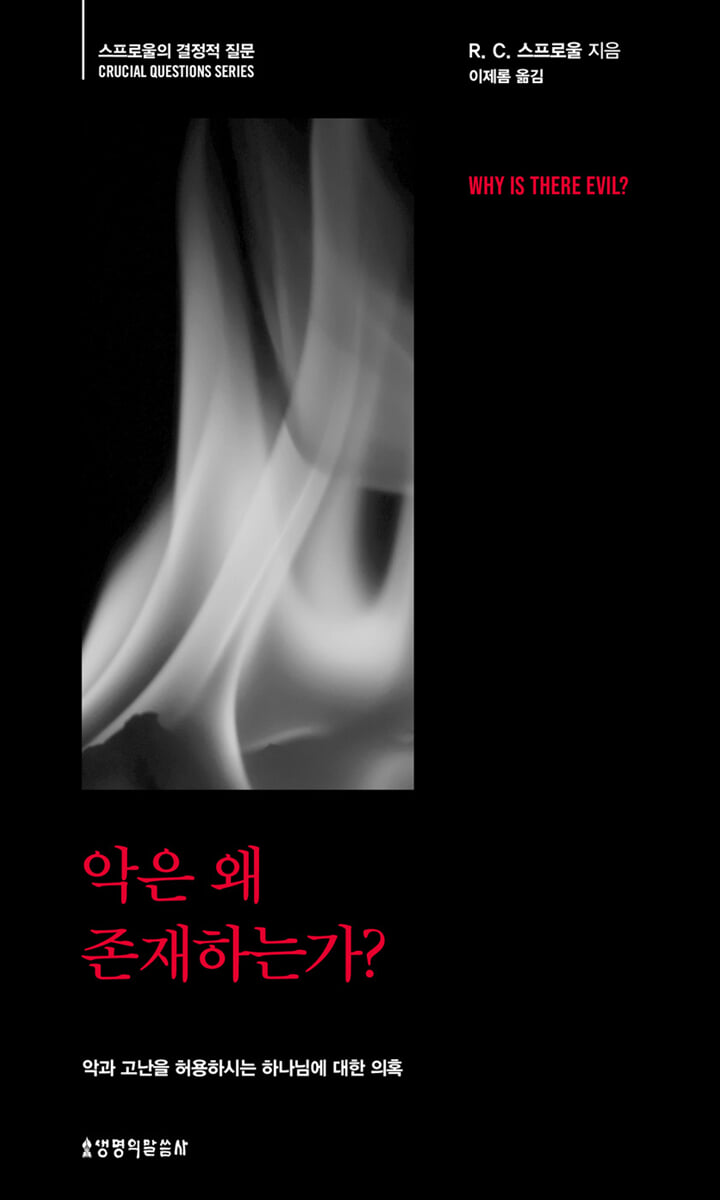
Why does evil exist?
 |
Description
Book Introduction
Two issues are often raised when criticizing Christianity:
Questions about the existence of evil and suffering
An infinitely righteous, holy and perfect being
How could one create a creature capable of sinning?
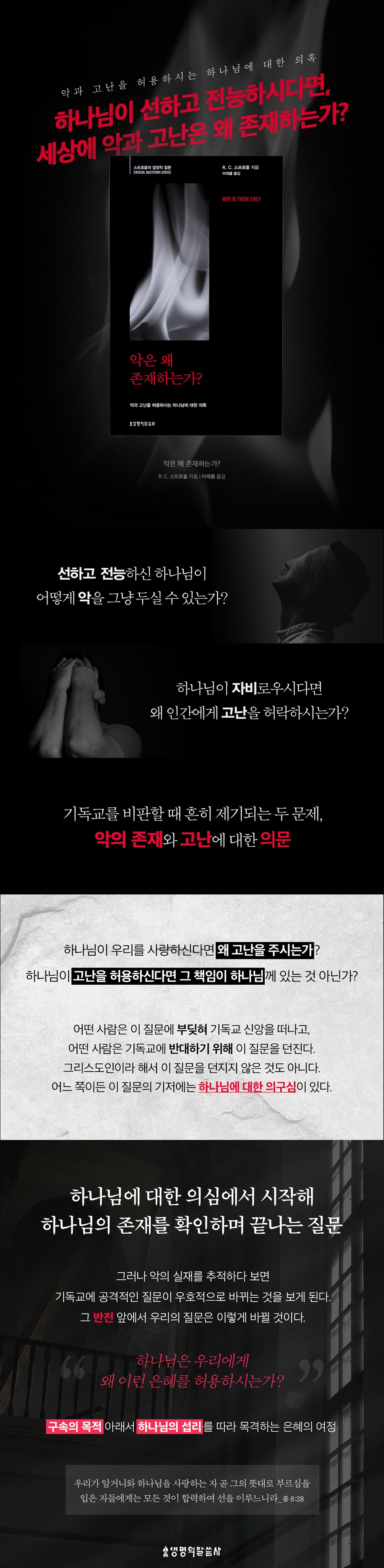
If God is good and omnipotent
How can you just leave evil alone?
If God is merciful
Why does God allow suffering to occur to humans?
We present a biblical defense of this difficult debate.
Questions about the existence of evil and suffering
An infinitely righteous, holy and perfect being
How could one create a creature capable of sinning?
If God is good and omnipotent
How can you just leave evil alone?
If God is merciful
Why does God allow suffering to occur to humans?
We present a biblical defense of this difficult debate.
- You can preview some of the book's contents.
Preview
index
01 The Difficult Problem of Evil
Why does evil exist under a good and omnipotent God?
A consideration of topics raised against Christianity
02 The Nature and Origin of Evil
What is evil, really?
A philosophical and theological approach to the premise of evil
03 Accidents and Coincidences
How do we understand a disaster that no one intended?
Exploring the ultimate cause
04 Providence and Suffering
Is God always on our side?
How God's Providence Works in Suffering
05 Providence and Evil
Can God's providence and evil coexist?
Grace to be found before justice
06 The Case of Job
Who is God, really?
The most comprehensive answer to pain and suffering
07 Suffering and Sin
How does sin cause suffering?
The Purpose of Redemption and the Sinner's Silence
08 Working together for good
Is everything that happens to us good?
A comforting promise to believers
09 Evil is never good
Is evil good if it brings about good consequences?
Risks to watch out for
10 Those who love God
Can good things be the occasion for more sin?
A Christian understanding that must be possessed
Why does evil exist under a good and omnipotent God?
A consideration of topics raised against Christianity
02 The Nature and Origin of Evil
What is evil, really?
A philosophical and theological approach to the premise of evil
03 Accidents and Coincidences
How do we understand a disaster that no one intended?
Exploring the ultimate cause
04 Providence and Suffering
Is God always on our side?
How God's Providence Works in Suffering
05 Providence and Evil
Can God's providence and evil coexist?
Grace to be found before justice
06 The Case of Job
Who is God, really?
The most comprehensive answer to pain and suffering
07 Suffering and Sin
How does sin cause suffering?
The Purpose of Redemption and the Sinner's Silence
08 Working together for good
Is everything that happens to us good?
A comforting promise to believers
09 Evil is never good
Is evil good if it brings about good consequences?
Risks to watch out for
10 Those who love God
Can good things be the occasion for more sin?
A Christian understanding that must be possessed
Detailed image
Into the book
We should define freedom as the ability to choose what I want.
The ability to choose without any desire is a natural occurrence, and even God cannot create that kind of thing.
Even God does not have the power of self-creation or spontaneous generation.
God has the power to bring something into existence out of nothingness.
But the term 'state of nothingness' does not mean that He had no intention of doing so.
It cannot be said that someone simply acted out of free choice.
We must ask 'why' he freely chose it.
What led him to choose it freely?
--- From "Chapter 1: The Difficult Problem of Evil"
The reason I emphasize this point is that we, as a culture, tend to think of evil as if it were some independent entity, or something in the water we drink or the air we breathe, or some independent force or power that exists on its own and thus influences our lives and what happens in the world.
So, the first thing we need to talk about in relation to what evil is is what it is not.
It is not something that exists.
Evil does not contain existence.
That is, evil has no ontological status.
Rather, evil is the act of something that exists.
I am something.
What are we?
If I do something bad, then I am doing something evil, and in this case, evil is the action of some being.
It does not exist in itself.
--- From “Chapter 2: The Nature and Origin of Evil”
We don't marvel at God's grace enough.
As Christians, we have a vague idea of grace and think that God should give us grace anyway, but we have forgotten what grace is.
Grace is, by its very concept, voluntary and free, not obligatory.
If there is an attitude that God is obligated to take when dealing with us, it is not grace but justice.
Only by clearly recognizing this difference between justice and grace can we understand how gracious grace is.
Because grace is the most important thing in our relationship with God.
We live by grace.
By grace we have eternal life.
By grace we receive forgiveness of sins.
This is only possible by grace.
--- From Chapter 5, Providence and Evil
When we stand before God on the Day of Judgment and the Book of Life is finally opened, there will be silence in heaven.
We will not be able to make any excuses.
For you will clearly see that God's work is not only amazing, but also entirely righteous, and that there is no injustice in His providence.
Even Christians sometimes find it extremely difficult to trust this.
Especially when we witness pain and suffering, illness and death.
In such cases, it is necessary to remain silent.
Of course, we try to find His way in the Bible, but sometimes we don't find the right answer.
There are times and places when holy silence is needed before God's sovereignty.
--- From "Chapter 7 Suffering and Sin"
If we do not love God, there is no guarantee that everything that happens to us will ultimately be for our good.
If we are not among those who have been called according to God's will, if we actively live against God's will, we should not take comfort in these words.
God's providence is a double-edged sword.
God's providence means that He rules, and God's rule means that His justice is done.
And His justice is done by punishing unrepentant sinners.
The ability to choose without any desire is a natural occurrence, and even God cannot create that kind of thing.
Even God does not have the power of self-creation or spontaneous generation.
God has the power to bring something into existence out of nothingness.
But the term 'state of nothingness' does not mean that He had no intention of doing so.
It cannot be said that someone simply acted out of free choice.
We must ask 'why' he freely chose it.
What led him to choose it freely?
--- From "Chapter 1: The Difficult Problem of Evil"
The reason I emphasize this point is that we, as a culture, tend to think of evil as if it were some independent entity, or something in the water we drink or the air we breathe, or some independent force or power that exists on its own and thus influences our lives and what happens in the world.
So, the first thing we need to talk about in relation to what evil is is what it is not.
It is not something that exists.
Evil does not contain existence.
That is, evil has no ontological status.
Rather, evil is the act of something that exists.
I am something.
What are we?
If I do something bad, then I am doing something evil, and in this case, evil is the action of some being.
It does not exist in itself.
--- From “Chapter 2: The Nature and Origin of Evil”
We don't marvel at God's grace enough.
As Christians, we have a vague idea of grace and think that God should give us grace anyway, but we have forgotten what grace is.
Grace is, by its very concept, voluntary and free, not obligatory.
If there is an attitude that God is obligated to take when dealing with us, it is not grace but justice.
Only by clearly recognizing this difference between justice and grace can we understand how gracious grace is.
Because grace is the most important thing in our relationship with God.
We live by grace.
By grace we have eternal life.
By grace we receive forgiveness of sins.
This is only possible by grace.
--- From Chapter 5, Providence and Evil
When we stand before God on the Day of Judgment and the Book of Life is finally opened, there will be silence in heaven.
We will not be able to make any excuses.
For you will clearly see that God's work is not only amazing, but also entirely righteous, and that there is no injustice in His providence.
Even Christians sometimes find it extremely difficult to trust this.
Especially when we witness pain and suffering, illness and death.
In such cases, it is necessary to remain silent.
Of course, we try to find His way in the Bible, but sometimes we don't find the right answer.
There are times and places when holy silence is needed before God's sovereignty.
--- From "Chapter 7 Suffering and Sin"
If we do not love God, there is no guarantee that everything that happens to us will ultimately be for our good.
If we are not among those who have been called according to God's will, if we actively live against God's will, we should not take comfort in these words.
God's providence is a double-edged sword.
God's providence means that He rules, and God's rule means that His justice is done.
And His justice is done by punishing unrepentant sinners.
--- From “Chapter 10: Those Who Love God”
Publisher's Review
Starting from doubt about God
A question that ends by confirming God's existence
Some people leave the Christian faith because of this question, and others ask this question to oppose Christianity.
Being a Christian doesn't mean you don't ask this question.
Either way, we must recognize that underlying this question is a doubt about God.
Sproul said that even he found the question of the existence and origin of evil difficult.
Some parts have not yet been revealed, and some parts will remain a mystery.
However, if we pursue the reality of evil, we cannot avoid the reality of good and end up proving the reality of God.
Sproul says:
“It’s certainly a difficult question, but it’s definitely a question that’s more beneficial to Christians.” You’ll glorify God in the reversal of how an aggressive question to Christianity turns into a friendly one.
Under the purpose of redemption, according to God's providence
A Journey of Grace Witnessed
The existence of suffering remains an emotionally difficult issue.
If God loves us, why does He allow suffering? Is our sin the cause of suffering? If God permits suffering, isn't the responsibility His? Sproul examines the cases of Job, the prophet Habakkuk, and the saints of the New Testament era, and explains how the suffering of the saints works together for good.
For those who love God in the purpose of redemption and in God's providence, this promise will be a hope.
Then our question will change to this:
"Why does God grant us this grace?" To those who stumble and stumble, doubting God's goodness, omnipotence, mercy, and grace, and failing to fully open their hearts to Him, I hope this book will be like a refreshing shower, allowing them to move forward into the world with unwavering faith and a faith that believes in the evidence they have received.
I recommend it!
ㆍBelievers who want to understand evil and suffering from a Christian worldview
ㆍMinisters seeking a theological foundation to apply to small group leadership, evangelism, and other ministries
Intellectual readers who are curious about what answers Christianity can provide to the problems of evil and suffering.
ㆍTheological students who want to briefly review the core doctrines on evil and suffering.
Features of the book!
ㆍOptimized for busy modern people with a burden-free portion size
ㆍLowering the barrier to doctrine by explaining the topics of evil and suffering in an easy-to-understand manner.
ㆍDeveloped with strong conviction and persuasive power, so that people can trust and rely on it
A question that ends by confirming God's existence
Some people leave the Christian faith because of this question, and others ask this question to oppose Christianity.
Being a Christian doesn't mean you don't ask this question.
Either way, we must recognize that underlying this question is a doubt about God.
Sproul said that even he found the question of the existence and origin of evil difficult.
Some parts have not yet been revealed, and some parts will remain a mystery.
However, if we pursue the reality of evil, we cannot avoid the reality of good and end up proving the reality of God.
Sproul says:
“It’s certainly a difficult question, but it’s definitely a question that’s more beneficial to Christians.” You’ll glorify God in the reversal of how an aggressive question to Christianity turns into a friendly one.
Under the purpose of redemption, according to God's providence
A Journey of Grace Witnessed
The existence of suffering remains an emotionally difficult issue.
If God loves us, why does He allow suffering? Is our sin the cause of suffering? If God permits suffering, isn't the responsibility His? Sproul examines the cases of Job, the prophet Habakkuk, and the saints of the New Testament era, and explains how the suffering of the saints works together for good.
For those who love God in the purpose of redemption and in God's providence, this promise will be a hope.
Then our question will change to this:
"Why does God grant us this grace?" To those who stumble and stumble, doubting God's goodness, omnipotence, mercy, and grace, and failing to fully open their hearts to Him, I hope this book will be like a refreshing shower, allowing them to move forward into the world with unwavering faith and a faith that believes in the evidence they have received.
I recommend it!
ㆍBelievers who want to understand evil and suffering from a Christian worldview
ㆍMinisters seeking a theological foundation to apply to small group leadership, evangelism, and other ministries
Intellectual readers who are curious about what answers Christianity can provide to the problems of evil and suffering.
ㆍTheological students who want to briefly review the core doctrines on evil and suffering.
Features of the book!
ㆍOptimized for busy modern people with a burden-free portion size
ㆍLowering the barrier to doctrine by explaining the topics of evil and suffering in an easy-to-understand manner.
ㆍDeveloped with strong conviction and persuasive power, so that people can trust and rely on it
GOODS SPECIFICS
- Date of issue: August 20, 2025
- Page count, weight, size: 168 pages | 230g | 121*200*10mm
- ISBN13: 9788904169306
- ISBN10: 8904169305
You may also like
카테고리
korean


korean

![ELLE 엘르 스페셜 에디션 A형 : 12월 [2025]](http://librairie.coreenne.fr/cdn/shop/files/b8e27a3de6c9538896439686c6b0e8fb.jpg?v=1766436872&width=3840)


