

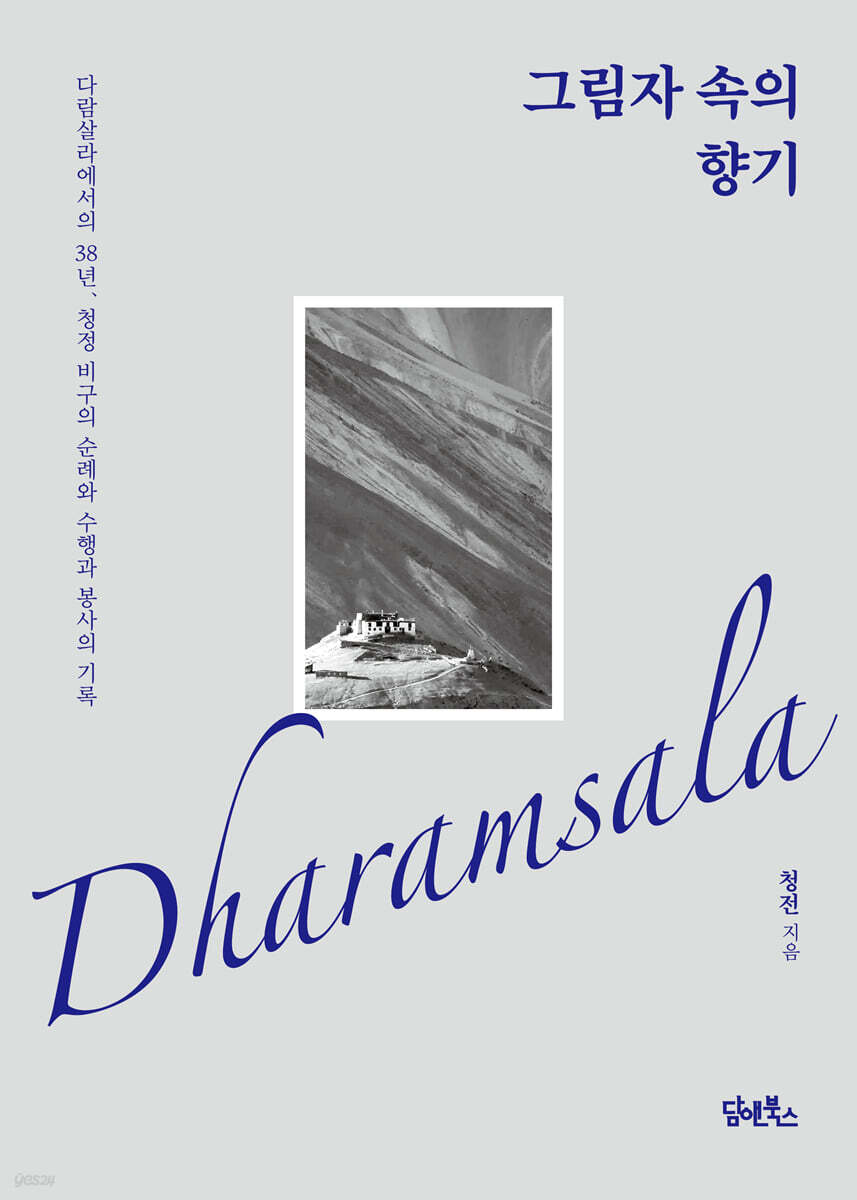
Fragrance in the Shadows
 |
Description
Book Introduction
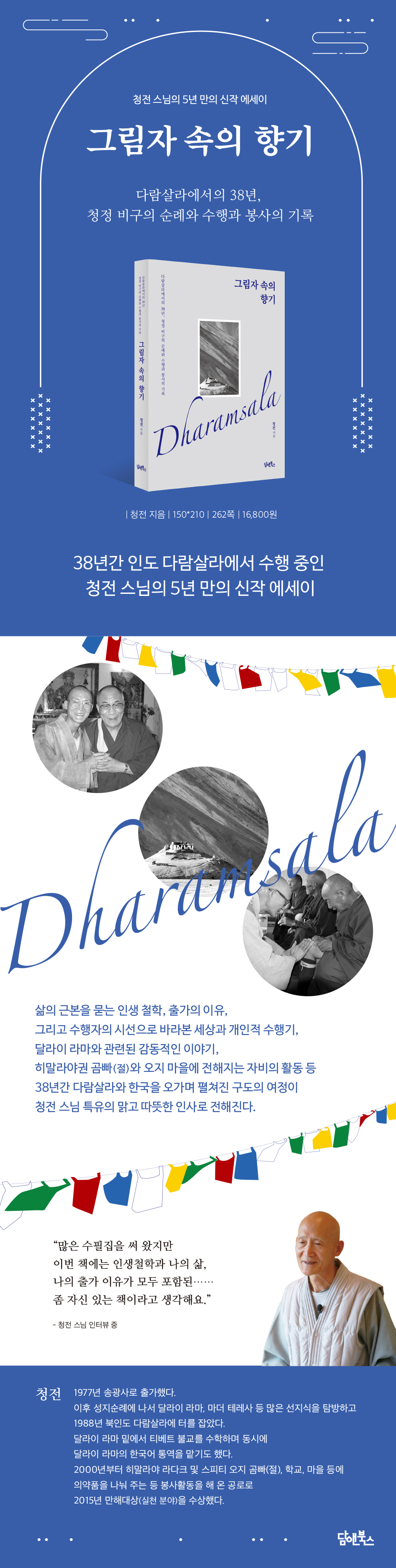
[Practicing in Dharamsala, North India for 38 years
[A new essay by Monk Cheongjeon, published after five years]
“I have written many essay collections, but in this book,
It contains my philosophy of life, my life, and the reason for my becoming a monk.
“I think it’s a book I can be quite confident in.” - From an interview with Monk Cheongjeon
A philosophy of life that asks the fundamentals of life, the reason for becoming a monk,
And the world and personal practice as seen through the eyes of a practitioner,
A touching story about the Dalai Lama,
Activities of compassion spread in Himalayan gompas (temples) and remote villages, etc.
The journey of Gudo, which unfolded between Dharamsala and Korea for 38 years
It is said to be a clear and warm greeting unique to Monk Cheongjeon.
[A new essay by Monk Cheongjeon, published after five years]
“I have written many essay collections, but in this book,
It contains my philosophy of life, my life, and the reason for my becoming a monk.
“I think it’s a book I can be quite confident in.” - From an interview with Monk Cheongjeon
A philosophy of life that asks the fundamentals of life, the reason for becoming a monk,
And the world and personal practice as seen through the eyes of a practitioner,
A touching story about the Dalai Lama,
Activities of compassion spread in Himalayan gompas (temples) and remote villages, etc.
The journey of Gudo, which unfolded between Dharamsala and Korea for 38 years
It is said to be a clear and warm greeting unique to Monk Cheongjeon.
- You can preview some of the book's contents.
Preview
index
The Indian land itself is a good place for practice.
I met a saint in my life
Dharamsala My Home
Tibetan traditional black room meditation practice
Oracle bone script and oracular rituals
The unquenchable lamp of faith
Hidden Stories I Discovered in India
Entering Bodhicitta's Practice
The Karmapa's escape and exile in India
I will live well as a pure monk.
My staple food
Coffee and tea
A strange country with many friends in the world
Graveyard of the World
Climbing Mount Sinai, where Moses in the Old Testament is said to have received the Ten Commandments.
Seongsan Nanda Devi
One night with Simmani
Memories of Ukraine
A story from when I was a private
My anger towards the clergy in this age
Helping people is the best Buddhist service.
A one-night stand at Lamayuru Gompa in Ladakh
Mr. Jang Chup North
The treasure of the Ringse Gompa, the Venerable Chering Wangdui
Banana Story
The sea seen for the first time in their lives by Ladakhi North people in their eighties
Nine Bhikkhus' Pilgrimage: 44 Nights and 45 Days
Learning to speak, Kakar Kong
I met a saint in my life
Dharamsala My Home
Tibetan traditional black room meditation practice
Oracle bone script and oracular rituals
The unquenchable lamp of faith
Hidden Stories I Discovered in India
Entering Bodhicitta's Practice
The Karmapa's escape and exile in India
I will live well as a pure monk.
My staple food
Coffee and tea
A strange country with many friends in the world
Graveyard of the World
Climbing Mount Sinai, where Moses in the Old Testament is said to have received the Ten Commandments.
Seongsan Nanda Devi
One night with Simmani
Memories of Ukraine
A story from when I was a private
My anger towards the clergy in this age
Helping people is the best Buddhist service.
A one-night stand at Lamayuru Gompa in Ladakh
Mr. Jang Chup North
The treasure of the Ringse Gompa, the Venerable Chering Wangdui
Banana Story
The sea seen for the first time in their lives by Ladakhi North people in their eighties
Nine Bhikkhus' Pilgrimage: 44 Nights and 45 Days
Learning to speak, Kakar Kong
Detailed image
Into the book
The Dharamsala oracle is revered as a representative of the Dharma protector in Tibetan Buddhism.
The monk's declaration is absolute.
For example, the declaration made by the Dalai Lama and his entourage in 1959 when they requested the final oracle before going into exile in India.
With the decisive words of the trustee, “Now is the time!”, he decided to go into exile and carried it out.
So what was the hidden meaning of the Dalai Lama calling me to an oracle that answered my years of curiosity and gave me a realization?
And how did you know my hidden curiosity and consciousness and put me there?
I had many personal experiences during my pilgrimage to Mount Kailash on foot in Tibet in 1993. When I returned from the pilgrimage and met you, how did you know and explain to me in detail before I could ask?
How did you know about my very personal religious and mystical experiences?
There have been many similar incidents since then, and He has always shown me the way on my important path of practice.
--- pp.40-40 From “Oracle Bone Script and Oracle Ritual”
In India, where I live, we drink 'chai', which is black tea boiled with milk and sugar.
For Indian people, drinking chai as soon as they wake up is the start of their day.
I drink a lot of tea a day.
It's saltier than coffee.
If I occasionally give a cup of Maxim coffee to the housework crew and say, "Kkorija Jjai," they rave about how delicious it is.
When I gave them five each, telling them to go home and share them with their families, they kept saying “Dannewat.”
The Hindi (Indian) expression for 'thank you' is 'danewat'.
As I have lived for a long time, I have become accustomed to the taste of jjajangmyeon, and I even boil it and drink it in my room.
When you feel hungry, a strong soup will satisfy your hunger.
If I had to indulge in my Indian life, it would be to make and drink Korean green tea, Chinese Pu-erh tea, Western coffee, and Indian chai by hand.
I feel grateful and happy for that kind of life.
--- pp.97-98 From "Coffee and Tea"
I also once had a dream where I received something from Buddha.
It was a clear, clean liquor, not ginseng.
How could the Buddha give alcohol to a monk? And on the first day of the lunar new year, at dawn, on the peak of the pure white snow-capped mountain, Mount Sumeru (the icy peak of Kailash).
Wasn't it the Buddha himself who poured wine into a clear crystal cup? I drank it all in one gulp, without a second thought.
I can't drink alcohol.
The secular family is like that.
Even my older brothers can't have a glass of beer.
A cup of wine given by the Buddha, it turns out that for esoteric Buddhist practitioners, alcohol is a symbol of gaining strength.
That's probably why I haven't been sick or hospitalized until now.
I have a rather thin constitution, but I still don't take any medication.
Sometimes, I receive medicine from believers that is good for my health, but I take it all back to India and give it to the monks.
--- p.159 From “One Night with Simmani”
It was exactly July 10, 1987 (June 15th in the lunar calendar).
I still can't forget that day. I had a strange experience in the temple.
When I bowed three times at a holy place or a large temple, I couldn't get up after bowing once.
The moment I touched my forehead to the floor of the temple, I was transported back to infinite time, thinking, “Yes, this is it! This is it!” The smell of the temple floor, filled with the scent of butter and incense, filled my whole body.
The musty smell inside the Ladak Gompa temple that I had smelled from countless past lives, the dream I had had on my first day of ordination after becoming a monk, and the memory of ten years ago when I woke up with a pinpointed dream, all of that time was coming back to me in reverse.
On the first night of my ordination, I had a dream in which I was chased out by monks for wearing red robes. Ah, the fact that I had once been a monk here in my past life was imprinted on my mind.
--- pp.196-197 From "A One-Night Connection at Lamayuru Gompa in Ladakh"
The Spiti Valley is located at a high altitude and experiences harsh winters.
Electric blankets are provided unconditionally to villages above 3,300 meters above sea level.
We finished supplying electric blankets to the Sangha, which was mainly composed of Gompa, three years ago.
We have decided to take extra care and provide electric blankets to the residents of Gagahoho Village.
Following last year, this year 1,200 sheets were distributed with priority to the valley villages.
We will need more than 1,000 sheets next year as well.
I am so grateful for the volunteer work in the Ladakh region.
He visits many gompa and monks every year and maintains personal relationships with them.
Every time I go to a temple, the first food I eat is bananas.
These days, the roads are paved so that fruits from the city can reach the villages in the mountain valleys.
It is so heartwarming to see the bright faces of the monks who are happy when I give them a banana.
Plus, now you can even get stickball candy!
The monk's declaration is absolute.
For example, the declaration made by the Dalai Lama and his entourage in 1959 when they requested the final oracle before going into exile in India.
With the decisive words of the trustee, “Now is the time!”, he decided to go into exile and carried it out.
So what was the hidden meaning of the Dalai Lama calling me to an oracle that answered my years of curiosity and gave me a realization?
And how did you know my hidden curiosity and consciousness and put me there?
I had many personal experiences during my pilgrimage to Mount Kailash on foot in Tibet in 1993. When I returned from the pilgrimage and met you, how did you know and explain to me in detail before I could ask?
How did you know about my very personal religious and mystical experiences?
There have been many similar incidents since then, and He has always shown me the way on my important path of practice.
--- pp.40-40 From “Oracle Bone Script and Oracle Ritual”
In India, where I live, we drink 'chai', which is black tea boiled with milk and sugar.
For Indian people, drinking chai as soon as they wake up is the start of their day.
I drink a lot of tea a day.
It's saltier than coffee.
If I occasionally give a cup of Maxim coffee to the housework crew and say, "Kkorija Jjai," they rave about how delicious it is.
When I gave them five each, telling them to go home and share them with their families, they kept saying “Dannewat.”
The Hindi (Indian) expression for 'thank you' is 'danewat'.
As I have lived for a long time, I have become accustomed to the taste of jjajangmyeon, and I even boil it and drink it in my room.
When you feel hungry, a strong soup will satisfy your hunger.
If I had to indulge in my Indian life, it would be to make and drink Korean green tea, Chinese Pu-erh tea, Western coffee, and Indian chai by hand.
I feel grateful and happy for that kind of life.
--- pp.97-98 From "Coffee and Tea"
I also once had a dream where I received something from Buddha.
It was a clear, clean liquor, not ginseng.
How could the Buddha give alcohol to a monk? And on the first day of the lunar new year, at dawn, on the peak of the pure white snow-capped mountain, Mount Sumeru (the icy peak of Kailash).
Wasn't it the Buddha himself who poured wine into a clear crystal cup? I drank it all in one gulp, without a second thought.
I can't drink alcohol.
The secular family is like that.
Even my older brothers can't have a glass of beer.
A cup of wine given by the Buddha, it turns out that for esoteric Buddhist practitioners, alcohol is a symbol of gaining strength.
That's probably why I haven't been sick or hospitalized until now.
I have a rather thin constitution, but I still don't take any medication.
Sometimes, I receive medicine from believers that is good for my health, but I take it all back to India and give it to the monks.
--- p.159 From “One Night with Simmani”
It was exactly July 10, 1987 (June 15th in the lunar calendar).
I still can't forget that day. I had a strange experience in the temple.
When I bowed three times at a holy place or a large temple, I couldn't get up after bowing once.
The moment I touched my forehead to the floor of the temple, I was transported back to infinite time, thinking, “Yes, this is it! This is it!” The smell of the temple floor, filled with the scent of butter and incense, filled my whole body.
The musty smell inside the Ladak Gompa temple that I had smelled from countless past lives, the dream I had had on my first day of ordination after becoming a monk, and the memory of ten years ago when I woke up with a pinpointed dream, all of that time was coming back to me in reverse.
On the first night of my ordination, I had a dream in which I was chased out by monks for wearing red robes. Ah, the fact that I had once been a monk here in my past life was imprinted on my mind.
--- pp.196-197 From "A One-Night Connection at Lamayuru Gompa in Ladakh"
The Spiti Valley is located at a high altitude and experiences harsh winters.
Electric blankets are provided unconditionally to villages above 3,300 meters above sea level.
We finished supplying electric blankets to the Sangha, which was mainly composed of Gompa, three years ago.
We have decided to take extra care and provide electric blankets to the residents of Gagahoho Village.
Following last year, this year 1,200 sheets were distributed with priority to the valley villages.
We will need more than 1,000 sheets next year as well.
I am so grateful for the volunteer work in the Ladakh region.
He visits many gompa and monks every year and maintains personal relationships with them.
Every time I go to a temple, the first food I eat is bananas.
These days, the roads are paved so that fruits from the city can reach the villages in the mountain valleys.
It is so heartwarming to see the bright faces of the monks who are happy when I give them a banana.
Plus, now you can even get stickball candy!
--- p.227 From "Banana Story"
Publisher's Review
"Scent in the Shadows" is a new essay by Monk Cheongjeon, published after five years.
He lived in Dharamsala, North India for 38 years with the Dalai Lama as his teacher.
Records of the pilgrimage, practice, and service of Monk Cheongjeon
This book includes photos provided directly by the author.
The connection between Venerable Cheongjeon, a monk from the Himalayas, and the Dalai Lama
After setting foot on India for the first time on July 1, 1987, I have lived in Dharamsala for 38 years thanks to my relationship with His Holiness the Dalai Lama.
Sometimes when I visit Korea, there are quite a few people who ask me if I am still in India and if it would be a good idea for me to come back now that I am quite old.
But for me, Dharamsala is still my ‘home’.
It's been five years since I last shared news through a book, so I thought you might be curious about how I'm doing, so I've decided to write down the story of my life so far.
- Full text of "Publishing a Book"
Monk Cheongjeon said that the moment he took the Dalai Lama's outstretched hand in 1987, he felt a great emotion that could not be expressed in words or writing, and a thrill ran through his entire body.
After meeting a truly difficult person, he decided to live in India and continue his true practice for the rest of his life, and has remained in the same place ever since.
He studied Tibetan Buddhism under the Dalai Lama, and also assisted the Dalai Lama with Korean interpretation and sermon performances.
The author had many personal mystical experiences while on a walking pilgrimage to Mount Kailash in Tibet in 1993. Upon returning from the pilgrimage, he met the Dalai Lama, who explained everything to him in detail before he could even ask questions.
How did you come to know about this very personal religious mystical experience?
The extraordinary hidden behind the ordinary aroused in me an indescribable sense of faith and respect.
The author plans not to leave Dharamsala as long as the Dalai Lama is there.
A true teacher, a true human practitioner, a monk with absolute will.
And yet, he is humble and unhypocritical.
The Dalai Lama has always shown the way to Venerable Cheongjeon's important path of practice.
A life written on the road, not at the desk
While learning Tibetan Buddhism in Dharamsala and walking the path of practice, I naturally became close to the gompa (temples) and nosunim and novice monks of the Ladakh region beyond the Himalayas. I thought about how I could be of some help to the people there, and so I started volunteering by distributing medicine and daily necessities.
At that time, when transportation was not developed, people had to cross several 4,000-5,000 meter high passes in the foothills of the Himalayas and then load goods onto horses and donkeys to transport them to the village.
These days, small solar-powered electric blankets from India are being provided to Gompa and other mountain villages.
The harsh winters of the mud houses must be unbearable, but the residents there survive the long winters by cooking meals over a poorly made stove.
Occasionally, people who need special medication are referred to pharmacies or hospitals in the city, and people who need treatment or surgery are referred to Dharamsala in the winter, and help is provided mainly for cataracts, dental problems, and other related issues.
We have a place to stay in Dharamsala and are happy to help anyone who wants to.
This is something the author always emphasizes.
“When giving something to someone, it should be given from below, not from above.”
He also went on several pilgrimages to sacred places in India and abroad with Ladakhi and Tibetan monks who have lived in gompas at the foot of the Himalayas their entire lives.
We have been conducting pilgrimage services that are by no means easy, such as taking monks in their eighties on a pilgrimage to various parts of India and Buddhist sites in Thailand, Laos, Cambodia, and Sri Lanka, providing meals that are different from the highland food of barley, wheat, and potatoes, and taking monks from Ladakh, located in the inland, on a 40-hour train ride to show them the sea.
Monk Cheongjeon received the Manhae Grand Prize (Practice Category) in 2015 for his volunteer work distributing medicine and daily necessities in the remote Himalayan region of Ladakh since 2000.
A Himalayan monk who was once a monk here in his previous life
The first gompa in Ladakh I visited after arriving in India in 1987.
The author has a strange experience there.
It is said that he was bowing three times at Gompa, but after bowing once, he was unable to get up.
The moment I placed my forehead on the floor of the temple, the smell of butter and incense filled the temple floor with my whole body. It was the musty smell of the Gompa temple that I had smelled from countless past lives, and the dream I had on my first day of ordination after becoming a monk, where I was chased out by monks for wearing red robes, came to mind, and the fact that I had once been a monk here was imprinted on me.
Since then, I have been traveling throughout Ladakh every year, meeting people in gompas, schools, and villages, and continuing my practical training.
In addition, we will meet monks who have completed the 'Thousand-Day Black Room Closing Practice', a Tibetan tradition that is practiced at the Mumun Hall for a thousand days, observe the religious rites of the oracle monks that are unique to Tibet, translate the Tibetan text 'Entry to the Bodhi Path', a representative text of Tibetan Buddhism, into Korean, and treasure a monk who has read the Tripitaka Koreana twice. We will also practice Tibetan Buddhism together.
For reference, Tibetan Buddhism is a unique tradition that integrates esoteric Buddhism with the teachings and practice system of Mahayana Buddhism transmitted from India.
Beyond being simply a religious system, it is an integrated system that combines with Tibetan culture, politics, and art in general, and has a distinct ‘color unique to Tibetan Buddhism.’
The author says that poverty itself is a practice.
Monk Cheongjeon refuses any fancy title or position and wishes to remain a monk.
I want to remain a practitioner who serves and supports people.
A short video containing the author's brief introduction to this new book has been included in the QR code.
He lived in Dharamsala, North India for 38 years with the Dalai Lama as his teacher.
Records of the pilgrimage, practice, and service of Monk Cheongjeon
This book includes photos provided directly by the author.
The connection between Venerable Cheongjeon, a monk from the Himalayas, and the Dalai Lama
After setting foot on India for the first time on July 1, 1987, I have lived in Dharamsala for 38 years thanks to my relationship with His Holiness the Dalai Lama.
Sometimes when I visit Korea, there are quite a few people who ask me if I am still in India and if it would be a good idea for me to come back now that I am quite old.
But for me, Dharamsala is still my ‘home’.
It's been five years since I last shared news through a book, so I thought you might be curious about how I'm doing, so I've decided to write down the story of my life so far.
- Full text of "Publishing a Book"
Monk Cheongjeon said that the moment he took the Dalai Lama's outstretched hand in 1987, he felt a great emotion that could not be expressed in words or writing, and a thrill ran through his entire body.
After meeting a truly difficult person, he decided to live in India and continue his true practice for the rest of his life, and has remained in the same place ever since.
He studied Tibetan Buddhism under the Dalai Lama, and also assisted the Dalai Lama with Korean interpretation and sermon performances.
The author had many personal mystical experiences while on a walking pilgrimage to Mount Kailash in Tibet in 1993. Upon returning from the pilgrimage, he met the Dalai Lama, who explained everything to him in detail before he could even ask questions.
How did you come to know about this very personal religious mystical experience?
The extraordinary hidden behind the ordinary aroused in me an indescribable sense of faith and respect.
The author plans not to leave Dharamsala as long as the Dalai Lama is there.
A true teacher, a true human practitioner, a monk with absolute will.
And yet, he is humble and unhypocritical.
The Dalai Lama has always shown the way to Venerable Cheongjeon's important path of practice.
A life written on the road, not at the desk
While learning Tibetan Buddhism in Dharamsala and walking the path of practice, I naturally became close to the gompa (temples) and nosunim and novice monks of the Ladakh region beyond the Himalayas. I thought about how I could be of some help to the people there, and so I started volunteering by distributing medicine and daily necessities.
At that time, when transportation was not developed, people had to cross several 4,000-5,000 meter high passes in the foothills of the Himalayas and then load goods onto horses and donkeys to transport them to the village.
These days, small solar-powered electric blankets from India are being provided to Gompa and other mountain villages.
The harsh winters of the mud houses must be unbearable, but the residents there survive the long winters by cooking meals over a poorly made stove.
Occasionally, people who need special medication are referred to pharmacies or hospitals in the city, and people who need treatment or surgery are referred to Dharamsala in the winter, and help is provided mainly for cataracts, dental problems, and other related issues.
We have a place to stay in Dharamsala and are happy to help anyone who wants to.
This is something the author always emphasizes.
“When giving something to someone, it should be given from below, not from above.”
He also went on several pilgrimages to sacred places in India and abroad with Ladakhi and Tibetan monks who have lived in gompas at the foot of the Himalayas their entire lives.
We have been conducting pilgrimage services that are by no means easy, such as taking monks in their eighties on a pilgrimage to various parts of India and Buddhist sites in Thailand, Laos, Cambodia, and Sri Lanka, providing meals that are different from the highland food of barley, wheat, and potatoes, and taking monks from Ladakh, located in the inland, on a 40-hour train ride to show them the sea.
Monk Cheongjeon received the Manhae Grand Prize (Practice Category) in 2015 for his volunteer work distributing medicine and daily necessities in the remote Himalayan region of Ladakh since 2000.
A Himalayan monk who was once a monk here in his previous life
The first gompa in Ladakh I visited after arriving in India in 1987.
The author has a strange experience there.
It is said that he was bowing three times at Gompa, but after bowing once, he was unable to get up.
The moment I placed my forehead on the floor of the temple, the smell of butter and incense filled the temple floor with my whole body. It was the musty smell of the Gompa temple that I had smelled from countless past lives, and the dream I had on my first day of ordination after becoming a monk, where I was chased out by monks for wearing red robes, came to mind, and the fact that I had once been a monk here was imprinted on me.
Since then, I have been traveling throughout Ladakh every year, meeting people in gompas, schools, and villages, and continuing my practical training.
In addition, we will meet monks who have completed the 'Thousand-Day Black Room Closing Practice', a Tibetan tradition that is practiced at the Mumun Hall for a thousand days, observe the religious rites of the oracle monks that are unique to Tibet, translate the Tibetan text 'Entry to the Bodhi Path', a representative text of Tibetan Buddhism, into Korean, and treasure a monk who has read the Tripitaka Koreana twice. We will also practice Tibetan Buddhism together.
For reference, Tibetan Buddhism is a unique tradition that integrates esoteric Buddhism with the teachings and practice system of Mahayana Buddhism transmitted from India.
Beyond being simply a religious system, it is an integrated system that combines with Tibetan culture, politics, and art in general, and has a distinct ‘color unique to Tibetan Buddhism.’
The author says that poverty itself is a practice.
Monk Cheongjeon refuses any fancy title or position and wishes to remain a monk.
I want to remain a practitioner who serves and supports people.
A short video containing the author's brief introduction to this new book has been included in the QR code.
GOODS SPECIFICS
- Date of issue: July 1, 2025
- Page count, weight, size: 262 pages | 448g | 150*210*22mm
- ISBN13: 9791162015490
- ISBN10: 1162015497
You may also like
카테고리
korean


korean

![GQ KOREA Mark (Monthly): December [2025]](http://librairie.coreenne.fr/cdn/shop/files/8ef265dbbfbf186523ed75ba7319009d.jpg?v=1765340328&width=3840)


