

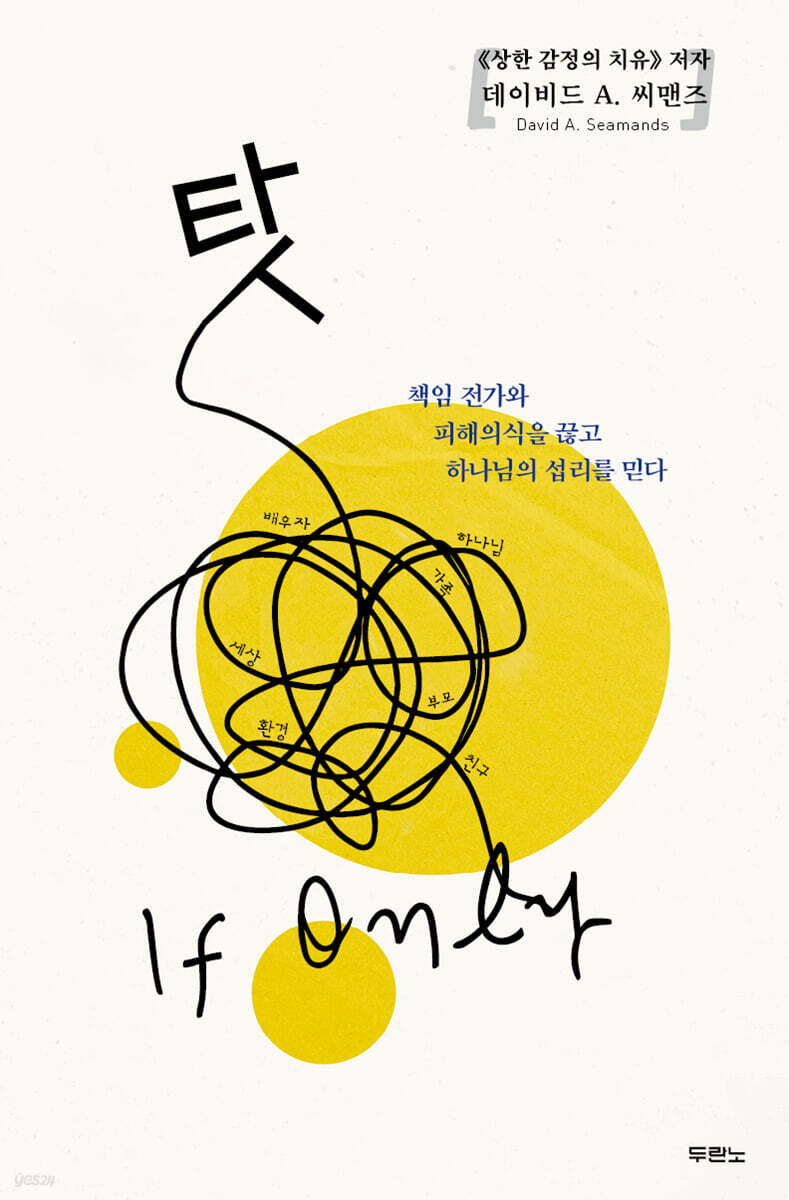
fault
 |
Description
Book Introduction
This book is for those who wish to shake off their victim mentality and live boldly, believing in God's will.
There are people who always blame their parents, their friends, their environment, and sometimes even God.
In fact, in some ways, we may all be victims.
There are times when I struggle with things that are not my fault: parents and siblings I didn't choose, accidents I didn't cause, genetic defects I was born with, damage caused by the sins of others.
However, continuing to be a victim only serves to poison you.
David Seamans, author of "Healing Your Hurt Feelings," uses the Bible and counseling psychology to suggest a way to live as victors, not victims, by relying on God, the sovereign ruler of our lives.
There are people who always blame their parents, their friends, their environment, and sometimes even God.
In fact, in some ways, we may all be victims.
There are times when I struggle with things that are not my fault: parents and siblings I didn't choose, accidents I didn't cause, genetic defects I was born with, damage caused by the sins of others.
However, continuing to be a victim only serves to poison you.
David Seamans, author of "Healing Your Hurt Feelings," uses the Bible and counseling psychology to suggest a way to live as victors, not victims, by relying on God, the sovereign ruler of our lives.
- You can preview some of the book's contents.
Preview
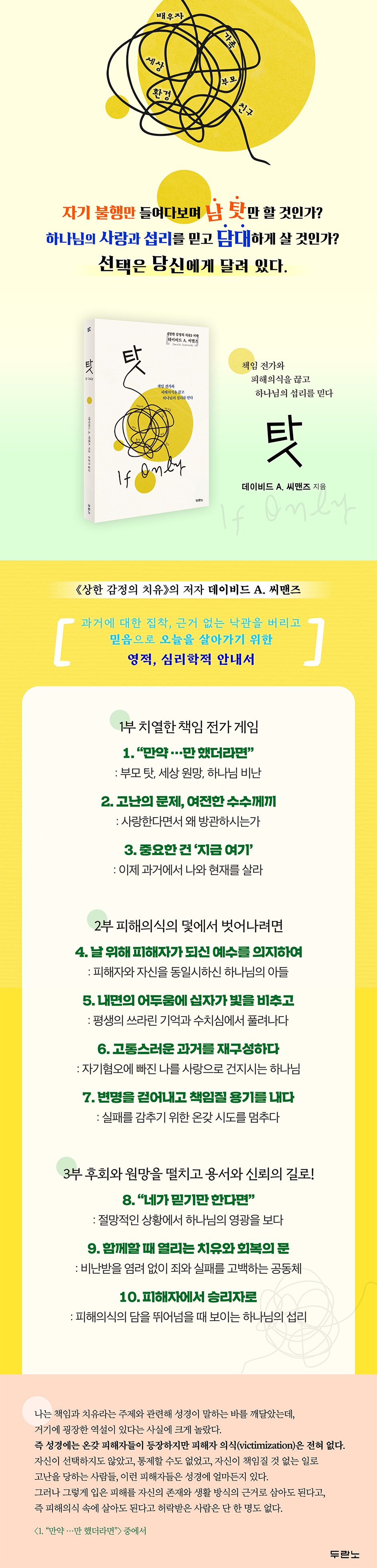
index
Part 1: A Fierce Game of Passing the Blame
1.
“If only…”
: Blaming parents, blaming the world, blaming God
2.
The problem of suffering, a persistent mystery
: If you love me, why are you just standing by?
3.
What matters is 'here and now'
: Now come out of the past and live in the present.
Part 2: How to escape the trap of victim mentality
4.
By relying on Jesus who became a victim for me
: The Son of God who identified himself with the victim
5.
Shine the light of the cross on the darkness within
: Free from a lifetime of bitter memories and shame
6.
Reconstructing a painful past
God, who saves me from self-loathing with love
7.
Have the courage to step away from excuses and take responsibility
: Stop all attempts to hide your failures
Part 3: Shake off regret and resentment and walk the path of forgiveness and trust!
8.
“If you just believe”
: Seeing God's glory in desperate situations
9.
The door to healing and recovery opens when we come together
: A community where sins and failures are confessed without fear of being condemned
10.
From victim to victor
: God's providence revealed when we overcome the wall of victim consciousness
1.
“If only…”
: Blaming parents, blaming the world, blaming God
2.
The problem of suffering, a persistent mystery
: If you love me, why are you just standing by?
3.
What matters is 'here and now'
: Now come out of the past and live in the present.
Part 2: How to escape the trap of victim mentality
4.
By relying on Jesus who became a victim for me
: The Son of God who identified himself with the victim
5.
Shine the light of the cross on the darkness within
: Free from a lifetime of bitter memories and shame
6.
Reconstructing a painful past
God, who saves me from self-loathing with love
7.
Have the courage to step away from excuses and take responsibility
: Stop all attempts to hide your failures
Part 3: Shake off regret and resentment and walk the path of forgiveness and trust!
8.
“If you just believe”
: Seeing God's glory in desperate situations
9.
The door to healing and recovery opens when we come together
: A community where sins and failures are confessed without fear of being condemned
10.
From victim to victor
: God's providence revealed when we overcome the wall of victim consciousness
Detailed image
Into the book
I was struck by what the Bible says about responsibility and healing, and the profound paradox it contains.
In other words, although all kinds of victims appear in the Bible, there is no victimization at all.
The Bible is full of victims who suffer for things they did not choose, had no control over, or were not responsible for.
However, not a single person has been given permission to use the damage they have suffered as the basis for their existence and lifestyle, that is, to live with a sense of victimization.
I took a cue from this and based my research on the two key words of the whole topic: 'if' and 'if only'.
--- 「1.
From “If only…”
“Lord, look!
“The one you love is sick.” The unique expression of this message sent by the sisters when their older brother became ill can be understood based on this special love.
Can you see the true meaning behind these words? I can vaguely sense that they are as much a complaint as a request.
This could be said to be a subtle, perhaps unconscious, expression of a question that has remained unsolved for a long time.
“Lord, we knew that you loved him.
But how could this happen?” We ask the fundamental question we ask God when things go wrong: “Why?”
We've all said, or at least thought, that when we or someone we love gets sick or in trouble.
I said that to my wife Helen about 15 years ago.
“Lord, my dear wife, the person you love has cancer.”
--- 「2.
From "The Problem of Suffering, a Persistent Mystery"
'If only...' fixes our gaze on the past, which can no longer be undone.
Therefore, the words are not only weak but also worthless.
It does nothing but make an already bad situation worse.
It doesn't help people break the chains of bad habits.
It doesn't even try to persuade you to reopen a door that appears to be closed.
It doesn't give you back the days you lost.
Rather than restoring the scattered dreams, it only shatters them further.
We close the book that speaks of change, put the lid on the box called hope, and nail it down.
'If only...' drains your energy by making you dwell on past, irreversible events.
It takes away the power to look at the present reality and the hope for the future.
It prevents us from remembering that while past events cannot be changed, the way we view them can be changed.
The past can be reconstructed in any way.
We can look at the past through new glasses and understand it from a new perspective.
'If only...' is a past tense perspective that fixes life forever.
--- 「3.
What's important is 'here and now'
This statement is written in the context of Paul's discussion of the cross.
But what could God say to a sexual assault victim from the cross? Yet, the word came to him.
If you look at the early paintings depicting Jesus' crucifixion, he is always depicted naked.
This story became the word of God to the woman.
By enduring these insults and humiliations, Christ became one with all those who suffered the shame of nakedness.
The woman realized that Jesus understood the pain of shameful exposure.
Because you have experienced it yourself.
Jesus understood why she was so hurt and angry, and why she had such difficulty forgiving others.
Jesus did not judge or condemn the woman for her anger toward God, but rather wept with her and for her.
--- 「4.
From “Relying on Jesus, who became a victim for me”
This sense of victimization becomes the foundation of self-identity, self-esteem, and self-worth.
If you cling to the "what if" and shift the blame, you're bringing up situations where you were a victim of other people's sins and making incidents or accidents into the very essence of your personality.
Past events are no longer 'what happened to me', but 'I am'.
By doing this, we are giving the past the power to control us.
Even though the Bible says that there was no such power in the past.
“Blotting out the handwriting of regulations that was against us and that was contrary to us, he took it out of the way, nailing it to his cross. Having disarmed the rulers and authorities, he made a public spectacle of them, triumphing over them in it” (Col 2:14-15).
--- 「6.
From “Reconstructing a Painful Past”
It would be a grave mistake to say to God, who is mending our broken lives and restoring us to the image of Christ, “This is trivial,” “That’s too trivial,” or “I’ll wait until something more important comes up.”
What matters is not the size of the task, but the depth of your willingness to obey.
God's will, which we reject to the end, is often revealed in these 'little things'.
To paraphrase what we say to ourselves:
“This is trivial.
“It’s my problem, so I’ll do whatever I want.” But if Jesus is our Lord, he must be the Lord of everything.
--- 「7.
From “Kick out excuses and have the courage to take responsibility”
Our lives are the same.
The Bible repeatedly emphasizes the importance of basing our faith on gratitude and praise.
“But in everything, by prayer and petition, with thanksgiving, present your requests to God” (Philippians 4:6).
“Rejoice always, pray without ceasing, give thanks in all circumstances; for this is God’s will for you in Christ Jesus” (1 Thessalonians 5:16-18).
This is not to say that we should not express our feelings of pain or that we should always cover everything with a “Hallelujah!”
It's not that anything in itself is worth being thankful for.
It's not like I'm saying that if you get seriously injured in an accident, get cancer, your child dies, or anything else happens, it's all God's will, so you should be thankful for that.
God does not want us to be thankful for things in and of themselves because they turned out that way.
God's will for us is to be constantly thankful.
It is God's will that we always praise Him no matter what the circumstances.
--- 「8.
From “If You Only Believe”
Up until now, God has placed me in many different situations with many different people.
So I couldn't help but broaden my horizons.
It's truly a blessing.
God was working in so many different ways among these different people.
My limited view of God and how He works was slowly but surely broadening.
Best of all, God taught me how to strip away the veils that bound others, effectively stripping me of my shroud and making me an instrument for His will.
I can't tell you how much it has benefited my life to have met God, who touches the hearts of people in such an amazing way.
Jesus still commands our ministers today to “loosen them and let them go.”
Rather than viewing people's flaws as fixed or burying their sins and failures in concrete, we are urged to maintain a hopeful and redemptive attitude toward all people.
He shows us again that the reason so many people remain stuck is because we don't believe they can improve.
If we don't believe they can change, they won't really change.
We are not only binding them, but we are also binding the hand of God who wants to free them.
Love is to 'believe all things', and faith is to acknowledge that 'God can do all things'.
--- 「9.
From “The Door to Healing and Recovery Opens When We Come Together”
I can almost hear the retorts of those who see themselves as victims.
“But don’t we need terrible events, deep wounds, the sins others have committed against us, and our own sins, failures, and failings to accomplish God’s plan and will?” Of course, God doesn’t need any of that.
But in this fallen and imperfect world, almost all the materials God has to work with are of that kind.
Not many of the victims took these materials themselves.
There is only one path we can choose.
What will we do with those materials? Will we give them to God so that He can work with them?
In other words, although all kinds of victims appear in the Bible, there is no victimization at all.
The Bible is full of victims who suffer for things they did not choose, had no control over, or were not responsible for.
However, not a single person has been given permission to use the damage they have suffered as the basis for their existence and lifestyle, that is, to live with a sense of victimization.
I took a cue from this and based my research on the two key words of the whole topic: 'if' and 'if only'.
--- 「1.
From “If only…”
“Lord, look!
“The one you love is sick.” The unique expression of this message sent by the sisters when their older brother became ill can be understood based on this special love.
Can you see the true meaning behind these words? I can vaguely sense that they are as much a complaint as a request.
This could be said to be a subtle, perhaps unconscious, expression of a question that has remained unsolved for a long time.
“Lord, we knew that you loved him.
But how could this happen?” We ask the fundamental question we ask God when things go wrong: “Why?”
We've all said, or at least thought, that when we or someone we love gets sick or in trouble.
I said that to my wife Helen about 15 years ago.
“Lord, my dear wife, the person you love has cancer.”
--- 「2.
From "The Problem of Suffering, a Persistent Mystery"
'If only...' fixes our gaze on the past, which can no longer be undone.
Therefore, the words are not only weak but also worthless.
It does nothing but make an already bad situation worse.
It doesn't help people break the chains of bad habits.
It doesn't even try to persuade you to reopen a door that appears to be closed.
It doesn't give you back the days you lost.
Rather than restoring the scattered dreams, it only shatters them further.
We close the book that speaks of change, put the lid on the box called hope, and nail it down.
'If only...' drains your energy by making you dwell on past, irreversible events.
It takes away the power to look at the present reality and the hope for the future.
It prevents us from remembering that while past events cannot be changed, the way we view them can be changed.
The past can be reconstructed in any way.
We can look at the past through new glasses and understand it from a new perspective.
'If only...' is a past tense perspective that fixes life forever.
--- 「3.
What's important is 'here and now'
This statement is written in the context of Paul's discussion of the cross.
But what could God say to a sexual assault victim from the cross? Yet, the word came to him.
If you look at the early paintings depicting Jesus' crucifixion, he is always depicted naked.
This story became the word of God to the woman.
By enduring these insults and humiliations, Christ became one with all those who suffered the shame of nakedness.
The woman realized that Jesus understood the pain of shameful exposure.
Because you have experienced it yourself.
Jesus understood why she was so hurt and angry, and why she had such difficulty forgiving others.
Jesus did not judge or condemn the woman for her anger toward God, but rather wept with her and for her.
--- 「4.
From “Relying on Jesus, who became a victim for me”
This sense of victimization becomes the foundation of self-identity, self-esteem, and self-worth.
If you cling to the "what if" and shift the blame, you're bringing up situations where you were a victim of other people's sins and making incidents or accidents into the very essence of your personality.
Past events are no longer 'what happened to me', but 'I am'.
By doing this, we are giving the past the power to control us.
Even though the Bible says that there was no such power in the past.
“Blotting out the handwriting of regulations that was against us and that was contrary to us, he took it out of the way, nailing it to his cross. Having disarmed the rulers and authorities, he made a public spectacle of them, triumphing over them in it” (Col 2:14-15).
--- 「6.
From “Reconstructing a Painful Past”
It would be a grave mistake to say to God, who is mending our broken lives and restoring us to the image of Christ, “This is trivial,” “That’s too trivial,” or “I’ll wait until something more important comes up.”
What matters is not the size of the task, but the depth of your willingness to obey.
God's will, which we reject to the end, is often revealed in these 'little things'.
To paraphrase what we say to ourselves:
“This is trivial.
“It’s my problem, so I’ll do whatever I want.” But if Jesus is our Lord, he must be the Lord of everything.
--- 「7.
From “Kick out excuses and have the courage to take responsibility”
Our lives are the same.
The Bible repeatedly emphasizes the importance of basing our faith on gratitude and praise.
“But in everything, by prayer and petition, with thanksgiving, present your requests to God” (Philippians 4:6).
“Rejoice always, pray without ceasing, give thanks in all circumstances; for this is God’s will for you in Christ Jesus” (1 Thessalonians 5:16-18).
This is not to say that we should not express our feelings of pain or that we should always cover everything with a “Hallelujah!”
It's not that anything in itself is worth being thankful for.
It's not like I'm saying that if you get seriously injured in an accident, get cancer, your child dies, or anything else happens, it's all God's will, so you should be thankful for that.
God does not want us to be thankful for things in and of themselves because they turned out that way.
God's will for us is to be constantly thankful.
It is God's will that we always praise Him no matter what the circumstances.
--- 「8.
From “If You Only Believe”
Up until now, God has placed me in many different situations with many different people.
So I couldn't help but broaden my horizons.
It's truly a blessing.
God was working in so many different ways among these different people.
My limited view of God and how He works was slowly but surely broadening.
Best of all, God taught me how to strip away the veils that bound others, effectively stripping me of my shroud and making me an instrument for His will.
I can't tell you how much it has benefited my life to have met God, who touches the hearts of people in such an amazing way.
Jesus still commands our ministers today to “loosen them and let them go.”
Rather than viewing people's flaws as fixed or burying their sins and failures in concrete, we are urged to maintain a hopeful and redemptive attitude toward all people.
He shows us again that the reason so many people remain stuck is because we don't believe they can improve.
If we don't believe they can change, they won't really change.
We are not only binding them, but we are also binding the hand of God who wants to free them.
Love is to 'believe all things', and faith is to acknowledge that 'God can do all things'.
--- 「9.
From “The Door to Healing and Recovery Opens When We Come Together”
I can almost hear the retorts of those who see themselves as victims.
“But don’t we need terrible events, deep wounds, the sins others have committed against us, and our own sins, failures, and failings to accomplish God’s plan and will?” Of course, God doesn’t need any of that.
But in this fallen and imperfect world, almost all the materials God has to work with are of that kind.
Not many of the victims took these materials themselves.
There is only one path we can choose.
What will we do with those materials? Will we give them to God so that He can work with them?
--- 「10.
From Victim to Victor
From Victim to Victor
Publisher's Review
Are you only going to look at your own misfortune and blame others?
Will you live boldly, believing in God's love and providence?
The choice is yours.
Let go of obsession with the past and unfounded optimism.
To live today with faith
Spiritual and Psychological Guide
The 'blame game' is spreading like an epidemic in today's culture.
People blame their parents, their schools, their politicians, their environment, and sometimes even God for their current state and life.
David Seamans, a renowned author and counselor, acknowledges that many people are actually victims of others' hurt.
But he realized a surprising truth: the Bible tells the story of the lives of victims of injustice, but it does not condone victimhood.
Dr. Seamans said, “If only I had met good parents,” “If only I hadn’t made friends like that back then,” “If only I hadn’t married that person.”
I tell you to let go of the words that make you blame someone, pass the buck, and cling to the past, like, “If only that hadn’t happened back then.”
In particular, while explaining in detail the story of the resurrection of Lazarus in John 11, he contrasts the words of regret and blame for the past, “If only you had been here…” with Jesus’ words, “If you only believe, you will see the glory of God,” which should be confessed in faith in the present.
Drawing on a variety of case studies gleaned from decades of counseling ministry, the author connects God's healing work to how we can forgive perpetrators, act responsibly without making excuses for our own mistakes, stop blaming others, and live in faith, trusting in God.
We may actually be victims of other people's sins.
But we must not sit in the victim's place, but step into the victor's place of recovery, forgiveness, and freedom.
God help us to do so.
Will you live boldly, believing in God's love and providence?
The choice is yours.
Let go of obsession with the past and unfounded optimism.
To live today with faith
Spiritual and Psychological Guide
The 'blame game' is spreading like an epidemic in today's culture.
People blame their parents, their schools, their politicians, their environment, and sometimes even God for their current state and life.
David Seamans, a renowned author and counselor, acknowledges that many people are actually victims of others' hurt.
But he realized a surprising truth: the Bible tells the story of the lives of victims of injustice, but it does not condone victimhood.
Dr. Seamans said, “If only I had met good parents,” “If only I hadn’t made friends like that back then,” “If only I hadn’t married that person.”
I tell you to let go of the words that make you blame someone, pass the buck, and cling to the past, like, “If only that hadn’t happened back then.”
In particular, while explaining in detail the story of the resurrection of Lazarus in John 11, he contrasts the words of regret and blame for the past, “If only you had been here…” with Jesus’ words, “If you only believe, you will see the glory of God,” which should be confessed in faith in the present.
Drawing on a variety of case studies gleaned from decades of counseling ministry, the author connects God's healing work to how we can forgive perpetrators, act responsibly without making excuses for our own mistakes, stop blaming others, and live in faith, trusting in God.
We may actually be victims of other people's sins.
But we must not sit in the victim's place, but step into the victor's place of recovery, forgiveness, and freedom.
God help us to do so.
GOODS SPECIFICS
- Date of issue: June 11, 2025
- Page count, weight, size: 264 pages | 330g | 136*205*16mm
- ISBN13: 9788953151161
- ISBN10: 8953151163
You may also like
카테고리
korean


korean

![GQ KOREA Mark (Monthly): December [2025]](http://librairie.coreenne.fr/cdn/shop/files/8ef265dbbfbf186523ed75ba7319009d.jpg?v=1765340328&width=3840)


