

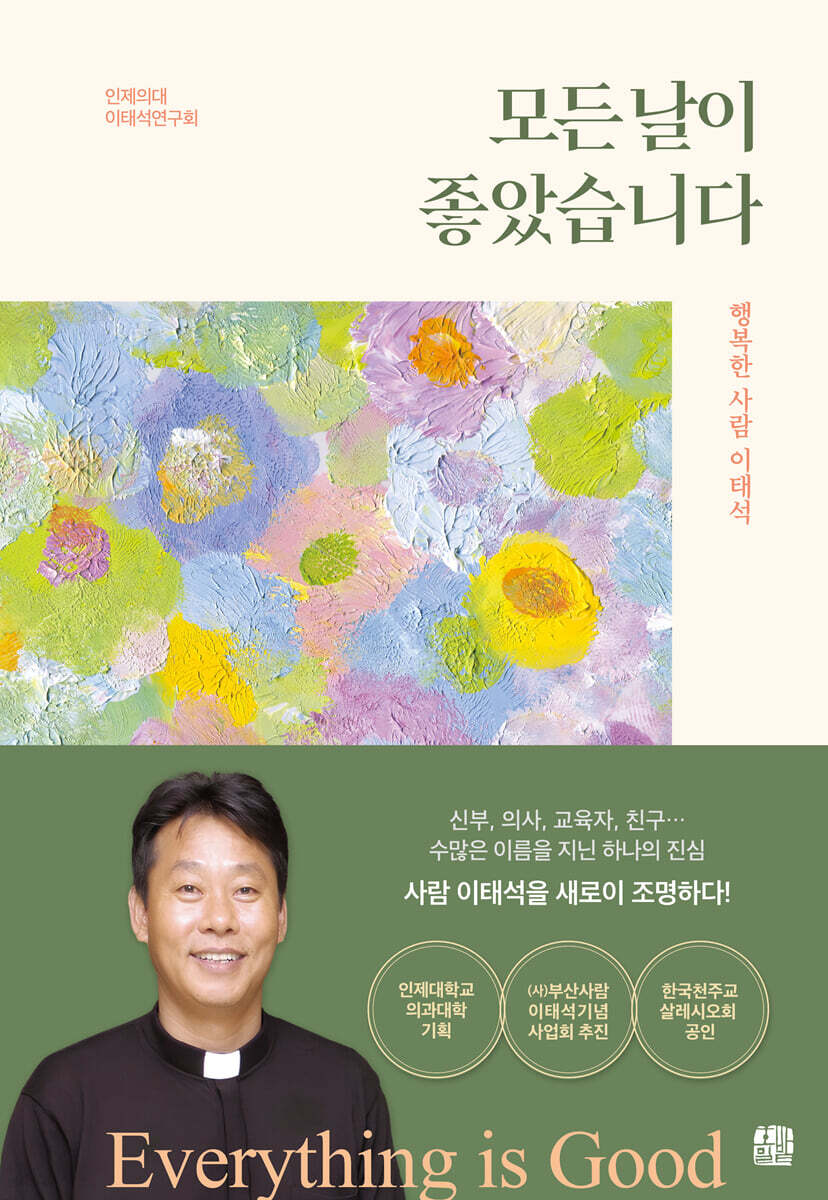
Every day was good
 |
Description
Book Introduction
Father Lee Tae-seok has become a symbol of love, sacrifice, and human beauty in our time.
Since becoming known to many people through the movie "Don't Cry for Me", many activities have been carried out to commemorate his life and will.
One of these activities is Inje University College of Medicine's efforts to enable students pursuing a medical career to learn from his spirit by offering the "Lee Tae-seok Memorial Course" as a subject since 2013.
Fifteen years have passed since Father Lee Tae-seok left us in 2010.
Inje University Medical School, the alma mater of Father Lee Tae-seok, planned this book with ten humanists to shed more three-dimensional light on the various aspects of Father Lee Tae-seok, who was not only a priest but also a doctor, an educator, and, above all, a friend and a humorous human being.
Since becoming known to many people through the movie "Don't Cry for Me", many activities have been carried out to commemorate his life and will.
One of these activities is Inje University College of Medicine's efforts to enable students pursuing a medical career to learn from his spirit by offering the "Lee Tae-seok Memorial Course" as a subject since 2013.
Fifteen years have passed since Father Lee Tae-seok left us in 2010.
Inje University Medical School, the alma mater of Father Lee Tae-seok, planned this book with ten humanists to shed more three-dimensional light on the various aspects of Father Lee Tae-seok, who was not only a priest but also a doctor, an educator, and, above all, a friend and a humorous human being.
- You can preview some of the book's contents.
Preview
index
Lee Tae-seok in photos
Lee Tae-seok in chronological order
To celebrate the publication
Itaewon's path, lingering in fragrance
The Lee Tae-seok spirit that continues through learning
Part 1: The Path of a Doctor
Lee Tae-seok, a life of health and healing
Beyond Patients to Society: Dr. Lee Tae-seok's Perspective
Lee Tae-seok from a colonialist perspective
Part 2: The Road We Walk Together
Let's be friends, Father Lee Tae-seok!
Two African priests I know: Charles de Foucauld and Lee Tae-seok
Tae-Seok Lee, a man of teaching knowledge and an educational practitioner
Part 3: The Path of Gratitude
Pingjigohwa (平地高話): A story of high places on low land
The symbiotic paradigm of love and sharing recreated in "The Lee Tae-seok Film"
The Road to Becoming Father Lee Tae-seok's Friend and Busan
Lee Tae-seok as seen through text and keyword data
Epilogue: Remembering Father Lee Tae-seok
John Mayen Ruben
Thomas Taban Accott
References
Lee Tae-seok in chronological order
To celebrate the publication
Itaewon's path, lingering in fragrance
The Lee Tae-seok spirit that continues through learning
Part 1: The Path of a Doctor
Lee Tae-seok, a life of health and healing
Beyond Patients to Society: Dr. Lee Tae-seok's Perspective
Lee Tae-seok from a colonialist perspective
Part 2: The Road We Walk Together
Let's be friends, Father Lee Tae-seok!
Two African priests I know: Charles de Foucauld and Lee Tae-seok
Tae-Seok Lee, a man of teaching knowledge and an educational practitioner
Part 3: The Path of Gratitude
Pingjigohwa (平地高話): A story of high places on low land
The symbiotic paradigm of love and sharing recreated in "The Lee Tae-seok Film"
The Road to Becoming Father Lee Tae-seok's Friend and Busan
Lee Tae-seok as seen through text and keyword data
Epilogue: Remembering Father Lee Tae-seok
John Mayen Ruben
Thomas Taban Accott
References
Detailed image

Into the book
Just because Father Lee Tae-seok's life was noble, there is no need to distinguish between him and us.
We should not think that Father Lee Tae-seok was born a holy man from the beginning.
Because what he did might be considered impossible for an ordinary person to achieve.
The inspiration that Father Lee Tae-seok conveys should not end with looking up to him.
The value of the impression will increase as we strive to be like him.
--- p.12~13
The title of the book, “All Days Were Good,” is borrowed from Lee Tae-seok’s last words, “Everything is good,” and contains the meaning of encompassing his life by following the footsteps he left behind based on the multiple identities he possessed.
Inje University College of Medicine and its writing team studied Lee Tae-seok's life and tried to write about it as fully as possible in the hope that many people would easily approach and meet him.
Although Lee Tae-seok's life was great, the materials he left behind were too insufficient for research.
Our writing team felt anew that Lee Tae-seok lived for others with his whole body and soul, not for himself.
--- p.18
Father Lee Tae-seok's love for others was the 'image of Jesus' that he met in Tonz, and Doctor Lee Tae-seok's love was a healing that willingly shared not only physical illness and pain, but also the suffering of the lives of the people of Tonz.
The path he walked with these two senses of calling was one of interest, consideration, and sharing, and that love was a fragrance that changed people's lives.
--- p.45
One way could be to feel sympathy for those who are less educated and have less than you, and to try to teach and enlighten them from a vertical perspective.
However, Lee Tae-seok showed a much more patient-centered attitude than that.
He wanted to become a member of the Tonze community.
--- p.75
Growing up amidst the influence of these many people, Lee Tae-seok was eventually able to create his own beautiful fragrance.
In that respect, Lee Tae-seok doesn't really need any adjectives.
Because he is none other than Lee Tae-seok himself.
--- p.101
"Universal love," the core of Mozi's philosophy, refers to the mutual concern and consideration of individuals in groups and society. It is a universal love that transcends blood ties or personal relationships, regardless of social status, and "loves others as one loves oneself." Isn't its most distinctive characteristic a utilitarian love that "benefits one another?" Ultimately, Mozi's love overlaps with Li T'ai-shi's in that the practical goal of peace in family, group, society, and nation is a core goal, suggesting that this may be the starting point for another perspective from Li T'ai-shi.
--- p.137
Father Lee Tae-seok's life left us with another pioneering insight, one that fundamentally rethought our perceptions and approaches toward minorities, demonstrating how diverse capabilities can be integrated and practiced in complex modern society.
His life is significant in that it provides a model of missionary work different from that of Western saints such as Charles de Foucauld.
--- p.164
Lee Tae-seok expressed the passion he poured into it by saying, "It was something you did to me."
What he did to Tonze was not done to the people of Tonze, but to himself.
If you water it, you can experience the joy of sprouting, if you take care of it, you can experience the joy of growing it, and if you fertilize it, you can experience the joy of bearing good fruit.
To Lee Tae-seok, the Tones kids were soon my joy.
It was because she was an irreplaceable and charming joy that Lee Tae-seok was able to love Tones.
--- p.210
The lowest land does not carry any racial or geographical connotations.
Because God's love is the love of the cross where the vertical (heaven) and the horizontal (earth) meet.
Missionaries go out to do their work wearing a cross around their neck.
At the intersection of vertical and horizontal, there were countless events that became history.
The words that Father Lee Tae-seok reflected on for his inner spirituality attest to this.
“I must enter into them and become humble.”
--- p.217~218
The common mood revealed in the four films related to Lee Tae-seok is the power of love and empathy.
When you truly love and empathize, you naturally serve and share.
--- p.269
Father Lee Tae-seok's life is not something that should remain merely a memory of the past.
His spirit must be actualized in a public and sustainable way, incorporating the identity of the Busan community.
Busan has the potential to grow into a city symbolizing love, sharing, and community solidarity, based on the spirit of Father Lee Tae-seok.
It is time to reinterpret the bride's message, "Will you be my friend?" within us, and to plan and implement more active and comprehensive commemorative projects so that citizens can become "friends" alongside her.
Through this, the spirit of Father Lee Tae-seok will become a precious legacy of Busan's future that will be passed down to future generations.
--- p.298
Systematizing the research and analysis of literature that remembers and describes Lee Tae-seok will allow us to understand him more objectively, rather than relying on the image and discourse of Lee Tae-seok reproduced by the media.
Please do not misunderstand, this does not mean that the life of the current priest Lee Tae-seok, or the life of the human Lee Tae-seok, is exaggerated.
This article is not about Lee Tae-seok as portrayed in the media or as the effect of media discourse, but rather a small suggestion that we need to newly understand and examine the thoughts and values of Lee Tae-seok, who lived a life devoted to others in his multi-talented roles as a priest, doctor, educator, musician, and writer.
--- p.328~329
Since I was little, my dream was to become a doctor.
This vague dream became firm after meeting the priest.
Because everything the priest did when he came to Tonze was so moving to me, and I wanted to be like him.
Seeing you work hard and make an effort to help those in need gave me the determination to become a doctor, and it also made me realize the importance of the profession.
--- p.336
I was also touched by the sight of Father Lee Tae-seok coming from far away to treat the sick and express his gratitude to God.
Father Lee Tae-seok, who came from another continent, Korea, to save the people of South Sudan, may truly be an angel.
I felt that the consistent way I treated people wherever I went was exactly the same as how Jesus treated people.
The priest had the power and heart to make people happy, regardless of age, whether they were children or adults, men or women.
We should not think that Father Lee Tae-seok was born a holy man from the beginning.
Because what he did might be considered impossible for an ordinary person to achieve.
The inspiration that Father Lee Tae-seok conveys should not end with looking up to him.
The value of the impression will increase as we strive to be like him.
--- p.12~13
The title of the book, “All Days Were Good,” is borrowed from Lee Tae-seok’s last words, “Everything is good,” and contains the meaning of encompassing his life by following the footsteps he left behind based on the multiple identities he possessed.
Inje University College of Medicine and its writing team studied Lee Tae-seok's life and tried to write about it as fully as possible in the hope that many people would easily approach and meet him.
Although Lee Tae-seok's life was great, the materials he left behind were too insufficient for research.
Our writing team felt anew that Lee Tae-seok lived for others with his whole body and soul, not for himself.
--- p.18
Father Lee Tae-seok's love for others was the 'image of Jesus' that he met in Tonz, and Doctor Lee Tae-seok's love was a healing that willingly shared not only physical illness and pain, but also the suffering of the lives of the people of Tonz.
The path he walked with these two senses of calling was one of interest, consideration, and sharing, and that love was a fragrance that changed people's lives.
--- p.45
One way could be to feel sympathy for those who are less educated and have less than you, and to try to teach and enlighten them from a vertical perspective.
However, Lee Tae-seok showed a much more patient-centered attitude than that.
He wanted to become a member of the Tonze community.
--- p.75
Growing up amidst the influence of these many people, Lee Tae-seok was eventually able to create his own beautiful fragrance.
In that respect, Lee Tae-seok doesn't really need any adjectives.
Because he is none other than Lee Tae-seok himself.
--- p.101
"Universal love," the core of Mozi's philosophy, refers to the mutual concern and consideration of individuals in groups and society. It is a universal love that transcends blood ties or personal relationships, regardless of social status, and "loves others as one loves oneself." Isn't its most distinctive characteristic a utilitarian love that "benefits one another?" Ultimately, Mozi's love overlaps with Li T'ai-shi's in that the practical goal of peace in family, group, society, and nation is a core goal, suggesting that this may be the starting point for another perspective from Li T'ai-shi.
--- p.137
Father Lee Tae-seok's life left us with another pioneering insight, one that fundamentally rethought our perceptions and approaches toward minorities, demonstrating how diverse capabilities can be integrated and practiced in complex modern society.
His life is significant in that it provides a model of missionary work different from that of Western saints such as Charles de Foucauld.
--- p.164
Lee Tae-seok expressed the passion he poured into it by saying, "It was something you did to me."
What he did to Tonze was not done to the people of Tonze, but to himself.
If you water it, you can experience the joy of sprouting, if you take care of it, you can experience the joy of growing it, and if you fertilize it, you can experience the joy of bearing good fruit.
To Lee Tae-seok, the Tones kids were soon my joy.
It was because she was an irreplaceable and charming joy that Lee Tae-seok was able to love Tones.
--- p.210
The lowest land does not carry any racial or geographical connotations.
Because God's love is the love of the cross where the vertical (heaven) and the horizontal (earth) meet.
Missionaries go out to do their work wearing a cross around their neck.
At the intersection of vertical and horizontal, there were countless events that became history.
The words that Father Lee Tae-seok reflected on for his inner spirituality attest to this.
“I must enter into them and become humble.”
--- p.217~218
The common mood revealed in the four films related to Lee Tae-seok is the power of love and empathy.
When you truly love and empathize, you naturally serve and share.
--- p.269
Father Lee Tae-seok's life is not something that should remain merely a memory of the past.
His spirit must be actualized in a public and sustainable way, incorporating the identity of the Busan community.
Busan has the potential to grow into a city symbolizing love, sharing, and community solidarity, based on the spirit of Father Lee Tae-seok.
It is time to reinterpret the bride's message, "Will you be my friend?" within us, and to plan and implement more active and comprehensive commemorative projects so that citizens can become "friends" alongside her.
Through this, the spirit of Father Lee Tae-seok will become a precious legacy of Busan's future that will be passed down to future generations.
--- p.298
Systematizing the research and analysis of literature that remembers and describes Lee Tae-seok will allow us to understand him more objectively, rather than relying on the image and discourse of Lee Tae-seok reproduced by the media.
Please do not misunderstand, this does not mean that the life of the current priest Lee Tae-seok, or the life of the human Lee Tae-seok, is exaggerated.
This article is not about Lee Tae-seok as portrayed in the media or as the effect of media discourse, but rather a small suggestion that we need to newly understand and examine the thoughts and values of Lee Tae-seok, who lived a life devoted to others in his multi-talented roles as a priest, doctor, educator, musician, and writer.
--- p.328~329
Since I was little, my dream was to become a doctor.
This vague dream became firm after meeting the priest.
Because everything the priest did when he came to Tonze was so moving to me, and I wanted to be like him.
Seeing you work hard and make an effort to help those in need gave me the determination to become a doctor, and it also made me realize the importance of the profession.
--- p.336
I was also touched by the sight of Father Lee Tae-seok coming from far away to treat the sick and express his gratitude to God.
Father Lee Tae-seok, who came from another continent, Korea, to save the people of South Sudan, may truly be an angel.
I felt that the consistent way I treated people wherever I went was exactly the same as how Jesus treated people.
The priest had the power and heart to make people happy, regardless of age, whether they were children or adults, men or women.
--- p.340
Publisher's Review
Priest, doctor, educator, friend…
One true heart with countless names
A new look at the 'human' Lee Tae-seok!
Tae-seok Lee, a righteous man who dedicated his body and soul to spreading hope to the world.
He took on numerous roles as a single body to heal the pain of Sudan, Africa, a country devastated by war.
He treated patients, built schools to teach children, and formed a brass band to sing songs of hope.
The reason this beautiful life still lingers today is probably because he gave himself endlessly to practicing love.
Lee Tae-seok is a true soul with many faces, not only as a priest, but also as a doctor, educator, musician, and architect.
At the end of his life, Lee Tae-seok's last breath was "Everything is Good."
That short but firm conviction is an affirmation and confession that embraces all the choices we have made to wear the clothes of various identities in order to save the poor and the sick.
It is not a turning point in a difficult life, but a final farewell that only those who have embraced love to the end can say.
The book begins with this one sentence.
"All the Days Were Good" is a quiet journey that follows one person as they face the countless decisions they have to make.
"The Human Lee Tae-seok" as Called by Ten Humanities
With reflection, not electricity, with questions, not commemoration
Rereading Lee Tae-seok's Calling
"All Days Were Good" is a project book by the Inje University Lee Tae-seok Research Group, a group of ten scholars who gathered to comprehensively capture the overall aspects of Lee Tae-seok.
By calling out Lee Tae-seok in the language of their respective fields, the authors depicted one footprint from ten perspectives.
The charm of this book is that the writings that started from different points of view eventually converge on one point: 'the person Lee Tae-seok.'
This book is not just a simple biography.
It is the result of humanities research that analyzes a person's life, which has been somewhat narrowly focused, from various perspectives.
That is why it does not stop at simply honoring one person.
This book raises questions about how we will remember him and how we will call him back.
This is why the direction of the book was set as a general education book that simultaneously embraces a researcher's perspective and literary reflection, departing from the conventional biographical or memorial writing.
The footsteps of Lee Tae-seok, a doctor, educator, and artist
A life revived by three-pronged gaze and the testimony of two disciples
Discussing the love contained in the name 'Lee Tae-seok'
This book is divided into three parts and sheds light on Lee Tae-seok's life.
In Part 1, “The Path of a Doctor,” three professors from Inje University College of Medicine, Lee Tae-seok’s alma mater, follow the path that Dr. Lee Tae-seok took.
Kim Seong-ri examines the mindset with which Lee Tae-seok healed the lives of the people of Tonze.
Park Ji-young looks into how patient-centered Lee Tae-seok's approach to fighting infectious diseases was.
Finally, Kim Taek-joong directly compares the lives of Schweitzer and Lee Tae-seok, emphasizing that Lee Tae-seok needs no other modifiers.
In Part 2, “The Path We Walk Together,” three educators from Lee Tae-seok’s hometown of Busan shed new light on his journey as a friend and educator alongside others.
Kim Tae-man emphasizes that following the will of heaven is not discrimination but togetherness, based on the core of Mohist thought, 'universality.'
Lim Ki-dae analyzes how African saints Charles de Foucauld and Lee Tae-seok shared a common vision of vision.
Lastly, Oh Hyeon-seok calls out the educational practitioner side of Lee Tae-seok, who founded a school in a barren Tonz and taught children.
In Part 3, "The Path of Gratitude," four scholars exploring culture and art examine how Lee Tae-seok's cultural and artistic talent transformed the lives of others and the world.
Lee Seong-cheol sheds new light on the musical and artistic talents of Lee Tae-seok, who sought to practice love from the lowest to the highest.
Baek Tae-hyun compares and analyzes the various visual media that spread Lee Tae-seok's emotions to the world, examining the paradigm of mutual growth of love and sharing.
Song Gyo-seong examines how Lee Tae-seok's spirit has continued after the death of Seonjong, and then connects it to the spirit of Busan.
Finally, Park Hyung-jun analyzes data on how the name Lee Tae-seok is invoked in academic research and revisits his core ideas.
The epilogue, “Remembering Father Lee Tae-seok,” continues the story of two disciples who decided to follow in Lee Tae-seok’s footsteps.
John Mayen Ruben and Thomas Taban Accott saw in Father Lee Tae-seok a man who was not indifferent to pain, and were moved by his sincere touch, and dreamed of becoming doctors.
Afterwards, they went abroad to study medicine at Inje University College of Medicine. The time they endured was not simply learning, but a process of applying their teacher's spirit to their own lives.
The two disciples, now full-time doctors, hope to one day return to their hometown and stand on the path to healing those who are sick in body and mind, just like Lee Tae-seok.
At the beginning of that road, there was one person's sincerity.
One true heart with countless names
A new look at the 'human' Lee Tae-seok!
Tae-seok Lee, a righteous man who dedicated his body and soul to spreading hope to the world.
He took on numerous roles as a single body to heal the pain of Sudan, Africa, a country devastated by war.
He treated patients, built schools to teach children, and formed a brass band to sing songs of hope.
The reason this beautiful life still lingers today is probably because he gave himself endlessly to practicing love.
Lee Tae-seok is a true soul with many faces, not only as a priest, but also as a doctor, educator, musician, and architect.
At the end of his life, Lee Tae-seok's last breath was "Everything is Good."
That short but firm conviction is an affirmation and confession that embraces all the choices we have made to wear the clothes of various identities in order to save the poor and the sick.
It is not a turning point in a difficult life, but a final farewell that only those who have embraced love to the end can say.
The book begins with this one sentence.
"All the Days Were Good" is a quiet journey that follows one person as they face the countless decisions they have to make.
"The Human Lee Tae-seok" as Called by Ten Humanities
With reflection, not electricity, with questions, not commemoration
Rereading Lee Tae-seok's Calling
"All Days Were Good" is a project book by the Inje University Lee Tae-seok Research Group, a group of ten scholars who gathered to comprehensively capture the overall aspects of Lee Tae-seok.
By calling out Lee Tae-seok in the language of their respective fields, the authors depicted one footprint from ten perspectives.
The charm of this book is that the writings that started from different points of view eventually converge on one point: 'the person Lee Tae-seok.'
This book is not just a simple biography.
It is the result of humanities research that analyzes a person's life, which has been somewhat narrowly focused, from various perspectives.
That is why it does not stop at simply honoring one person.
This book raises questions about how we will remember him and how we will call him back.
This is why the direction of the book was set as a general education book that simultaneously embraces a researcher's perspective and literary reflection, departing from the conventional biographical or memorial writing.
The footsteps of Lee Tae-seok, a doctor, educator, and artist
A life revived by three-pronged gaze and the testimony of two disciples
Discussing the love contained in the name 'Lee Tae-seok'
This book is divided into three parts and sheds light on Lee Tae-seok's life.
In Part 1, “The Path of a Doctor,” three professors from Inje University College of Medicine, Lee Tae-seok’s alma mater, follow the path that Dr. Lee Tae-seok took.
Kim Seong-ri examines the mindset with which Lee Tae-seok healed the lives of the people of Tonze.
Park Ji-young looks into how patient-centered Lee Tae-seok's approach to fighting infectious diseases was.
Finally, Kim Taek-joong directly compares the lives of Schweitzer and Lee Tae-seok, emphasizing that Lee Tae-seok needs no other modifiers.
In Part 2, “The Path We Walk Together,” three educators from Lee Tae-seok’s hometown of Busan shed new light on his journey as a friend and educator alongside others.
Kim Tae-man emphasizes that following the will of heaven is not discrimination but togetherness, based on the core of Mohist thought, 'universality.'
Lim Ki-dae analyzes how African saints Charles de Foucauld and Lee Tae-seok shared a common vision of vision.
Lastly, Oh Hyeon-seok calls out the educational practitioner side of Lee Tae-seok, who founded a school in a barren Tonz and taught children.
In Part 3, "The Path of Gratitude," four scholars exploring culture and art examine how Lee Tae-seok's cultural and artistic talent transformed the lives of others and the world.
Lee Seong-cheol sheds new light on the musical and artistic talents of Lee Tae-seok, who sought to practice love from the lowest to the highest.
Baek Tae-hyun compares and analyzes the various visual media that spread Lee Tae-seok's emotions to the world, examining the paradigm of mutual growth of love and sharing.
Song Gyo-seong examines how Lee Tae-seok's spirit has continued after the death of Seonjong, and then connects it to the spirit of Busan.
Finally, Park Hyung-jun analyzes data on how the name Lee Tae-seok is invoked in academic research and revisits his core ideas.
The epilogue, “Remembering Father Lee Tae-seok,” continues the story of two disciples who decided to follow in Lee Tae-seok’s footsteps.
John Mayen Ruben and Thomas Taban Accott saw in Father Lee Tae-seok a man who was not indifferent to pain, and were moved by his sincere touch, and dreamed of becoming doctors.
Afterwards, they went abroad to study medicine at Inje University College of Medicine. The time they endured was not simply learning, but a process of applying their teacher's spirit to their own lives.
The two disciples, now full-time doctors, hope to one day return to their hometown and stand on the path to healing those who are sick in body and mind, just like Lee Tae-seok.
At the beginning of that road, there was one person's sincerity.
GOODS SPECIFICS
- Date of issue: May 15, 2025
- Page count, weight, size: 352 pages | 145*210*30mm
- ISBN13: 9791168261617
- ISBN10: 1168261619
You may also like
카테고리
korean


korean

![GQ KOREA Mark (Monthly): December [2025]](http://librairie.coreenne.fr/cdn/shop/files/8ef265dbbfbf186523ed75ba7319009d.jpg?v=1765340328&width=3840)


