

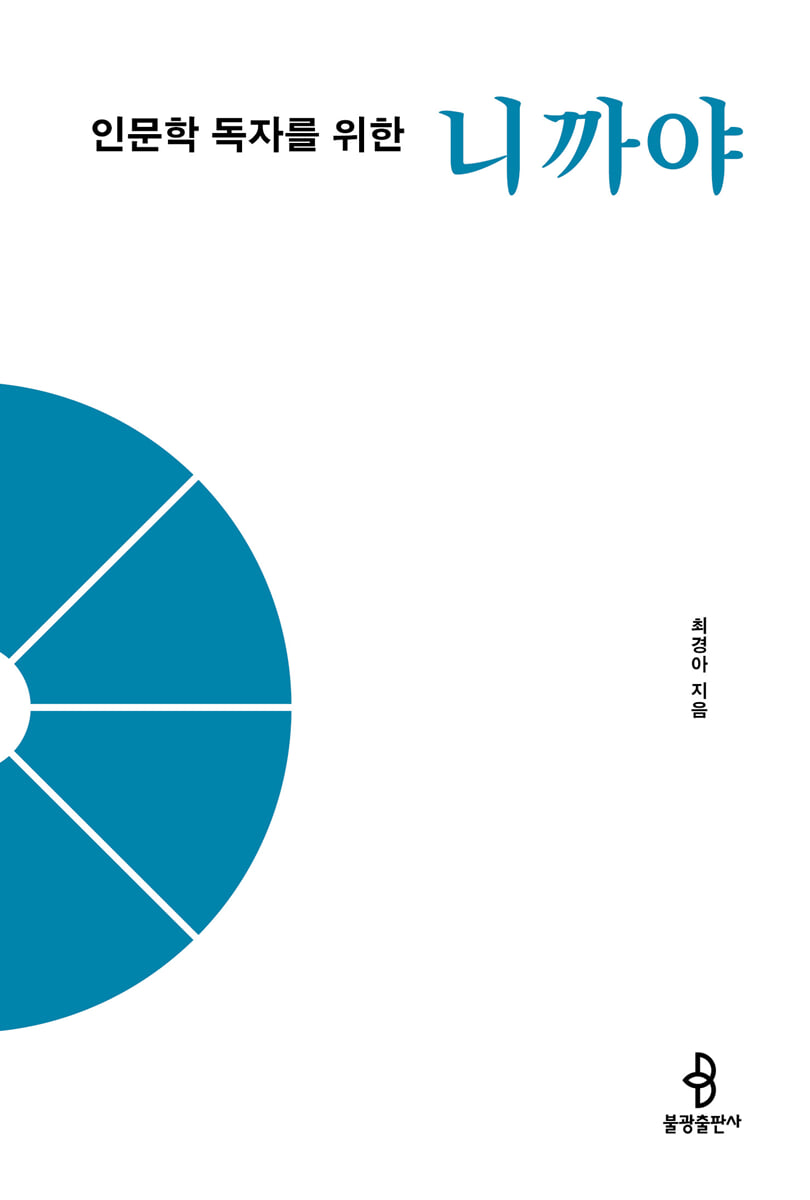
Nikaya for Humanities Readers
 |
Description
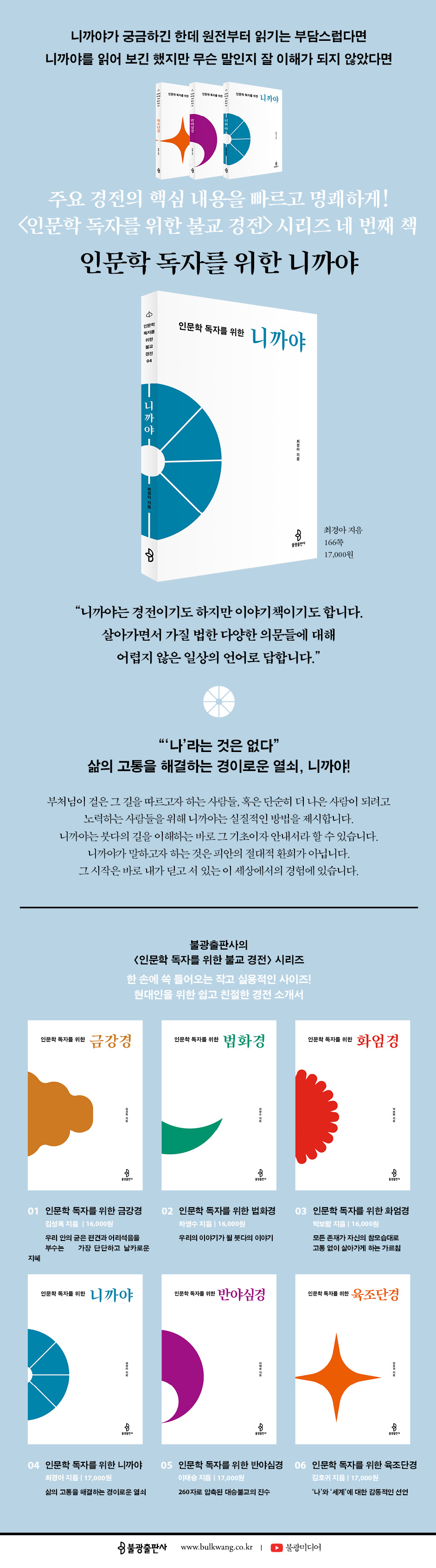
Book Introduction
The fourth book in the Buddhist scriptures series for humanities readers
Nikaya for Humanities Readers
“There is no such thing as ‘I’”
The wondrous key to solving life's pain!
The Nikaya is an early Buddhist scripture that contains the teachings given by the historical figure Shakyamuni himself.
The teachings of the Nikayas do not aim to solve theoretical and speculative problems, but rather to resolve human suffering represented by aging and death.
And as a result of pursuing this goal, it presents the insight that “there is no such thing as ‘I’.”
The teachings of the Nikayas are easily understandable to any thoughtful person, and the issues raised are still urgent for us today, thousands of years after the era of the Nikayas.
『Nikāyas for Humanities Readers』 analyzes the vast Nikāya literature and carefully selects and explains the teachings that can be said to be the core of Buddhism.
Through this book, we will learn what Buddhism's original questions and answers are, and further, begin a serious dialogue with Buddhism, humanity's great spiritual heritage.
Nikaya for Humanities Readers
“There is no such thing as ‘I’”
The wondrous key to solving life's pain!
The Nikaya is an early Buddhist scripture that contains the teachings given by the historical figure Shakyamuni himself.
The teachings of the Nikayas do not aim to solve theoretical and speculative problems, but rather to resolve human suffering represented by aging and death.
And as a result of pursuing this goal, it presents the insight that “there is no such thing as ‘I’.”
The teachings of the Nikayas are easily understandable to any thoughtful person, and the issues raised are still urgent for us today, thousands of years after the era of the Nikayas.
『Nikāyas for Humanities Readers』 analyzes the vast Nikāya literature and carefully selects and explains the teachings that can be said to be the core of Buddhism.
Through this book, we will learn what Buddhism's original questions and answers are, and further, begin a serious dialogue with Buddhism, humanity's great spiritual heritage.
- You can preview some of the book's contents.
Preview
index
Entering
1.
Why should we know the Nikaya?
A humanitarian encounter with the Buddha, not the Buddha
Hear directly from the Buddha, the problem solver.
2.
Why was the Nikaya created?
People who set out in search of freedom
Indian recitation culture and documentation of the Nikayas
How did early Buddhism become known?
3.
What does Nikaya mean?
From this place where I was born as a human and stand
The truth is a cave…
Five, Twelve, and Eighteen Things That Make the World and Me
Are you really saying I'm not there?
The Four Noble Truths
The nature of suffering
The way the world works
The power to make the right choices
4.
What can we learn from the Nikaya?
The created world and the workings of karma
The power of the right word at the right time
1.
Why should we know the Nikaya?
A humanitarian encounter with the Buddha, not the Buddha
Hear directly from the Buddha, the problem solver.
2.
Why was the Nikaya created?
People who set out in search of freedom
Indian recitation culture and documentation of the Nikayas
How did early Buddhism become known?
3.
What does Nikaya mean?
From this place where I was born as a human and stand
The truth is a cave…
Five, Twelve, and Eighteen Things That Make the World and Me
Are you really saying I'm not there?
The Four Noble Truths
The nature of suffering
The way the world works
The power to make the right choices
4.
What can we learn from the Nikaya?
The created world and the workings of karma
The power of the right word at the right time
Detailed image
Into the book
Why did the Buddha ask a woman who had lost her child to do the impossible? He could have comforted her by telling her that the baby had not sinned and would have gone to heaven.
Or, they could have reassured the child that if they performed a ritual for the child, the child would be born in heaven or have a good afterlife through the merits of the sacrifice.
But the Buddha didn't do that.
Rather, the Buddha guides the woman to realize for herself that in the vast ocean of birth, aging, illness, and death, from which no one is an exception, nothing is eternal.
--- p.9
The Buddha tells the story of a man who, after being shot by a poisoned arrow, did not even think of pulling it out, but only tried to find out who had shot it and what kind of arrow it was.
The Buddha said that being preoccupied with metaphysical questions without being able to resolve the suffering of life is like being shot by a poisoned arrow and not thinking about pulling it out, but instead being preoccupied with irrelevant questions.
--- p.34
According to the Mahaparinibbana Sutta, the Buddha did not want to be worshipped, and left a will to follow the Dharma rather than himself.
It was the Buddha's will to preserve his words.
Therefore, it can be said that the best thing Buddhists can do is to organize the Buddha's words well and study and put them into practice.
--- p.70~71
An unsatisfactory state in which things do not go as one wishes, in Nikaya this is called 'suffering (dukkha)'.
To escape from this, we explore the nature of suffering.
Are there any other living beings on Earth who ponder the cycle of birth, aging, illness, and death, and contemplate the nature of suffering? Enlightenment is open to those who seek to overcome it.
In a way, isn't it a great fortune to be born human for this purpose? According to the Nikayas, being born human is itself considered a significant opportunity to attain enlightenment.
--- p.75
What the Nikaya is talking about is not the absolute bliss of peace.
Its beginning lies in my experiences in this world where I stand.
--- p.77
In the Sutra of “Matjimanikaya” there is a scripture that says, “All living things are destined to perish.”
This is the most basic view of the Nikayas on the world.
The world we live in is fleeting and impermanent.
My body and all things also gradually decay with the passage of time, which is not what I desire and does not happen as I wish.
We know this truth from experience.
--- p.96
The Buddha's teachings are meant to set us free.
This is a warning against the excessive obsession and preoccupation with the Atman, and the excessive interpretation and pursuit of the perfection and eternity of the Atman, as shown by the thinkers and practitioners of the Buddha's time.
The self is merely a phenomenon formed by physical and mental functions, and is neither permanent nor subject to my will. Therefore, we must understand this as a counter-question: where is the Atman you speak of?
--- p.99
When we set out to find ourselves, we first discover our body.
And a series of mental functions such as feeling, thinking, intention, and perception are discovered through the contact between the sense organs and the object.
But we cannot bring out the ego here.
It means that we have entered the typhoon of experience, but we cannot find the 'self', which is the eye of the typhoon.
We cannot discover the 'self' as a fixed entity, or the 'self' as the master behind the phenomenon, because there is only the action of inertia formed by the accumulation of experiences resulting from the contact between the sense organs and the objects of sense.
--- p.109
My thoughts today are about 90 percent similar to what I pursued yesterday.
We can see that the force of inertia controls our thoughts and actions.
Ultimately, self-control is about one's own habitual thoughts and actions.
We may not be aware of it, but most of our actions are conditioned reflexes, with the exception of a very small number of unconditional reflexes.
The reason I'm hungry now is because I always eat at this time.
Our actions are merely inertial actions formed by the accumulation of experiences resulting from contact and interaction between our sense organs and objects.
Or, they could have reassured the child that if they performed a ritual for the child, the child would be born in heaven or have a good afterlife through the merits of the sacrifice.
But the Buddha didn't do that.
Rather, the Buddha guides the woman to realize for herself that in the vast ocean of birth, aging, illness, and death, from which no one is an exception, nothing is eternal.
--- p.9
The Buddha tells the story of a man who, after being shot by a poisoned arrow, did not even think of pulling it out, but only tried to find out who had shot it and what kind of arrow it was.
The Buddha said that being preoccupied with metaphysical questions without being able to resolve the suffering of life is like being shot by a poisoned arrow and not thinking about pulling it out, but instead being preoccupied with irrelevant questions.
--- p.34
According to the Mahaparinibbana Sutta, the Buddha did not want to be worshipped, and left a will to follow the Dharma rather than himself.
It was the Buddha's will to preserve his words.
Therefore, it can be said that the best thing Buddhists can do is to organize the Buddha's words well and study and put them into practice.
--- p.70~71
An unsatisfactory state in which things do not go as one wishes, in Nikaya this is called 'suffering (dukkha)'.
To escape from this, we explore the nature of suffering.
Are there any other living beings on Earth who ponder the cycle of birth, aging, illness, and death, and contemplate the nature of suffering? Enlightenment is open to those who seek to overcome it.
In a way, isn't it a great fortune to be born human for this purpose? According to the Nikayas, being born human is itself considered a significant opportunity to attain enlightenment.
--- p.75
What the Nikaya is talking about is not the absolute bliss of peace.
Its beginning lies in my experiences in this world where I stand.
--- p.77
In the Sutra of “Matjimanikaya” there is a scripture that says, “All living things are destined to perish.”
This is the most basic view of the Nikayas on the world.
The world we live in is fleeting and impermanent.
My body and all things also gradually decay with the passage of time, which is not what I desire and does not happen as I wish.
We know this truth from experience.
--- p.96
The Buddha's teachings are meant to set us free.
This is a warning against the excessive obsession and preoccupation with the Atman, and the excessive interpretation and pursuit of the perfection and eternity of the Atman, as shown by the thinkers and practitioners of the Buddha's time.
The self is merely a phenomenon formed by physical and mental functions, and is neither permanent nor subject to my will. Therefore, we must understand this as a counter-question: where is the Atman you speak of?
--- p.99
When we set out to find ourselves, we first discover our body.
And a series of mental functions such as feeling, thinking, intention, and perception are discovered through the contact between the sense organs and the object.
But we cannot bring out the ego here.
It means that we have entered the typhoon of experience, but we cannot find the 'self', which is the eye of the typhoon.
We cannot discover the 'self' as a fixed entity, or the 'self' as the master behind the phenomenon, because there is only the action of inertia formed by the accumulation of experiences resulting from the contact between the sense organs and the objects of sense.
--- p.109
My thoughts today are about 90 percent similar to what I pursued yesterday.
We can see that the force of inertia controls our thoughts and actions.
Ultimately, self-control is about one's own habitual thoughts and actions.
We may not be aware of it, but most of our actions are conditioned reflexes, with the exception of a very small number of unconditional reflexes.
The reason I'm hungry now is because I always eat at this time.
Our actions are merely inertial actions formed by the accumulation of experiences resulting from contact and interaction between our sense organs and objects.
--- p.109~110
Publisher's Review
Nikaya, conveying the voice of Shakyamuni
Nikaya is a Pali scripture that collects and organizes the teachings of Shakyamuni.
Although most Buddhist scriptures claim to be the teachings of the Buddha, the Nikaya is the only scripture that has completely transcribed the teachings of Shakyamuni, which were previously recited together.
Among the Chinese scriptures, the Agamas correspond to the Nikayas, and many parts of their content are similar to the Nikayas.
Nikaya is not the name of a single scripture, but a general term for the five Nikayas, which are composed of the Digha Nikaya, the Majjiman Nikaya, the Samyutta Nikaya, the Anguttara Nikaya, and the Kutdaka Nikaya.
The individual Nikayas that make up the five Nikayas are also made up of several shorter suttas.
A fresh and simple encounter with Buddhism
The importance of the Nikayas in the history of Buddhism is indescribable.
Because the Nikaya is like an inexhaustible spring from which the great river of Buddhism originates.
We today can still learn much from the Nikayas.
You can learn about the fundamental teachings of Buddhism, such as the Four Noble Truths, the Three Dharma Seals, and dependent origination, through Shakyamuni's own explanations, and also learn in what context these teachings were preached.
Many of the concepts unique to Mahayana Buddhism can also be found in embryonic form, though not in a refined form.
Above all, by reading the Nikaya, we can encounter Buddhism in its fresh and simple form.
In India, Buddhism became theoretically complex during the sectarian period and became even more difficult during the Mahayana period.
However, early Buddhism, before these changes occurred, was neither complex nor difficult.
Early Buddhism had a simple goal of resolving the suffering of life, such as aging and death, and sought to find ways to achieve that goal by examining common-sense and empirical principles.
The representative teaching of the Nikaya, that everything is subject to change and that there is nothing that can be called 'I', also emerged from this process.
By confirming the inherent questions and answers of Buddhism, which can easily be overlooked, through the Nikaya, we are forced to reconsider what Buddhism is.
Perhaps this is the greatest reason why we should read the Nikaya.
Beyond the charm of Nikaya to the charm of Buddhism
『Nikāyas for Humanities Readers』 carefully selects and unravels the core content of the vast five-part Nikāyas, particularly those that are crucial and deeply relevant to our lives today.
Dr. Choi Kyung-ah, who teaches students at Dongguk University's Dharma College, fully demonstrates her own understanding of eye-level education in this book.
In this book, the author talks about his experiences studying abroad in India, his reading experiences, and introduces traditional Indian fables.
Although various interesting stories unfold throughout in a friendly style, their direction and destination never deviate from the teachings of the Nikaya.
As readers follow this book, feeling like they are reading an easy and fun essay, they will soon find themselves captivated by the world of the Nikayas.
And you will discover the charm of Buddhism, which appears indifferent to worldly life on the outside but secretly embraces it in your heart.
“What Nikaya is talking about is not the absolute bliss of peace.
“Its beginning lies in my experience in this world where I stand.” (From the text)
Author's Note
“The Nikaya is both a scripture and a storybook.
We answer various questions you might have in life in easy, everyday language.
“Even if things don’t go our way, if the belief that the world will turn in its natural order supports our daily lives, we gain the strength to live.”
Nikaya is a Pali scripture that collects and organizes the teachings of Shakyamuni.
Although most Buddhist scriptures claim to be the teachings of the Buddha, the Nikaya is the only scripture that has completely transcribed the teachings of Shakyamuni, which were previously recited together.
Among the Chinese scriptures, the Agamas correspond to the Nikayas, and many parts of their content are similar to the Nikayas.
Nikaya is not the name of a single scripture, but a general term for the five Nikayas, which are composed of the Digha Nikaya, the Majjiman Nikaya, the Samyutta Nikaya, the Anguttara Nikaya, and the Kutdaka Nikaya.
The individual Nikayas that make up the five Nikayas are also made up of several shorter suttas.
A fresh and simple encounter with Buddhism
The importance of the Nikayas in the history of Buddhism is indescribable.
Because the Nikaya is like an inexhaustible spring from which the great river of Buddhism originates.
We today can still learn much from the Nikayas.
You can learn about the fundamental teachings of Buddhism, such as the Four Noble Truths, the Three Dharma Seals, and dependent origination, through Shakyamuni's own explanations, and also learn in what context these teachings were preached.
Many of the concepts unique to Mahayana Buddhism can also be found in embryonic form, though not in a refined form.
Above all, by reading the Nikaya, we can encounter Buddhism in its fresh and simple form.
In India, Buddhism became theoretically complex during the sectarian period and became even more difficult during the Mahayana period.
However, early Buddhism, before these changes occurred, was neither complex nor difficult.
Early Buddhism had a simple goal of resolving the suffering of life, such as aging and death, and sought to find ways to achieve that goal by examining common-sense and empirical principles.
The representative teaching of the Nikaya, that everything is subject to change and that there is nothing that can be called 'I', also emerged from this process.
By confirming the inherent questions and answers of Buddhism, which can easily be overlooked, through the Nikaya, we are forced to reconsider what Buddhism is.
Perhaps this is the greatest reason why we should read the Nikaya.
Beyond the charm of Nikaya to the charm of Buddhism
『Nikāyas for Humanities Readers』 carefully selects and unravels the core content of the vast five-part Nikāyas, particularly those that are crucial and deeply relevant to our lives today.
Dr. Choi Kyung-ah, who teaches students at Dongguk University's Dharma College, fully demonstrates her own understanding of eye-level education in this book.
In this book, the author talks about his experiences studying abroad in India, his reading experiences, and introduces traditional Indian fables.
Although various interesting stories unfold throughout in a friendly style, their direction and destination never deviate from the teachings of the Nikaya.
As readers follow this book, feeling like they are reading an easy and fun essay, they will soon find themselves captivated by the world of the Nikayas.
And you will discover the charm of Buddhism, which appears indifferent to worldly life on the outside but secretly embraces it in your heart.
“What Nikaya is talking about is not the absolute bliss of peace.
“Its beginning lies in my experience in this world where I stand.” (From the text)
Author's Note
“The Nikaya is both a scripture and a storybook.
We answer various questions you might have in life in easy, everyday language.
“Even if things don’t go our way, if the belief that the world will turn in its natural order supports our daily lives, we gain the strength to live.”
GOODS SPECIFICS
- Date of issue: March 4, 2025
- Page count, weight, size: 166 pages | 192g | 125*185*20mm
- ISBN13: 9791172611378
- ISBN10: 1172611378
You may also like
카테고리
korean


korean

![GQ KOREA Mark (Monthly): December [2025]](http://librairie.coreenne.fr/cdn/shop/files/8ef265dbbfbf186523ed75ba7319009d.jpg?v=1765340328&width=3840)


