

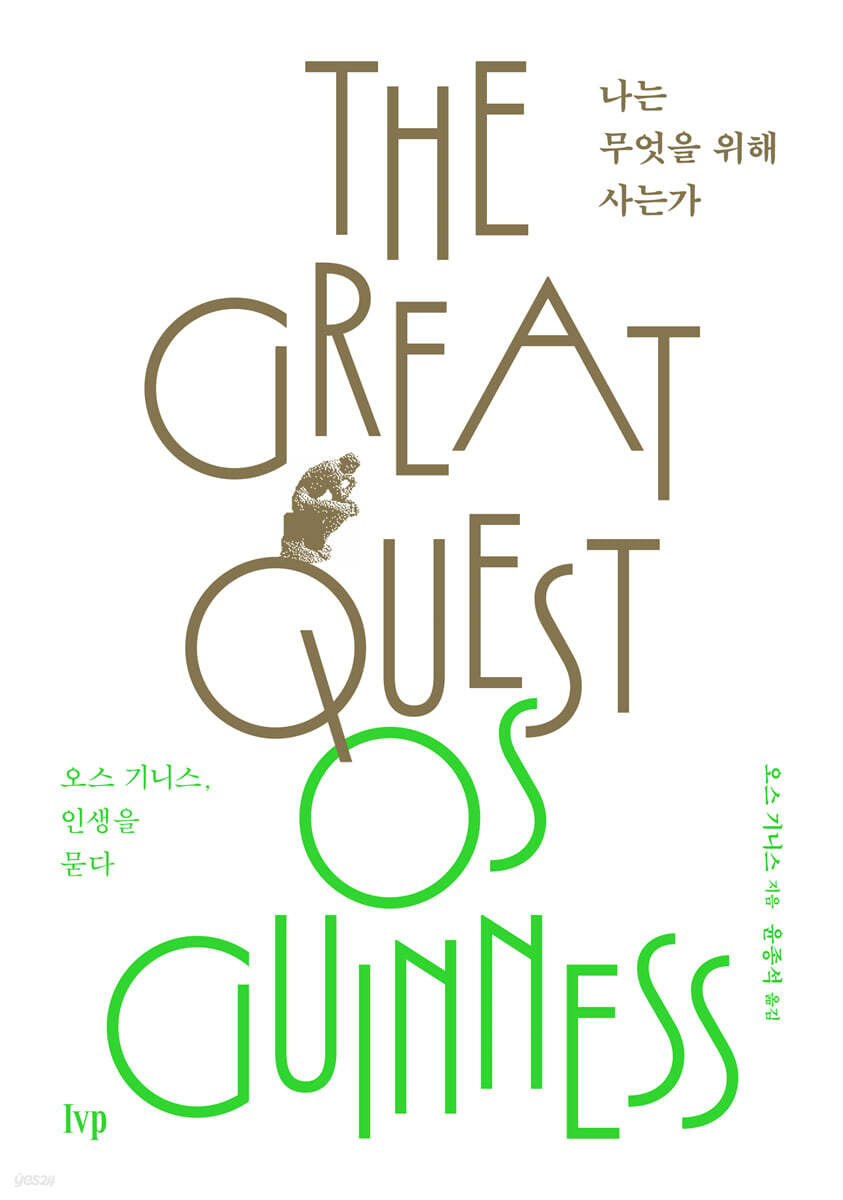
What do I live for?
 |
Description
Book Introduction
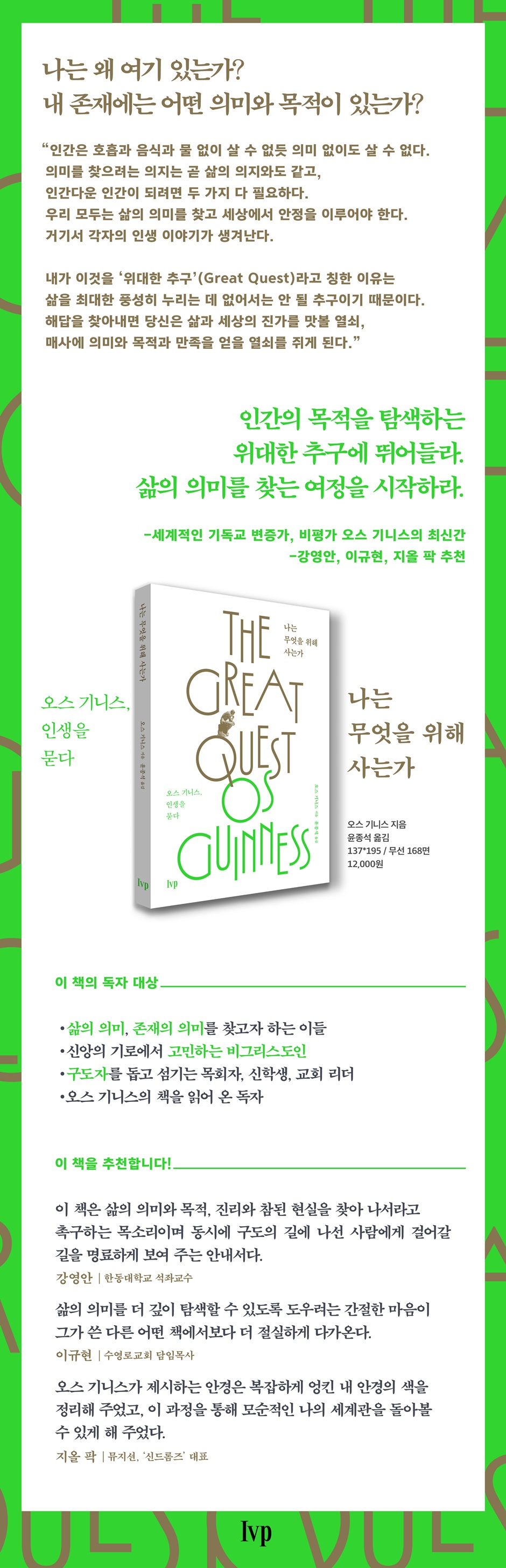
Why am I here?
What meaning and purpose is there in my existence?
Embark on the great quest to explore human purpose.
Begin your journey to find the meaning of life.
The latest book by world-renowned Christian apologist and critic Os Guinness
Recommended by Kang Young-an (Handong University Professor), Lee Kyu-hyun (Senior Pastor, Suyeongro Church), and Ji-ol Park (Musician)
This book is a voice urging us to find meaning and purpose in life, and at the same time, it is a guide that clearly shows the path to take for those who have embarked on the path of seeking enlightenment.
Os Guinness finds that many people today are not interested in the meaning of their existence and no longer ask questions about their lives.
They have lost their sense of wonder not only for their own lives but also for the existence of the entire universe, including the ordinary things around them.
But Os Guinness says that just as humans cannot live without breath, food, and water, they cannot live without meaning.
The will to find meaning is synonymous with the will to live, and exploring life's purpose is an essential pursuit for living life to its fullest.
He presents the steps of the pursuit one by one, guides the reader along the journey of the pursuit, and encourages the reader to begin his own pursuit.
I challenge you to enjoy the greatest reward that comes with pursuing life - a life worth living, a life full of life.
What meaning and purpose is there in my existence?
Embark on the great quest to explore human purpose.
Begin your journey to find the meaning of life.
The latest book by world-renowned Christian apologist and critic Os Guinness
Recommended by Kang Young-an (Handong University Professor), Lee Kyu-hyun (Senior Pastor, Suyeongro Church), and Ji-ol Park (Musician)
This book is a voice urging us to find meaning and purpose in life, and at the same time, it is a guide that clearly shows the path to take for those who have embarked on the path of seeking enlightenment.
Os Guinness finds that many people today are not interested in the meaning of their existence and no longer ask questions about their lives.
They have lost their sense of wonder not only for their own lives but also for the existence of the entire universe, including the ordinary things around them.
But Os Guinness says that just as humans cannot live without breath, food, and water, they cannot live without meaning.
The will to find meaning is synonymous with the will to live, and exploring life's purpose is an essential pursuit for living life to its fullest.
He presents the steps of the pursuit one by one, guides the reader along the journey of the pursuit, and encourages the reader to begin his own pursuit.
I challenge you to enjoy the greatest reward that comes with pursuing life - a life worth living, a life full of life.
- You can preview some of the book's contents.
Preview
index
Chapter 1: Inviting You to a Life of Reflection
Chapter 2: Embark on Your Own Journey
Chapter 3: Adventures Beyond Argument
Chapter 4 It all starts with a question
Step 1 - Time to Ask
Chapter 5: The Journey's Starter
Chapter 6: The Difference Between Heaven and Earth
Step 2 - The Time for Answers
Check out Chapter 7
Step 3 - Verification Time
Chapter 8: The Way Home
Step 4 - The Time of Decision
Find a person's name
Chapter 2: Embark on Your Own Journey
Chapter 3: Adventures Beyond Argument
Chapter 4 It all starts with a question
Step 1 - Time to Ask
Chapter 5: The Journey's Starter
Chapter 6: The Difference Between Heaven and Earth
Step 2 - The Time for Answers
Check out Chapter 7
Step 3 - Verification Time
Chapter 8: The Way Home
Step 4 - The Time of Decision
Find a person's name
Detailed image
Into the book
Is your mind constantly searching for meaning? Does your heart yearn for order and belonging? Have you ever been captivated by a sense of wonder, thrilled by the beauty of the world and the mystery of existence? Or are you simply uninterested in these questions? If you're determined to pursue a life of contemplation, here's a surefire way to explore that longing.
Let us now consider together these questions and the pursuit of faith and meaning they evoke.
The reward of this great pursuit is a life worth living.
--- From "Chapter 1: Invitation to a Life of Reflection"
Life is a journey, a voyage, an expedition, a pilgrimage.
It's a long adventure for each of us.
Without exception, we are all somewhere in between the beginning and the end of our journey.
We did not choose our own birth date, and we do not know the day we will die.
It wasn't something that came into existence by one's own will.
But like it or not, we are alive now and we cannot turn back time.
There is no stagnation as time pushes us forward.
Like it or not, our life's journey has already begun.
It is up to us to figure out how to make the most of this inevitable and irreversible path of life.
Philosophy of life transcends biography, but the roots of a satisfying philosophy are always intertwined with the biography that is the story of our lives.
--- From "Chapter 2: Embark on Your Own Journey"
Actor Marlon Brando is said to have said this on his deathbed:
“Life is an unsolvable riddle.
“It is just that when you live and take your last breath, you say, ‘What is life?’” What a sad death and what a miserable life.
This book is designed to help you avoid such a harsh conclusion.
The thinking person's pursuit of meaning will now be presented, and I believe this will be a conversation, not a monologue.
So I invite you to react.
First, imagine yourself lying in a coffin.
Tell your story to yourself or a friend.
Just tell us where you are on your journey and what you're looking for.
Where are you? As the Chinese proverb goes, a journey of a thousand miles begins with a single step.
--- From "Chapter 3: Adventures Beyond Argument"
The best philosophers are those who ask the best questions with the best skill.
It is no coincidence that questioning is the first step in the pursuit.
Questions give birth to and constitute the first step.
Exploration begins with a question.
Questions also have a significant impact on the results.
If questions don't push the pursuit, it will deflate like a deflated balloon.
It shrinks and becomes nothing more than an intellectual walk in the park or a long-term battle of theories.
Ultimately, there are two questions each of us must ask:
Am I asking a question? Is it the right question?
--- From "Chapter 4: It All Begins with a Question"
The signal of transcendence penetrates the boundaries of the outlines and scope of reality we think of, poking holes in our existing perceptions.
Second, this signal seems to point to something beyond existing reality.
That which, when revealed as truth, will change everything, calls us.
These signs of transcendence or expansions of experience come to us much more often than we usually recognize or acknowledge.
If we only pay closer attention, life throws us inspirations, clues, clues, suggestions, and realizations.
As all of this cries out, our world here and now is by no means everything.
There is a reality beyond the world before our eyes that calls us to a deeper, ultimate meaning.
Whatever that means.
--- From "Chapter 5: The Journey's Starter"
In my experience, the two issues that most strongly highlight differences between religious groups are the question of human worth (which naturally includes purpose and fulfillment) and the question of evil and suffering.
Furthermore, differences are clearly evident on a variety of topics, including time, freedom, justice, forgiveness, and community.
Whatever issue is driving the seeker, when viewed through the lens of one of the three faith groups, the results are dramatically different.
Depending on what faith and worldview you use to understand reality, truth, time, history, freedom, justice, equality, forgiveness, and peace, they all change.
In each case, contrast is the mother of clarity.
--- From "Chapter 6: The Difference Between Heaven and Earth"
The key to step 3 is, of course, evidence.
At this stage, it is natural and very important for the seeker to think evidence-centered.
In the case of the Christian faith, examples include the credibility of the gospels and the historicity of Jesus' resurrection.
Evidence is no longer mere information, much less “Christian information” that is swallowed up by the framework of existing beliefs.
Rather, it comes across as a fact that makes complete sense within the framework of the Christian worldview under consideration.
Now the seeker opens his heart and mind and considers the evidence.
In Step 3, the Christian evidence serves as a solid foundation upon which the seeker can examine the sufficiency and truthfulness of the Christian faith.
--- From "Check Chapter 7"
The final step of faith is based on deep thought and encompasses three important elements.
Knowledge, the confidence it has matured into, and trust it has matured into.
The reason faith includes knowledge is because one cannot believe without knowing anything about the object.
The reason faith includes certainty is not because we are attracted to the content of faith, but because it must be certainly true.
Finally, the reason faith includes trust is because faith is not just a conviction about a concept, but a total commitment of the person to God.
This has enormous consequences.
There is no moment in our lives when we are more free, more active, and more responsible than when we decide to trust God and actually embark on the journey home to Him.
Let us now consider together these questions and the pursuit of faith and meaning they evoke.
The reward of this great pursuit is a life worth living.
--- From "Chapter 1: Invitation to a Life of Reflection"
Life is a journey, a voyage, an expedition, a pilgrimage.
It's a long adventure for each of us.
Without exception, we are all somewhere in between the beginning and the end of our journey.
We did not choose our own birth date, and we do not know the day we will die.
It wasn't something that came into existence by one's own will.
But like it or not, we are alive now and we cannot turn back time.
There is no stagnation as time pushes us forward.
Like it or not, our life's journey has already begun.
It is up to us to figure out how to make the most of this inevitable and irreversible path of life.
Philosophy of life transcends biography, but the roots of a satisfying philosophy are always intertwined with the biography that is the story of our lives.
--- From "Chapter 2: Embark on Your Own Journey"
Actor Marlon Brando is said to have said this on his deathbed:
“Life is an unsolvable riddle.
“It is just that when you live and take your last breath, you say, ‘What is life?’” What a sad death and what a miserable life.
This book is designed to help you avoid such a harsh conclusion.
The thinking person's pursuit of meaning will now be presented, and I believe this will be a conversation, not a monologue.
So I invite you to react.
First, imagine yourself lying in a coffin.
Tell your story to yourself or a friend.
Just tell us where you are on your journey and what you're looking for.
Where are you? As the Chinese proverb goes, a journey of a thousand miles begins with a single step.
--- From "Chapter 3: Adventures Beyond Argument"
The best philosophers are those who ask the best questions with the best skill.
It is no coincidence that questioning is the first step in the pursuit.
Questions give birth to and constitute the first step.
Exploration begins with a question.
Questions also have a significant impact on the results.
If questions don't push the pursuit, it will deflate like a deflated balloon.
It shrinks and becomes nothing more than an intellectual walk in the park or a long-term battle of theories.
Ultimately, there are two questions each of us must ask:
Am I asking a question? Is it the right question?
--- From "Chapter 4: It All Begins with a Question"
The signal of transcendence penetrates the boundaries of the outlines and scope of reality we think of, poking holes in our existing perceptions.
Second, this signal seems to point to something beyond existing reality.
That which, when revealed as truth, will change everything, calls us.
These signs of transcendence or expansions of experience come to us much more often than we usually recognize or acknowledge.
If we only pay closer attention, life throws us inspirations, clues, clues, suggestions, and realizations.
As all of this cries out, our world here and now is by no means everything.
There is a reality beyond the world before our eyes that calls us to a deeper, ultimate meaning.
Whatever that means.
--- From "Chapter 5: The Journey's Starter"
In my experience, the two issues that most strongly highlight differences between religious groups are the question of human worth (which naturally includes purpose and fulfillment) and the question of evil and suffering.
Furthermore, differences are clearly evident on a variety of topics, including time, freedom, justice, forgiveness, and community.
Whatever issue is driving the seeker, when viewed through the lens of one of the three faith groups, the results are dramatically different.
Depending on what faith and worldview you use to understand reality, truth, time, history, freedom, justice, equality, forgiveness, and peace, they all change.
In each case, contrast is the mother of clarity.
--- From "Chapter 6: The Difference Between Heaven and Earth"
The key to step 3 is, of course, evidence.
At this stage, it is natural and very important for the seeker to think evidence-centered.
In the case of the Christian faith, examples include the credibility of the gospels and the historicity of Jesus' resurrection.
Evidence is no longer mere information, much less “Christian information” that is swallowed up by the framework of existing beliefs.
Rather, it comes across as a fact that makes complete sense within the framework of the Christian worldview under consideration.
Now the seeker opens his heart and mind and considers the evidence.
In Step 3, the Christian evidence serves as a solid foundation upon which the seeker can examine the sufficiency and truthfulness of the Christian faith.
--- From "Check Chapter 7"
The final step of faith is based on deep thought and encompasses three important elements.
Knowledge, the confidence it has matured into, and trust it has matured into.
The reason faith includes knowledge is because one cannot believe without knowing anything about the object.
The reason faith includes certainty is not because we are attracted to the content of faith, but because it must be certainly true.
Finally, the reason faith includes trust is because faith is not just a conviction about a concept, but a total commitment of the person to God.
This has enormous consequences.
There is no moment in our lives when we are more free, more active, and more responsible than when we decide to trust God and actually embark on the journey home to Him.
--- From "Chapter 8: The Way Home"
Publisher's Review
A life without questions
The statement that faith in God is an essential element of life has been a proven statement since ancient times.
Psychologist Carl Gustav Jung also used to say that the ultimate question in life is whether we are in touch with the infinite.
But in today's cultural discourse, that statement no longer seems self-evident.
Many people say they do not want God.
Some people say that there is no need for God.
Nowadays, there are even talks that humans can replace God through biogenetics and artificial intelligence.
It's not just indifference and cynicism towards God.
Questions and pursuits about life are also considered meaningless.
Many people do not ask how everything came into being, what made them who they are, what they live for now, how to make the most of their life on this earth, is this life all there is, or is there something afterward?
Just living.
What Makes Pursuit Frustrating
Os Guinness first diagnoses the cause of this life without pursuit and reflection.
He lists three obstacles that hinder serious pursuit: 'deviation', 'negotiation', and 'noise and interference'.
The first obstacle is the so-called “weapon of mass entertainment,” which refers to the endless immersion of modern people in information, entertainment, and distraction to avoid thinking about the inevitability of death.
The second is negotiation, which means postponing important life issues for later.
The third is the noise and interference from within ourselves and from our past, which means that our personal experiences distort our responses to life.
Even unconsciously, serious pursuits can be frustrated for these reasons.
How to pursue
But Guinness says humans cannot endure a life without meaning.
He argues that asking questions about the meaning of life and human identity, such as 'Who am I?' and 'Why am I here?', is crucial and transforms all lives.
To live life to the fullest, I encourage you to begin your journey of seeking meaning before it's too late.
He explains this journey in four stages.
In the first stage, “A Time of Questioning,” you ask yourself questions like, “Where am I? Where am I on my life’s journey? Am I satisfied with my current life and circumstances, or do I feel like I need something more?” and prepare to look beyond what you have believed and lived by.
Step 2 is the “Time of Answers,” where decisions are made after comparing the many answers offered by numerous thinkers and religions.
Guinness suggests three groups of beliefs that seem to offer the most satisfactory answers: Eastern, secular, and Abrahamic.
Step 3 is the “time of verification,” where you carefully examine a particular group of beliefs that you are particularly drawn to using reason and reasoning to determine whether it is true and whether there is credible evidence.
In the final stage, “Time of Decision,” you can finally choose one based on the verified information.
Before it's too late, start
Are you searching for meaning in life? Are you reflecting on your own life? Even if you haven't started yet, it's never too late.
To pursue meaning, you must be honest, open-minded, and courageous.
Will we seek it out, or will we settle for life? The choice is ours.
Of course, the compensation that comes with it is entirely ours.
Main Readers
· Those who seek the meaning of life and existence
· Non-Christians struggling at a crossroads of faith
· Non-Christians who want to know about Christianity
Pastors, seminarians, and church leaders who help and serve seekers
· Readers who have read Os Guinness's books
The statement that faith in God is an essential element of life has been a proven statement since ancient times.
Psychologist Carl Gustav Jung also used to say that the ultimate question in life is whether we are in touch with the infinite.
But in today's cultural discourse, that statement no longer seems self-evident.
Many people say they do not want God.
Some people say that there is no need for God.
Nowadays, there are even talks that humans can replace God through biogenetics and artificial intelligence.
It's not just indifference and cynicism towards God.
Questions and pursuits about life are also considered meaningless.
Many people do not ask how everything came into being, what made them who they are, what they live for now, how to make the most of their life on this earth, is this life all there is, or is there something afterward?
Just living.
What Makes Pursuit Frustrating
Os Guinness first diagnoses the cause of this life without pursuit and reflection.
He lists three obstacles that hinder serious pursuit: 'deviation', 'negotiation', and 'noise and interference'.
The first obstacle is the so-called “weapon of mass entertainment,” which refers to the endless immersion of modern people in information, entertainment, and distraction to avoid thinking about the inevitability of death.
The second is negotiation, which means postponing important life issues for later.
The third is the noise and interference from within ourselves and from our past, which means that our personal experiences distort our responses to life.
Even unconsciously, serious pursuits can be frustrated for these reasons.
How to pursue
But Guinness says humans cannot endure a life without meaning.
He argues that asking questions about the meaning of life and human identity, such as 'Who am I?' and 'Why am I here?', is crucial and transforms all lives.
To live life to the fullest, I encourage you to begin your journey of seeking meaning before it's too late.
He explains this journey in four stages.
In the first stage, “A Time of Questioning,” you ask yourself questions like, “Where am I? Where am I on my life’s journey? Am I satisfied with my current life and circumstances, or do I feel like I need something more?” and prepare to look beyond what you have believed and lived by.
Step 2 is the “Time of Answers,” where decisions are made after comparing the many answers offered by numerous thinkers and religions.
Guinness suggests three groups of beliefs that seem to offer the most satisfactory answers: Eastern, secular, and Abrahamic.
Step 3 is the “time of verification,” where you carefully examine a particular group of beliefs that you are particularly drawn to using reason and reasoning to determine whether it is true and whether there is credible evidence.
In the final stage, “Time of Decision,” you can finally choose one based on the verified information.
Before it's too late, start
Are you searching for meaning in life? Are you reflecting on your own life? Even if you haven't started yet, it's never too late.
To pursue meaning, you must be honest, open-minded, and courageous.
Will we seek it out, or will we settle for life? The choice is ours.
Of course, the compensation that comes with it is entirely ours.
Main Readers
· Those who seek the meaning of life and existence
· Non-Christians struggling at a crossroads of faith
· Non-Christians who want to know about Christianity
Pastors, seminarians, and church leaders who help and serve seekers
· Readers who have read Os Guinness's books
GOODS SPECIFICS
- Date of issue: December 10, 2024
- Page count, weight, size: 168 pages | 216g | 137*195*12mm
- ISBN13: 9788932823089
- ISBN10: 8932823081
You may also like
카테고리
korean


korean

![GQ KOREA Mark (Monthly): December [2025]](http://librairie.coreenne.fr/cdn/shop/files/8ef265dbbfbf186523ed75ba7319009d.jpg?v=1765340328&width=3840)


