

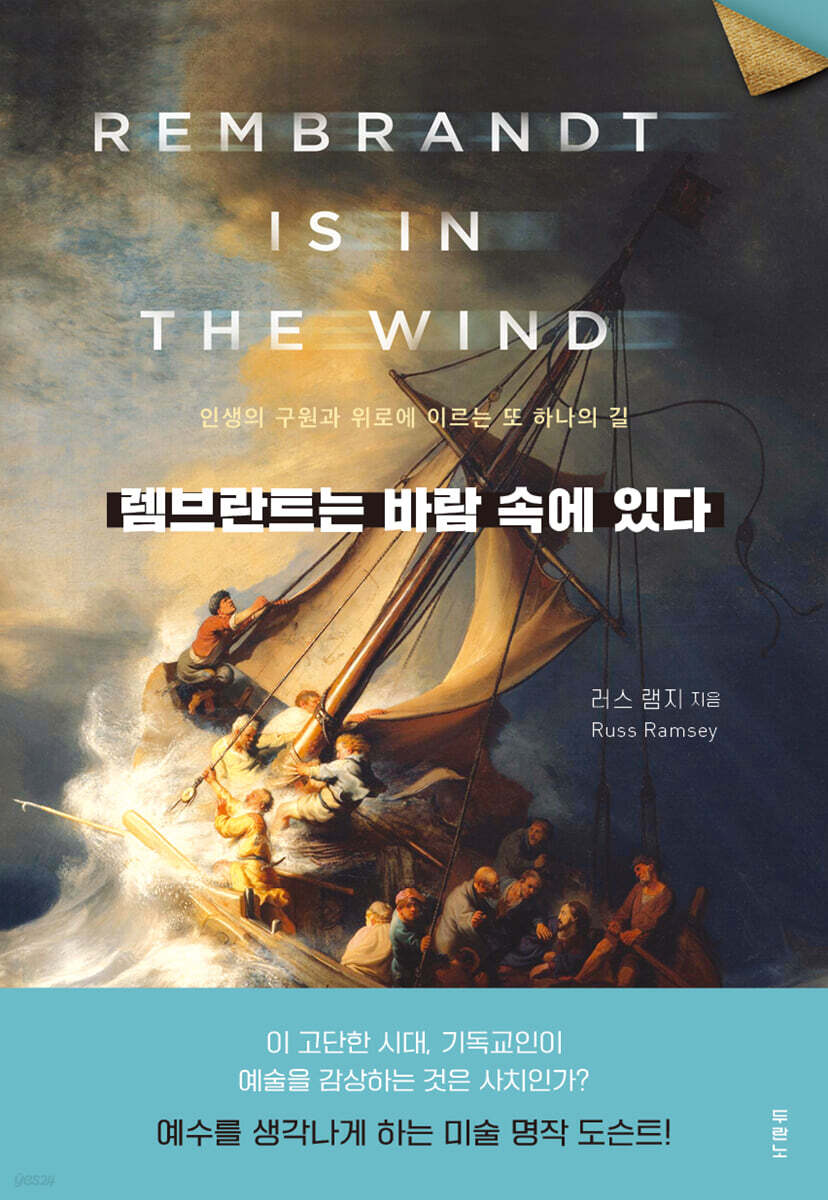
Rembrandt in the Wind
 |
Description
Book Introduction
In these difficult times, is it a luxury for Christians to appreciate art?
In every corner of the art museum, human suffering, longing, and contradictions are intertwined.
Encounter the abundant grace that covers it!
- Docent on art masterpieces that remind you of Jesus
From Michelangelo and Rembrandt to Edward Hopper and Lilias Trotter
The untold stories of the lives and works of nine artists we love!
Art historical, philosophical, and theological insights that nourish the soul
- A captivating introductory art book that's fun to read page by page!
Did you know that Rembrandt's "The Storm on the Sea of Galilee" was stolen in 1990 and remains unrecovered? Did you know that Van Gogh sold only one painting during his lifetime? Did you know that Michelangelo's "David" was the product of countless mistakes and failures? Did you know that Caravaggio killed several people while creating some of the world's most glorious icons? This book offers a meticulous and insightful chronological exploration of nine artists and their works, spanning nearly 500 years of Western art history.
This book is part art history, part biblical study, part philosophy, and part rich analysis of human experience.
Each 'story' illustrates the difficulties of life on this earth and points to the beauty of redemption possible in Christ.
Of course, among the artists introduced in this book, there are some famous and some not so famous.
Some people lived a life of faithful faith, while others seemed to stubbornly reject God.
Some stories end in glorious victory, while others end in suffering.
But all these stories raise important questions about the human desire for glory and the human capacity to pursue that glory.
It also awakens us to see and love 'beauty', the clothing we must wear forever.
Goodness and truth without beauty are powerless.
Interpret masterpieces of art through the eyes of faith, and learn to recognize and richly enjoy the "beauty" God has granted us in life.
Another way to understand life and the gospel more deeply!
“Awaken our five senses toward the world God created,
Furthermore, awakening the sense of God,
“This is the gift of beauty that the artist gives to the community.”
_From the text
In every corner of the art museum, human suffering, longing, and contradictions are intertwined.
Encounter the abundant grace that covers it!
- Docent on art masterpieces that remind you of Jesus
From Michelangelo and Rembrandt to Edward Hopper and Lilias Trotter
The untold stories of the lives and works of nine artists we love!
Art historical, philosophical, and theological insights that nourish the soul
- A captivating introductory art book that's fun to read page by page!
Did you know that Rembrandt's "The Storm on the Sea of Galilee" was stolen in 1990 and remains unrecovered? Did you know that Van Gogh sold only one painting during his lifetime? Did you know that Michelangelo's "David" was the product of countless mistakes and failures? Did you know that Caravaggio killed several people while creating some of the world's most glorious icons? This book offers a meticulous and insightful chronological exploration of nine artists and their works, spanning nearly 500 years of Western art history.
This book is part art history, part biblical study, part philosophy, and part rich analysis of human experience.
Each 'story' illustrates the difficulties of life on this earth and points to the beauty of redemption possible in Christ.
Of course, among the artists introduced in this book, there are some famous and some not so famous.
Some people lived a life of faithful faith, while others seemed to stubbornly reject God.
Some stories end in glorious victory, while others end in suffering.
But all these stories raise important questions about the human desire for glory and the human capacity to pursue that glory.
It also awakens us to see and love 'beauty', the clothing we must wear forever.
Goodness and truth without beauty are powerless.
Interpret masterpieces of art through the eyes of faith, and learn to recognize and richly enjoy the "beauty" God has granted us in life.
Another way to understand life and the gospel more deeply!
“Awaken our five senses toward the world God created,
Furthermore, awakening the sense of God,
“This is the gift of beauty that the artist gives to the community.”
_From the text
- You can preview some of the book's contents.
Preview
index
Recommended introduction.
Reading the Art of Life and God the Artist
Chapter 1.
Learn to see and love beauty
: Why it is important to pursue goodness, truth, and beauty
Chapter 2.
Michelangelo, the pursuit of wholeness in a decaying world
: Man's longing for glory
Chapter 3.
Caravaggio, Tightrope Walking Between the Sacred and the Profane
: The depth and breadth of grace
Chapter 4.
Rembrandt, Still in the Wind
: The Tragedy of the Earth and the Hope of Redemption
Chapter 5.
Johannes Vermeer, the power and grandeur of borrowed light
: The Mystery of the Sub-Creative Work
Chapter 6.
Jean-Frédéric Bazille and the Impressionists: A Community That Lives Together
: The importance of solidarity
Chapter 7.
Vincent van Gogh, A Struggling Life
: The elusive quality of satisfaction
Chapter 8.
Henry Osawa Tanner: Eyes Beyond Imagination and Prejudice
: The humble power of curiosity
Chapter 9.
Edward Hopper, the profound loneliness of modern man
: The desire for connection
Chapter 10.
Lilias Trotter: The Joys and Pains of Sacrificial Obedience
: Evaluation of our lives
Epilogue.
What am I practicing today?
Appendix 1.
How to enjoy an art museum
Appendix 2.
How to appreciate art
Appendix 3.
Overview of Western Art History: From the Renaissance to the Modern Age
References
main
Reading the Art of Life and God the Artist
Chapter 1.
Learn to see and love beauty
: Why it is important to pursue goodness, truth, and beauty
Chapter 2.
Michelangelo, the pursuit of wholeness in a decaying world
: Man's longing for glory
Chapter 3.
Caravaggio, Tightrope Walking Between the Sacred and the Profane
: The depth and breadth of grace
Chapter 4.
Rembrandt, Still in the Wind
: The Tragedy of the Earth and the Hope of Redemption
Chapter 5.
Johannes Vermeer, the power and grandeur of borrowed light
: The Mystery of the Sub-Creative Work
Chapter 6.
Jean-Frédéric Bazille and the Impressionists: A Community That Lives Together
: The importance of solidarity
Chapter 7.
Vincent van Gogh, A Struggling Life
: The elusive quality of satisfaction
Chapter 8.
Henry Osawa Tanner: Eyes Beyond Imagination and Prejudice
: The humble power of curiosity
Chapter 9.
Edward Hopper, the profound loneliness of modern man
: The desire for connection
Chapter 10.
Lilias Trotter: The Joys and Pains of Sacrificial Obedience
: Evaluation of our lives
Epilogue.
What am I practicing today?
Appendix 1.
How to enjoy an art museum
Appendix 2.
How to appreciate art
Appendix 3.
Overview of Western Art History: From the Renaissance to the Modern Age
References
main
Detailed image

Into the book
There are countless beautiful things in the world.
But not all of that is necessarily practical.
God made them beautiful to capture our hearts and awaken us from the slumber of pragmatic economics.
This is the core function of beauty.
Awakening our five senses toward the world God created, and further awakening our sense of God, is the gift of beauty that artists give to the community.
--- p.38
How would David have been different if Michelangelo had begun with the original, untouched stone? What artistic choices would he have made? Would the sculpture have been as beloved as it is today? Michelangelo carved the stone given to him.
He had to adapt his vision to the vision of other sculptors.
It had to fit the molds of the stonemasons who first cut the marble of the Apuan Alps.
He also had to fit it into the framework of the Bible story.
The story of David was not something he created.
These various constraints influenced Michelangelo's ability to extract the shepherd he had read and imagined from the stone.
Quite a few choices had already been made.
Something might have been created without these constraints, but it wouldn't be Michelangelo's David as we see it today.
There is not a single thing in my life that has not been touched by other people.
You too, I'm sure.
Of course, we don't want other people's traces of affection.
Traces that make us sigh, traces that make us long for the day when all things will be renewed.
But there is goodness, truth, and beauty that cannot be born without the traces of others.
Living within limits allows us to enter into beauty we would not see without limits, good deeds we would not choose without limits, and relationships we would not cherish without limits.
For Christians, accepting their limitations is one of the keys to being built together as living stones into the body of Christ.
Our limitations, as well as our strengths, are a gift to the church.
--- pp.67~68
Martin Luther called Christians “both sinners and righteous.”
From beginning to end of the Bible, God worked through flawed people.
Moses the murderer, Jacob the liar, David the adulterer, Solomon the womanizer, and Jonah the man who delivered a warning message to his enemies and was angry at God for showing mercy.
In the New Testament, Jesus welcomed prostitutes, ate with tax collectors and sinners, and called as disciples those who would later deny him.
Saul of Tarsus was converted while on his way to destroy the church.
The pattern in Scripture is that God works through unlikely servants for the glory of His name and the spread of the gospel.
Caravaggio's life reminds us that we, who share both the sacred and the profane, can inflict great harm on one another.
Caravaggio lived a destructive life.
But his artwork shouts one message into the chaos.
The message is that God's grace is so great that Christ called a tax collector to be his disciple and brought beauty and wonder out of the heart of Caravaggio, who was the most hardened of all men, between the debaucherous days of Carnival.
Grace can transform even the most stubborn heart.
--- pp.110~111
The empty picture frame is a message from the thief to Isabella.
The message is that even if she wants to create something that transcends death, this world won't allow it.
She may be able to heal the wounds, but whatever she created cannot last forever.
This world is a world where thieves come in and steal.
This is a world where beautiful things are destroyed, precious treasures are sold for cheap, and talents are buried and rot away.
This world is one where people try to completely hide their true selves from each other.
The shadow of sin covers the world.
… (omitted) … The disciples’ questions resonate even today, centuries later.
“God, won’t you care if we perish?” Jesus came to the middle of the most violent sea and calmed the waves.
Jesus will do it again.
His victory over death gives the dying a new hope, a living hope.
The peace He brought through His resurrection is not a myth or a fantasy.
It is an incorruptible inheritance and an eternal kingdom prepared for those who believe.
His kingdom is an everlasting kingdom.
But such a country is unique in that it is his country.
If The Storm on the Sea of Galilee still exists, it may be hidden away in some secret room, attic, or basement.
Rembrandt would still be holding the string with one hand and holding the hat with the other to keep it from flying away.
And looking out over this world, everyone will be waiting for someone to make eye contact with.
If he exists, he would still be caught in the rough waves.
If the Bible is true, then one day Jesus will stand up and say the same thing to widows and thieves.
“Be still! Be still!” Then unprecedented and eternal peace will come.
Knowing this fact will help you live in the present moment.
No matter what hardships you are going through, there is no need to mourn as if you have no hope.
So we must learn to wait for the country to come.
And at the same time, we must remember that in this world, at least for the time being, Rembrandt is in the wind.
--- pp.137~139
This is why community is so important.
Without community, it's easy to think that we're the only ones who face limitations and hardships, and that we have to overcome them alone.
But when we enter a community, we come into contact with others who are suffering, and we feel reassured that we are not alone.
They may be able to impart wisdom to us because they know the forest we have lost, and they may be able to benefit from the experiences and insights we have gained through our struggles.
… (omitted) … Of course, it cannot be argued that Bazille was the direct reason for the birth of Impressionism.
It cannot be said with certainty that the reason Monet and others were successful was because of Bazille.
But it is clear that he played a significant role in the birth of one of the world's most famous art schools.
He was a valuable contributor to a community that strives to create something beautiful, meaningful, and lasting.
He gave friendship.
He gave me space.
He shared his art tools.
He hosted the meeting.
He bought the paintings his friends had drawn.
And the thing we must never forget is that he died fighting for his comrades.
According to Jesus, laying down one's life for a friend is the highest form of love.
--- pp.199~201
Van Gogh was not a saint.
He cannot be placed in the ranks of saints.
… (omitted) … It is difficult to glorify him while ignoring his bad temper, immorality, and arrogance.
But we cannot conclude that he went to hell just by looking at his imperfect and immoral appearance.
… (omitted) … Perhaps one of the greatest gifts Van Gogh left behind was the conviction that this world, in which we await glory, is neither ugly nor vain.
This conviction is evident in his paintings of ordinary people and places.
The world he knew was glorious.
The world was alive with color, texture and wonder.
He helped us see it and hope for a truer and greater glory.
Van Gogh taught us to look at the night sky and see the stars that decorate it.
Through the painting of Iris, we are taught to remember that there is life in what is dead during winter and to look forward to its full bloom.
When dew falls on the poppy field, he teaches us to look at the dew that sparkles with countless tiny lights.
… (omitted) … Thanks to Van Gogh, we can encounter a glory deeper than we expected.
But still we only see a small part of the real glory.
All I can see is a thin wisp of smoke rising.
“All things are tired.”
--- pp.233~235
In this chapter, I wanted to tell a complex story that is difficult to unravel.
Tanner is one of my favorite painters.
I own more copies of Tanner's works than any other artist.
His story is complex, heartbreaking and sad.
His story forces us to examine our own assumptions and expectations.
I want to confess the unmet expectations I had when I first discovered him.
My desire for him to be a black artist painting black people stemmed from the same prejudices he had struggled to overcome throughout his life.
The fact that he drew Bible scenes that I have been teaching all my life adds to my guilt.
… (omitted) … Every story of a black painter involves enormous sacrifices that no other white painter in Europe or America could even imagine.
To truly understand Tanner's story, we must understand what he had to overcome, what he sacrificed, and what choices he had to make because of his race.
Failure to do so risks reducing him to a mere symbol.
--- p.267
The world we live in now and the world we will live in forever are completely different.
“I have longed to gather you under my wings, as a hen gathers her chicks under her wings.” Jesus’ words acknowledge Israel’s loneliness.
The world shouldn't be like this.
God knew the distance they felt and did not want it.
The great irony here is that the God they thought had abandoned them was in fact incarnated and dwelt among them to permanently erase this distance.
God does not just see our loneliness; He moves to address it.
Loneliness speaks volumes about the reality we face.
Loneliness does not come from evil roots.
It comes from a deep, God-given longing to know that we are not alone.
It stems from a longing for satisfaction, peace, and belonging, and a desire to be loved and accepted.
Loneliness awakens in us a passionate resistance to being alone.
Hopper's work is both an expression of loneliness and a resistance to loneliness.
Nivison's existence is resistance.
Of course, the relationship between Hopper and Nivison was always on thin ice.
Hopper's professional success came at the expense of Nivison.
There was no one who didn't know how loud their fights were.
Nevertheless, they enjoyed a deep and mysterious union.
They navigated their marriage, which was like an active volcano, not as people who had become estranged, but as people who were united.
They were like fugitives trying to pass through an unfamiliar forest, still chained to each other.
And both were hurt.
--- pp.293~294
Serving God is never in vain, even if no one recognizes it.
God will surely see and use it.
For Trotter, this was not just a hope, it was a certainty.
… (omitted) … Trotter saw beauty everywhere.
When I look at her diary or her sketches and drawings, I feel my heart swell with the beauty of the world she lives in.
Even in the harshest of circumstances, she marveled at the lilies that bloomed in the desert, and saw God's kindness and grace in each of their petals.
In front of the natural beauty that filled her surroundings, she thought of God who works in history.
The thought that God was working through her filled her heart with joy.
One particularly difficult day while serving in Algiers, Trotter took his journal and went into the garden to pray.
It was written there like this:
“The bee was just hovering over the blackberry blossoms, touching them here and there.
But the guy unconsciously left life wherever he touched.”
But not all of that is necessarily practical.
God made them beautiful to capture our hearts and awaken us from the slumber of pragmatic economics.
This is the core function of beauty.
Awakening our five senses toward the world God created, and further awakening our sense of God, is the gift of beauty that artists give to the community.
--- p.38
How would David have been different if Michelangelo had begun with the original, untouched stone? What artistic choices would he have made? Would the sculpture have been as beloved as it is today? Michelangelo carved the stone given to him.
He had to adapt his vision to the vision of other sculptors.
It had to fit the molds of the stonemasons who first cut the marble of the Apuan Alps.
He also had to fit it into the framework of the Bible story.
The story of David was not something he created.
These various constraints influenced Michelangelo's ability to extract the shepherd he had read and imagined from the stone.
Quite a few choices had already been made.
Something might have been created without these constraints, but it wouldn't be Michelangelo's David as we see it today.
There is not a single thing in my life that has not been touched by other people.
You too, I'm sure.
Of course, we don't want other people's traces of affection.
Traces that make us sigh, traces that make us long for the day when all things will be renewed.
But there is goodness, truth, and beauty that cannot be born without the traces of others.
Living within limits allows us to enter into beauty we would not see without limits, good deeds we would not choose without limits, and relationships we would not cherish without limits.
For Christians, accepting their limitations is one of the keys to being built together as living stones into the body of Christ.
Our limitations, as well as our strengths, are a gift to the church.
--- pp.67~68
Martin Luther called Christians “both sinners and righteous.”
From beginning to end of the Bible, God worked through flawed people.
Moses the murderer, Jacob the liar, David the adulterer, Solomon the womanizer, and Jonah the man who delivered a warning message to his enemies and was angry at God for showing mercy.
In the New Testament, Jesus welcomed prostitutes, ate with tax collectors and sinners, and called as disciples those who would later deny him.
Saul of Tarsus was converted while on his way to destroy the church.
The pattern in Scripture is that God works through unlikely servants for the glory of His name and the spread of the gospel.
Caravaggio's life reminds us that we, who share both the sacred and the profane, can inflict great harm on one another.
Caravaggio lived a destructive life.
But his artwork shouts one message into the chaos.
The message is that God's grace is so great that Christ called a tax collector to be his disciple and brought beauty and wonder out of the heart of Caravaggio, who was the most hardened of all men, between the debaucherous days of Carnival.
Grace can transform even the most stubborn heart.
--- pp.110~111
The empty picture frame is a message from the thief to Isabella.
The message is that even if she wants to create something that transcends death, this world won't allow it.
She may be able to heal the wounds, but whatever she created cannot last forever.
This world is a world where thieves come in and steal.
This is a world where beautiful things are destroyed, precious treasures are sold for cheap, and talents are buried and rot away.
This world is one where people try to completely hide their true selves from each other.
The shadow of sin covers the world.
… (omitted) … The disciples’ questions resonate even today, centuries later.
“God, won’t you care if we perish?” Jesus came to the middle of the most violent sea and calmed the waves.
Jesus will do it again.
His victory over death gives the dying a new hope, a living hope.
The peace He brought through His resurrection is not a myth or a fantasy.
It is an incorruptible inheritance and an eternal kingdom prepared for those who believe.
His kingdom is an everlasting kingdom.
But such a country is unique in that it is his country.
If The Storm on the Sea of Galilee still exists, it may be hidden away in some secret room, attic, or basement.
Rembrandt would still be holding the string with one hand and holding the hat with the other to keep it from flying away.
And looking out over this world, everyone will be waiting for someone to make eye contact with.
If he exists, he would still be caught in the rough waves.
If the Bible is true, then one day Jesus will stand up and say the same thing to widows and thieves.
“Be still! Be still!” Then unprecedented and eternal peace will come.
Knowing this fact will help you live in the present moment.
No matter what hardships you are going through, there is no need to mourn as if you have no hope.
So we must learn to wait for the country to come.
And at the same time, we must remember that in this world, at least for the time being, Rembrandt is in the wind.
--- pp.137~139
This is why community is so important.
Without community, it's easy to think that we're the only ones who face limitations and hardships, and that we have to overcome them alone.
But when we enter a community, we come into contact with others who are suffering, and we feel reassured that we are not alone.
They may be able to impart wisdom to us because they know the forest we have lost, and they may be able to benefit from the experiences and insights we have gained through our struggles.
… (omitted) … Of course, it cannot be argued that Bazille was the direct reason for the birth of Impressionism.
It cannot be said with certainty that the reason Monet and others were successful was because of Bazille.
But it is clear that he played a significant role in the birth of one of the world's most famous art schools.
He was a valuable contributor to a community that strives to create something beautiful, meaningful, and lasting.
He gave friendship.
He gave me space.
He shared his art tools.
He hosted the meeting.
He bought the paintings his friends had drawn.
And the thing we must never forget is that he died fighting for his comrades.
According to Jesus, laying down one's life for a friend is the highest form of love.
--- pp.199~201
Van Gogh was not a saint.
He cannot be placed in the ranks of saints.
… (omitted) … It is difficult to glorify him while ignoring his bad temper, immorality, and arrogance.
But we cannot conclude that he went to hell just by looking at his imperfect and immoral appearance.
… (omitted) … Perhaps one of the greatest gifts Van Gogh left behind was the conviction that this world, in which we await glory, is neither ugly nor vain.
This conviction is evident in his paintings of ordinary people and places.
The world he knew was glorious.
The world was alive with color, texture and wonder.
He helped us see it and hope for a truer and greater glory.
Van Gogh taught us to look at the night sky and see the stars that decorate it.
Through the painting of Iris, we are taught to remember that there is life in what is dead during winter and to look forward to its full bloom.
When dew falls on the poppy field, he teaches us to look at the dew that sparkles with countless tiny lights.
… (omitted) … Thanks to Van Gogh, we can encounter a glory deeper than we expected.
But still we only see a small part of the real glory.
All I can see is a thin wisp of smoke rising.
“All things are tired.”
--- pp.233~235
In this chapter, I wanted to tell a complex story that is difficult to unravel.
Tanner is one of my favorite painters.
I own more copies of Tanner's works than any other artist.
His story is complex, heartbreaking and sad.
His story forces us to examine our own assumptions and expectations.
I want to confess the unmet expectations I had when I first discovered him.
My desire for him to be a black artist painting black people stemmed from the same prejudices he had struggled to overcome throughout his life.
The fact that he drew Bible scenes that I have been teaching all my life adds to my guilt.
… (omitted) … Every story of a black painter involves enormous sacrifices that no other white painter in Europe or America could even imagine.
To truly understand Tanner's story, we must understand what he had to overcome, what he sacrificed, and what choices he had to make because of his race.
Failure to do so risks reducing him to a mere symbol.
--- p.267
The world we live in now and the world we will live in forever are completely different.
“I have longed to gather you under my wings, as a hen gathers her chicks under her wings.” Jesus’ words acknowledge Israel’s loneliness.
The world shouldn't be like this.
God knew the distance they felt and did not want it.
The great irony here is that the God they thought had abandoned them was in fact incarnated and dwelt among them to permanently erase this distance.
God does not just see our loneliness; He moves to address it.
Loneliness speaks volumes about the reality we face.
Loneliness does not come from evil roots.
It comes from a deep, God-given longing to know that we are not alone.
It stems from a longing for satisfaction, peace, and belonging, and a desire to be loved and accepted.
Loneliness awakens in us a passionate resistance to being alone.
Hopper's work is both an expression of loneliness and a resistance to loneliness.
Nivison's existence is resistance.
Of course, the relationship between Hopper and Nivison was always on thin ice.
Hopper's professional success came at the expense of Nivison.
There was no one who didn't know how loud their fights were.
Nevertheless, they enjoyed a deep and mysterious union.
They navigated their marriage, which was like an active volcano, not as people who had become estranged, but as people who were united.
They were like fugitives trying to pass through an unfamiliar forest, still chained to each other.
And both were hurt.
--- pp.293~294
Serving God is never in vain, even if no one recognizes it.
God will surely see and use it.
For Trotter, this was not just a hope, it was a certainty.
… (omitted) … Trotter saw beauty everywhere.
When I look at her diary or her sketches and drawings, I feel my heart swell with the beauty of the world she lives in.
Even in the harshest of circumstances, she marveled at the lilies that bloomed in the desert, and saw God's kindness and grace in each of their petals.
In front of the natural beauty that filled her surroundings, she thought of God who works in history.
The thought that God was working through her filled her heart with joy.
One particularly difficult day while serving in Algiers, Trotter took his journal and went into the garden to pray.
It was written there like this:
“The bee was just hovering over the blackberry blossoms, touching them here and there.
But the guy unconsciously left life wherever he touched.”
--- pp.322~323
GOODS SPECIFICS
- Publication date: September 28, 2022
- Page count, weight, size: 380 pages | 603g | 145*210*24mm
- ISBN13: 9788953142985
- ISBN10: 8953142989
You may also like
카테고리
korean


korean

![GQ KOREA Mark (Monthly): December [2025]](http://librairie.coreenne.fr/cdn/shop/files/8ef265dbbfbf186523ed75ba7319009d.jpg?v=1765340328&width=3840)


