

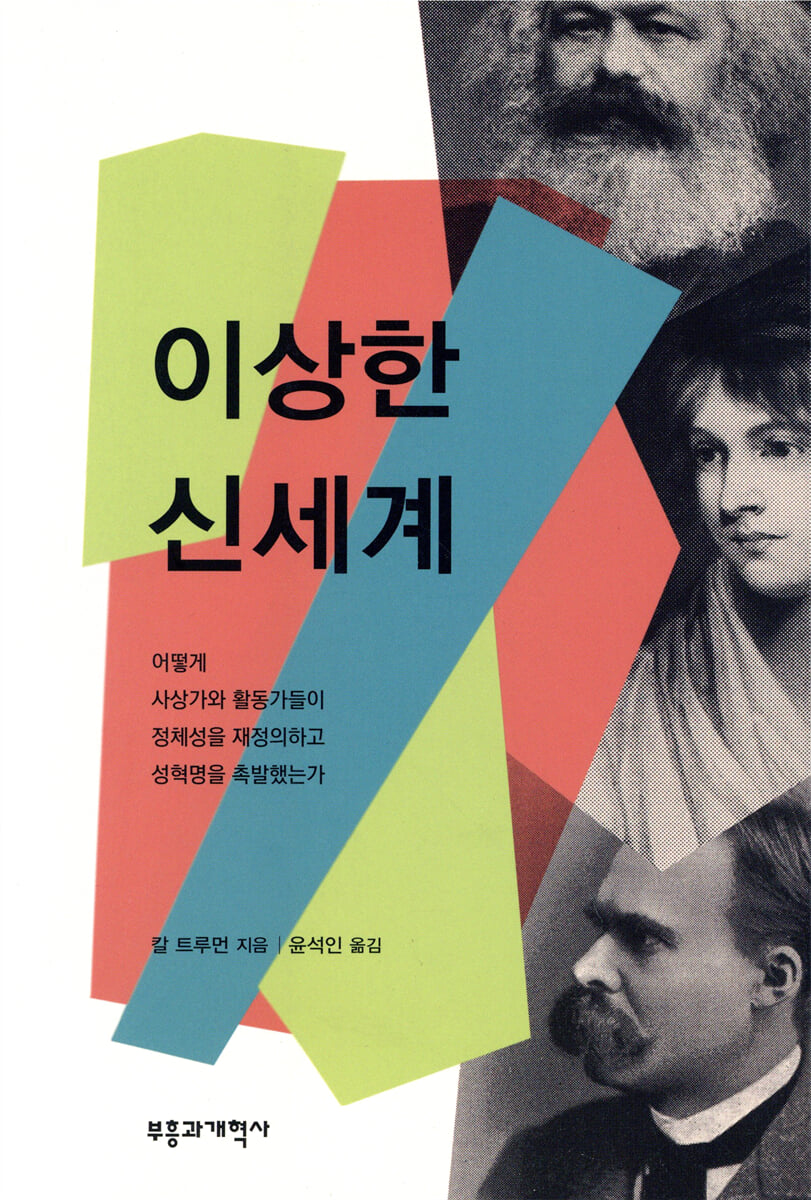
Strange New World
 |
Description
Book Introduction
As identity politics rapidly gains influence, it is creating confusion around aspects of personality and morality that were once clear.
From the sexual revolution to same-sex marriage and gender issues, humanity has become politicized.
How should we respond to this?
In "The New Left's Sexual Revolution and the Strange New World of the LGBTQ+ Movement," Carl Truman explores the historical, philosophical, and technological factors driving identity politics today.
This book is shorter and easier to read than "The New Left's Sexual Revolution and Sexual Politicization," and provides an easy-to-understand analysis of the influence of cultural ideologies from Romanticism to the New Left, as well as technology and pornography.
Truman presents a piercingly biblical perspective on personality, confronting contemporary “expressive individualism” head-on and showing readers how to respond to a culture often hostile to the Christian faith.
From the sexual revolution to same-sex marriage and gender issues, humanity has become politicized.
How should we respond to this?
In "The New Left's Sexual Revolution and the Strange New World of the LGBTQ+ Movement," Carl Truman explores the historical, philosophical, and technological factors driving identity politics today.
This book is shorter and easier to read than "The New Left's Sexual Revolution and Sexual Politicization," and provides an easy-to-understand analysis of the influence of cultural ideologies from Romanticism to the New Left, as well as technology and pornography.
Truman presents a piercingly biblical perspective on personality, confronting contemporary “expressive individualism” head-on and showing readers how to respond to a culture often hostile to the Christian faith.
- You can preview some of the book's contents.
Preview
index
introduction
Preface
Chapter 1: Welcome to this strange new world
introduction
What is the self?
What is expressive individualism?
What is the sexual revolution?
Why do we think about the way we act?
conclusion
Chapter 2: The Roots of Romanticism
introduction
René Descartes
Jean-Jacques Rousseau
Identity and Mental Life
Society and Individual
Romanticism
conclusion
Chapter 3: Prometheus Freed
introduction
From Hegel to Marx
Marx's critique of religion
Friedrich Nietzsche and the Death of God
The essence of morality
superman
conclusion
Chapter 4: The Sexualization of Psychology and the Politicization of Sex
introduction
Sigmund Freud and Human Happiness
Freud, Morality, and Civilization
Sexuality becomes politicized
Wilhelm Reich: Marx Meets Freud
sexual revolution
The changing nature of political oppression
conclusion
Chapter 5: The Popular Uprising
introduction
From a fixed world to a flexible world
The collapse of traditional authority
loss of divine order
Contraception, pornography, sex
Rebellion of the elite
conclusion
Chapter 6: Plastic Humans, Fluid Worlds
introduction
What is a person?
The politics of approval
imagined community
Approval and narrative
conclusion
Chapter 7: The LGBTQ+ Sexual Revolution
introduction
LGBTQ+ Coalitions: A Political Union
transgenderism
Transgender issues
Transgenderism and Feminism
Sexual Orientation and Gender Identity: The Yogyakarta Principles
Transgenderism is inevitable
conclusion
Chapter 8: Life, Liberty, and the Pursuit of Happiness
introduction
modern life
modern freedom
The question of religion
Equality, not tolerance
The issue of freedom of the press
conclusion
Chapter 9: The Stranger in This Strange New World
introduction
Understanding our involvement
Learning from the Ancient Church
Teaching the entire plan of God
Forming Intuition Through Biblical Worship
Natural Law and the Theology of the Body
Neither despair nor optimism is forbidden.
Key Glossary
Preface
Chapter 1: Welcome to this strange new world
introduction
What is the self?
What is expressive individualism?
What is the sexual revolution?
Why do we think about the way we act?
conclusion
Chapter 2: The Roots of Romanticism
introduction
René Descartes
Jean-Jacques Rousseau
Identity and Mental Life
Society and Individual
Romanticism
conclusion
Chapter 3: Prometheus Freed
introduction
From Hegel to Marx
Marx's critique of religion
Friedrich Nietzsche and the Death of God
The essence of morality
superman
conclusion
Chapter 4: The Sexualization of Psychology and the Politicization of Sex
introduction
Sigmund Freud and Human Happiness
Freud, Morality, and Civilization
Sexuality becomes politicized
Wilhelm Reich: Marx Meets Freud
sexual revolution
The changing nature of political oppression
conclusion
Chapter 5: The Popular Uprising
introduction
From a fixed world to a flexible world
The collapse of traditional authority
loss of divine order
Contraception, pornography, sex
Rebellion of the elite
conclusion
Chapter 6: Plastic Humans, Fluid Worlds
introduction
What is a person?
The politics of approval
imagined community
Approval and narrative
conclusion
Chapter 7: The LGBTQ+ Sexual Revolution
introduction
LGBTQ+ Coalitions: A Political Union
transgenderism
Transgender issues
Transgenderism and Feminism
Sexual Orientation and Gender Identity: The Yogyakarta Principles
Transgenderism is inevitable
conclusion
Chapter 8: Life, Liberty, and the Pursuit of Happiness
introduction
modern life
modern freedom
The question of religion
Equality, not tolerance
The issue of freedom of the press
conclusion
Chapter 9: The Stranger in This Strange New World
introduction
Understanding our involvement
Learning from the Ancient Church
Teaching the entire plan of God
Forming Intuition Through Biblical Worship
Natural Law and the Theology of the Body
Neither despair nor optimism is forbidden.
Key Glossary
Publisher's Review
『The New Left's Sexual Revolution and Sexual Politicization』, a book that allows you to learn in depth and detail!
"The New Left's Sexual Revolution and the New World Created by the LGBTQ+ Movement" explains the core concepts clearly and easily!
This book, published in 2022, clearly explains the author's 2020 book, "The New Left's Sexual Revolution and Sexual Politicization," in an easy-to-understand manner.
In particular, the 'Research Questions' at the end of each chapter briefly summarize the core content of the unit, and the 'Glossary' as an appendix is also helpful for understanding.
"introduction"
In late 2020, as the world shut down due to COVID-19, Carl Truman published one of his most important works in decades.
In The New Left's Sexual Revolution and its Politicization, Truman draws on the insights of contemporary thinkers such as Charles Taylor, Philip Rieff, and Alasdair MacIntyre to show how modern thinkers and artists such as Jean-Jacques Rousseau, Friedrich Nietzsche, Karl Marx, Charles Darwin, Percy Bysshe Shelley, and William Blake articulate a worldview (what Taylor calls a “social imaginary”) that makes possible and plausible the claims of late modern theorists like Sigmund Freud, Wilhelm Reich, and Herbert Marcuse who shaped the postmodern sexual revolution.
This book offers a sharp analysis of recent centuries to show why people today are willing to believe ideas that, just two generations ago, our grandparents would have dismissed out of hand, without argument, evidence, or proof.
The only problem is that the book is over 400 pages long.
So most people are not familiar with, let alone have heard of, many of the people I mentioned above.
While a know-it-all like me might accept such a name in a thick academic tome of the history of thought as a person rather than an insect, I realized that many of Truman's potential readers would not have the time or desire to read many of his better and more nuanced discussions.
So I emailed Truman, praising the book as essential reading for our time, a book that scholars must digest and grapple with as they examine how we got to where we are and what we must do to return to sanity.
But I also suggested that non-experts who would benefit from the core narrative consider rewriting the basic argument in a more concise and accessible form, so that they can better understand the historical moment in which they find themselves and what they need to do to shape ministry, culture, politics, business, and, more importantly, nurture the next generation.
Truman has now written a book, and his insights are evident on every page.
Now you have in your hands a must-read introductory book for anyone interested in sound anthropology and healthy culture.
At the risk of oversimplifying Truman's accomplishments, I would summarize the overall impression of this work as a story about how humans become selves, how the self becomes sexualized, and how sex becomes politicized.
Of course, the human beings in the Psalms, the letters of the Apostle Paul, and Augustine's Confessions were also "selves" in the sense that they had an inner life.
But the inward turn of the biblical tradition contributed to the outward turn toward God.
Just a few hundred years ago, the “self” promoted by Western civilization was what Harvard political theorist Michael Sandel describes as a “disturbed” self, in contrast to the “undisturbed” self of modernity.
As God's creation, humans have strived to follow truth and objective moral standards in their pursuit of eternal life.
But modern people strive to “be true to themselves.”
Rather than aligning thoughts, feelings, and actions with objective truth, human mental life itself becomes the source of truth.
The modern self is at the heart of what Robert Bellah describes as a culture of “expressive individualism,” a culture in which each of us strives to express our own mental lives rather than understanding ourselves as embedded in society and bound by natural and supernatural laws.
Being true to one's inner feelings becomes the norm rather than adhering to transcendental truths.
So the responsibility for this modern self lies not with the theologian who preaches that we must submit to God, but with the psychotherapist who advises us to be true to ourselves, thereby bringing about what Philip Rieff calls “the triumph of psychotherapy.”
But it is this psychotherapeutic self that later becomes sexualized.
For most of human history, our sexual embodiment was a fairly mundane, purely given thing, meant to unite couples and form families.
In contrast, modern psychotherapeutic and introverted turns advise people to be true to their inner sexual desires.
In the past, it was a self-evident truth that boys should grow into men, become husbands, and take on the responsibilities of fathers. Now, however, it requires a quest to find the inner truth related to 'gender identity' and 'sexual orientation', which are based on emotions and will rather than nature and reason.
Historically, a person's 'gender identity' was determined by their physical sex, and the same goes for their 'sexual orientation', so a man's 'identity' was male, and he 'conformed' to uniting with women according to nature and reason, regardless of where his (fallen) desires might lead him.
But if our sexuality is our deepest and most important inner truth, and if politics is about promoting that truth, then the politicization of sex was inevitable.
Whereas culture once promoted the virtues that fostered family and religion, the law is now routinely used to suppress these institutions that impede sexual 'authenticity', as politics seeks to create a world where it is safe (and free from criticism) to follow one's sexual desires.
So the pressure to legally redefine marriage actually had nothing to do with joint tax filings or hospital visits, and everything to do with churches revising their doctrine and bakers being forced to affirm same-sex relationships.
The affirmation of the sexualized self was central to our new politics.
And this was our new language.
What was once called gender 'reassignment' surgery is now known as gender 'confirmation' procedure.
So if you object, the federal government's order will punish you.
None of this suggests that our current cultural moment can be explained solely by ideas.
After all, without plastic surgery to create genital-like entities, and synthetic testosterone and estrogen to 'masculinize' or 'feminize' bodies, few would take seriously the idea that sex is inherently inherent and can be 'reassigned.'
The way we effectively use various technological advances, and even the way we think about the concepts of science and technology, is deeply influenced by ideas, either explicitly in the case of intellectuals or implicitly through the social imaginary.
The idea that will will govern nature (creation) is ultimately plausible only under certain conditions.
Therefore, an effective response will require challenging these long-standing conditions from both intellectual and cultural perspectives.
Truman urges the church to boldly proclaim sound doctrine, live intentionally and counterculturally in accordance with biblical and liturgical seasons (embodying and promoting an alternative social imaginary), and challenge the sexual revolution from above and below.
By exposing the various false presuppositions that make the sexual revolution plausible above and demonstrating the truth about the human person and body below, there is no tension between faith and reason, science and revelation.
Most importantly, Truman urges the church not only to bear witness to the truth, but also to be a place of belonging for the brokenhearted, forming community and living culturally.
Families in particular will need to consider what this means for their children's formation.
Unlike in the past, simply attending church every week will no longer be enough.
A socially embodied way of life will ultimately be essential, depending on the ultimate reality.
In 2018, I published a book called When Harry Became Sally.
The title was meant to imply two things: that transgenderism is not a truth about humanity, but the result of various cultural forces shaping this "moment" in history, and that in a single generation, popular culture has gone from asking in When Harry Met Sally whether men and women can be "just friends" to declaring that men have the civil right to become women.
In "The New Left's Sexual Revolution and the Strange New World of the LGBTQ+ Movement," Truman identifies and explains the profound and fundamental social and intellectual influences that would have dismissed such claims without a second thought, but why President Biden has declared that "transgender equality is the civil rights issue of our time."
I have long admired Truman's popular and scholarly writings.
This book is the best of both worlds, combining Truman's accessible writing with profound scholarship.
I am deeply grateful that this book is Truman's first major publication as a Fellow at the Institute for Ethics and Public Policy, and I am honored to have been asked to write the foreword.
I hope you will have a bountiful harvest.
Ryan Anderson, Director of the Institute for Ethics and Public Policy
Author's Preface
Strictly speaking, this short book is not a summary of my larger work, The Sexual Revolution and the Politicization of Sex in the New Left, but it addresses the same position in a more concise and (hopefully) more accessible form.
Readers who want a full argument with detailed notes should consult a longer work.
As always, I am deeply indebted to many people for their help in writing this book.
Ryan Anderson was the first to suggest that I consider condensing the larger book's arguments into a concise form that might be more helpful to the pressured Washington staff.
Anderson also kindly wrote a foreword.
Justin Taylor and the staff at Crossway Publishing were, as always, incredibly supportive of this project.
Special thanks to Paul Helm for reading and commenting on drafts of Chapters 5 and 6, especially in light of helpful critiques he raised about my earlier work; to the Institute for Faith and Liberty at Grove City College for generously funding not one but two research assistants during the 2021-2022 academic year; to the two assistants just mentioned, Emma Peel and Joy Jaberlick, whose inspiring enthusiasm, diligent editing, and work on the research questions and key terms (which I encourage you to consult when you encounter unfamiliar terms) greatly improved the final version; and to my wife, Catriona, for her invaluable support of my work over these many years, as always.
This book is dedicated to David and Anne Hall for their faithful ministry and precious friendship.
"The New Left's Sexual Revolution and the New World Created by the LGBTQ+ Movement" explains the core concepts clearly and easily!
This book, published in 2022, clearly explains the author's 2020 book, "The New Left's Sexual Revolution and Sexual Politicization," in an easy-to-understand manner.
In particular, the 'Research Questions' at the end of each chapter briefly summarize the core content of the unit, and the 'Glossary' as an appendix is also helpful for understanding.
"introduction"
In late 2020, as the world shut down due to COVID-19, Carl Truman published one of his most important works in decades.
In The New Left's Sexual Revolution and its Politicization, Truman draws on the insights of contemporary thinkers such as Charles Taylor, Philip Rieff, and Alasdair MacIntyre to show how modern thinkers and artists such as Jean-Jacques Rousseau, Friedrich Nietzsche, Karl Marx, Charles Darwin, Percy Bysshe Shelley, and William Blake articulate a worldview (what Taylor calls a “social imaginary”) that makes possible and plausible the claims of late modern theorists like Sigmund Freud, Wilhelm Reich, and Herbert Marcuse who shaped the postmodern sexual revolution.
This book offers a sharp analysis of recent centuries to show why people today are willing to believe ideas that, just two generations ago, our grandparents would have dismissed out of hand, without argument, evidence, or proof.
The only problem is that the book is over 400 pages long.
So most people are not familiar with, let alone have heard of, many of the people I mentioned above.
While a know-it-all like me might accept such a name in a thick academic tome of the history of thought as a person rather than an insect, I realized that many of Truman's potential readers would not have the time or desire to read many of his better and more nuanced discussions.
So I emailed Truman, praising the book as essential reading for our time, a book that scholars must digest and grapple with as they examine how we got to where we are and what we must do to return to sanity.
But I also suggested that non-experts who would benefit from the core narrative consider rewriting the basic argument in a more concise and accessible form, so that they can better understand the historical moment in which they find themselves and what they need to do to shape ministry, culture, politics, business, and, more importantly, nurture the next generation.
Truman has now written a book, and his insights are evident on every page.
Now you have in your hands a must-read introductory book for anyone interested in sound anthropology and healthy culture.
At the risk of oversimplifying Truman's accomplishments, I would summarize the overall impression of this work as a story about how humans become selves, how the self becomes sexualized, and how sex becomes politicized.
Of course, the human beings in the Psalms, the letters of the Apostle Paul, and Augustine's Confessions were also "selves" in the sense that they had an inner life.
But the inward turn of the biblical tradition contributed to the outward turn toward God.
Just a few hundred years ago, the “self” promoted by Western civilization was what Harvard political theorist Michael Sandel describes as a “disturbed” self, in contrast to the “undisturbed” self of modernity.
As God's creation, humans have strived to follow truth and objective moral standards in their pursuit of eternal life.
But modern people strive to “be true to themselves.”
Rather than aligning thoughts, feelings, and actions with objective truth, human mental life itself becomes the source of truth.
The modern self is at the heart of what Robert Bellah describes as a culture of “expressive individualism,” a culture in which each of us strives to express our own mental lives rather than understanding ourselves as embedded in society and bound by natural and supernatural laws.
Being true to one's inner feelings becomes the norm rather than adhering to transcendental truths.
So the responsibility for this modern self lies not with the theologian who preaches that we must submit to God, but with the psychotherapist who advises us to be true to ourselves, thereby bringing about what Philip Rieff calls “the triumph of psychotherapy.”
But it is this psychotherapeutic self that later becomes sexualized.
For most of human history, our sexual embodiment was a fairly mundane, purely given thing, meant to unite couples and form families.
In contrast, modern psychotherapeutic and introverted turns advise people to be true to their inner sexual desires.
In the past, it was a self-evident truth that boys should grow into men, become husbands, and take on the responsibilities of fathers. Now, however, it requires a quest to find the inner truth related to 'gender identity' and 'sexual orientation', which are based on emotions and will rather than nature and reason.
Historically, a person's 'gender identity' was determined by their physical sex, and the same goes for their 'sexual orientation', so a man's 'identity' was male, and he 'conformed' to uniting with women according to nature and reason, regardless of where his (fallen) desires might lead him.
But if our sexuality is our deepest and most important inner truth, and if politics is about promoting that truth, then the politicization of sex was inevitable.
Whereas culture once promoted the virtues that fostered family and religion, the law is now routinely used to suppress these institutions that impede sexual 'authenticity', as politics seeks to create a world where it is safe (and free from criticism) to follow one's sexual desires.
So the pressure to legally redefine marriage actually had nothing to do with joint tax filings or hospital visits, and everything to do with churches revising their doctrine and bakers being forced to affirm same-sex relationships.
The affirmation of the sexualized self was central to our new politics.
And this was our new language.
What was once called gender 'reassignment' surgery is now known as gender 'confirmation' procedure.
So if you object, the federal government's order will punish you.
None of this suggests that our current cultural moment can be explained solely by ideas.
After all, without plastic surgery to create genital-like entities, and synthetic testosterone and estrogen to 'masculinize' or 'feminize' bodies, few would take seriously the idea that sex is inherently inherent and can be 'reassigned.'
The way we effectively use various technological advances, and even the way we think about the concepts of science and technology, is deeply influenced by ideas, either explicitly in the case of intellectuals or implicitly through the social imaginary.
The idea that will will govern nature (creation) is ultimately plausible only under certain conditions.
Therefore, an effective response will require challenging these long-standing conditions from both intellectual and cultural perspectives.
Truman urges the church to boldly proclaim sound doctrine, live intentionally and counterculturally in accordance with biblical and liturgical seasons (embodying and promoting an alternative social imaginary), and challenge the sexual revolution from above and below.
By exposing the various false presuppositions that make the sexual revolution plausible above and demonstrating the truth about the human person and body below, there is no tension between faith and reason, science and revelation.
Most importantly, Truman urges the church not only to bear witness to the truth, but also to be a place of belonging for the brokenhearted, forming community and living culturally.
Families in particular will need to consider what this means for their children's formation.
Unlike in the past, simply attending church every week will no longer be enough.
A socially embodied way of life will ultimately be essential, depending on the ultimate reality.
In 2018, I published a book called When Harry Became Sally.
The title was meant to imply two things: that transgenderism is not a truth about humanity, but the result of various cultural forces shaping this "moment" in history, and that in a single generation, popular culture has gone from asking in When Harry Met Sally whether men and women can be "just friends" to declaring that men have the civil right to become women.
In "The New Left's Sexual Revolution and the Strange New World of the LGBTQ+ Movement," Truman identifies and explains the profound and fundamental social and intellectual influences that would have dismissed such claims without a second thought, but why President Biden has declared that "transgender equality is the civil rights issue of our time."
I have long admired Truman's popular and scholarly writings.
This book is the best of both worlds, combining Truman's accessible writing with profound scholarship.
I am deeply grateful that this book is Truman's first major publication as a Fellow at the Institute for Ethics and Public Policy, and I am honored to have been asked to write the foreword.
I hope you will have a bountiful harvest.
Ryan Anderson, Director of the Institute for Ethics and Public Policy
Author's Preface
Strictly speaking, this short book is not a summary of my larger work, The Sexual Revolution and the Politicization of Sex in the New Left, but it addresses the same position in a more concise and (hopefully) more accessible form.
Readers who want a full argument with detailed notes should consult a longer work.
As always, I am deeply indebted to many people for their help in writing this book.
Ryan Anderson was the first to suggest that I consider condensing the larger book's arguments into a concise form that might be more helpful to the pressured Washington staff.
Anderson also kindly wrote a foreword.
Justin Taylor and the staff at Crossway Publishing were, as always, incredibly supportive of this project.
Special thanks to Paul Helm for reading and commenting on drafts of Chapters 5 and 6, especially in light of helpful critiques he raised about my earlier work; to the Institute for Faith and Liberty at Grove City College for generously funding not one but two research assistants during the 2021-2022 academic year; to the two assistants just mentioned, Emma Peel and Joy Jaberlick, whose inspiring enthusiasm, diligent editing, and work on the research questions and key terms (which I encourage you to consult when you encounter unfamiliar terms) greatly improved the final version; and to my wife, Catriona, for her invaluable support of my work over these many years, as always.
This book is dedicated to David and Anne Hall for their faithful ministry and precious friendship.
GOODS SPECIFICS
- Publication date: July 10, 2022
- Page count, weight, size: 235 pages | 153*225*20mm
- ISBN13: 9788960927261
- ISBN10: 8960927260
You may also like
카테고리
korean


korean

![GQ KOREA Mark (Monthly): December [2025]](http://librairie.coreenne.fr/cdn/shop/files/8ef265dbbfbf186523ed75ba7319009d.jpg?v=1765340328&width=3840)


