

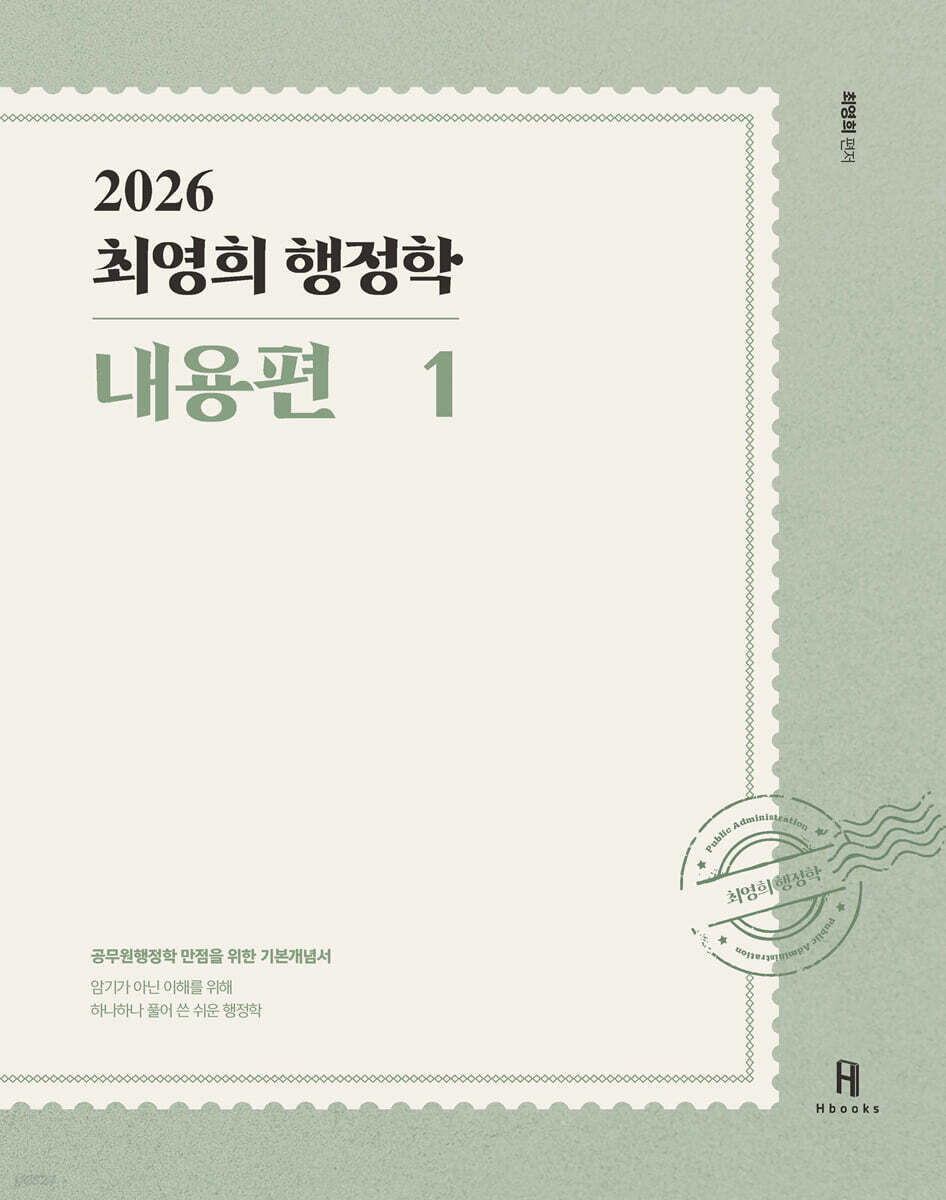
2026 Choi Young-hee Public Administration Contents
 |
Description
Book Introduction
- Basic Concepts for Perfect Score in Civil Service Administration
- Easy administrative studies written step by step for understanding, not memorization
- Easy administrative studies written step by step for understanding, not memorization
- You can preview some of the book's contents.
Preview
index
Volume 1
PART 1: Basic Theories of Public Administration
CHAPTER 1: The Fundamentals of Administration 026
CHAPTER 2 Market Failure and Government Failure 044
CHAPTER 3 Administrative Values 068
CHAPTER 4 Public Administration Theory 082
PART 2 Policy Theory
CHAPTER 1: Foundations of Policy Studies 160
CHAPTER 2 PARTICIPANTS IN THE POLICY PROCESS 172
CHAPTER 3 Policy Agenda Setting 184
CHAPTER 4 POLICY ANALYSIS 194
CHAPTER 5 POLICY DECISIONS 206
CHAPTER 6 POLICY EXECUTIVE 222
CHAPTER 7 Policy Evaluation and Policy Change 236
PART 3 ORGANIZATIONAL THEORY
CHAPTER 1 The Foundations of Organization 286
CHAPTER 2 ORGANIZATIONAL THEORY 316
CHAPTER 3 Government Organizational Structure 360
CHAPTER 4 Organizational Management Theory 384
Volume 2
PART 4 Personnel Administration Theory
CHAPTER 1: The Fundamentals of Personnel Administration 428
CHAPTER 2: CLASSIFICATION OF PUBLIC OFFICES 444
CHAPTER 3 HUMAN RESOURCE MANAGEMENT 468
CHAPTER 4 PERFORMANCE MANAGEMENT 484
CHAPTER 5 Motivation 496
CHAPTER 6 Administrative Ethics and Corruption 514
PART 5 Financial Administration Theory
CHAPTER 1 The Essence of Budgeting 562
CHAPTER 2 Types of Budgets 588
CHAPTER 3 Budget Theory and Budget System 606
CHAPTER 4: THE BUDGETING PROCESS 626
PART 6 Administrative Reflux Theory
CHAPTER 1 Administrative Control and Administrative Participation 690
CHAPTER 2 Government Innovation and E-Government 704
PART 7 Local Autonomy Theory
CHAPTER 1 The Essence of Local Autonomy 738
CHAPTER 2: The System and Structure of Local Governments 752
CHAPTER 3 Relations between the State and Local Governments 782
CHAPTER 4 LOCAL GOVERNMENT FINANCES 800
CHAPTER 5 Local Autonomy and Citizen Participation 820
PART 1: Basic Theories of Public Administration
CHAPTER 1: The Fundamentals of Administration 026
CHAPTER 2 Market Failure and Government Failure 044
CHAPTER 3 Administrative Values 068
CHAPTER 4 Public Administration Theory 082
PART 2 Policy Theory
CHAPTER 1: Foundations of Policy Studies 160
CHAPTER 2 PARTICIPANTS IN THE POLICY PROCESS 172
CHAPTER 3 Policy Agenda Setting 184
CHAPTER 4 POLICY ANALYSIS 194
CHAPTER 5 POLICY DECISIONS 206
CHAPTER 6 POLICY EXECUTIVE 222
CHAPTER 7 Policy Evaluation and Policy Change 236
PART 3 ORGANIZATIONAL THEORY
CHAPTER 1 The Foundations of Organization 286
CHAPTER 2 ORGANIZATIONAL THEORY 316
CHAPTER 3 Government Organizational Structure 360
CHAPTER 4 Organizational Management Theory 384
Volume 2
PART 4 Personnel Administration Theory
CHAPTER 1: The Fundamentals of Personnel Administration 428
CHAPTER 2: CLASSIFICATION OF PUBLIC OFFICES 444
CHAPTER 3 HUMAN RESOURCE MANAGEMENT 468
CHAPTER 4 PERFORMANCE MANAGEMENT 484
CHAPTER 5 Motivation 496
CHAPTER 6 Administrative Ethics and Corruption 514
PART 5 Financial Administration Theory
CHAPTER 1 The Essence of Budgeting 562
CHAPTER 2 Types of Budgets 588
CHAPTER 3 Budget Theory and Budget System 606
CHAPTER 4: THE BUDGETING PROCESS 626
PART 6 Administrative Reflux Theory
CHAPTER 1 Administrative Control and Administrative Participation 690
CHAPTER 2 Government Innovation and E-Government 704
PART 7 Local Autonomy Theory
CHAPTER 1 The Essence of Local Autonomy 738
CHAPTER 2: The System and Structure of Local Governments 752
CHAPTER 3 Relations between the State and Local Governments 782
CHAPTER 4 LOCAL GOVERNMENT FINANCES 800
CHAPTER 5 Local Autonomy and Citizen Participation 820
Publisher's Review
preface
Lectures and textbook writing should be done from the examinee's perspective.
After the civil service examination was recently changed to a common subject + specialized subject system, the exam has clearly changed.
Common subjects have become easier, the passing score has risen, and the importance of specialized subjects has grown.
In fact, it is quite natural that the specialized knowledge required will differ depending on the type of civil servant you wish to become.
Some series, including the general administrative series, require public administration as a specialized subject, so those preparing for these series have no choice but to study public administration.
The problem is that we have never studied public administration, either during our school days or since.
What exactly does public administration entail? How should we prepare for it?
When I started teaching public administration, the first thing I did was to think about how much I should cover.
In the process of finding an answer to this question, I went to graduate school, completed a master's degree, and read most of the public administration textbooks on the market.
Of course, we have analyzed all the past questions from the administrative studies exam (grade 9-7 general administration, National Assembly, police officers, firefighters, military personnel) since 2013.
And there was one thing that really surprised me during that process.
Can someone new to public administration prepare for the exam with just this lecture and book? It's a mess: sentences that are difficult to read even a couple of lines, inconsistently translated terms, duplicate content patched together from various introductory textbooks, and unnecessary topics and theories that don't quite match the exam questions.
When I started taking public administration classes, I established one principle.
The principle is that lectures and textbook writing should be conducted from the examinee's perspective.
For the past several years, I have been developing a curriculum and conducting classes under the name of Choi Young-hee Public Administration.
Many students trusted me and studied with me, and I enjoyed the fruits of my labor in the form of high scores and passing the exam.
And their feedback on my classes was usually similar.
The explanations and examples are easy to understand, the answers to questions are really kind and considerate, I finally learned terms and difficult concepts I didn't know before, the study volume was reduced so I was able to study other subjects, etc.
I did not pass the civil service examination, majored in public administration in college, or have any experience in public service.
However, I studied the contents of public administration more thoroughly than anyone else, and above all, I prepared lectures and textbooks from the perspective of a test taker.
As a result, we were able to help many people study public administration more easily and pass the exam.
The principle I've had since I first published my textbooks has been, "Let's create a textbook that students can study from the perspective of a test taker."
You'll have to study it yourself to really understand, but the general principles are as follows:
First, find and include everything you need to prepare for the exam, even if it's just a little bit.
As mentioned earlier, I analyzed all the past exam questions since 2013.
And I consulted all the basic books on the market, most of the latest introductory books, government policy collections and data collections, and major papers.
I have organized the topics so that one volume can suffice, and have not just roughly selected them.
In addition, we have included enough laws so that you do not have to search for them separately.
In particular, Chapter 4, Personnel Administration, Chapter 5, Financial Administration, and Chapter 7, Local Autonomy, which are important laws, include most of the relevant laws and regulations, and do not omit any revised items.
But I never added unnecessary content just to show off my knowledge.
A test taker's time is truly precious.
I believe that saving it is my most important responsibility.
Second, organize it so that you can understand it even if you read it alone.
We did not patch together expressions and terms from different books and scholars, and we organized complex sentences by unpacking them and replacing them with easier expressions and terms.
To make the content more accessible, we've included additional colloquial explanations in the middle through an element called "Teacher Younghee Talk."
And we've added elements like auxiliary sections, references, and more to differentiate between main content and reference content.
Public administration has no standard expressions or content elements, and many strange translations have emerged as Western theories have passed through Japan.
There are many cases where scholars have different theories, claims, and opinions.
The content itself is difficult, and I also think that we should not place this burden on test takers, as it is difficult for scholars and instructors as well.
But what's best about this book is that it never misses the terms and expressions used in the exam.
Third, it systematizes the vast content of public administration.
I know from experience that understanding the structure of the content and organizing it in your head is a shortcut to effective learning.
To help you grasp the overall flow of public administration, this book has structured the table of contents by chapter and created "Essence Special Lectures" to aid in understanding.
Rather than cramming a lot of knowledge into your head and memorizing it, the intention of this book is to help you organize it systematically, labeling it like files in a drawer, so that you can retrieve it whenever you need it.
Many people's efforts went into making this book.
Director Ryu Jeong-yeol, Director Han Ji-hoon, and Researcher Kim Su-yeon of the Choi Young-hee Public Administration Research Lab, who put their utmost effort and passion into all of their textbook projects; the designers and typesetters at H-Books; and Professor Kim Jeong-hyeon, who helped shape me from my shortcomings into the instructor Choi Young-hee I am today, were with me from the initial planning stages of this book all the way to the very last page.
Thanks to you, I was able to finish the book.
Above all, all of you who believe in me and listen to my lectures are unsung heroes.
I would like to express my deepest gratitude.
Although this book is the result of the hard work of many people, there are regrets due to the limitations of the publication.
I believe that if you take the help of the lectures provided by the institute, you will be able to utilize the textbook much more quickly and effectively.
I can assure you that your efforts will never betray you.
So, please run until the end without getting tired.
So that this time doesn't feel like a waste later.
June 2025
At the Noryangjin Laboratory
Choi Young-hee's dream
Lectures and textbook writing should be done from the examinee's perspective.
After the civil service examination was recently changed to a common subject + specialized subject system, the exam has clearly changed.
Common subjects have become easier, the passing score has risen, and the importance of specialized subjects has grown.
In fact, it is quite natural that the specialized knowledge required will differ depending on the type of civil servant you wish to become.
Some series, including the general administrative series, require public administration as a specialized subject, so those preparing for these series have no choice but to study public administration.
The problem is that we have never studied public administration, either during our school days or since.
What exactly does public administration entail? How should we prepare for it?
When I started teaching public administration, the first thing I did was to think about how much I should cover.
In the process of finding an answer to this question, I went to graduate school, completed a master's degree, and read most of the public administration textbooks on the market.
Of course, we have analyzed all the past questions from the administrative studies exam (grade 9-7 general administration, National Assembly, police officers, firefighters, military personnel) since 2013.
And there was one thing that really surprised me during that process.
Can someone new to public administration prepare for the exam with just this lecture and book? It's a mess: sentences that are difficult to read even a couple of lines, inconsistently translated terms, duplicate content patched together from various introductory textbooks, and unnecessary topics and theories that don't quite match the exam questions.
When I started taking public administration classes, I established one principle.
The principle is that lectures and textbook writing should be conducted from the examinee's perspective.
For the past several years, I have been developing a curriculum and conducting classes under the name of Choi Young-hee Public Administration.
Many students trusted me and studied with me, and I enjoyed the fruits of my labor in the form of high scores and passing the exam.
And their feedback on my classes was usually similar.
The explanations and examples are easy to understand, the answers to questions are really kind and considerate, I finally learned terms and difficult concepts I didn't know before, the study volume was reduced so I was able to study other subjects, etc.
I did not pass the civil service examination, majored in public administration in college, or have any experience in public service.
However, I studied the contents of public administration more thoroughly than anyone else, and above all, I prepared lectures and textbooks from the perspective of a test taker.
As a result, we were able to help many people study public administration more easily and pass the exam.
The principle I've had since I first published my textbooks has been, "Let's create a textbook that students can study from the perspective of a test taker."
You'll have to study it yourself to really understand, but the general principles are as follows:
First, find and include everything you need to prepare for the exam, even if it's just a little bit.
As mentioned earlier, I analyzed all the past exam questions since 2013.
And I consulted all the basic books on the market, most of the latest introductory books, government policy collections and data collections, and major papers.
I have organized the topics so that one volume can suffice, and have not just roughly selected them.
In addition, we have included enough laws so that you do not have to search for them separately.
In particular, Chapter 4, Personnel Administration, Chapter 5, Financial Administration, and Chapter 7, Local Autonomy, which are important laws, include most of the relevant laws and regulations, and do not omit any revised items.
But I never added unnecessary content just to show off my knowledge.
A test taker's time is truly precious.
I believe that saving it is my most important responsibility.
Second, organize it so that you can understand it even if you read it alone.
We did not patch together expressions and terms from different books and scholars, and we organized complex sentences by unpacking them and replacing them with easier expressions and terms.
To make the content more accessible, we've included additional colloquial explanations in the middle through an element called "Teacher Younghee Talk."
And we've added elements like auxiliary sections, references, and more to differentiate between main content and reference content.
Public administration has no standard expressions or content elements, and many strange translations have emerged as Western theories have passed through Japan.
There are many cases where scholars have different theories, claims, and opinions.
The content itself is difficult, and I also think that we should not place this burden on test takers, as it is difficult for scholars and instructors as well.
But what's best about this book is that it never misses the terms and expressions used in the exam.
Third, it systematizes the vast content of public administration.
I know from experience that understanding the structure of the content and organizing it in your head is a shortcut to effective learning.
To help you grasp the overall flow of public administration, this book has structured the table of contents by chapter and created "Essence Special Lectures" to aid in understanding.
Rather than cramming a lot of knowledge into your head and memorizing it, the intention of this book is to help you organize it systematically, labeling it like files in a drawer, so that you can retrieve it whenever you need it.
Many people's efforts went into making this book.
Director Ryu Jeong-yeol, Director Han Ji-hoon, and Researcher Kim Su-yeon of the Choi Young-hee Public Administration Research Lab, who put their utmost effort and passion into all of their textbook projects; the designers and typesetters at H-Books; and Professor Kim Jeong-hyeon, who helped shape me from my shortcomings into the instructor Choi Young-hee I am today, were with me from the initial planning stages of this book all the way to the very last page.
Thanks to you, I was able to finish the book.
Above all, all of you who believe in me and listen to my lectures are unsung heroes.
I would like to express my deepest gratitude.
Although this book is the result of the hard work of many people, there are regrets due to the limitations of the publication.
I believe that if you take the help of the lectures provided by the institute, you will be able to utilize the textbook much more quickly and effectively.
I can assure you that your efforts will never betray you.
So, please run until the end without getting tired.
So that this time doesn't feel like a waste later.
June 2025
At the Noryangjin Laboratory
Choi Young-hee's dream
GOODS SPECIFICS
- Date of issue: July 4, 2025
- Page count, weight, size: 856 pages | 205*260*40mm
- ISBN13: 9791199224971
- ISBN10: 1199224979
You may also like
카테고리
korean


korean

![GQ KOREA Mark (Monthly): December [2025]](http://librairie.coreenne.fr/cdn/shop/files/8ef265dbbfbf186523ed75ba7319009d.jpg?v=1765340328&width=3840)


