

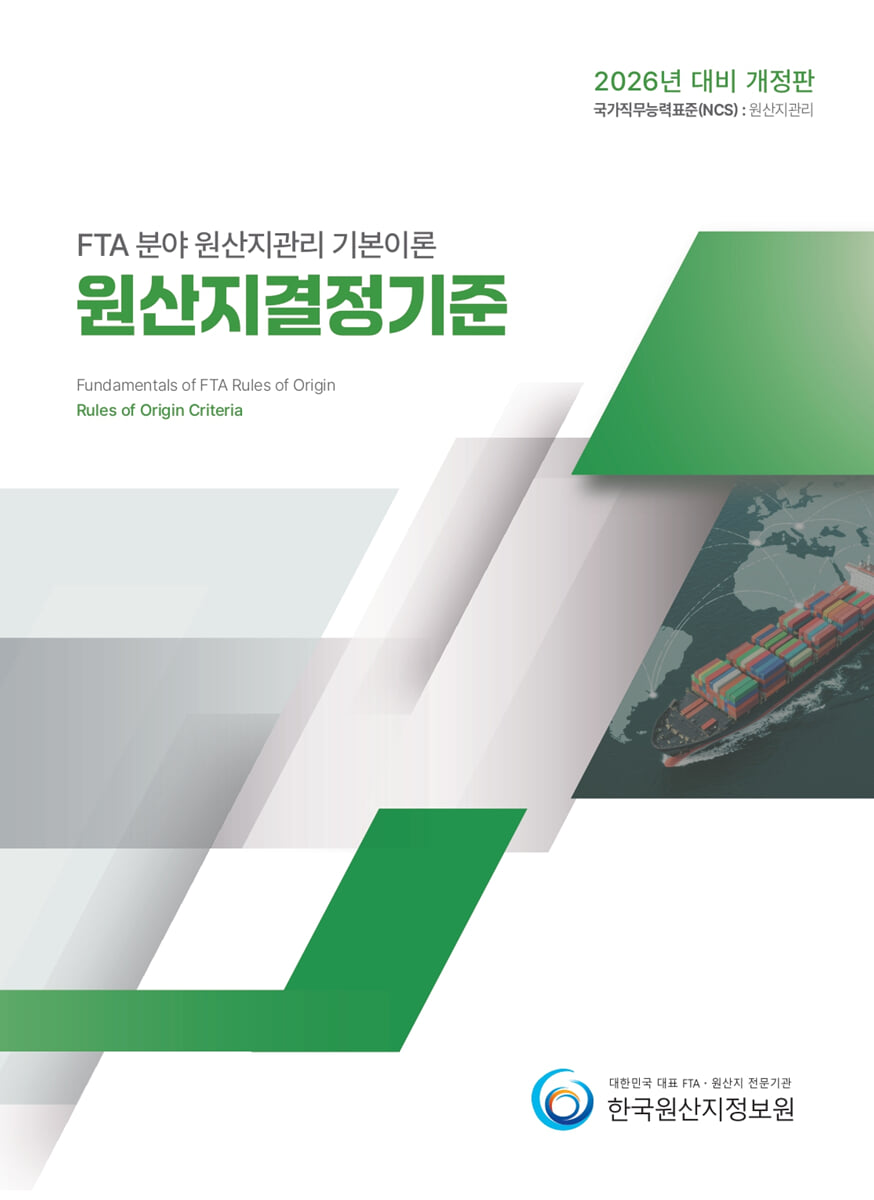
2026 FTA Field Origin Management Basic Theory and Origin Determination Criteria
 |
Description
Book Introduction
This book serves as a basic reference for practice and learning of country of origin management in the FTA field, focusing on the “Criteria for Determining Country of Origin.” It also includes information on FTAs with major advanced economies such as the United States, the EU, and the United Kingdom, as well as the recently enacted RCEP.
The rules of origin are divided into substantive provisions for determining the origin of goods and procedural provisions such as methods for preparing certificates of origin and methods for confirming origin. The content covered in this book deals with substantive provisions, which are the standards for determining the origin of manufactured goods.
The rules of origin are divided into substantive provisions for determining the origin of goods and procedural provisions such as methods for preparing certificates of origin and methods for confirming origin. The content covered in this book deals with substantive provisions, which are the standards for determining the origin of manufactured goods.
index
- Chapter 1 Overview of Rules of Origin
PART 1 THE CONCEPT OF ORIGIN
PART 2 CONCEPTS AND CLASSIFICATION OF RULES OF ORIGIN
PART 3 FUNCTIONS OF RULES OF ORIGIN
PART 4 Our country's rules of origin system
PART 5: Origin Determination Criteria System
- Common standards of Chapter 2 General Rules
Section 1: Wholly obtained or entirely produced
Section 2: Principle of Local Production (Territory Principle)
Section 3: Principle of Sufficient Processing
Section 4 Transportation Requirements
- Chapter 3: Origin Criteria by Product
Section 1 Overview of country of origin standards by product
Section 2 Change in Tariff Classification Criterion
Section 3 Processing Operation Criterion
Section 4 Value-added Standards
- Special standards for Chapter 4 General Rules
Section 1 Cumulative Standards
Section 2 Minimum Acceptable Standards
Section 3 Intermediate goods
Section 4 Fungible Goods
Section 5 Indirect Materials
Section 6 Accessories, spare parts, and tools
Section 7 Retail Packaging and Containers
Section 8 Transportation Packaging and Containers
Section 9 Set Items
Section 10 Reimported Goods
Section 11. Bonded Exhibition Goods from Third Countries
- Appendix
Section 1: How to check the origin determination criteria using the Korea Customs Service FTA Portal
PART 1 THE CONCEPT OF ORIGIN
PART 2 CONCEPTS AND CLASSIFICATION OF RULES OF ORIGIN
PART 3 FUNCTIONS OF RULES OF ORIGIN
PART 4 Our country's rules of origin system
PART 5: Origin Determination Criteria System
- Common standards of Chapter 2 General Rules
Section 1: Wholly obtained or entirely produced
Section 2: Principle of Local Production (Territory Principle)
Section 3: Principle of Sufficient Processing
Section 4 Transportation Requirements
- Chapter 3: Origin Criteria by Product
Section 1 Overview of country of origin standards by product
Section 2 Change in Tariff Classification Criterion
Section 3 Processing Operation Criterion
Section 4 Value-added Standards
- Special standards for Chapter 4 General Rules
Section 1 Cumulative Standards
Section 2 Minimum Acceptable Standards
Section 3 Intermediate goods
Section 4 Fungible Goods
Section 5 Indirect Materials
Section 6 Accessories, spare parts, and tools
Section 7 Retail Packaging and Containers
Section 8 Transportation Packaging and Containers
Section 9 Set Items
Section 10 Reimported Goods
Section 11. Bonded Exhibition Goods from Third Countries
- Appendix
Section 1: How to check the origin determination criteria using the Korea Customs Service FTA Portal
Publisher's Review
Beginning with the FTA with Chile in 2004, our country has concluded FTAs with all three major global economies: the EU, the United States, and China. As a trade environment based on FTAs is rapidly being established, FTA trade is expected to expand further.
Accordingly, this book is based on organizing and explaining the origin determination standards of 59 countries and 22 agreements that Korea has currently concluded and entered into force, in an easy-to-understand manner, by agreement.
In order to utilize FTAs, determining the origin of goods according to the rules of origin of each agreement is the core of utilizing FTAs. Therefore, to help you understand the rules of origin of the agreement well and determine the origin by applying them to the products you produce, the origin determination criteria of the rules of origin are organized into Chapter 1 Rules of Origin, Chapter 2 Common Criteria of General Criteria, Chapter 3 Product-Specific Origin Criteria, Chapter 4 Special Criteria of General Criteria, and Appendix.
Accordingly, this book is based on organizing and explaining the origin determination standards of 59 countries and 22 agreements that Korea has currently concluded and entered into force, in an easy-to-understand manner, by agreement.
In order to utilize FTAs, determining the origin of goods according to the rules of origin of each agreement is the core of utilizing FTAs. Therefore, to help you understand the rules of origin of the agreement well and determine the origin by applying them to the products you produce, the origin determination criteria of the rules of origin are organized into Chapter 1 Rules of Origin, Chapter 2 Common Criteria of General Criteria, Chapter 3 Product-Specific Origin Criteria, Chapter 4 Special Criteria of General Criteria, and Appendix.
GOODS SPECIFICS
- Date of issue: October 1, 2025
- Page count, weight, size: 281 pages | 190*260*20mm
- ISBN13: 9791185815862
- ISBN10: 1185815864
You may also like
카테고리
korean


korean

![GQ KOREA Mark (Monthly): December [2025]](http://librairie.coreenne.fr/cdn/shop/files/8ef265dbbfbf186523ed75ba7319009d.jpg?v=1765340328&width=3840)


