

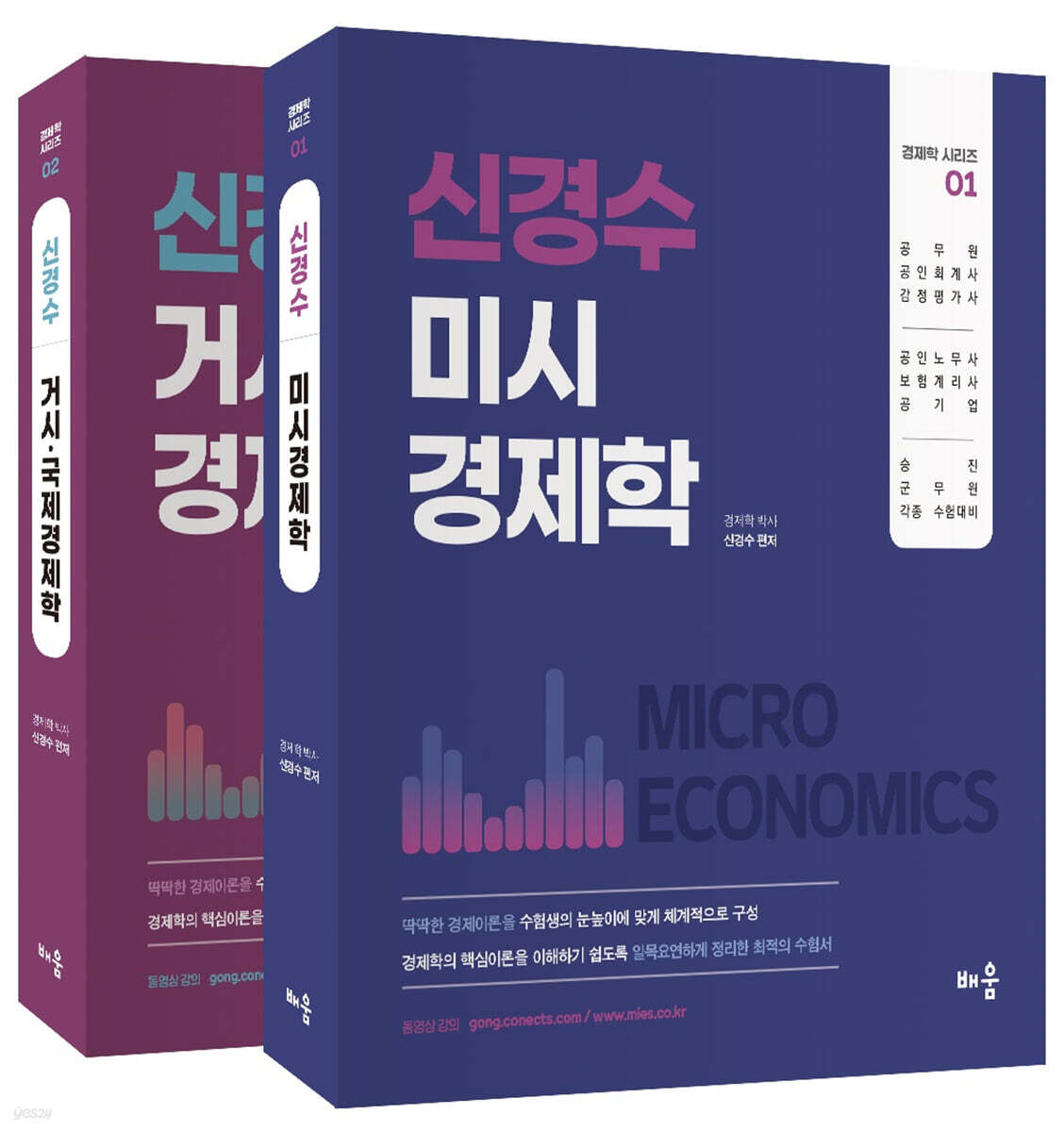
Shin Kyeong-soo's Micro/Macro/International Economics Set
 |
Description
Book Introduction
Systematically organizes rigid economic theories to suit the level of test takers.
The best study guide that clearly organizes the core theories of economics for easy understanding.
This book consists of two volumes: Microeconomics and Macroeconomics/International Economics. In the two volumes, I wrote a separate section titled Introduction to Economics, which summarizes only the basic theories of economics.
And this book was written for students preparing for civil service exams, certified public accountants, real estate appraisers, certified labor attorneys, insurance actuaries, various public corporations, and promotion exams.
We also made every effort to ensure that it is not insufficient as a university textbook for economics students taking economics classes at school.
The best study guide that clearly organizes the core theories of economics for easy understanding.
This book consists of two volumes: Microeconomics and Macroeconomics/International Economics. In the two volumes, I wrote a separate section titled Introduction to Economics, which summarizes only the basic theories of economics.
And this book was written for students preparing for civil service exams, certified public accountants, real estate appraisers, certified labor attorneys, insurance actuaries, various public corporations, and promotion exams.
We also made every effort to ensure that it is not insufficient as a university textbook for economics students taking economics classes at school.
index
Microeconomics
Part 01.
Fundamentals of Economics
CHAPTER 01.
An Overview of Economics
CHAPTER 02.
The essence of economics
Part 02.
Theory of Supply and Demand
CHAPTER 03.
supply and demand
CHAPTER 04.
Elasticity of supply and demand
CHAPTER 05.
Application of supply and demand theory
Part 03.
consumer theory
CHAPTER 06.
Overview of Consumer Theory
CHAPTER 07.
marginal utility theory
CHAPTER 08.
Indifference curve theory
CHAPTER 09.
Present Preference Theory
CHAPTER 10.
Application of consumer theory
CHAPTER 11.
Expected utility theory
Part 04.
producer theory
CHAPTER 12.
production function theory
CHAPTER 13.
Cost function theory
CHAPTER 14.
Profit maximization
Part 05.
Product Market Theory
CHAPTER 15.
perfectly competitive market
CHAPTER 16.
monopoly market
CHAPTER 17.
monopolistic competitive market
CHAPTER 18.
oligopoly market
CHAPTER 19.
Game theory
Part 06.
Factor Markets and Income Distribution
CHAPTER 20.
Profit maximization in the factor markets
CHAPTER 21.
Factors of production market theory
CHAPTER 22.
Income distribution theory
Part 07.
General equilibrium theory and welfare economics
CHAPTER 23.
General equilibrium theory
CHAPTER 24.
Welfare economics
Part 08.
Public Economics and Information Economics
CHAPTER 25.
market failure
CHAPTER 26.
public choice theory
CHAPTER 27.
Information Economics
CHAPTER 28.
behavioral economics
** Index
[Macroeconomics]
Part 01.
Fundamentals of Macroeconomics
CHAPTER 01.
The World of Macroeconomics
CHAPTER 02.
Measurement of national income
Part 02.
National Income Determination Theory
CHAPTER 03.
Classical theory of national income determination
CHAPTER 04.
Keynes (J.
M. Keynes's theory of national income determination
CHAPTER 05.
Keynes (J.
M. Keynes's multiplier theory
Part 03.
Consumption function and investment function
CHAPTER 06.
Consumption function theory
CHAPTER 07.
Investment function theory
Part 04.
Monetary and Financial Theory
CHAPTER 08.
Currency and Finance
CHAPTER 09.
Money supply theory
CHAPTER 10.
Theory of Money Demand
CHAPTER 11.
Equilibrium in the money market and monetary policy
Part 05.
Aggregate demand-aggregate supply theory
CHAPTER 12. IS-LM MODEL
CHAPTER 13.
Fiscal and monetary policy
CHAPTER 14.
Aggregate demand-aggregate supply model
Part 06.
Unemployment and inflation
CHAPTER 15.
Real estate
CHAPTER 16.
inflation
CHAPTER 17.
Phillips curve theory
Part 07.
Macroeconomics theories by school of thought
CHAPTER 18.
Classical school and Keynes (J.
M. Keynes)
CHAPTER 19.
Keynesian and monetarist schools
CHAPTER 20.
New Classical School and New Keynesian School
CHAPTER 21.
supply-side economics
Part 08.
Dynamic economic theory
CHAPTER 22.
Business cycle theory
CHAPTER 23.
economic growth theory
CHAPTER 24.
Economic development theory
[International Economics]
Part 01.
International Trade Theory
CHAPTER 01.
International Trade Theory
CHAPTER 02.
Trade Policy Theory
Part 02.
International Finance Theory
CHAPTER 03.
Foreign Exchange Market Theory
CHAPTER 04.
Balance of Payments
** Index
Part 01.
Fundamentals of Economics
CHAPTER 01.
An Overview of Economics
CHAPTER 02.
The essence of economics
Part 02.
Theory of Supply and Demand
CHAPTER 03.
supply and demand
CHAPTER 04.
Elasticity of supply and demand
CHAPTER 05.
Application of supply and demand theory
Part 03.
consumer theory
CHAPTER 06.
Overview of Consumer Theory
CHAPTER 07.
marginal utility theory
CHAPTER 08.
Indifference curve theory
CHAPTER 09.
Present Preference Theory
CHAPTER 10.
Application of consumer theory
CHAPTER 11.
Expected utility theory
Part 04.
producer theory
CHAPTER 12.
production function theory
CHAPTER 13.
Cost function theory
CHAPTER 14.
Profit maximization
Part 05.
Product Market Theory
CHAPTER 15.
perfectly competitive market
CHAPTER 16.
monopoly market
CHAPTER 17.
monopolistic competitive market
CHAPTER 18.
oligopoly market
CHAPTER 19.
Game theory
Part 06.
Factor Markets and Income Distribution
CHAPTER 20.
Profit maximization in the factor markets
CHAPTER 21.
Factors of production market theory
CHAPTER 22.
Income distribution theory
Part 07.
General equilibrium theory and welfare economics
CHAPTER 23.
General equilibrium theory
CHAPTER 24.
Welfare economics
Part 08.
Public Economics and Information Economics
CHAPTER 25.
market failure
CHAPTER 26.
public choice theory
CHAPTER 27.
Information Economics
CHAPTER 28.
behavioral economics
** Index
[Macroeconomics]
Part 01.
Fundamentals of Macroeconomics
CHAPTER 01.
The World of Macroeconomics
CHAPTER 02.
Measurement of national income
Part 02.
National Income Determination Theory
CHAPTER 03.
Classical theory of national income determination
CHAPTER 04.
Keynes (J.
M. Keynes's theory of national income determination
CHAPTER 05.
Keynes (J.
M. Keynes's multiplier theory
Part 03.
Consumption function and investment function
CHAPTER 06.
Consumption function theory
CHAPTER 07.
Investment function theory
Part 04.
Monetary and Financial Theory
CHAPTER 08.
Currency and Finance
CHAPTER 09.
Money supply theory
CHAPTER 10.
Theory of Money Demand
CHAPTER 11.
Equilibrium in the money market and monetary policy
Part 05.
Aggregate demand-aggregate supply theory
CHAPTER 12. IS-LM MODEL
CHAPTER 13.
Fiscal and monetary policy
CHAPTER 14.
Aggregate demand-aggregate supply model
Part 06.
Unemployment and inflation
CHAPTER 15.
Real estate
CHAPTER 16.
inflation
CHAPTER 17.
Phillips curve theory
Part 07.
Macroeconomics theories by school of thought
CHAPTER 18.
Classical school and Keynes (J.
M. Keynes)
CHAPTER 19.
Keynesian and monetarist schools
CHAPTER 20.
New Classical School and New Keynesian School
CHAPTER 21.
supply-side economics
Part 08.
Dynamic economic theory
CHAPTER 22.
Business cycle theory
CHAPTER 23.
economic growth theory
CHAPTER 24.
Economic development theory
[International Economics]
Part 01.
International Trade Theory
CHAPTER 01.
International Trade Theory
CHAPTER 02.
Trade Policy Theory
Part 02.
International Finance Theory
CHAPTER 03.
Foreign Exchange Market Theory
CHAPTER 04.
Balance of Payments
** Index
Publisher's Review
Systematically organizes rigid economic theories to suit the level of test takers.
The best study guide that clearly organizes the core theories of economics for easy understanding.
* Video lecture gong.conects.com
Based on the latest trends in various economics exam questions, I have tried to include rich and novel content so that readers can judge for themselves how economic theory is applied and turned into exam questions. Also, keeping in mind that this book would be meaningless without readers, the author has put in all his effort to write the book by standing on the reader's side with the mindset of becoming a reader himself.
Nevertheless, as an author, I cannot help but point out that there are still many shortcomings.
As with all authors, publishing a book was never an easy task.
For years, I'd barely slept, stayed up all night writing books, and never felt tired. And despite the few temptations to put the book down, it was the presence of so many potential readers that drew me back to the computer.
The passion of countless test-takers and students, their trust in the author, and their loving gazes were a great stimulus to me, and it goes without saying that they were the catalyst for this book to see the light of day.
It is made clear that this book is solely for the readers.
The great hope and confidence I had when I first decided to write a book never faded as the book progressed, but now that I have actually published it, I feel incredibly embarrassed.
Despite the author's meticulous nature, which does not forgive even the slightest error, it is expected that many errors will be discovered.
I promise to continue to revise this with the help of readers who are more attentive than I am.
This book consists of two volumes: Microeconomics and Macroeconomics/International Economics. In the two volumes, I wrote a separate section titled Introduction to Economics, which summarizes only the basic theories of economics.
And this book was written for students preparing for civil service exams, certified public accountants, real estate appraisers, certified labor attorneys, insurance actuaries, various public corporations, and promotion exams.
We also made every effort to ensure that it is not insufficient as a university textbook for economics students taking economics classes at school.
Despite its many shortcomings, this book has many strengths of its own.
1.
Most economics textbooks are written in a complex, abstract, and general style, making it difficult to acquire theoretical content.
Taking these points into account, the author has made every effort to make sentences as clear and concise as possible so that even beginners can easily understand the content.
2.
To help students focus on their exam preparation, we bolded and colored the parts that were frequently tested on exams or were considered theoretically important.
3.
Formulas and key contents required for economic theory are boxed for easy understanding.
4.
Economics is a discipline that studies numerous economic phenomena occurring in society using a scientific approach, so the overall story is logically connected.
Therefore, when studying economics, it is important for readers to find the overall context rather than understanding individual theories separately.
To this end, by mentioning in the text how each individual theory is connected to other theories, readers can understand the relationships between economic theories.
5.
To provide readers with the opportunity to test their own skills after studying economic theory, the book includes past exam questions and expected questions.
Including more past exam questions in the main text of this book would make it too thick, and with new past exam questions coming out every year, it would be difficult to revise them constantly, so only the most necessary questions have been included.
Readers who wish to experience more past exam questions can refer to "Integrated Objective Economics," written by this author.
6.
Additional information that is unnecessary in the main text but needs to be added to the explanation of economic theory is included in the ‘References’.
7.
Although this may be difficult for beginners in economics, it is essential for students majoring in economics or considering graduate school to know the material, which is covered separately in "In-Depth Analysis," so students who are new to this book can skip over it without any problems.
8.
In cases where a comparative analysis of the overall plot and theories of each chapter is absolutely necessary, this is organized into a table for easy understanding at a glance and included as an appendix at the end of the chapter.
I am confident that this will be of great help in grasping the overall theoretical system even with a small investment of time.
The best study guide that clearly organizes the core theories of economics for easy understanding.
* Video lecture gong.conects.com
Based on the latest trends in various economics exam questions, I have tried to include rich and novel content so that readers can judge for themselves how economic theory is applied and turned into exam questions. Also, keeping in mind that this book would be meaningless without readers, the author has put in all his effort to write the book by standing on the reader's side with the mindset of becoming a reader himself.
Nevertheless, as an author, I cannot help but point out that there are still many shortcomings.
As with all authors, publishing a book was never an easy task.
For years, I'd barely slept, stayed up all night writing books, and never felt tired. And despite the few temptations to put the book down, it was the presence of so many potential readers that drew me back to the computer.
The passion of countless test-takers and students, their trust in the author, and their loving gazes were a great stimulus to me, and it goes without saying that they were the catalyst for this book to see the light of day.
It is made clear that this book is solely for the readers.
The great hope and confidence I had when I first decided to write a book never faded as the book progressed, but now that I have actually published it, I feel incredibly embarrassed.
Despite the author's meticulous nature, which does not forgive even the slightest error, it is expected that many errors will be discovered.
I promise to continue to revise this with the help of readers who are more attentive than I am.
This book consists of two volumes: Microeconomics and Macroeconomics/International Economics. In the two volumes, I wrote a separate section titled Introduction to Economics, which summarizes only the basic theories of economics.
And this book was written for students preparing for civil service exams, certified public accountants, real estate appraisers, certified labor attorneys, insurance actuaries, various public corporations, and promotion exams.
We also made every effort to ensure that it is not insufficient as a university textbook for economics students taking economics classes at school.
Despite its many shortcomings, this book has many strengths of its own.
1.
Most economics textbooks are written in a complex, abstract, and general style, making it difficult to acquire theoretical content.
Taking these points into account, the author has made every effort to make sentences as clear and concise as possible so that even beginners can easily understand the content.
2.
To help students focus on their exam preparation, we bolded and colored the parts that were frequently tested on exams or were considered theoretically important.
3.
Formulas and key contents required for economic theory are boxed for easy understanding.
4.
Economics is a discipline that studies numerous economic phenomena occurring in society using a scientific approach, so the overall story is logically connected.
Therefore, when studying economics, it is important for readers to find the overall context rather than understanding individual theories separately.
To this end, by mentioning in the text how each individual theory is connected to other theories, readers can understand the relationships between economic theories.
5.
To provide readers with the opportunity to test their own skills after studying economic theory, the book includes past exam questions and expected questions.
Including more past exam questions in the main text of this book would make it too thick, and with new past exam questions coming out every year, it would be difficult to revise them constantly, so only the most necessary questions have been included.
Readers who wish to experience more past exam questions can refer to "Integrated Objective Economics," written by this author.
6.
Additional information that is unnecessary in the main text but needs to be added to the explanation of economic theory is included in the ‘References’.
7.
Although this may be difficult for beginners in economics, it is essential for students majoring in economics or considering graduate school to know the material, which is covered separately in "In-Depth Analysis," so students who are new to this book can skip over it without any problems.
8.
In cases where a comparative analysis of the overall plot and theories of each chapter is absolutely necessary, this is organized into a table for easy understanding at a glance and included as an appendix at the end of the chapter.
I am confident that this will be of great help in grasping the overall theoretical system even with a small investment of time.
GOODS SPECIFICS
- Date of issue: January 14, 2025
- Page count, weight, size: 1,552 pages | 210*260*80mm
- ISBN13: 9791194002949
- ISBN10: 1194002943
You may also like
카테고리
korean


korean

![GQ KOREA Mark (Monthly): December [2025]](http://librairie.coreenne.fr/cdn/shop/files/8ef265dbbfbf186523ed75ba7319009d.jpg?v=1765340328&width=3840)


