

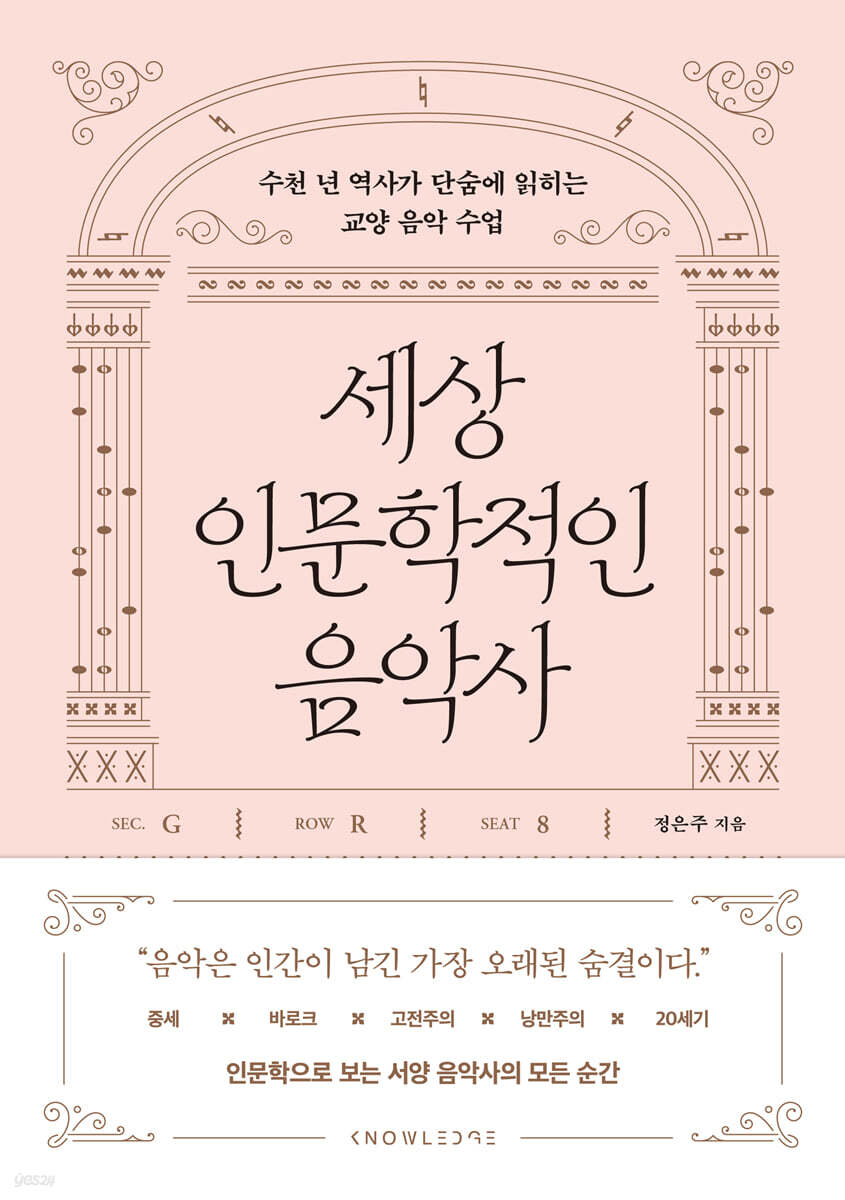
The humanistic history of music in the world
 |
Description
Book Introduction
“It is a comprehensive art form that weaves together thousands of years of Western civilization into a single melody!”
The most friendly music history that reads the era and sound as living history.
Music is the first art created by humans.
From the signals that primitive humans used to shout for survival to the ancient Greeks' attempts to explain the order of the universe through musical scales, sound has always moved alongside the human worldview.
However, when we talk about the history of music, we still only think of the changes in style and great composers, such as “Renaissance was like this, Romanticism was like that,” and we do not ask the question of why music was created that way.
《A Humanistic History of Music》 begins with that question.
Rather than viewing music as merely a branch of art, it shows that behind the moment when music and sound were born, the vast structures of the times, including politics, science, philosophy, religion, and economics, were at work.
Music is never a product of independent emotions, but rather a civilization that most quickly and honestly records the spirit of the times.
This book does not simply explain a specific era in a long, drawn-out manner.
The book follows the principles of music that evolved along with civilization, suggesting that as the way humans understand the world changes, so too does music, allowing readers to read the history of Western music in one sitting.
Rather than fragmentary knowledge that only distinguishes eras, it connects music with humanistic insight into “what kind of world did people live in during that era?”
In the Middle Ages, Hildegard of Hibon composed original hymns in an era when women's activities were strictly restricted.
It was born out of the conflict between the church power structure and mystical theology at the time.
The fact that the 'love' sung by the troubadours was in fact a political code to maintain the order of feudal power, and that the mathematical structure of Notre Dame Cathedral played a decisive role in the birth of polyphonic music, also show that music was not viewed simply as art.
As times change, so does music.
In other words, if you know music, you can see through that era.
It's okay if you don't know much about classical music.
You will come to realize that music up to now is no longer just background music, but the clearest record left to mankind.
The most friendly music history that reads the era and sound as living history.
Music is the first art created by humans.
From the signals that primitive humans used to shout for survival to the ancient Greeks' attempts to explain the order of the universe through musical scales, sound has always moved alongside the human worldview.
However, when we talk about the history of music, we still only think of the changes in style and great composers, such as “Renaissance was like this, Romanticism was like that,” and we do not ask the question of why music was created that way.
《A Humanistic History of Music》 begins with that question.
Rather than viewing music as merely a branch of art, it shows that behind the moment when music and sound were born, the vast structures of the times, including politics, science, philosophy, religion, and economics, were at work.
Music is never a product of independent emotions, but rather a civilization that most quickly and honestly records the spirit of the times.
This book does not simply explain a specific era in a long, drawn-out manner.
The book follows the principles of music that evolved along with civilization, suggesting that as the way humans understand the world changes, so too does music, allowing readers to read the history of Western music in one sitting.
Rather than fragmentary knowledge that only distinguishes eras, it connects music with humanistic insight into “what kind of world did people live in during that era?”
In the Middle Ages, Hildegard of Hibon composed original hymns in an era when women's activities were strictly restricted.
It was born out of the conflict between the church power structure and mystical theology at the time.
The fact that the 'love' sung by the troubadours was in fact a political code to maintain the order of feudal power, and that the mathematical structure of Notre Dame Cathedral played a decisive role in the birth of polyphonic music, also show that music was not viewed simply as art.
As times change, so does music.
In other words, if you know music, you can see through that era.
It's okay if you don't know much about classical music.
You will come to realize that music up to now is no longer just background music, but the clearest record left to mankind.
- You can preview some of the book's contents.
Preview
index
prolog
Chapter 1.
The world's first music that you can only imagine
What kind of songs did Homo sapiens sing?
From Babylonia, Egypt and ancient Greece
Musical Conclusions from Archaeology
Chapter 2.
Such a mysterious sound, medieval music
Saint Hildegard of Bingen
I know nothing but love, troubadours and trouvères
Like Notre Dame Cathedral! The 13th-century Ars Antiqua
The New Age of Beauty, Ars Nova in the 14th Century
Chapter 3.
Italian and European Renaissance music
The Renaissance Trio: Dufay, Ockegem, and Palestrina
The development of sheet music for everyone
chorus of instruments
Study Humanism for Me
Martin Luther and the Reformation
Chapter 4.
The Crystal of Patience, Baroque Music
The Baroque Quartet: Pachelbel, Vivaldi, Bach, and Handel
The Sun King rules the world through music
Even if you don't know how to write, you know how to write!
A look inside the Violin Workshop in Cremona
The originator of the Grand Tour, the British artist scout
Chapter 5.
Explosive! Innovative! Classical music
The Classical Triumvirate: Haydn, Mozart, and Beethoven
The Highlight of Classicism: The Birth of the Symphony
The Relationship Between Literature and Music: Goethe and Musicians
Publishing Classical Era Sheet Music
The emergence of public concerts: 18th-century concert scenes
The Strange Story of Haydn and Beethoven
Chapter 6.
Romantic music
The Romantic Four: Schubert, Schumann, Chopin, and Brahms
The most successful artistic revival policy in Rome
Romantic sisters' hip place, Salon
For female musicians
The Romantic Era Fueled by London's Piano Trade
My art of my choice
Chapter 7.
20th century music
The American Conservatory of Fontainebleau, a music school for Americans in France
The Framework of a 20th-Century Classical Concert: Conductor, Baton, and Podium
A new music invented by Edison
The devilish Russian musicians
White Supremacy and Black Beethoven
Freedom to work wherever I want
Chapter 8.
Classical music today
Classical music performed by Hammerprice
Stunning Women on the Podium
From January to December, classical music concerts are held every day.
The latest story about the concours
AI Musician and Beethoven's Symphony No. 10
Survival Strategies for 21st Century Classical Music
Epilogue
References
Chapter 1.
The world's first music that you can only imagine
What kind of songs did Homo sapiens sing?
From Babylonia, Egypt and ancient Greece
Musical Conclusions from Archaeology
Chapter 2.
Such a mysterious sound, medieval music
Saint Hildegard of Bingen
I know nothing but love, troubadours and trouvères
Like Notre Dame Cathedral! The 13th-century Ars Antiqua
The New Age of Beauty, Ars Nova in the 14th Century
Chapter 3.
Italian and European Renaissance music
The Renaissance Trio: Dufay, Ockegem, and Palestrina
The development of sheet music for everyone
chorus of instruments
Study Humanism for Me
Martin Luther and the Reformation
Chapter 4.
The Crystal of Patience, Baroque Music
The Baroque Quartet: Pachelbel, Vivaldi, Bach, and Handel
The Sun King rules the world through music
Even if you don't know how to write, you know how to write!
A look inside the Violin Workshop in Cremona
The originator of the Grand Tour, the British artist scout
Chapter 5.
Explosive! Innovative! Classical music
The Classical Triumvirate: Haydn, Mozart, and Beethoven
The Highlight of Classicism: The Birth of the Symphony
The Relationship Between Literature and Music: Goethe and Musicians
Publishing Classical Era Sheet Music
The emergence of public concerts: 18th-century concert scenes
The Strange Story of Haydn and Beethoven
Chapter 6.
Romantic music
The Romantic Four: Schubert, Schumann, Chopin, and Brahms
The most successful artistic revival policy in Rome
Romantic sisters' hip place, Salon
For female musicians
The Romantic Era Fueled by London's Piano Trade
My art of my choice
Chapter 7.
20th century music
The American Conservatory of Fontainebleau, a music school for Americans in France
The Framework of a 20th-Century Classical Concert: Conductor, Baton, and Podium
A new music invented by Edison
The devilish Russian musicians
White Supremacy and Black Beethoven
Freedom to work wherever I want
Chapter 8.
Classical music today
Classical music performed by Hammerprice
Stunning Women on the Podium
From January to December, classical music concerts are held every day.
The latest story about the concours
AI Musician and Beethoven's Symphony No. 10
Survival Strategies for 21st Century Classical Music
Epilogue
References
Detailed image

Into the book
The ancient Greeks were as faithful record-keepers as the Babylonians or Egyptians.
Thanks to this, we can read today about the thoughts of the Greek people of that time about music.
To them, music was both art and mathematics, a science connected to astronomy.
Furthermore, they added philosophical thoughts about music's place in the universe, its influence, and its social uses.
You can see the thoughts of contemporary philosophers on music in works such as 『Republic』 written by Plato and 『Politics』 written by his disciple Aristotle.
--- p.24, from “Babylonia, Egypt, and Ancient Greece”
The 13th century, which can be seen as the golden age of Ars Antiqua, is the time when polyphonic music began to flourish in earnest.
It was the time when the journey to break away from the monotony of the melody and find the beauty of Mars began in earnest.
Especially during the century or so since construction of Notre Dame Cathedral began in Paris, France in 1163, the musicians of the time also created a musical style that was equally magnificent, grandiose, and grandiose.
We call them the 'Notre Dame School'.
At the time, musicians added new parts to the existing monophonic Gregorian chant to create decorative and ornate organum, an early form of polyphonic music.
The polyphonic music born in this way led to a gradual evolution that overcame medieval traditions and led to the musical idiom of the next era.
Among the recorded polyphonic music surviving today, this period is considered the most important turning point.
--- p.45, from "Like Notre Dame Cathedral! 13th-Century Ars Antiqua"
The mass production of sheet music brought competition to the market, and the beneficiaries were ultimately the general public who wanted to listen to and play music.
Thanks to the printing press, music was no longer the exclusive domain of a select few, but rather a commodity for everyone.
By the end of the Renaissance, musical scores printed with letterpress were being published in Rome, Nuremberg, Lyon, Louvain, London, Venice, and Paris.
However, the church's hymnals still adhered to the handwritten method.
Nonetheless, the invention of printing deserves to be remembered as an event that broadened and deepened the history of Western music.
--- p.75, from “Development of Musical Notation Printing for Everyone”
One of the great characteristics of the Baroque era was the invention of opera.
Of course, it is not that there were no works in previous times that played a role similar to opera.
If we look at just the two core elements that make up opera, drama and song, we can trace the roots of opera back to ancient Greek theater.
Medieval hymns praising God and Renaissance vocal works were all on the journey to opera.
The work of Sister Hildegard of Bingen, which we looked at in Chapter 2, can also be seen as a form that serves as the basis for opera.
William Shakespeare's plays also provided important clues to the birth of opera.
--- p.120, from “I don’t know the text, but I know the opera!”
The symphony can be said to be a genre that encapsulates the essence of Western music history.
Of course, other musical forms have also produced countless outstanding works, but few genres bring together as many diverse musical elements as the symphony.
In Korean, it is called 'symphony', but it is more commonly called 'symphony'.
The word's etymology, which originated from ancient Greek and French, means harmony, togetherness, and diversity.
The harmony of many instruments coming together to create a single piece of music is the essence of a symphony.
--- p.163, from “Highlights of Classicism, The Birth of the Symphony”
The German songbook published in Germany in the late 18th century became so popular that by the early 19th century, more than 100 copies were being sold per month.
At that time, song was a new and popular genre in Europe.
This trend was greatly influenced by poetry that was popular among the middle class and contemporary citizens.
This is because the art of singing songs by adding beautiful melodies to verses of poetry has become more abundant along with the development of poetry literature.
Especially during this period, there was a tendency to compose songs based on poems in the form of a series containing the story's introduction, development, turn, and conclusion.
The beginning can be found in Beethoven's "To a Distant Beloved" composed in 1816.
The later musician Robert Schumann also loved this piece very much.
He even showed his deep affection for this piece by citing its themes in his own works, “Fantasia in C major” and “String Quartet No. 2.”
Thanks to this, we can read today about the thoughts of the Greek people of that time about music.
To them, music was both art and mathematics, a science connected to astronomy.
Furthermore, they added philosophical thoughts about music's place in the universe, its influence, and its social uses.
You can see the thoughts of contemporary philosophers on music in works such as 『Republic』 written by Plato and 『Politics』 written by his disciple Aristotle.
--- p.24, from “Babylonia, Egypt, and Ancient Greece”
The 13th century, which can be seen as the golden age of Ars Antiqua, is the time when polyphonic music began to flourish in earnest.
It was the time when the journey to break away from the monotony of the melody and find the beauty of Mars began in earnest.
Especially during the century or so since construction of Notre Dame Cathedral began in Paris, France in 1163, the musicians of the time also created a musical style that was equally magnificent, grandiose, and grandiose.
We call them the 'Notre Dame School'.
At the time, musicians added new parts to the existing monophonic Gregorian chant to create decorative and ornate organum, an early form of polyphonic music.
The polyphonic music born in this way led to a gradual evolution that overcame medieval traditions and led to the musical idiom of the next era.
Among the recorded polyphonic music surviving today, this period is considered the most important turning point.
--- p.45, from "Like Notre Dame Cathedral! 13th-Century Ars Antiqua"
The mass production of sheet music brought competition to the market, and the beneficiaries were ultimately the general public who wanted to listen to and play music.
Thanks to the printing press, music was no longer the exclusive domain of a select few, but rather a commodity for everyone.
By the end of the Renaissance, musical scores printed with letterpress were being published in Rome, Nuremberg, Lyon, Louvain, London, Venice, and Paris.
However, the church's hymnals still adhered to the handwritten method.
Nonetheless, the invention of printing deserves to be remembered as an event that broadened and deepened the history of Western music.
--- p.75, from “Development of Musical Notation Printing for Everyone”
One of the great characteristics of the Baroque era was the invention of opera.
Of course, it is not that there were no works in previous times that played a role similar to opera.
If we look at just the two core elements that make up opera, drama and song, we can trace the roots of opera back to ancient Greek theater.
Medieval hymns praising God and Renaissance vocal works were all on the journey to opera.
The work of Sister Hildegard of Bingen, which we looked at in Chapter 2, can also be seen as a form that serves as the basis for opera.
William Shakespeare's plays also provided important clues to the birth of opera.
--- p.120, from “I don’t know the text, but I know the opera!”
The symphony can be said to be a genre that encapsulates the essence of Western music history.
Of course, other musical forms have also produced countless outstanding works, but few genres bring together as many diverse musical elements as the symphony.
In Korean, it is called 'symphony', but it is more commonly called 'symphony'.
The word's etymology, which originated from ancient Greek and French, means harmony, togetherness, and diversity.
The harmony of many instruments coming together to create a single piece of music is the essence of a symphony.
--- p.163, from “Highlights of Classicism, The Birth of the Symphony”
The German songbook published in Germany in the late 18th century became so popular that by the early 19th century, more than 100 copies were being sold per month.
At that time, song was a new and popular genre in Europe.
This trend was greatly influenced by poetry that was popular among the middle class and contemporary citizens.
This is because the art of singing songs by adding beautiful melodies to verses of poetry has become more abundant along with the development of poetry literature.
Especially during this period, there was a tendency to compose songs based on poems in the form of a series containing the story's introduction, development, turn, and conclusion.
The beginning can be found in Beethoven's "To a Distant Beloved" composed in 1816.
The later musician Robert Schumann also loved this piece very much.
He even showed his deep affection for this piece by citing its themes in his own works, “Fantasia in C major” and “String Quartet No. 2.”
--- p.198~199, from “The Romantic Four: Schubert, Schumann, Chopin, Brahms”
Publisher's Review
The most important question in music history that we have been missing,
The untold story of Western music history not told in textbooks
When we study music history, we have only heard things like, “This era had this style” or “This era had this type of composer.”
But no one tells us in detail why that person created that kind of music, what happened during that time, or in what environment the music was born.
This book does not view genius musicians simply as genius artists.
It delves into the social, political, technological, economic, and professional environments surrounding the great musicians of the era and how they influenced their music.
In the Middle Ages, only the church could read and write, so all music was created within the church.
In it, a female composer named Hildegard created her own unique hymns at a time when women's activities were strictly restricted.
We can learn specifically about the environment in which she worked and how Hildegard's music differed from other music.
During the Renaissance, printing technology developed and the social and economic situation changed significantly.
It used to take several days to copy a single sheet of music, but with the development of printing technology, it became possible to mass-produce music scores.
Composers like Dufay and Palestrina were able to spread their music to many countries, and thus the profession of composer began to take root for the first time.
During the Classical period, as cities grew and people began to enjoy leisure time, the cultural institution of public concerts emerged.
Until then, music was considered the property of the nobility, but with the advent of public concerts, anyone could see a performance if they paid the money.
Thanks to this environment, the three representative figures of Classicism, Haydn, Mozart, and Beethoven, were able to create forms such as symphonies and sonatas and engage in popular activities.
In this way, this book shows musicians not as geniuses born on their own, but as professionals who seized new opportunities amidst the changing society of the time.
A liberal arts music course that explains for the first time “why this kind of music came into being”
A three-dimensional reading of Western music history that even those who don't know music can easily learn.
《A Humanistic History of Music》 goes beyond simply explaining the history of Western music with simple knowledge, but shows in detail the environments in which musicians lived and how those environments gave birth to music.
The reality that Hildegard was only allowed to compose within the monastery, the clergy-centered rules, and the church structure that monopolized Latin clearly show why it was difficult for women to engage in musical activities during the Middle Ages.
This specificity allows the reader to feel as if they lived through the period, rather than just knowing the background information.
For those who have consistently studied music history, this book fills in the missing links, and for those who are new to music history, it presents a new standard for how music history should be read.
You can read people's lives through music.
This is because it convincingly shows through historical events of each era that the times create people and that people leave behind music.
In other words, it is a record that contains the worries and changes of the times in which people lived.
For readers who love music, it will provide the joy of learning the context of their favorite works, and for readers unfamiliar with music, it will open a new door to understanding Western history.
The untold story of Western music history not told in textbooks
When we study music history, we have only heard things like, “This era had this style” or “This era had this type of composer.”
But no one tells us in detail why that person created that kind of music, what happened during that time, or in what environment the music was born.
This book does not view genius musicians simply as genius artists.
It delves into the social, political, technological, economic, and professional environments surrounding the great musicians of the era and how they influenced their music.
In the Middle Ages, only the church could read and write, so all music was created within the church.
In it, a female composer named Hildegard created her own unique hymns at a time when women's activities were strictly restricted.
We can learn specifically about the environment in which she worked and how Hildegard's music differed from other music.
During the Renaissance, printing technology developed and the social and economic situation changed significantly.
It used to take several days to copy a single sheet of music, but with the development of printing technology, it became possible to mass-produce music scores.
Composers like Dufay and Palestrina were able to spread their music to many countries, and thus the profession of composer began to take root for the first time.
During the Classical period, as cities grew and people began to enjoy leisure time, the cultural institution of public concerts emerged.
Until then, music was considered the property of the nobility, but with the advent of public concerts, anyone could see a performance if they paid the money.
Thanks to this environment, the three representative figures of Classicism, Haydn, Mozart, and Beethoven, were able to create forms such as symphonies and sonatas and engage in popular activities.
In this way, this book shows musicians not as geniuses born on their own, but as professionals who seized new opportunities amidst the changing society of the time.
A liberal arts music course that explains for the first time “why this kind of music came into being”
A three-dimensional reading of Western music history that even those who don't know music can easily learn.
《A Humanistic History of Music》 goes beyond simply explaining the history of Western music with simple knowledge, but shows in detail the environments in which musicians lived and how those environments gave birth to music.
The reality that Hildegard was only allowed to compose within the monastery, the clergy-centered rules, and the church structure that monopolized Latin clearly show why it was difficult for women to engage in musical activities during the Middle Ages.
This specificity allows the reader to feel as if they lived through the period, rather than just knowing the background information.
For those who have consistently studied music history, this book fills in the missing links, and for those who are new to music history, it presents a new standard for how music history should be read.
You can read people's lives through music.
This is because it convincingly shows through historical events of each era that the times create people and that people leave behind music.
In other words, it is a record that contains the worries and changes of the times in which people lived.
For readers who love music, it will provide the joy of learning the context of their favorite works, and for readers unfamiliar with music, it will open a new door to understanding Western history.
GOODS SPECIFICS
- Date of issue: December 10, 2025
- Page count, weight, size: 344 pages | 578g | 148*210*22mm
- ISBN13: 9791199184008
- ISBN10: 1199184004
You may also like
카테고리
korean


korean

![GQ KOREA Mark (Monthly): December [2025]](http://librairie.coreenne.fr/cdn/shop/files/8ef265dbbfbf186523ed75ba7319009d.jpg?v=1765340328&width=3840)


