

Understanding Photography
 |
Description
Book Introduction
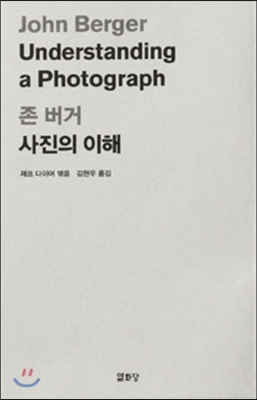
Along with Roland Barthes and Susan Sontag, John Berger is one of the most original writers on photography in the twentieth century.
John Berger, who has been active in various fields such as art critic, novelist, and social critic, has also written a lot about photography.
By the mid-1960s, his interests had expanded beyond art and fiction, and he began to become more involved with photography through his collaboration with photographer Jean Mohr.
The essays in this book are his photo essays written over a period of forty years, from 1967 to 2007, and have been brought together by the keenly sensible writer Geoff Dyer.
Geoff Dyer, author of the critical book on John Berger, The Ways of Telling, and editor of Selected Essays of John Berger, is perhaps the person who understands Berger's entire world of work more accurately than anyone else.
John Berger's photo essays contain an outside perspective that cannot be found in the writings of photographers or theorists.
Because he did not approach photography with the authority of a curator or photography researcher, his writing can be seen as an active record of the process rather than the result of accumulated knowledge.
He did not get lost in discourse or semiotics, but instead, by identifying intimately with his objects, he concentrated so intensely that he became a theory in his own right.
His perspective, which can be said to be truly unique, sometimes surprises the reader.
In addition to the writings on photography included in other books, this book includes twenty-four essays, including exhibition reviews, prefaces and reviews of photo collections, and other essays that were not included in the book, arranged chronologically alongside the photographers' major works.
John Berger, who has been active in various fields such as art critic, novelist, and social critic, has also written a lot about photography.
By the mid-1960s, his interests had expanded beyond art and fiction, and he began to become more involved with photography through his collaboration with photographer Jean Mohr.
The essays in this book are his photo essays written over a period of forty years, from 1967 to 2007, and have been brought together by the keenly sensible writer Geoff Dyer.
Geoff Dyer, author of the critical book on John Berger, The Ways of Telling, and editor of Selected Essays of John Berger, is perhaps the person who understands Berger's entire world of work more accurately than anyone else.
John Berger's photo essays contain an outside perspective that cannot be found in the writings of photographers or theorists.
Because he did not approach photography with the authority of a curator or photography researcher, his writing can be seen as an active record of the process rather than the result of accumulated knowledge.
He did not get lost in discourse or semiotics, but instead, by identifying intimately with his objects, he concentrated so intensely that he became a theory in his own right.
His perspective, which can be said to be truly unique, sometimes surprises the reader.
In addition to the writings on photography included in other books, this book includes twenty-four essays, including exhibition reviews, prefaces and reviews of photo collections, and other essays that were not included in the book, arranged chronologically alongside the photographers' major works.
index
Geoff Dyer 5 at the beginning of the book
Imperialism Image 17
Understanding Photography 31
The Political Use of Photomontage 37
Photo of Pain 44
Gentleman's Suit and Photo 49
Paul Strand 57
Use of photos
For Susan Sontag 63
Appearances 75
Stories 112
Christ of the Farmers
Marketa Ruskachova's The Pilgrim 119
Eugene Smith
A documentary filmmaker making a film about Smith
Summary 124 to help Kirk Morris
Steps back home
Chris Killip's "Caught in the Red" 131
The meaning of life
Nick Waplington's The Living Room 143
André Kertész's On Reading 149
A man begging on the subway
Henri Cartier-Bresson 151
Martin Frank
Facsimile Preface to "Day by Day" 159
Jean Mor: Sketch for a Portrait 171
A tragedy the size of the Earth
Conversation with Sebastião Salgado 181
Find out
Moira Peralta's "Almost Invisible" 189
Tribute to Cartier-Bresson 193
Between here and then
Marc Trivier 195
Marc Trivier's "My Beautiful" 201
Itka Hanzlova's "The Forest" 213
Ahlam Sibli's The Scout 219
Note 227
Source of the text 231
Translator's Note 235
Search 239
Imperialism Image 17
Understanding Photography 31
The Political Use of Photomontage 37
Photo of Pain 44
Gentleman's Suit and Photo 49
Paul Strand 57
Use of photos
For Susan Sontag 63
Appearances 75
Stories 112
Christ of the Farmers
Marketa Ruskachova's The Pilgrim 119
Eugene Smith
A documentary filmmaker making a film about Smith
Summary 124 to help Kirk Morris
Steps back home
Chris Killip's "Caught in the Red" 131
The meaning of life
Nick Waplington's The Living Room 143
André Kertész's On Reading 149
A man begging on the subway
Henri Cartier-Bresson 151
Martin Frank
Facsimile Preface to "Day by Day" 159
Jean Mor: Sketch for a Portrait 171
A tragedy the size of the Earth
Conversation with Sebastião Salgado 181
Find out
Moira Peralta's "Almost Invisible" 189
Tribute to Cartier-Bresson 193
Between here and then
Marc Trivier 195
Marc Trivier's "My Beautiful" 201
Itka Hanzlova's "The Forest" 213
Ahlam Sibli's The Scout 219
Note 227
Source of the text 231
Translator's Note 235
Search 239
Publisher's Review
Photography: A Weapon That Has Become a Part of Our Daily Lives
“Each photograph is a means of testing, confirming, and constructing a holistic view of reality.
Therefore, the role of photography in ideological struggle is very important.
That is why we need to understand the weapons at our disposal and the weapons aimed at us.” _John Berger, from “Understanding Photography”
The first half of the book begins with critic John Berger's in-depth exploration of 'what is photography' and 'what can photography do'.
He now says that photography, which has become commonplace and natural, is not in fact natural.
For example, in the first essay, “Images of Imperialism,” about the photograph of Che Guevara’s body taken in 1967, we discover the hidden purpose contained in the photograph, the secret blade pointed at us.
In “Photographs of Pain,” written in 1972, he recognized that photographs that appear political often dissociate the suffering depicted in the photographs from political decisions, thereby making that suffering an eternal and unchangeable condition of human existence.
But photography can also be an 'ideal' weapon.
This is true not for consciousness that perceives things through convention or blindness, but for consciousness that actively seeks to obtain something within the chain of truth.
John Berger uses a variety of examples to guide readers through the process of answering the question, "What is photography?"
Intimate conversations with photographers
“People come to you, to your lens, as if they were coming to speak in front of a microphone.
Then, with a great sense of responsibility, we must tell their stories.
That means we have to show them what they are.” _Sebastião Salgado, in conversation with John Berger in “A Tragedy the Size of the Planet.”
The second half of the book features works by André Kertesz, Henri Cartier-Bresson, and Eugene Smith.
It consists of vivid stories of photographers who are no longer visible, such as Eugene Smith, older photographers who are still active, such as Moyra Peralta, Sebastiao Salgado, Chris Killip, Jitka Hanzlova, Marc Trivier, Nick Waplington, and Ahlam Shibli, as well as young photographers who are not widely known but are doing meaningful work.
John Berger delves into their world of work, expressing his own opinions, engaging in direct or indirect conversations with them, and reflecting on the photographers in a relaxed manner, expressing what he 'saw' in various ways.
We gain a deeper understanding of the photographers' work by looking into their inner selves, something we have never encountered before.
In the forty years since these writings were written, John Berger has gone from being an art critic who writes without fear of controversy based on a Marxist worldview, to a Booker Prize-winning author, to an activist writer who lives with farmers and documents their lives, and now to a veteran writer who defines himself as a "storyteller."
But even in this journey of change, the aesthetic criterion that runs through all of his writing remains clear: “Does this work help or encourage people to recognize and assert their social rights?” This idea, which he declared in 1960, is naturally connected to the question of what role photography has played and should play in society.
This book contains his way of asking those questions, sometimes strongly and sometimes softly, along with his message of love and solidarity to Korean readers.
“Each photograph is a means of testing, confirming, and constructing a holistic view of reality.
Therefore, the role of photography in ideological struggle is very important.
That is why we need to understand the weapons at our disposal and the weapons aimed at us.” _John Berger, from “Understanding Photography”
The first half of the book begins with critic John Berger's in-depth exploration of 'what is photography' and 'what can photography do'.
He now says that photography, which has become commonplace and natural, is not in fact natural.
For example, in the first essay, “Images of Imperialism,” about the photograph of Che Guevara’s body taken in 1967, we discover the hidden purpose contained in the photograph, the secret blade pointed at us.
In “Photographs of Pain,” written in 1972, he recognized that photographs that appear political often dissociate the suffering depicted in the photographs from political decisions, thereby making that suffering an eternal and unchangeable condition of human existence.
But photography can also be an 'ideal' weapon.
This is true not for consciousness that perceives things through convention or blindness, but for consciousness that actively seeks to obtain something within the chain of truth.
John Berger uses a variety of examples to guide readers through the process of answering the question, "What is photography?"
Intimate conversations with photographers
“People come to you, to your lens, as if they were coming to speak in front of a microphone.
Then, with a great sense of responsibility, we must tell their stories.
That means we have to show them what they are.” _Sebastião Salgado, in conversation with John Berger in “A Tragedy the Size of the Planet.”
The second half of the book features works by André Kertesz, Henri Cartier-Bresson, and Eugene Smith.
It consists of vivid stories of photographers who are no longer visible, such as Eugene Smith, older photographers who are still active, such as Moyra Peralta, Sebastiao Salgado, Chris Killip, Jitka Hanzlova, Marc Trivier, Nick Waplington, and Ahlam Shibli, as well as young photographers who are not widely known but are doing meaningful work.
John Berger delves into their world of work, expressing his own opinions, engaging in direct or indirect conversations with them, and reflecting on the photographers in a relaxed manner, expressing what he 'saw' in various ways.
We gain a deeper understanding of the photographers' work by looking into their inner selves, something we have never encountered before.
In the forty years since these writings were written, John Berger has gone from being an art critic who writes without fear of controversy based on a Marxist worldview, to a Booker Prize-winning author, to an activist writer who lives with farmers and documents their lives, and now to a veteran writer who defines himself as a "storyteller."
But even in this journey of change, the aesthetic criterion that runs through all of his writing remains clear: “Does this work help or encourage people to recognize and assert their social rights?” This idea, which he declared in 1960, is naturally connected to the question of what role photography has played and should play in society.
This book contains his way of asking those questions, sometimes strongly and sometimes softly, along with his message of love and solidarity to Korean readers.
GOODS SPECIFICS
- Date of issue: July 1, 2015
- Page count, weight, size: 248 pages | 140*220*20mm
- ISBN13: 9788930104845
- ISBN10: 8930104843
You may also like
카테고리
korean


korean

![GQ KOREA Mark (Monthly): December [2025]](http://librairie.coreenne.fr/cdn/shop/files/8ef265dbbfbf186523ed75ba7319009d.jpg?v=1765340328&width=3840)


