

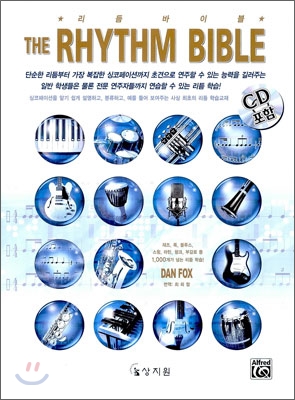
THE RHYTHM BIBLE
 |
Description
Book Introduction
A useful resource for both general students and professional players - vocalists, keyboard, guitar, bass, wind and string players, or mallet players such as vibraphone, marimba, and xylophone, as well as drummers and percussionists.
Contains over 1,000 rhythm examples (from simple quarter notes and eighth notes to very complex syncopations) in various styles including jazz, rock, Latin, blues, and funk.
This is the first textbook to systematically classify and explain syncopation.
Because it consists of a variety of rhythms, from very easy to extremely difficult, I recommend that you start from the beginning and learn them step by step in order, rather than skipping parts that feel easy.
If you get stuck on a certain rhythm, go back to the beginning of the section that contains that rhythm and start again.
It will be even more helpful if you use the included CD.
Contains over 1,000 rhythm examples (from simple quarter notes and eighth notes to very complex syncopations) in various styles including jazz, rock, Latin, blues, and funk.
This is the first textbook to systematically classify and explain syncopation.
Because it consists of a variety of rhythms, from very easy to extremely difficult, I recommend that you start from the beginning and learn them step by step in order, rather than skipping parts that feel easy.
If you get stuck on a certain rhythm, go back to the beginning of the section that contains that rhythm and start again.
It will be even more helpful if you use the included CD.
- You can preview some of the book's contents.
Preview
index
How to use CDs
How to practice
Chapter 1 Basic Rhythm
Whole notes, half notes, quarter notes, and rests
A string that spans the joint
staccato symbol
eighth note
8th note, tie
eighth note, eighth rest
Dotted quarter notes and eighth notes
Eighth note triplets and eighth notes
A group of four sixteenth notes
(...)
Chapter 2 Single Syncopation
A Brief History of Syncopation in American Jazz and Popular Music
Playing syncopation
Third Park Syncopation
A combination of the third beat syncopation and the rest located on the downbeat.
Third beat syncopation & tie-line across the measure
Third beat syncopation in staccato notation
(...)
Chapter 3 Double, Triple, and Quadruple Syncopation
Syncopation and Latin American Music
Second and fourth beat syncopation
Second and third beat syncopation
Third and fourth beat syncopation
(...)
Chapter 4: Accent-pulling patterns, syncopation in cut time, and double time syncopation in 2/4 (4/4) time.
A form with an accent on the eighth note offbeat
First and second beat syncopation
Variations of the first and second beat syncopation
2/4 beat or 4/4 beat
Chapter 5: Basic Rhythm and Syncopation in 3/4 Time
Eighth rest, quarter rest, and tie line across the measure
Hemiola
Syncopation is a form in which strings are connected across the joints.
If it starts with a comma
Glue across joints
Staccato notation
Chapter 6 Rhythm in Other Beats
6/8 time signature
3/8 time signature
9/8 time signature
12/8 time signature
When counting by dividing 5/4 time by 3+2
When counting by dividing 5/4 time by 2+3
How to practice
Chapter 1 Basic Rhythm
Whole notes, half notes, quarter notes, and rests
A string that spans the joint
staccato symbol
eighth note
8th note, tie
eighth note, eighth rest
Dotted quarter notes and eighth notes
Eighth note triplets and eighth notes
A group of four sixteenth notes
(...)
Chapter 2 Single Syncopation
A Brief History of Syncopation in American Jazz and Popular Music
Playing syncopation
Third Park Syncopation
A combination of the third beat syncopation and the rest located on the downbeat.
Third beat syncopation & tie-line across the measure
Third beat syncopation in staccato notation
(...)
Chapter 3 Double, Triple, and Quadruple Syncopation
Syncopation and Latin American Music
Second and fourth beat syncopation
Second and third beat syncopation
Third and fourth beat syncopation
(...)
Chapter 4: Accent-pulling patterns, syncopation in cut time, and double time syncopation in 2/4 (4/4) time.
A form with an accent on the eighth note offbeat
First and second beat syncopation
Variations of the first and second beat syncopation
2/4 beat or 4/4 beat
Chapter 5: Basic Rhythm and Syncopation in 3/4 Time
Eighth rest, quarter rest, and tie line across the measure
Hemiola
Syncopation is a form in which strings are connected across the joints.
If it starts with a comma
Glue across joints
Staccato notation
Chapter 6 Rhythm in Other Beats
6/8 time signature
3/8 time signature
9/8 time signature
12/8 time signature
When counting by dividing 5/4 time by 3+2
When counting by dividing 5/4 time by 2+3
Publisher's Review
Whether you're a student or a professional musician, playing music from this era is a remarkable feat.
However, in this day and age, there are few teaching materials that help musicians specialize in playing complex rhythms, including syncopation.
This book was created to address these issues.
Chapter 1 - Basic Rhythm
Chapter 1 begins with the simplest rhythm in 4/4 time.
It also covers areas that players might find difficult, such as when a long sustained note is followed by a fast note, when the piece begins with a rest, and when a tie spans a measure.
Just as there are various patterns of sixteenth notes, there are also various patterns of eighth notes, quarter notes, and half-note triplets.
Chapter 2 - Single Syncopation
After a brief history and explanation of syncopation, we begin with the most common pattern: pulling on the third beat of a measure.
Next, we introduce the pattern of pulling the second beat, the pattern of pulling the fourth beat, and the pattern of pulling the first beat.
Chapter 3 - Double, Triple, and Quadruple Syncopation
In 4/4 time, you can create up to four syncopations within a measure.
In this chapter, we will start with two syncopations per measure and gradually develop to four syncopations per measure.
Chapter 4 - Syncopation in Cut Time, Double-Time Syncopation in 2/4 and 4/4 Time, When Accents Are Pulled
This chapter covers forms of syncopation, such as accented sounds at specific locations (which create the effect of syncopation even if it is not), and forms of cut-time syncopation commonly found in marches, Las Vegas show music, and Dixieland jazz, as well as double-time in rock and disco.
Chapter 5 - Basic Rhythm and Syncopation in 3/4 Time
The first four chapters were about the most commonly used 4/4 time signature.
In this chapter, we will first explain the form of 3/4 time without syncopation and then the form with syncopation.
There is also a description of hemiola.
Chapter 6 - Other Beats
It consists of explanations of 3/8, 6/8, 9/8, 12/8 time signatures, and irregular time signatures through the 5/4 time signature pattern.
However, in this day and age, there are few teaching materials that help musicians specialize in playing complex rhythms, including syncopation.
This book was created to address these issues.
Chapter 1 - Basic Rhythm
Chapter 1 begins with the simplest rhythm in 4/4 time.
It also covers areas that players might find difficult, such as when a long sustained note is followed by a fast note, when the piece begins with a rest, and when a tie spans a measure.
Just as there are various patterns of sixteenth notes, there are also various patterns of eighth notes, quarter notes, and half-note triplets.
Chapter 2 - Single Syncopation
After a brief history and explanation of syncopation, we begin with the most common pattern: pulling on the third beat of a measure.
Next, we introduce the pattern of pulling the second beat, the pattern of pulling the fourth beat, and the pattern of pulling the first beat.
Chapter 3 - Double, Triple, and Quadruple Syncopation
In 4/4 time, you can create up to four syncopations within a measure.
In this chapter, we will start with two syncopations per measure and gradually develop to four syncopations per measure.
Chapter 4 - Syncopation in Cut Time, Double-Time Syncopation in 2/4 and 4/4 Time, When Accents Are Pulled
This chapter covers forms of syncopation, such as accented sounds at specific locations (which create the effect of syncopation even if it is not), and forms of cut-time syncopation commonly found in marches, Las Vegas show music, and Dixieland jazz, as well as double-time in rock and disco.
Chapter 5 - Basic Rhythm and Syncopation in 3/4 Time
The first four chapters were about the most commonly used 4/4 time signature.
In this chapter, we will first explain the form of 3/4 time without syncopation and then the form with syncopation.
There is also a description of hemiola.
Chapter 6 - Other Beats
It consists of explanations of 3/8, 6/8, 9/8, 12/8 time signatures, and irregular time signatures through the 5/4 time signature pattern.
GOODS SPECIFICS
- Date of publication: November 21, 2011
- Page count, weight, size: 129 pages | 498g | 224*304*20mm
- ISBN13: 9788982718557
- ISBN10: 8982718559
You may also like
카테고리
korean


korean

![GQ KOREA Mark (Monthly): December [2025]](http://librairie.coreenne.fr/cdn/shop/files/8ef265dbbfbf186523ed75ba7319009d.jpg?v=1765340328&width=3840)


