

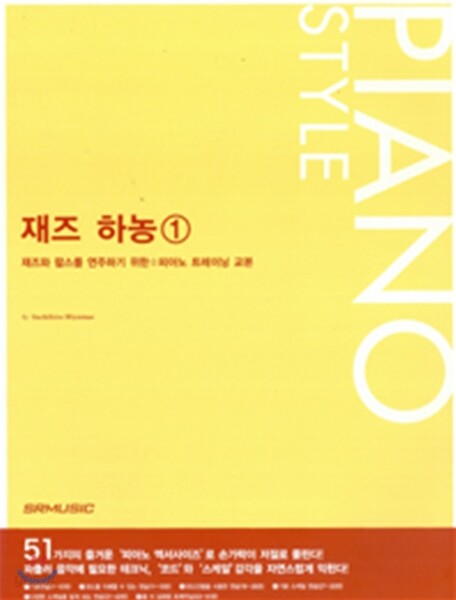
Jazz Hanon 1
 |
Description
Book Introduction
This is a 'Hanong' created for modern popular music such as jazz and pop, allowing you to learn the techniques needed to play popular music while training the fingers of each hand.
It consists of content that allows you to naturally acquire a sense of 'pitch', 'chord', and 'scale'.
It consists of content that allows you to naturally acquire a sense of 'pitch', 'chord', and 'scale'.
- You can preview some of the book's contents.
Preview
index
Part 1 Basic Practice
1. Warm-up (A)
2. Warm-up (B)
3: Basic Exercises to Get Familiar with the Phrasing of '3-beat' (A)
4. Basic Exercises to Get Familiar with the Phrasing of '3-beat' (B)
5. Pattern using syncopation (omitting the preceding beat by two beats)
6. Pattern using syncopation (omitting the preceding beat of the 3rd beat)
7. Pattern using syncopation (omitting the preceding beat by one beat)
8: Pattern using syncopation (increase the back beat by 4 beats)
9: Basic Training with Triplets (A)
10: Basic Training with Triplets (B)
Part 2: Exercises to Understand Code
11. Train your awareness of 'long notes' and 'short notes' (A)
12. Train your awareness of 'long notes' and 'short notes' (B)
13: Understanding Major Chords (C~C6~C7~C△7)
14: Understanding Minor Chords (Cm~Cm6~Cm7~Cm△7)
5: Understand even seemingly difficult code (Cdim~C7sus4~Caug)
Part 3: Practice using chord progression
16: Let's learn the basic chord progression 'C→G'
17: Let's learn the basic chord progression 'C→F'
18: Let's learn the basic chord progression 'C→F→G→C'
19: Major Triad Cyclic Chord 'C→Am→Dm→G'
20: The cyclic chord of the minor triad 'Am→Dm→E→Am'
21: Cycle of 4-note chords (major) 'C△7→Am7→Dm7→G7'
22: Cycle of 4th chord (minor) 'Am7→Bm7(♭5)→E7→Am7'
23: 8-beat progression 'C→Em→F→G7'
24: 8-bit progression 'Ballad style'
25: 16-beat progression 'C→D→Em→D'
26: 16-bit progression 'R&B style'
Part 4 Basic Scale Practice
Exercise 27: Understanding the C Major Scale
Exercise 28: Understanding the A minor scale
29: Basics of Major/Minor Scales, Preliminary Exercises (C, Am)
Basics of Major/Minor Scales, Preliminary Exercises (F, Dm)
Basics of Major/Minor Scales, Preliminary Exercises (B♭, Gm)
Basics of Major/Minor Scales, Preliminary Exercises (E♭, Cm)
Basics of Major/Minor Scales, Preliminary Exercises (A♭, Fm)
Basics of Major/Minor Scales, Preliminary Exercises (D♭, B♭m)
Basics of Major/Minor Scales, Preliminary Exercises (G♭, E♭m)
Basics of Major/Minor Scales, Preliminary Exercises (B, G#m)
Basics of Major/Minor Scales, Preliminary Exercises (E, C#m)
Basics of Major/Minor Scales, Preliminary Exercises (A, F#m)
Basics of Major/Minor Scales, Preliminary Exercises (D, Bm)
Basics of Major/Minor Scales, Preliminary Exercises (G, Em)
30: Training to Understand the Structure of 'Diatonic'
Part 5: Practice to learn about different scales
31: Basic Pentatonic Scale Exercises
32: Pentatonic Scale Application Exercises
33: 7th scale (mixolydian)
34: 7th scale (harmonic minor perfect 5th below)
35: 7th Scale (Altered)
36: 7th scale (Lydian 7th)
37: 7th Scale (Combination Diminished)
38: 7th scale (whole tone)
39: Play various scales in a 'Ⅱ→Ⅴ→Ⅰ' progression (A)
40: Play various scales in a 'Ⅱ→Ⅴ→Ⅰ' progression (B)
41: Play various scales in a 'Ⅱ→Ⅴ→Ⅰ' progression (C)
42: Play various scales in a 'Ⅱ→Ⅴ→Ⅰ' progression (D)
(※Practice methods 39-42 are explained in detail on page 65)
Part 6: More In-Depth Training
43: Practice for playing chords and complex sounds accurately
44: Get the feel of the approach note
45: Chromatic ~ Play the white and black keys accurately
46: More Advanced Chromatic Scale Practice
47: Understand the basics of homophonic repetition.
Exercise 48: Developing a Sense of the Beat
49: Jazz-Style Finger Training
Number 50: A parody-like exercise that involves brisk left-right movements.
51: Etude for Strengthening Harmony Playing
1. Warm-up (A)
2. Warm-up (B)
3: Basic Exercises to Get Familiar with the Phrasing of '3-beat' (A)
4. Basic Exercises to Get Familiar with the Phrasing of '3-beat' (B)
5. Pattern using syncopation (omitting the preceding beat by two beats)
6. Pattern using syncopation (omitting the preceding beat of the 3rd beat)
7. Pattern using syncopation (omitting the preceding beat by one beat)
8: Pattern using syncopation (increase the back beat by 4 beats)
9: Basic Training with Triplets (A)
10: Basic Training with Triplets (B)
Part 2: Exercises to Understand Code
11. Train your awareness of 'long notes' and 'short notes' (A)
12. Train your awareness of 'long notes' and 'short notes' (B)
13: Understanding Major Chords (C~C6~C7~C△7)
14: Understanding Minor Chords (Cm~Cm6~Cm7~Cm△7)
5: Understand even seemingly difficult code (Cdim~C7sus4~Caug)
Part 3: Practice using chord progression
16: Let's learn the basic chord progression 'C→G'
17: Let's learn the basic chord progression 'C→F'
18: Let's learn the basic chord progression 'C→F→G→C'
19: Major Triad Cyclic Chord 'C→Am→Dm→G'
20: The cyclic chord of the minor triad 'Am→Dm→E→Am'
21: Cycle of 4-note chords (major) 'C△7→Am7→Dm7→G7'
22: Cycle of 4th chord (minor) 'Am7→Bm7(♭5)→E7→Am7'
23: 8-beat progression 'C→Em→F→G7'
24: 8-bit progression 'Ballad style'
25: 16-beat progression 'C→D→Em→D'
26: 16-bit progression 'R&B style'
Part 4 Basic Scale Practice
Exercise 27: Understanding the C Major Scale
Exercise 28: Understanding the A minor scale
29: Basics of Major/Minor Scales, Preliminary Exercises (C, Am)
Basics of Major/Minor Scales, Preliminary Exercises (F, Dm)
Basics of Major/Minor Scales, Preliminary Exercises (B♭, Gm)
Basics of Major/Minor Scales, Preliminary Exercises (E♭, Cm)
Basics of Major/Minor Scales, Preliminary Exercises (A♭, Fm)
Basics of Major/Minor Scales, Preliminary Exercises (D♭, B♭m)
Basics of Major/Minor Scales, Preliminary Exercises (G♭, E♭m)
Basics of Major/Minor Scales, Preliminary Exercises (B, G#m)
Basics of Major/Minor Scales, Preliminary Exercises (E, C#m)
Basics of Major/Minor Scales, Preliminary Exercises (A, F#m)
Basics of Major/Minor Scales, Preliminary Exercises (D, Bm)
Basics of Major/Minor Scales, Preliminary Exercises (G, Em)
30: Training to Understand the Structure of 'Diatonic'
Part 5: Practice to learn about different scales
31: Basic Pentatonic Scale Exercises
32: Pentatonic Scale Application Exercises
33: 7th scale (mixolydian)
34: 7th scale (harmonic minor perfect 5th below)
35: 7th Scale (Altered)
36: 7th scale (Lydian 7th)
37: 7th Scale (Combination Diminished)
38: 7th scale (whole tone)
39: Play various scales in a 'Ⅱ→Ⅴ→Ⅰ' progression (A)
40: Play various scales in a 'Ⅱ→Ⅴ→Ⅰ' progression (B)
41: Play various scales in a 'Ⅱ→Ⅴ→Ⅰ' progression (C)
42: Play various scales in a 'Ⅱ→Ⅴ→Ⅰ' progression (D)
(※Practice methods 39-42 are explained in detail on page 65)
Part 6: More In-Depth Training
43: Practice for playing chords and complex sounds accurately
44: Get the feel of the approach note
45: Chromatic ~ Play the white and black keys accurately
46: More Advanced Chromatic Scale Practice
47: Understand the basics of homophonic repetition.
Exercise 48: Developing a Sense of the Beat
49: Jazz-Style Finger Training
Number 50: A parody-like exercise that involves brisk left-right movements.
51: Etude for Strengthening Harmony Playing
GOODS SPECIFICS
- Date of issue: July 20, 2007
- Page count, weight, size: 85 pages | 418g | 228*303*15mm
- ISBN13: 9788992456081
- ISBN10: 8992456085
You may also like
카테고리
korean


korean

![GQ KOREA Mark (Monthly): December [2025]](http://librairie.coreenne.fr/cdn/shop/files/8ef265dbbfbf186523ed75ba7319009d.jpg?v=1765340328&width=3840)


